

Before asking for an MRI referral, bring the concern you want help with and ask what assessment could address it. You do not need to prove function loss, classify your symptoms or complete a treatment trial to raise the question. A useful consultation connects your concerns and existing information with the clinician’s actual explanation, options and agreed next plan. It does not require a predetermined scan or no-scan outcome.
Start with six essential consultation questions, use the concern, information and question comparison, read two fictional examples, or build a discussion and next-plan record. Unknown and pending are valid. There is no imaging-eligibility score, symptom classification, home test or universal waiting period.
Needed urgent or emergency assessment must not wait for an MRI request or paperwork. With back pain, new difficulty urinating or bladder/bowel control changes, numbness around the genitals or anus, symptoms such as weakness or numbness in both legs, chest pain or pain after a serious accident need emergency assessment. Use appropriate local emergency services, including 911 for U.S. emergencies. NHS back-pain warning guidance.
A suddenly very painful, swollen or hot joint needs urgent assessment even without fever. NHS joint-infection guidance. These are selected examples, not a complete triage list. Describe new or worsening concerns to the relevant clinical service; do not sort yourself into a stable category to postpone assessment. Ability to perform some tasks or absence of a named warning sign does not establish waiting safety.
This is U.S.-focused education from a family-caregiver-run site. The operator is not a medical professional. Clinicians assess your situation and appropriate testing; offices and plans explain their actual processes. The worksheet organizes facts and questions. It supplies no individual diagnosis, treatment, insurance decision or scanner safety clearance.
Table of Contents
Before an MRI referral: six essential consultation questions
| Question to discuss | What to retain from the actual answer | What you do not need to supply |
|---|---|---|
| 1. What concern are we assessing? | The clinician’s explanation, including uncertainty and the concern important to you. | A self-diagnosis or proof that function matters more than pain. |
| 2. What does existing information tell us? | Actual history, prior assessment and available report or image relevance. | A complete record or extra imaging before asking for help. |
| 3. What question could MRI address? | The purpose and potential effect on diagnosis, management or another decision, as explained. | Your own prediction that a scan will change treatment. |
| 4. What options apply here? | Actual alternatives, reasons, benefits, limits and uncertainties discussed. | A generic sequence of examination, therapy and then MRI. |
| 5. What plan did we actually agree? | Decision, conditions, unanswered point and responsible role. | A preference for ordering or avoiding imaging to count as success. |
| 6. How will concerns be reviewed? | Actual current contact, reassessment advice and next owner. | A safe waiting period inferred from a future appointment or authorization. |
Use the questions that matter to you; completing all six is not a condition for care. You may ask directly whether MRI could help, say what worries you and request an explanation. A calm presentation, polished timeline or documented loss of a particular task is not required for your concern to be legitimate.
Current concerns, existing information and consultation questions
| Your existing information or concern | Keep the fact separate from its interpretation | Useful open question |
|---|---|---|
| Pain, sleep, function, distress or daily burden | What you have already experienced and what is uncertain. | How should this concern be assessed? |
| Onset, injury or change already noticed | Timing if known; no need to reproduce a trigger or test strength. | Does this existing change alter the assessment or plan? |
| Previous visit, report or image | What actually exists and whether the clinician can access it. | What does this information explain, and what remains unanswered? |
| Treatment already prescribed or performed | Actual instructions, use, effects and barriers, without a failed-treatment label. | Which concern or conflicting instruction needs clarification? |
| Question about imaging | Your question or preference, not a claimed indication. | Could imaging address this question, and what alternatives apply? |
| Cost, communication or participation barrier | Actual difficulty and support requested or offered. | Which relevant team can help with the real barrier? |
Record pain in your own words. Intensity, quality, sleep, ordinary function, distress and burden are all relevant. MedlinePlus pain information describes these different dimensions of assessment. Function is not inherently cleaner evidence than pain, and an emotional or incomplete account is not a reason to discount a concern.
Describe existing experiences rather than labeling yourself mechanical, inflammatory or nerve-related. A symptom word does not establish its cause. Do not perform walking, weight-bearing, resistance or painful movement tests to build a stronger request. If you do not know a trigger, say unknown. If a helper contributes an observation, keep its source distinct and respect the patient’s permission and voice.
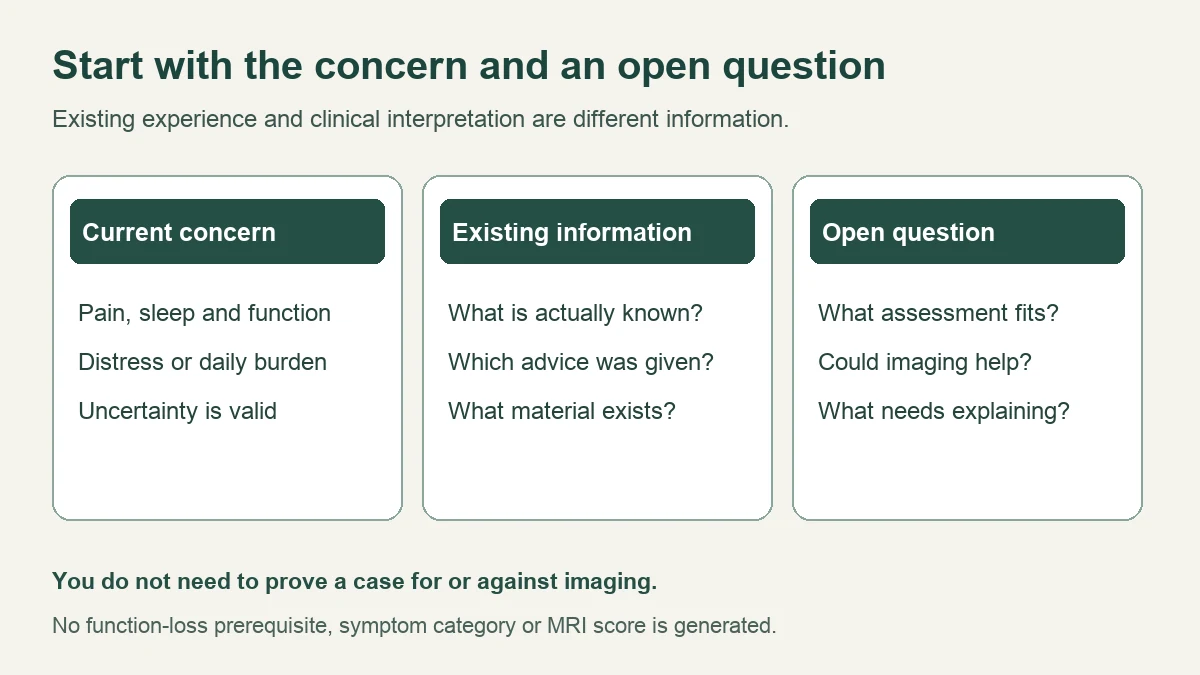
Gather what exists without creating a treatment prerequisite
Use brief labels for available prior visits, relevant injury history, existing reports or images and current instructions. Tell the clinical service if material is missing. A report and access to the actual images can be different items; sending a file does not confirm it can be reviewed. Use the clinic’s approved route and keep identifiers and complete records private.
Retain care already received and effects already observed without turning treatment into a diagnostic experiment. A response does not independently prove or exclude a lesion. Treatments may aim at relief, maintenance or preventing decline; immediate functional improvement is not the sole measure of value. Do not stop prescribed care, extend a trial or undertake an unnecessary treatment just to earn imaging.
There is no universal physical-therapy, medication, rest or X-ray sequence on this page. Ask the clinician what actual assessment and care fit the current concern. If instructions conflict or a barrier prevents following them, explain that problem and ask for clarification. The record does not create a medicine change, exercise plan, duration requirement or treatment-failure threshold.
Ask about the imaging question, options and limits
MRI is one imaging technique; its usefulness depends on the clinical question. It can show many soft-tissue and other structures, but it is not guaranteed to identify the cause of every symptom. Findings need clinical interpretation. Not having a clear finding does not invalidate pain, and a structural finding is not automatically its explanation. The AAOS imaging overview explains techniques and uses, not a universal pre-referral pathway.
Ask what the clinician is considering, what further information might help and how a proposed study could affect diagnosis, management, timing or another decision. If you do not understand the purpose, ask for an explanation rather than inventing one. The patient is not responsible for proving the test will change treatment before the clinician assesses the question.
Where alternatives are discussed, record the actual reasons, expected usefulness, limits and uncertainties. Options may differ with the clinical situation; this article does not give a menu for self-selection. Neither an order nor a decision not to order MRI is inherently the better outcome. An unresolved explanation or concern should remain visible, with a real next contact or review plan.
One bounded example: ACR Low Back Pain criteria separate several clinical scenarios. One addresses surgery or intervention candidates with subacute/chronic symptoms persisting or progressing during or after six weeks of appropriate management. Others address suspected serious causes or different histories. That specific scenario is not a waiting rule for every painful region, an insurance rule or a reason to delay necessary assessment. Do not apply its duration to yourself from a checklist.
Separate clinical reasoning, authorization and scan preparation
| Issue | Relevant real answer | Avoid confusing it with |
|---|---|---|
| Clinical assessment and testing purpose | What the clinician explained about the concern, options and plan. | An insurance approval, an eligibility score or a generic treatment sequence. |
| Actual recommendation or order | What was recommended or ordered, with conditions if explained. | Authorization, a booking or an examination completed. |
| Insurance / planned-service administration | Which actual requirements, network and cost conditions the office or plan confirmed. | Medical urgency or proof that a test is clinically needed. |
| MRI safety and participation preparation | Information and support the ordering and imaging teams need, if scanning is planned. | A blog-based safety clearance or a decision that MRI is indicated. |
| Review and follow-through | Who addresses remaining clinical questions and what actually happened next. | A portal alert, referral sent or future date as proof of completed care. |
There is no universal plan authorization rule here. If a planned service is discussed, ask the relevant office or insurer which exact requirement and service it concerns and retain the actual reply. A decision not to order a test is not automatically an insurance denial. An administrative barrier does not replace assessment of current clinical needs; emergency care must not wait for routine approval paperwork.
If MRI is being considered or arranged, tell the clinical/imaging team about relevant implants or metal, kidney problems, pregnancy possibility and difficulty in enclosed spaces, as applicable. MedlinePlus MRI information explains preparation considerations. This is not an exhaustive screening list: follow the team’s actual screening and provide device information through its approved route. Do not assume an implant automatically prohibits scanning or that this record clears it. No device settings, contrast choice or sedation advice is generated.
Tell the relevant team if cost, transport, communication, positioning or another practical issue blocks the proposed assessment. Record help actually requested and offered. Our care-access guide organizes support inquiries without choosing care or a payment route. No visit-cost ranking or savings estimate is supplied here.
Preserve the real answer and agreed next plan
A question prepared is not yet asked. Asking is not the same as receiving a full explanation. Retain the clinician’s actual words in brief, their role, any stated uncertainty, options discussed and the plan actually agreed. Keep a working explanation distinct from a confirmed diagnosis. If a point was not answered, write pending rather than infer the answer.
For a conditional plan, retain the actual condition and responsible role as explained. Ask what should prompt contact or reassessment, who addresses an unresolved concern and how to reach the service through its usual route. No response deadline or safe waiting interval is created. A change or emergency may need assessment before a routine reply; a future booking is not reassurance.
Record the next action actually taken separately from the agreement. A recommendation, order, authorization, referral receipt and appointment are different events. This record does not book, cancel or change anything. Preserve unanswered questions even if another administrative step is complete.
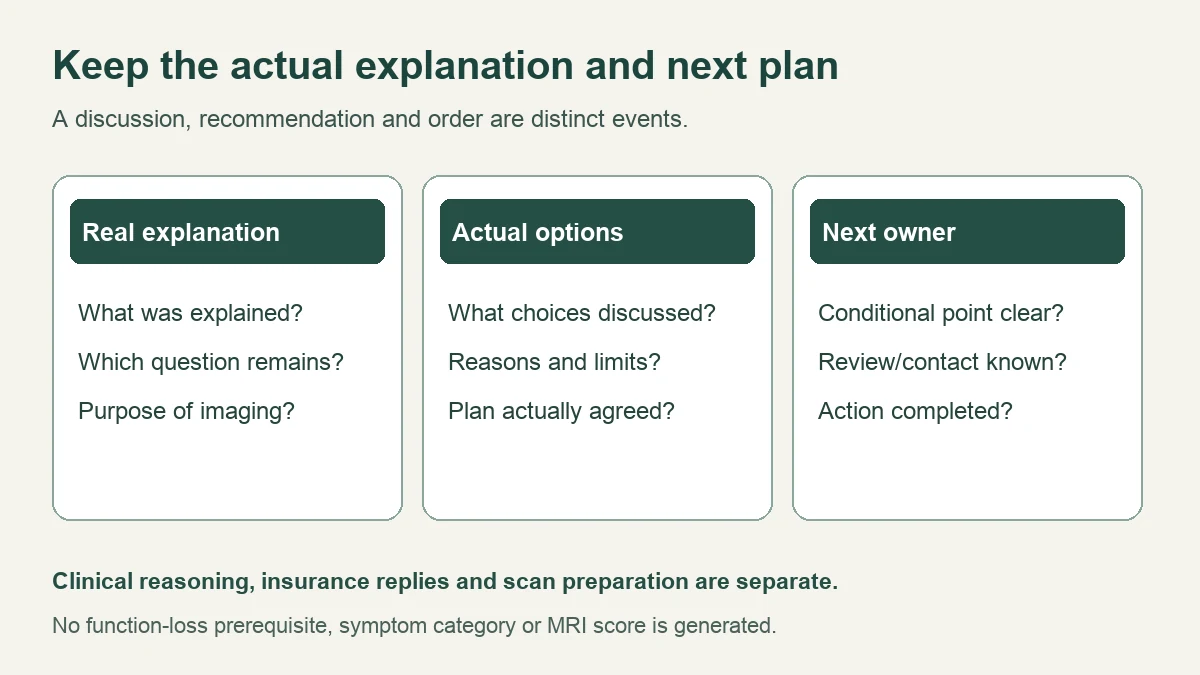
This page focuses on the conversation before an imaging decision. Our MRI referral guide records an existing imaging purpose, material and referral progress. The normal-X-ray guide connects a completed test with explanation, later changes and reassessment. Keeping these purposes distinct avoids repeating a generic MRI pathway across all three.
Two fictional MRI-discussion writing examples
These are invented documentation examples, not real patient stories, advice or outcomes. They show uncertainty and incomplete discussion without inventing a diagnosis or successful scan request. Tool buttons replace entries and label generated output fictional.
Example A: MRI question not yet discussed
| Area | Fictional entry |
|---|---|
| Concern / information | Ongoing pain and uncertainty about further assessment. Existing material incomplete; no function loss, report or diagnosis invented. |
| Actual question | Could MRI help address the concern? Prepared, not yet asked. |
| Explanation / options | Not yet received. The reader does not predict the treatment impact or select a modality. |
| Decision / next owner | No recommendation or order supplied. Record the actual explanation, options and next action when discussed; no treatment prerequisite. |
The example permits a direct question without converting it into a demand or a case that must be won. Missing information does not make the concern illegitimate or require a delay before asking for help.
Example B: explanation or conditional next plan still unclear
| Area | Fictional entry |
|---|---|
| Consultation | A question about assessment and imaging was asked in this invented record. |
| Actual answer | Explanation incomplete; no diagnosis or reason for declining imaging is supplied. |
| Options / decision | Reasons and options need clarification. No final scan/no-scan choice or completed order confirmed. |
| Next point | Review criteria, clinical contact and responsible role need real confirmation. Authorization and scan preparation are separate unknowns. |
This is not evidence that a test was wrongly refused or that avoiding a scan was a success. It records the remaining explanation and plan questions. Needed assessment must not wait for routine administration or a completed worksheet.
Private consultation, options, real-answer and next-plan tool
Download an offline copy before entering actual health or consultation details. Use fictional entries on this page because surrounding ads or analytics may be present. The tool makes no network requests, uses no browser storage and does not automatically save. The offline copy contains no external assets or automatic network requests. Keep completed copies private.
Use one concern and related discussion per record. Unknown, not asked, pending or not applicable according to an actual explanation are acceptable. Omit names, account numbers, device identifiers and full records. Paper with the same headings works. No complete form is needed before obtaining care.
MRI discussion preparation, options, real-answer and next-plan record
Start with your concern, then retain the actual explanation, options and agreed next plan. The tool does not make a case for or against imaging.
Download the offline tool before entering actual health or consultation details. Use fictional entries here; the surrounding page may contain ads and analytics.
Offline copy. No ads, analytics, external assets or automatic network requests.
The tool makes no network requests, uses no browser storage and does not automatically save. Refreshing may lose entries. Omit names, identifiers and full records; keep exports private. Needed care must not wait for this record, a treatment trial, referral or insurance answer.
Start with the fictional example or download a blank offline copy.
Paper alternative: concern; existing information; current advice; barrier/support; question; explanation; imaging purpose; actual options; agreed decision; separate conditions; review contact; next owner.
My MRI discussion, options, real-answer and next-plan record
Unverified personal record for discussion. Entries verify no clinical explanation, imaging decision, order, coverage or safety clearance.
Guide: living.kioptrix.com/orthopedic-pain-management-before-asking-for-mri/
Build again after editing, then copy, download text or print. Offline exports include current entries; refreshing or closing may lose unsaved notes. Blank fields create optional questions, not an MRI readiness score. Nothing is sent, clinically verified or ordered.
Common questions before asking about MRI
Can I directly ask whether MRI would help?
Yes. Explain the concern and ask for the clinical reasoning and applicable options. You do not need a persuasive script or proof of functional loss.
Must I finish therapy first?
No universal prerequisite is supplied here. Ask what fits your situation; do not undertake unsafe or unnecessary treatment to satisfy an assumed rule. Needed assessment must not wait for a routine trial.
Do I need to name the symptom category?
No. Describe existing experiences and uncertainty. Do not self-classify mechanical, nerve or inflammatory pain, or provoke symptoms to gather evidence.
Does a six-week criterion apply to every body part?
No. The cited ACR example has specific low-back clinical conditions. It is not a universal waiting deadline or plan authorization requirement.
Does a choice not to order MRI mean insurance denied it?
Not automatically. Keep the clinical explanation, actual order and plan decision separate. Ask which issue is actually being discussed.
Does MRI safety screening decide whether I need MRI?
No. Clinical need and test preparation are different. The relevant team performs actual screening; the worksheet provides neither eligibility nor safety clearance.
Sources, corrections and review limits
Sources checked: October 30, 2026. This revision removes function-over-pain language, symptom self-classification, a conservative-treatment-first pathway, yes/no pseudo-calculator, unsupported cost rankings and the unverified success story. It replaces persuasion framing with open questions, actual explanations and agreed next actions.
- AAOS: X-rays, CT Scans, and MRI Scans — general techniques and uses; not an exact-topic MRI-referral preparation protocol.
- ACR: Low Back Pain, 2021 — scenario-specific criteria, including the bounded six-week example; not every orthopedic body region or insurance policy.
- MedlinePlus: Pain — multiple dimensions of pain reporting and clinical assessment; not a function-first hierarchy.
- MedlinePlus: MRI Scans — basic uses and preparation considerations; not individual indication, authorization or scanner safety clearance.
- NHS: Back pain and NHS: Septic arthritis — selected warning-sign education. UK sources do not define U.S. access or coverage procedures.
This is document-based editorial education, not independent medical review or testing of a particular clinic or insurance plan. The worksheet is not validated as a clinical decision instrument. No approval, waiting safety, diagnostic outcome or cost saving is predicted. Actual professional assessment and explanation remain necessary.