

An orthopedic referral wait needs two separate records: what the receiving service has actually confirmed, and what your current clinical team has actually advised. An order, a queue position or an appointment date does not determine whether waiting is safe. This guide connects confirmed status, interim instructions, changes already noticed and the real clinical reply without creating a self-care plan.
Start with the six essential checks, compare status and what it does not confirm, read two fictional writing examples, or use the referral status and clinical-answer record. No average wait, urgency score, guaranteed appointment or fixed follow-up interval is provided. Procedures differ by service, location and plan.
Needed assessment must not wait for records, scheduling or insurance replies. With back pain, new difficulty urinating or bladder/bowel control changes, loss of feeling around the genitals or anus, symptoms such as weakness or numbness in both legs, chest pain or pain after a serious accident need emergency assessment. Use appropriate local emergency services, including 911 for U.S. emergencies. NHS back-pain warnings.
A suddenly very painful, swollen or hot joint needs urgent assessment even without fever. Other new or worsening concerns need appropriate clinical assessment rather than a request merely to move up a queue. These are selected examples, not a complete triage list. NHS joint-infection guidance. A stable-symptom label, no callback or a distant booking is not a clinical clearance to wait.
This is U.S.-focused education from a caregiver-run site, not individual medical, insurance or financial advice. The operator is not a medical professional. Relevant clinicians assess needs and instructions; offices and plans explain their actual processes. The worksheet records facts and questions. It does not diagnose a symptom pattern, choose treatment or assign clinical priority.
Table of Contents
Referral wait: six essential checks
| Check | Actual information to retain | Question to clarify |
|---|---|---|
| 1. Purpose and destination | Actual reason for specialist input, requested service and source. | Which clinical question is the referral intended to address? |
| 2. Locally confirmed status | Issued, sent, received, reviewed, accepted or booked, only if actually confirmed. | Who confirmed which fact, and what remains unknown? |
| 3. Required material | What was requested, delivered and acknowledged. | Is a particular report or image access still missing? |
| 4. Current clinical care | Actual instructions, responsible team and contact route. | Who reviews concerns while the appointment is pending? |
| 5. Changes and real reply | Existing observations, contact made and actual administrative or clinical response. | Was the update received and clinically addressed, or is an answer pending? |
| 6. Next owner | Actual agreed action, responsible role and outstanding barrier. | Who owns the unresolved task? |
These are categories, not a mandatory pathway or a six-step medical protocol. Not every service uses the same intake stages. Record local terms as they were actually explained rather than converting them into a universal approval ladder. You can ask for care or assistance with an incomplete record.
Keep referral status separate from clinical reassurance
| Status or message | What it may actually confirm | What it does not establish |
|---|---|---|
| Order issued | The referring team created an order. | That it was transmitted or received. |
| Sent | The relevant person reports transmitting particular material. | Receipt, completeness or clinical review. |
| Received / incomplete | A receiving office confirms possession or requests specific missing material. | Acceptance, appointment, coverage or safe waiting. |
| Under review | The office reports its actual review status. | Who reviewed it, a clinical decision or changed urgency unless separately confirmed. |
| Accepted / booked | The exact acceptance or appointment actually confirmed. | That the specialist has taken over interim care or new concerns can wait. |
| Cancelled / rescheduled | The actual booking change and reason if provided. | A clinical opinion about current symptoms or a guarantee of the next date. |
Keep source, date if known and the exact scope of each answer. “Processing” is useful only to the extent the office explains what it means there. Ask which fact is confirmed and which person can clarify the remaining issue. A status answer does not decide whether the initial referral was clinically appropriate or how soon you need reassessment.
If the destination cannot be identified, receipt is unconfirmed or the service reports a mismatch, ask the referring office to clarify the actual request and destination. Do not independently replace the order, choose another specialty or cancel an existing booking from this worksheet. Where another service is discussed, keep its actual suitability, access and coverage questions separate.
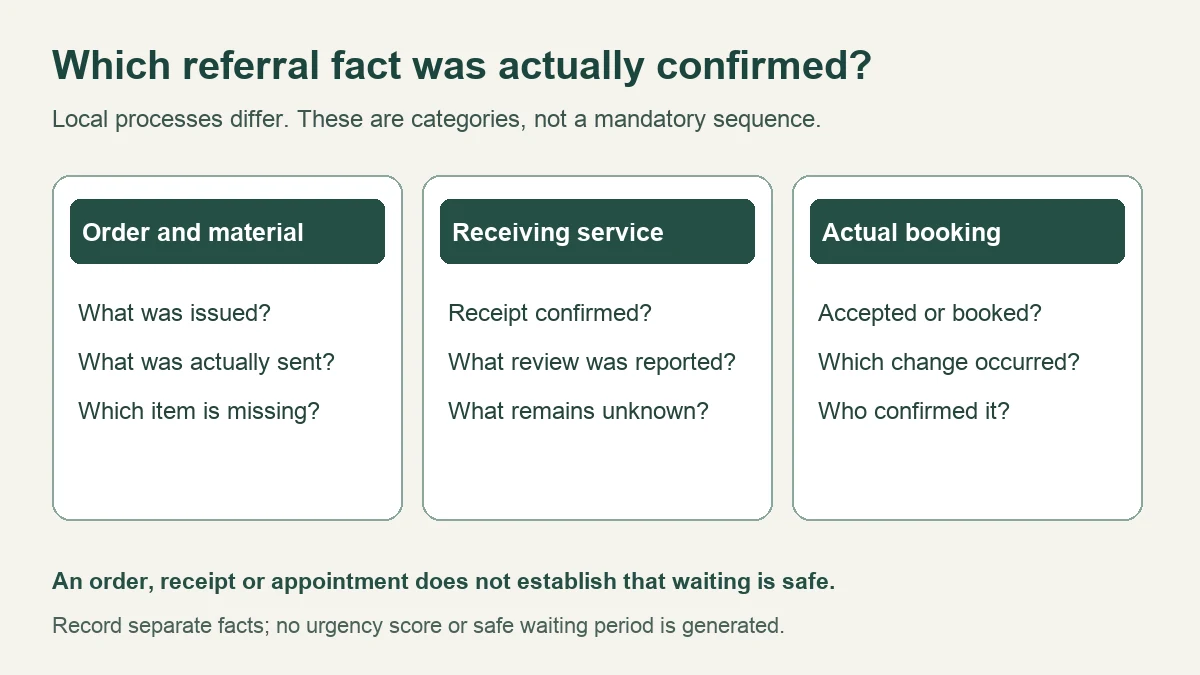
Check existing material and actual booking changes
Ask the relevant office which material applies to this request and the permitted transfer route. An existing report, the actual images, an order and previous visit notes can be different items. Keep what was requested, actually sent and receipt acknowledged distinct. Do not obtain extra imaging, repeat therapy or invent treatment failure to make a file look complete.
A request for a missing report is an administrative fact, not proof that no clinical concern exists. If an office cannot access a file, ask the appropriate team how to resolve that actual issue. Keep identifiers and complete reports private; the online tool is for fictional notes. A helper needs appropriate permission and a permitted channel to share records.
For a cancellation-list question or alternative appointment, record the real conditions and reply. A list entry does not guarantee a call, shorter wait or clinical priority. Confirm what happens to the existing booking and who handles an actual change, rather than assuming that a request has already changed it. No cancellation policy or time limit is supplied here.
For non-emergency cost or access questions, preserve the exact clinician, site, service and office/plan answer. Coverage, referral requirements and clinical urgency are different. If affordability or transport blocks recommended care, explain that barrier to the relevant clinical/support team. Our care-access guide records support questions without selecting treatment or a payment route.
Record actual interim instructions rather than choosing self-care from a chart
Ask the current clinical team about the plan while specialist input is pending and who reviews changes. Keep the actual source and date of advice, restrictions, contact route and any reassessment instructions. If responsibility has not been explained, record that uncertainty and ask the relevant team. A referral order alone does not prove that the specialist has assumed care.
| Actual care information | Record from the real explanation | Question if unclear |
|---|---|---|
| Medicines | Actual plan and responsible prescriber/pharmacist. | Who should clarify the real wording or a concern? |
| Activity, therapy or device restrictions | Instructions actually provided and their scope. | Does a conflicting or unclear instruction need review? |
| Access or practical barrier | What could not be performed or obtained and why, if known. | What help has actually been requested or offered? |
| Benefit, burden and concern | Pain, sleep, daily function and effects already observed. | Which point needs clinical discussion? |
| Reassessment and contact | Actual advice about contact and review. | Who should be contacted for an unresolved care question? |
This page supplies no heat/ice selection, movement dose, brace schedule, rest-versus-loading rule or walking/driving target. Do not stop prescribed treatment, extend a trial or provoke symptoms to measure function. A plan can have different goals, including symptom control, maintenance or prevention of decline. An immediate functional improvement is not required for pain relief to matter.
The MedlinePlus acute low-back page concerns that condition, not every orthopedic injury or postoperative restriction. The AAOS orthopaedics overview describes a specialty, not a waiting-period self-care protocol. The APTA physical-therapist selection resource describes access considerations; access or coverage does not itself decide whether a specific therapy is appropriate now.
Communicate existing changes without self-triage or persuasion
Describe what is actually known: the change, when noticed if remembered, pain, sleep, ordinary function, burden and current instructions. Include your uncertainty. Keep your observation separate from an explanation attributed to a clinician. Do not label yourself mechanical, inflammatory or nerve-related to fit a referral category, or test strength, walking or weight bearing to complete a log.
A short message can say: “Since the previous assessment I have noticed this change. These are the instructions I received. I need advice about the change and who should review it while the specialist visit is pending.” Use actual details privately. Do not exaggerate, minimize or invent a functional loss to obtain a faster appointment. Pain and distress are legitimate concerns alongside function.
No seven-day or two-week observation period is required. Start with existing facts, send the relevant concern through the appropriate route and record what actually happened. Needed assessment must not wait for a polished timeline or for several entries to establish a trend. A new serious symptom may require urgent or emergency care before a routine message is answered.
| Communication fact | Record accurately | Avoid inferring |
|---|---|---|
| Prepared | Question or update drafted and intended role. | A contact completed. |
| Sent | Actual recipient/channel and content scope. | Receipt or clinical review. |
| Acknowledged | Who acknowledged which message or material. | A clinical answer or change of priority. |
| Actual administrative reply | What the office said about process or booking. | Advice about symptoms, treatment or safe waiting. |
| Actual clinical reply | Clinician source, advice really received and remaining question. | An earlier appointment or complete resolution of another issue. |
Close the answer and responsibility gap
Preserve the actual clinical reply separately from the scheduling answer. If no clinical response has arrived, write pending rather than normal or safe. If a response addresses only one concern, retain the unanswered question. Ask the relevant service about its actual contact arrangements; the article provides no response-time promise or callback deadline.
Keep a reassessment requested separate from a reassessment actually received. An update being submitted is not evidence of reprioritization or an earlier appointment. Record a changed instruction only when a professional has actually explained it, including its source and scope. Conflicting advice needs clarification rather than selection by the worksheet.
The next-action record should name what was actually agreed, who owns it and what remains unconfirmed. An agreed administrative check-in is not a safe waiting interval. If the booking is delayed again, review the unresolved process and clinical-contact questions with appropriate roles without using the new date as reassurance about symptoms.
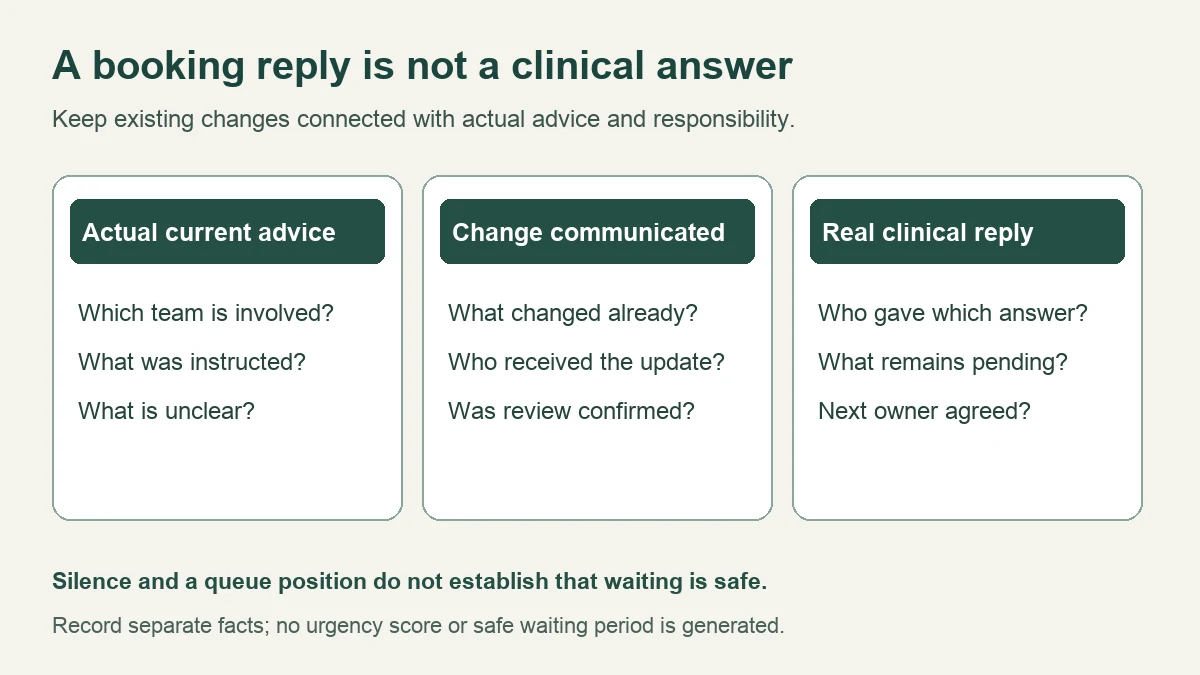
This is the distinct focus of this page: specialist access that has not yet occurred, current clinical responsibility and real answers to change. Our urgent-care assessment and follow-up guide concerns a first visit, results and onward handoff. Our MRI referral guide concerns an imaging question and existing material. A service comparison is available in the pain clinic and orthopedist guide; none establishes waiting safety.
Two fictional referral and clinical-answer writing examples
These are invented documentation examples, not real cases or instructions. They supply no diagnosis, urgency classification, outcome or waiting interval. Tool example buttons replace entries and label output fictional. Unknown and pending remain visible.
Example A: order issued, receiving-office receipt unconfirmed
| Area | Fictional entry |
|---|---|
| Purpose / status | Orthopedic referral issued for an unresolved assessment question. Issuing office reports an order exists; actual sending and receipt unconfirmed. |
| Material / booking | Required material and image access unknown. No acceptance or appointment confirmed; no extra test selected. |
| Question / answer | Question about delivery, receipt and missing requirements prepared, not sent. No actual reply supplied. |
| Next owner | Record real answers and next action agreed; no priority or safe-wait period inferred. |
This example identifies a process question without assuming that the receiving office lost the order or that another referral is required. Clinical needs and actual current-care instructions remain separate.
Example B: appointment booked, change needs an actual clinical answer
| Area | Fictional entry |
|---|---|
| Booking | Appointment exists; its date is not permission to wait with new concerns. |
| Existing change / advice | A change was noticed. Current instructions need clinical clarification; the example supplies no symptom test or replacement treatment. |
| Contact / actual reply | Change communicated to the current clinical team; receipt and review unconfirmed. No real clinical answer received. |
| Review / next owner | No reassessment or priority change confirmed. Obtain appropriate assessment for concerning changes without waiting for a routine reply; record real advice and owner. |
Sending an update is not the same as receiving clinical advice. The example cannot decide that the change is minor, that an appointment should be brought forward or that a particular self-care method will help.
Private referral status, interim advice and clinical-answer tool
Download the offline copy before entering actual health or referral information. Use fictional notes on this page because the surrounding site may contain ads and analytics. The tool makes no network requests, uses no browser storage and does not automatically save. The offline file contains no external assets or automatic network requests. Keep completed copies private.
Use one request and related care question per record, with matching short labels for several destinations or updates. Unknown, not asked, pending or not applicable according to an actual answer are valid. Omit names, account/claim identifiers and full records. A paper note with the same headings works. No complete form is required before obtaining help.
Referral status, actual interim instructions, change contact and clinical-answer record
Keep confirmed administrative status, current clinical advice, existing changes and real replies separate. No triage, self-care plan or safe waiting period is generated.
Download the offline tool before entering real health or referral details. Use fictional entries here; the surrounding page may contain ads and analytics.
Offline copy. No ads, analytics, external assets or automatic network requests.
No network requests, browser storage or automatic saving are used by the tool. Refreshing may lose entries. Omit names, identifiers and full records; keep exports private. Needed care must not wait for a log, referral reply or insurance answer.
Start with the fictional example or download a blank offline copy.
Paper alternative: referral purpose; actual status; material; booking; current team; actual instructions; existing changes; contact; real reply; reassessment; next owner; unanswered question.
My referral status, actual advice and clinical-answer record
Unverified personal record for discussion. Entries verify no referral status, instruction, clinical priority or safe waiting period.
Guide: living.kioptrix.com/orthopedic-referral-wait-times/
Rebuild after an edit, then copy, download text or print. Offline exports include current entries; closing or refreshing may lose unsaved notes. Blank items add optional questions rather than a missing-approval or urgency score. Nothing is submitted or booked, and no clinical instruction is verified or changed.
Common referral wait questions
How long is it safe to wait?
No safe interval is generated here. A queue estimate or appointment is an administrative fact. Actual symptoms, assessment and clinical advice determine care needs; emergencies must not wait for a routine reply.
Does an issued order mean I am on the waiting list?
Not automatically. Preserve what each relevant office has actually confirmed. Local terms and processes differ; this page supplies no mandatory intake ladder.
Should I start exercises or heat while waiting?
This guide selects no self-care or treatment. Keep actual instructions and ask the relevant clinician about unclear advice, restrictions or access barriers. Do not borrow a plan from symptom labels.
Will a log get me seen faster?
No faster appointment or priority is promised. Existing observations can help a care discussion, but needed assessment must not wait for a log. Do not invent or provoke symptoms.
What if a message is acknowledged but not answered clinically?
Keep receipt and clinical reply separate. Record the unanswered concern and actual contact advice; do not treat silence or administrative acknowledgment as reassurance.
Does PT access mean I should start before orthopedics?
Access, coverage and clinical suitability are different questions. Ask the appropriate roles about the actual plan rather than using a referral delay as a treatment instruction.
Sources, corrections and review limits
- NHS: Back pain; NHS: Septic arthritis — selected warning symptoms, not U.S. booking rules.
- MedlinePlus: Acute low-back pain — condition-specific education, not all orthopedic self-care.
- AAOS: Orthopaedics overview — specialty scope, not an official wait-time treatment protocol.
- APTA ChoosePT: Choosing a physical therapist — access considerations, not individual therapy clearance.
Source check and editorial update: October 30, 2026. Removed arbitrary observation periods and function targets, self-care matching instructions, symptom self-classification, sleep-loss calculations, unverified anecdotes and claims of faster or better appointments. Rebuilt around actual referral status, interim advice, existing changes, administrative versus clinical replies and responsibility. Original URL, publication date, author and category are retained.
This caregiver-created organizer has not been independently clinically reviewed or validated with real readers. No actual local wait-time dataset, faster appointment, triage accuracy, cost saving or clinical outcome is claimed. The featured image is AI-generated fictional artwork; diagrams illustrate separate facts, not a medical sequence. Our background and editorial approach.