

TENS for knee pain involves three different questions: what evidence applies to the diagnosis, whether the device is suitable for the person, and what actual instructions have been given. A product claim, no obvious listed risk or brief relief answers none of those questions on its own. This guide helps prepare a specific discussion rather than select a device or treatment.
Compare the guideline positions, use the evidence/suitability/instruction table, read two fictional writing examples or build a private offline discussion record. The six checks below keep proposals, actual use or non-use, observations and the real reply distinct. No electrode map, intensity, session schedule or eligibility score is provided.
New knee problems may need care before a TENS discussion. Seek urgent medical advice for very severe knee pain, inability to move the knee or bear weight, major swelling or a changed shape, or locking/giving way. Fever or feeling shivery with a red or hot knee also needs urgent advice. Do not use a device, test walking or wait for a log to see whether these changes settle. See NHS knee-pain contact guidance; use appropriate local services rather than copying UK service numbers. For an emergency, use local emergency services, including 911 in the U.S.
This is caregiver-written general education, not an examination, diagnosis or personal treatment recommendation. The person’s actual diagnosis, health context, device and professional advice matter. Guideline recommendations are not an individual permission slip. If the cause is unknown, make that uncertainty part of the clinical question rather than choosing a diagnosis from the location of pain.
Table of Contents
Six essential checks before a TENS discussion
| Check | Record the actual information | Question to take forward |
|---|---|---|
| 1. Diagnosis | What diagnosis was actually explained, by whom, and what remains unknown. | Which condition is the proposed treatment intended to address? |
| 2. Goal and evidence | A hoped-for benefit or product claim versus guidance for that condition. | What benefit is supported, how uncertain is it, and what alternatives deserve discussion? |
| 3. Individual suitability | What was actually reviewed and which health/device/skin questions remain. | Has the relevant professional addressed the person and actual device? |
| 4. Actual instructions | Model, manual and personal use education, with source/date and unanswered wording. | Should it be used at all, and what education is needed if appropriate? |
| 5. Existing use and observation | Actual use, non-use or stopping; response and ordinary daily-life observations already known. | What happened without another session or activity test? |
| 6. Contact and real answer | Question prepared/sent, answer received, scope, next owner and unresolved issue. | What has actually been answered, and what remains open? |
These are conversation checks, not a sequence that everyone must complete before asking for help. Unknown, not used and reply pending are useful entries. Full fields remain unverified notes. The tool makes no clinical decision and does not tell a reader to try TENS, change another treatment or demonstrate a functional limitation.
TENS evidence: why the guideline positions need context
General patient information and a diagnosis-specific guideline answer different questions. The NHS describes temporary pain relief that does not work for everyone. That does not establish an osteoarthritis treatment recommendation. The selected guidelines below also differ; this is a transparent comparison of those documents, not an exhaustive evidence review or a new ranking of treatments.
| Source and date | Population / TENS position | Interpretation to preserve |
|---|---|---|
| NICE NG226, 2022, recommendation 1.3.9 | People with osteoarthritis: recommends against offering TENS because evidence of benefit is insufficient. | Do not translate insufficient evidence into proof that no individual can ever report relief, or apply an OA recommendation to every cause of knee pain. |
| ACR/Arthritis Foundation 2019 guideline, published 2020 | Knee and/or hip osteoarthritis: strongly recommends against TENS. | This is an OA recommendation, not an instruction to diagnose the reader or change an individual treatment independently. |
| AAOS knee OA guideline, 2021, printed page 46 | Knee osteoarthritis: a limited recommendation allowing consideration for pain. | Limited is not strong endorsement. Its rationale describes pain findings favoring TENS but not functional improvement in that analysis; evidence inconsistency led to downgrading. |
Do not turn this table into a vote between organizations or choose whichever sentence supports buying a device. Ask the clinician which guidance and evidence fit the actual diagnosis, goal, other options and personal situation. The different recommendations do not establish that every device, setting or session has equal support. A guideline’s country and date belong with its recommendation.
Keep the outcome precise. A study or recommendation concerning pain does not establish tissue repair, prevention of joint deterioration or readiness for stairs or exercise. An individual report of temporary relief is also a different kind of information from comparative treatment evidence. Both can be discussed without treating either as an explanation of the cause.
A useful question is: “For the diagnosis you have explained, why is TENS being considered or advised against, what benefit is realistic, and which alternatives have better support for my goals?” Record the actual answer rather than copying a general guideline as if it were advice addressed to the person.
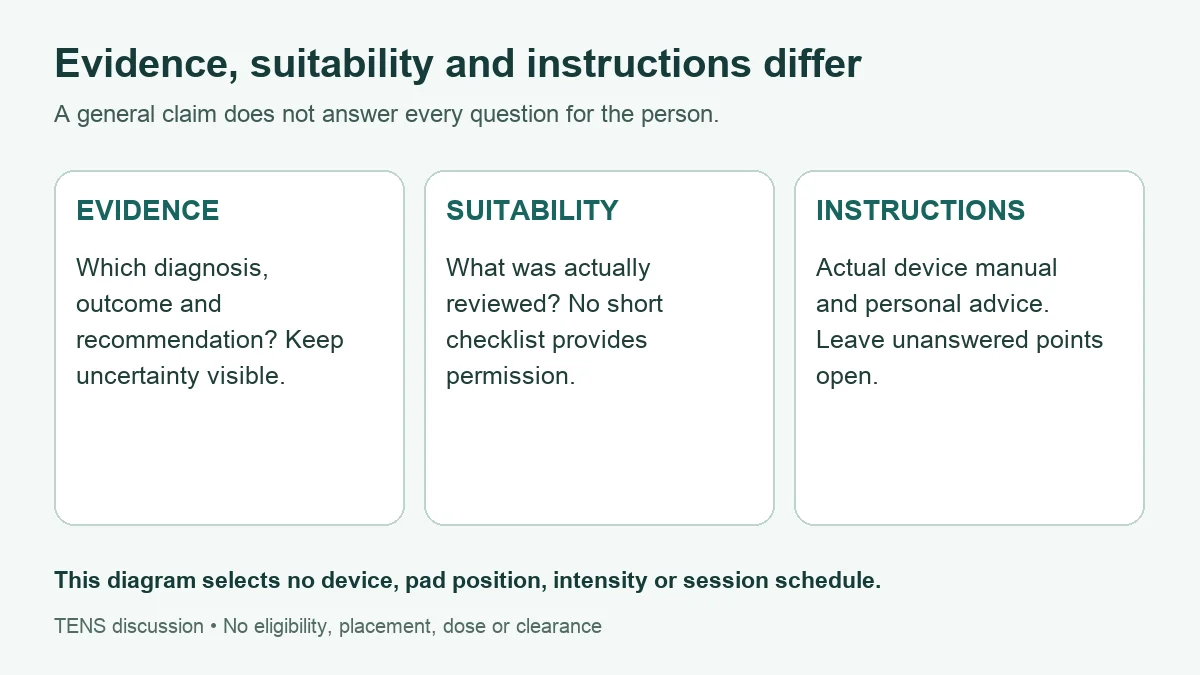
Compare TENS evidence, suitability and actual device instructions
| Area | Useful record | Conclusion to avoid |
|---|---|---|
| Evidence / proposal | Actual diagnosis, proposed goal, source of a claim and unresolved question. | A general pain-relief description establishes effectiveness for this condition. |
| Suitability | What the relevant professional actually reviewed and which questions remain. | Not seeing a listed risk or completing a form means the device is suitable. |
| Device / instruction | Actual model/manual and advice, education, source/date and scope. | A product listing or another device’s instructions supply a personal plan. |
| Use / non-use | What already happened, or not used, stopped or not remembered. | A new trial or a repeated skin response is needed to make a complete record. |
| Observation / daily life | Reported relief, no change, discomfort, skin observation and ordinary task effects already known. | Relief proves healing, causation, functional recovery or permission for activity. |
| Contact / reply | Question prepared or sent, actual answer and next agreed owner. | A booked appointment, pending question or product claim is a clinical response. |
Suitability and value are separate. Even if a professional considers a device acceptable for a person, that is not automatically evidence of worthwhile benefit for the intended condition. Conversely, a published finding does not address that person’s implanted devices, skin, sensation or actual device instructions. Ask about both questions and keep unanswered points visible.
NHS TENS guidance says not to use TENS with a pacemaker or epilepsy; during pregnancy, use only if a doctor or midwife advises it. It warns against use during sleep, bathing, driving or machinery use and on irritated, broken, infected or numb skin. These examples are not a complete safety checklist. Follow the actual manual and seek professional advice about uncertainty, including other implanted devices or relevant conditions; absence of an example is not permission.
If skin becomes itchy, irritated or red, the NHS advises switching the machine off and removing the pads. Keep any subsequent symptom or advice with the record. Do not increase stimulation to cover changing symptoms or repeat a session to reproduce a skin response. This article provides no electrode location, electrical parameter or restart instruction.
If TENS is not being recommended or the proposal is unresolved, record that status. You do not need to buy a machine to prepare questions. If it is already part of an individual plan, ask the relevant professional about uncertainty instead of independently changing medicines, device settings or treatment to produce a cleaner experiment.
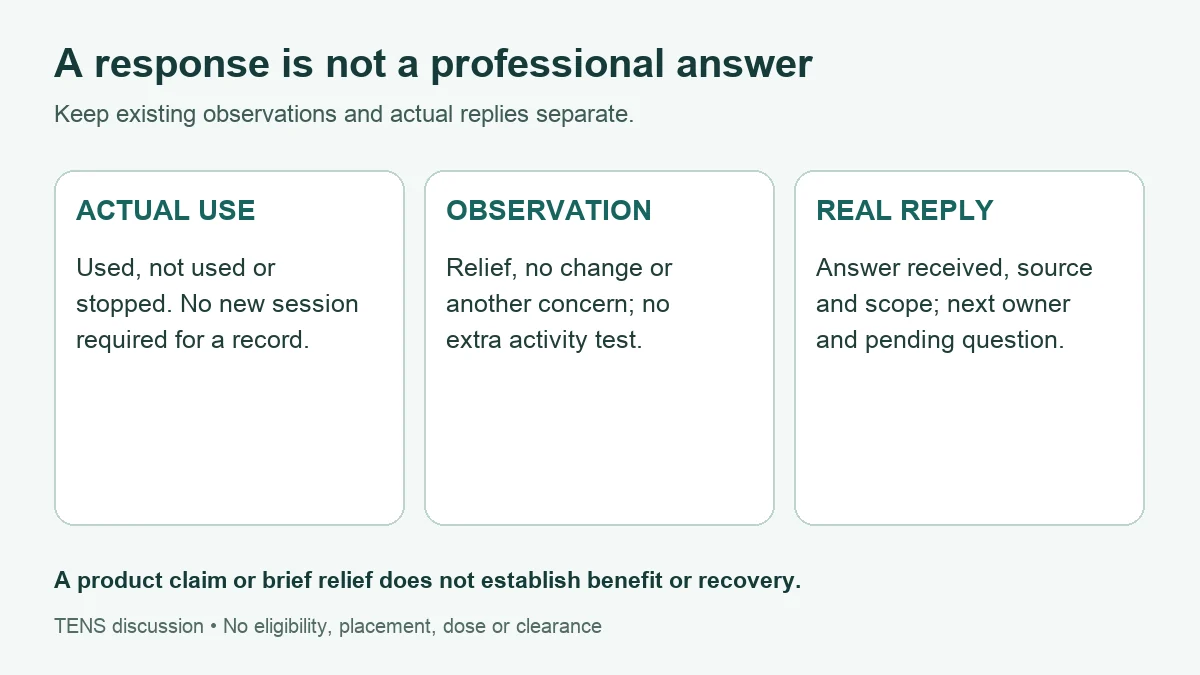
Record use, observations and the professional answer separately
Use information already available. Describe whether TENS was used, not used or stopped, the circumstances remembered and what was noticed. Where useful, keep a distinction between a person’s report and a helper’s observation. Unknown timing is preferable to invented precision. No minimum session count, baseline score or daily monitoring period is required.
A report that the knee felt quieter and a report that an ordinary daily task remained difficult can both be true. Neither should erase the other. Record existing daily-life observations without an extra walk, stair attempt or exercise test after relief. Changes in activity, other care or circumstances may also be relevant; this record cannot isolate a treatment effect.
Ask who will address the clinical question, who can explain the actual device if appropriate, and which new symptom needs a different contact route. A manufacturer can explain its manual and technical features but cannot supply a clinical assessment of the person. Keep a pending question separate from an answer actually received.
Record the actual reply, its source, date and scope. Advice addressing a device feature may leave the benefit or suitability question open. If an answer conflicts with another instruction, preserve both and ask the relevant professional to clarify. The tool neither sends information nor monitors symptoms or replies.
The companion TENS evidence, limits and safety overview provides brief background. This page adds a practical comparison of guidance and a record linking the diagnosis question, actual instructions, use, observations and real answer. For medication questions, the older-adult pain medicine review guide separates actual use from observations and replies. Neither record prescribes treatment.
Two fictional TENS discussion-record examples
These examples are invented writing models, not patient stories, clinical advice or evidence that TENS works. Neither supplies a real professional answer or successful outcome. Loading an example replaces tool entries. Use fictional examples on this page and an offline copy before entering private notes.
Example A: an osteoarthritis purchase question remains open
| Record | Fictional entry |
|---|---|
| Diagnosis / goal | Reader reports an osteoarthritis diagnosis previously explained by a clinician and is considering a product after a relief claim. |
| Evidence / suitability | Questions about condition-specific benefit, guideline differences and alternatives remain; no suitability discussion supplied. |
| Actual use | Not used. No purchase or trial requested by this example. |
| Contact / reply | Question prepared; actual contact not recorded. No actual clinical answer supplied. |
Writing example: “I am considering TENS after seeing a pain-relief claim. For the osteoarthritis diagnosis explained to me, which evidence and alternatives apply, and why would TENS be considered or advised against? I have not used it and have not recorded a professional reply.” The example does not choose a guideline or a product for the reader.
Example B: relief and another observation both need recording
| Record | Fictional entry |
|---|---|
| Actual event | An already-completed use episode is described. No new session or setting requested. |
| Observations | Temporary relief was reported, and itching was noticed during that episode. Machine switched off and pads removed; no cause or allergy diagnosed. |
| Daily life | An existing ordinary task limitation remained. No walking, stair or exercise test performed after relief. |
| Contact / answer | A question about both observations was submitted to the relevant professional. Reply pending; no actual answer received. |
Writing example: “I reported some temporary relief, but itching was also noticed and the existing daily-task difficulty remained. I have kept these observations separate. What advice applies to these concerns and the original treatment goal? The reply is pending.” Do not repeat a session to prove benefit or provoke a reaction; new concerning symptoms need appropriate care.
Free TENS use, observation and real-reply record
The tool has 11 optional fields for diagnosis, goal/evidence question, model/manual, suitability, actual instructions, actual use or non-use, response, daily context, contact, real answer and next owner. Blank items produce optional clarification questions. Full fields remain unverified notes. It generates no diagnosis, eligibility, device selection, setting, dose or activity clearance.
Download the offline HTML tool before entering actual health or personal notes. Try fictional examples on this page. The live site may use site services. The downloaded file has no ads, analytics, external assets, automatic network requests or browser storage and needs no account or email. Nothing is sent or automatically saved. Exports contain entries; keep them private and share through an agreed channel with consent.
Build, copy, download text or use browser print/save PDF. Editing hides the old result until rebuilt. Avoid names, addresses, identifying contact details and full medical records. If the tool is unavailable, use paper without delaying appropriate care. The form is not a reason to start or repeat treatment.
TENS evidence, actual use, observation and real-reply record
Keep diagnosis-specific evidence, suitability questions, actual instructions, use or non-use, observations and the answer received distinct. This organizer gives no TENS eligibility, electrode map, dose or activity clearance.
Download the offline tool before entering actual health or personal notes. Try fictional examples here. The offline copy has no site ads, analytics or external assets.
Offline copy. This file has no ads, analytics, external assets or automatic network requests.
The tool uses no network requests or browser storage and does not save automatically. Refreshing or closing may lose entries. Exports contain notes; keep them private. Avoid names, addresses, identifying contact details and full medical records. Do not delay appropriate care for a record or routine reply.
Start with the fictional example or download a blank offline copy.
If the tool does not load, use paper: actual diagnosis; goal/evidence question; model/manual; suitability question; actual instructions; use or not used; existing response; daily context; contact; real answer; next owner. Do not delay care for a form.
My TENS use, observation, contact and real-reply record
Unverified personal record for discussion. Entries are unverified notes, not medical advice, verified benefit, suitability or permission to use a device.
Guide: living.kioptrix.com/tens-unit-for-knee-pain/
Common questions about TENS discussion records
Does the disagreement mean I should try TENS myself?
No. The selected documents differ in recommendation, scope and evidence interpretation. The table is a question-preparation aid, not permission to choose a device or run a trial. Ask how the evidence applies to the actual diagnosis and alternatives.
Does brief pain relief prove recovery or benefit for ordinary activity?
No. Record the reported response and existing daily observations separately. Do not test stairs, walking or exercise to prove the effect. A symptom response does not diagnose the cause or clear an activity.
Can the tool tell me where to put the pads or which setting to use?
No. It selects no placement, intensity, frequency or session schedule. Keep the actual manual and professional education with the record; leave unclear instructions as questions.
What if I have not used a device or received a reply?
Not used, question prepared and reply pending are valid entries. No completed form establishes suitability or verifies a professional answer. Seek appropriate care for new concerning symptoms without waiting for the record.
Sources, source scope and review limits
- NHS: TENS — general patient information and safety restrictions, not a diagnosis-specific efficacy guideline.
- NICE NG226, 2022, 1.3.9 — osteoarthritis recommendation against offering TENS because benefit evidence is insufficient.
- ACR/Arthritis Foundation 2019 guideline, published 2020 — knee/hip osteoarthritis; strongly against TENS.
- AAOS knee OA guideline, 2021, printed page 46 — limited pain recommendation and rationale; not a general functional-recovery claim.
- NHS: Knee pain — symptom contact guidance; local service routes vary.
Source check and editorial update: October 29, 2026. Preserved the distinction between temporary relief and recovery. Added selected guideline differences, diagnosis/evidence/suitability/instruction comparisons, contact context, two fictional examples and an offline record. This is not an exhaustive systematic review. The original URL, publication date, author and category are retained.
Written from a family-caregiver editorial perspective. No independent clinical review, validated decision aid, real-reader usability study or improved outcome is claimed. Functional checks establish tool behavior only. The hero is AI-generated fictional artwork; body diagrams organize discussion notes and show no pad placement or device settings. Our background and editorial approach.