
Pickleball hip pain needs an individual assessment when symptoms persist, recur or affect daily life. A useful court discussion compares actual movement demands with current clinical instructions and any proposed change. Feeling better, choosing doubles or completing a quiet next morning does not establish readiness to play.
This guide helps recreational pickleball players prepare seven discussion checks, compare court demands and instructions, and record actual participation, existing observations and real replies. It includes two fictional writing examples and a free offline tool. Jump to the record tool or see the examples. It provides no diagnosis, safe playing time, exercise programme or return-to-court permission.
Emergency signs come before a court log. Severe hip pain after a fall or injury, inability to walk or bear weight, or tingling/loss of feeling after an injury needs emergency assessment. Do not force walking to demonstrate capacity or drive yourself. Use local emergency services, including 911 in the U.S. where emergency assistance is needed. NHS hip-pain guidance explains injury warning signs; its UK service numbers are not U.S. contact instructions.
With back/leg symptoms, new difficulty starting urination, inability to urinate, new bladder/bowel control changes, saddle-area numbness or severe/worsening weakness or numbness in both legs requires emergency assessment. See NHS sciatica emergency guidance. Do not treat these changes as a court-load problem or wait for a routine reply.
Sudden severe hip pain without injury, or a hot swollen hip, needs urgent medical advice; do not wait for fever or for a diary to finish. Arrange clinical review for worsening or recurring pain, limping, catching/locking, new weakness/numbness, or symptoms affecting ordinary activity or sleep. The appropriate urgency depends on the situation; severe injury or the emergency signs above override a routine appointment. No symptom list or ability to walk clears someone to play.
Stop an activity that feels unsafe and obtain appropriate help. You do not need a seven-day record, a second session or a failed self-directed trial before asking for care. Follow actual individual instructions; ask promptly if they are unclear or no longer address the difficulty. This is general education from a family-caregiver-run site, not a sports examination or clinical clearance.
Table of Contents
Seven essential checks for a pickleball hip-pain discussion
| Check | Keep these facts separate | Useful question |
|---|---|---|
| 1. Participation goal | Social practice, drills, recreational games or competition versus the movement actually required. | What level is the player hoping to return to, and what does it involve? |
| 2. Current instruction | Actual clinical advice, source/date and scope versus a generic prevention tip. | Does the advice address this activity and current symptoms? |
| 3. Proposed change | A suggestion about format or participation versus an agreed individual plan. | What remains unconfirmed before this proposal is treated as an arrangement? |
| 4. Actual participation | What happened or was not attempted versus what was intended. | Which demands differed in practice? |
| 5. Existing observations | During/after/later information versus a deliberately provoked test. | What is already known without another court session? |
| 6. Daily-life effects | Ordinary walking, stairs, sleep or other tasks versus sport readiness. | What has changed outside the court and needs review? |
| 7. Real answer and follow-through | A question sent, actual reply, its scope and agreed next owner/review. | Who can clarify the remaining issue and when? |
These are preparation checks, not a scoring system. Use what is already known and leave uncertainty visible. No minimum number of completed items makes a return appropriate. An incomplete note can still explain a useful concern. The player’s priorities matter, but a partner’s enthusiasm or an upcoming booking cannot supply medical permission.
Compare pickleball court demands, current instructions and proposals
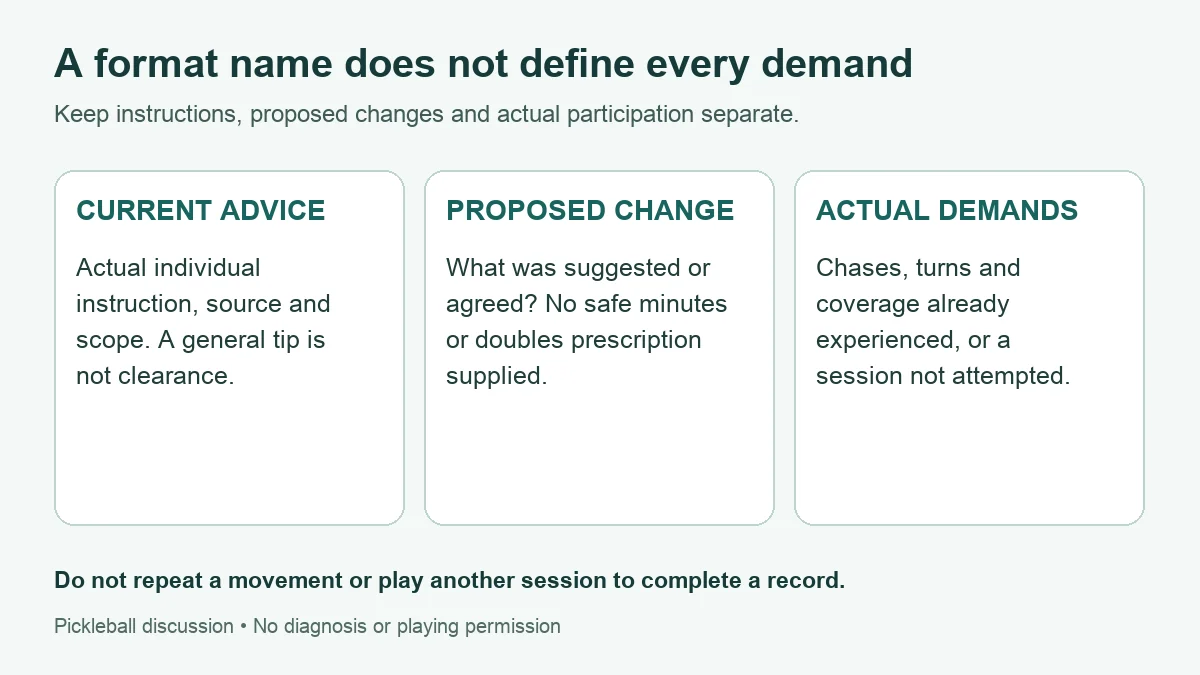
Pickleball can involve starting, stopping, lateral movement, turning, low reaches and unexpected ball pursuit. Record the actual event rather than assuming that its label describes its demand. A social doubles session may include wide coverage; a drill may change pace; a proposed shorter visit may not unfold as planned. These are contexts to discuss, not evidence that one format is safer for a particular hip.
| Demand or context already known | Instruction or proposal to clarify | Record actual participation |
|---|---|---|
| Starts, stops and direction changes | Does the current individual plan address these demands, and what remains unclear? | Turns or braking that actually occurred, or the activity not attempted; no movement test requested. |
| Lateral coverage and low reaching | Was a limited-coverage arrangement merely proposed or actually agreed? | Actual chases, reaches and any difference from the proposal; no prescribed reach or lunge distance. |
| Singles, doubles, practice or competition | Which parts of the real session are covered by the individual advice? | Actual format and demands; doubles is not an automatic low-risk bridge. |
| Duration, pauses and consecutive sessions | What does the treating professional actually advise for this person? | Known past duration and context if available, not a safe-minute limit or weekly increase calculation. |
| Surface, shoes, equipment and surroundings | Which practical concerns need review or instruction? | Actual conditions and changes without claiming that a shoe or surface caused or cured the pain. |
| Partner, coach or event expectations | Can the practical arrangement match actual clinical advice? | What was agreed, what happened and which barrier remained; agreement is not clinical clearance. |
Keep three entries distinct: what the clinician actually advised, what someone proposed changing, and what the player actually did. If the exact instruction is unknown, mark it unknown instead of reconstructing it from memory as a precise limit. If two instructions conflict, retain their wording, dates and sources and ask the relevant professional to clarify.
A proposed shorter session, doubles format or reduced chasing may be a discussion topic. This article supplies no 30–45-minute target and does not tell a symptomatic player to try another game. Record whether participation happened, changed or was not attempted. A task not attempted needs no demonstration to make it a legitimate part of the conversation.
When practical arrangements are discussed with a partner or coach, share only what is needed and with consent. A coach may help describe the session or explain technique; that does not replace medical assessment of pain. If a proposed arrangement cannot be maintained in practice, record the mismatch and seek a workable individual plan rather than treating the label “modified play” as sufficient.
What the pickleball and hip sources actually support
MedlinePlus: Hip Injuries and Disorders describes a range of hip problems and treatment categories. It explains why a single pain label is insufficient. It is not an official pickleball hip-pain management protocol and does not prescribe a court-time limit, distinguish a strain from a labral problem for an individual, or validate a home readiness checklist.
AAOS: Osteoarthritis of the Hip describes condition-specific symptoms, examination and individualized treatment options. It can provide background when osteoarthritis is actually part of the clinical situation. It should not be generalized to all athletic hip pain, referred symptoms, acute injuries or postoperative instructions. This guide therefore does not map front/side/groin pain directly to a diagnosis or rehabilitation menu.
AAOS: 5 Pickleball Injury Prevention Tips covers general prevention topics such as appropriate court shoes, warm-up and avoiding overdoing activity. General prevention advice is different from advice for an already painful hip. It does not validate this article’s former return ladder, a universal shortened-session dose or a claim that switching formats treats an injury.
The 2016 Bern return-to-sport consensus statement frames return as a collaborative process across participation, sport and performance, with individual context and roles. It supports documenting the sport goal, demands, relevant findings and responsibilities. It is a broad expert consensus, not a pickleball-specific clinical trial or a source of individual clearance. This editorial record adapts documentation questions; it is not a validated decision aid.
The sources support obtaining appropriate assessment and describing actual context. They do not prove that harder courts cause a particular player’s hip pain, that a new shoe outperforms another treatment, or that next-day stiffness identifies the tissue involved. The relevant question is what information an appropriate clinician needs, not which diagnosis a reader can infer from a symptom location.
Record participation and observations without a return-to-play test
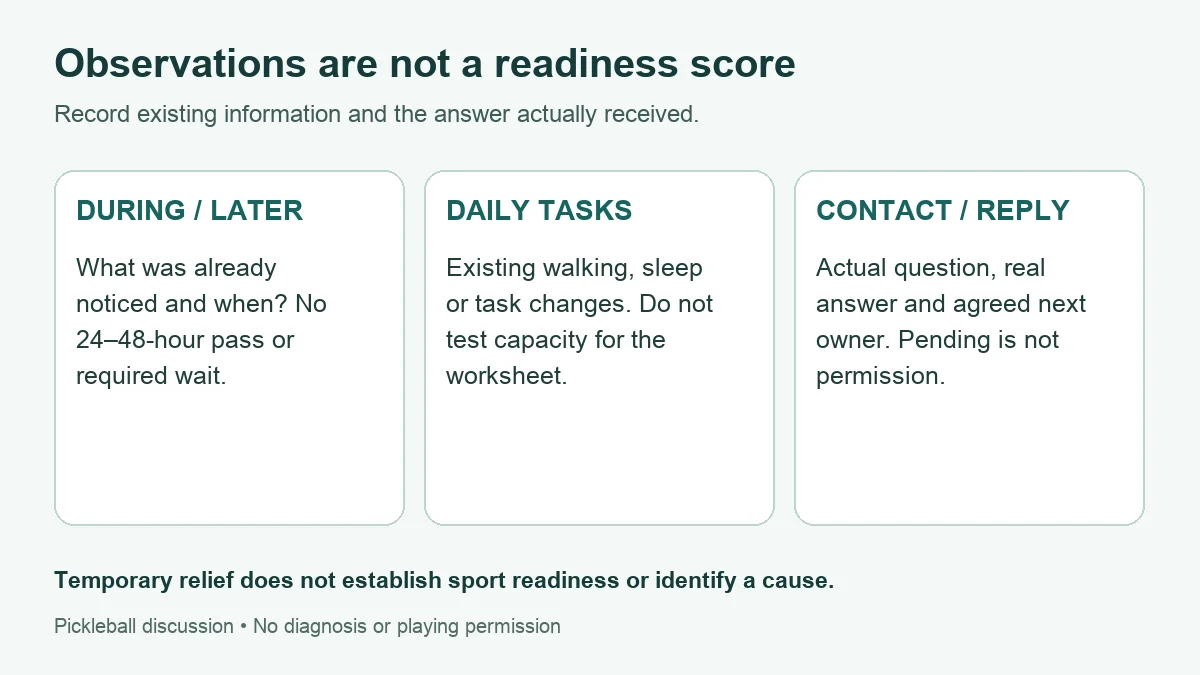
An observation during a session and an observation the next morning can both be useful if they already exist. Neither creates a pass/fail window. A quiet 24 or 48 hours, a low pain score or a comfortable walk does not independently establish sport readiness. Do not complete another game, repeat a pivot or walk stairs to see whether the hip “passes.”
Describe pain in the person’s own words: where it was felt, when noticed, what was happening and what effect it had. Record catching, a limp or altered daily activity as observations rather than naming a structure or claiming a cause. If a detail is uncertain, say so. The clinician may need history, examination and other information beyond the record.
| Keep distinct | Useful record | Avoid concluding |
|---|---|---|
| Plan / actual event | Shorter doubles was proposed; actual coverage and turns differed. | The format was appropriate or the proposed limit was followed. |
| During / later observation | Existing symptoms or no change, with timing if known. | No next-day flare means a return is safe. |
| Sport / ordinary tasks | An existing change in walking, stairs, sleep or another task. | Walking ability equals capacity for reactive sport. |
| Relief / readiness | Reported relief, other treatment/context and uncertainty. | Relief proves healing, or pain treatment should be withheld to expose the problem. |
| Question / actual reply | Who was contacted, when, pending status and the answer received. | A booked visit or partner agreement is an assessment or permission. |
Pain relief is a legitimate care goal. Follow medicine and other treatment instructions and discuss uncertainty with the clinician or pharmacist; do not change treatment to test the hip. A medicine, heat or ice response cannot establish readiness or cause. This guide selects no medication, heat/ice dose, stretch or strength programme and does not characterize appropriate treatment as cheating or camouflage.
If current rehabilitation instructions exist, keep their source, scope and actual execution with the record. Ask how they apply to the intended court activity and what changes require reassessment. Completing an exercise or feeling better in ordinary life does not automatically answer every court demand. The tool neither supplies functional tests nor interprets their results.
Timing after pickleball does not prove that court volume is the cause. Other activity, an injury, an underlying condition or several changes may be relevant. Describe rather than reconstruct an experiment. There is no required one-to-two-week delay before seeking review for function loss, worsening symptoms or another concern, and warning signs require appropriate help immediately.
Who helps with the pickleball return discussion?
| Role | Useful contribution | Boundary |
|---|---|---|
| Player | Goals, existing symptom account, actual participation and preferences. | No need to prove capacity with another game or conceal a concern to keep a booking. |
| Treating clinician / sports medicine professional | Assessment, individual advice, clinical follow-up and unresolved safety questions. | The worksheet, coach or generic prevention article cannot supply this assessment. |
| PT / relevant rehabilitation professional | Individual rehabilitation advice and interpretation of relevant function within scope. | The article provides no drill list, progression or home test to copy. |
| Partner / coach / organizer | Actual session demands and practical arrangements when sharing is appropriate. | A format change or social agreement is not clinical clearance. |
| Emergency / urgent care team | Timely assessment when symptoms need urgent or emergency attention. | Do not wait for a routine sports review or a completed log. |
Ask who will coordinate the plan and what to do if the practical arrangement or symptoms differ from what was discussed. Preserve the actual professional reply, its date and scope. If a reply addresses ordinary walking but not reactive court movement, leave the court question open. If it is unclear, ask for clarification rather than expanding it yourself.
For related care preparation, our pain medicine review guide for older adults separates actual product use from observations and real replies. This page focuses on court demands and participation. Use either record for its specific purpose; neither diagnoses a cause or authorizes activity.
Two fictional pickleball discussion-record examples
These are invented writing examples, not patient stories or proof that a change works. No real clinical answer, successful return, minute limit or recovery outcome is supplied. Their purpose is to keep an actual question open. Loading either example replaces tool entries. Follow your own individual instructions and seek appropriate care for real concerns.
Example A: proposed doubles, different actual demands
| Record | Fictional entry |
|---|---|
| Current instruction | No personal return-to-court instruction supplied; source/date/scope remain unconfirmed. |
| Proposal | A shorter doubles session was proposed. No safe duration or clinical approval implied. |
| Actual participation | An already-completed session included unexpected wide chases and repeated turns. No repeat attempt requested. |
| Difference | Actual coverage differed from the proposal; “doubles” did not define the whole demand. |
| Contact / answer | A clinical question about those demands and an individual plan was submitted. Reply pending; no successful outcome inferred. |
Writing example: “The proposal was doubles with reduced participation, but the actual session included wide chases and repeated turns. I have kept the proposal separate from the demands that occurred. Current individual guidance needs clarification. What assessment and specific plan fit these demands? The question is pending.” This does not recommend repeating the session or selecting a new minute target.
Example B: quieter pain, an existing daily-task change
| Record | Fictional entry |
|---|---|
| Relief | Pain reportedly felt quieter for a time; cause and recovery not established. |
| Ordinary activity | An existing change in walking was noticed. No walk, stair task or sport movement repeated to prove capacity. |
| Timing | Later observations are recorded only if already known; no 24–48-hour waiting test. |
| Contact / reply | Record the actual question and contact. No clinician answer supplied. |
| Next arrangement | Seek appropriate review without waiting for a log; record a real agreement only when received. |
Writing example: “The pain felt quieter, but there was an existing change in ordinary walking. I have recorded both observations without treating relief as recovery or doing another court test. What assessment and individual instructions apply now?” The example does not decide urgency or explain the cause; real emergency signs need emergency care.
Free pickleball participation, observation and real-reply record
The tool has 11 optional fields covering goals/demands, current instructions, proposal, actual participation, differences, during/after observations, later observations, daily tasks, contact, actual reply and next arrangement. Blank items produce optional clarification questions. Full fields remain unverified notes. It generates no diagnosis, safe duration, weekly increase rule, urgency score or playing permission.
Try fictional examples here. Download the offline HTML copy before entering actual health or personal information. The live site may use site services. The downloaded file has no ads, analytics, external assets, automatic network requests or browser storage. It needs no account or email. Exports contain entries; keep them private and share through an agreed channel with consent.
Build a record, copy it, download text or use browser print/save PDF. Editing hides the old output until rebuilt. Nothing is submitted to a clinician, coach or club, and entries are not automatically saved. Avoid names, addresses, club/member identifiers, identifying contact details and full medical records. If the tool is unavailable, use paper without delaying care.
Pickleball participation, observation and real-reply record
Keep court demands, current instructions, proposed changes, actual participation, existing observations and real replies separate. The tool provides no diagnosis, readiness score, exercise progression or permission to play.
Download the offline tool before entering actual health or personal notes. Try fictional examples here. The offline copy has no site ads, analytics or external assets.
Offline copy. This file has no ads, analytics, external assets or automatic network requests.
The tool uses no network requests or browser storage and does not save automatically. Refreshing or closing may lose entries. Exports contain your notes; keep them private. Avoid names, addresses, club/member identifiers, identifying contact details and full medical records. Do not delay urgent or emergency care for a record.
Start with the fictional example or download a blank offline copy.
If the tool does not load, use paper: court demands; current instructions; proposal; actual participation; differences; existing during/later observations; daily-task changes; contact; real reply; next owner and review. Do not wait for a form to seek care.
My pickleball participation, observation and real-reply record
Unverified personal record for discussion. Entries are unverified discussion notes, not medical advice, a functional test or sport clearance.
Guide: living.kioptrix.com/pickleball-hip-pain/
Common questions about pickleball hip-pain records
Does a quiet next morning clear me for pickleball?
No. Later observations describe what happened, not healing or readiness. There is no 24–48-hour pass. Use the information already available and seek appropriate assessment instead of another session to test it.
Is doubles always an appropriate modified return?
No. Record actual chasing, turns, reaches, pace and practical constraints. A format label cannot replace individual advice or guarantee that the proposed change occurred.
What is the safe number of minutes or weekly increase?
This guide supplies neither. Known past minutes can describe a session, but the tool calculates no tissue load or injury risk. Ask the relevant professional how an individual plan applies to the actual demands.
Does pain location tell me which injury I have?
No. Location, timing and quality can help a clinical discussion but do not diagnose the cause. Do not choose a rehabilitation menu or imaging test solely from the site of pain.
Should I stop prescribed pain relief to judge readiness?
Do not change treatment to test activity. Follow instructions and ask the clinician or pharmacist about uncertainty. Relief matters but does not establish sport readiness.
Must I wait until a seven-day diary is complete?
No. Seek care with the information available. Worsening or recurring symptoms and daily function changes deserve review; urgent and emergency warning signs override any routine plan.
What if a reply or instruction is unclear?
Keep its source, date and actual wording and ask the relevant professional to clarify. A pending question, booked visit or partner agreement is not assessment or playing permission.
Sources, corrections and review limits
- NHS: Hip pain in adults — symptoms, contact guidance and individual treatment context; UK service numbers have local scope.
- NHS: Sciatica — neurological emergency warning signs; not a diagnosis of pickleball symptoms.
- MedlinePlus: Hip Injuries and Disorders — general background; not a pickleball protocol.
- AAOS: Osteoarthritis of the Hip — condition-specific information; not all athletic hip pain.
- AAOS: 5 Pickleball Injury Prevention Tips — general prevention; not clearance after pain or injury.
- 2016 Bern consensus statement on return to sport — collaborative process, documentation and context; broad expert consensus, not an individual test.
Editorial correction and source check: October 29, 2026. Removed the eligibility checklist, play/modify/stop table, 30–45-minute example, 24–48-hour return ladder, five-tier symptom map, weekly-jump calculator, unsupported comparative risk claims and unverified third-person improvement story. Replaced generic “official pickleball guidance” labels with actual source names. The original URL is retained.
Written from a family-caregiver editorial perspective. No independent sports-medicine review, clinical validation, real-player usability study or improved outcome is claimed. Functional checks establish tool behavior only. The hero is AI-generated fictional artwork; body diagrams show record organization, not exercise technique. Our background and editorial approach.