

A doctor note for sciatica should reflect an appropriate professional’s assessment, not an approval formula. Your contribution is accurate information about actual work, difficulties already experienced and questions that remain. This guide helps prepare that discussion without inventing a sitting interval, lifting limit, recovery deadline or medical statement.
You do not need to finish this preparation note before starting a request. EEOC guidance explains that an accommodation request can be made in plain language and need not be written. Whether supporting documentation is needed depends on the situation. A clear memo may help a conversation, but this page promises no approval, faster response or legal sufficiency. See EEOC: requesting reasonable accommodation.
This is general U.S. employment-information and family-caregiver education. The operator is not a clinician or legal adviser. ADA Title I generally applies to employers with at least fifteen employees; diagnosis alone does not determine whether a particular person is covered. Other laws or employment settings may require different advice. ADA.gov’s introduction explains the broad disability definition and employment scope. No tool here determines coverage.
Use the practical sections: role comparison, six preparation checks, two fictional examples, or the private preparation note tool. Download the offline copy before entering actual health or employment notes. The output is employee-authored, not a clinician certificate or a message sent to HR.
On this page
A doctor note, my observations and an employer decision are different
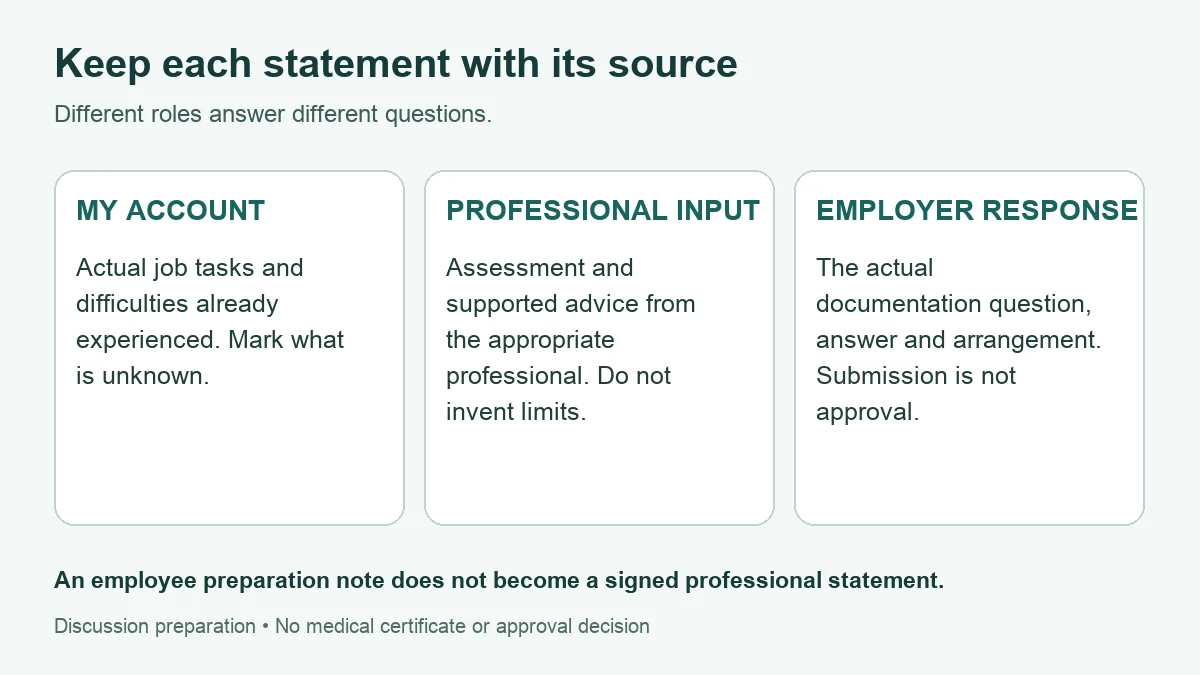
Keep each statement attached to its actual source. A job description can differ from how a task is performed in practice, and a workplace suggestion can differ from a medically supported restriction. Mark those differences rather than silently converting one into another.
| Role / source | Useful contribution | Boundary |
|---|---|---|
| Employee | Actual tasks, workplace barriers, observations already experienced and possible changes to discuss. | A personal account does not establish a medical restriction or legal eligibility. |
| Appropriate health or rehabilitation professional | Assessment, supported functional information, relevant restrictions and duration or uncertainty. | The professional uses their own judgment; a template does not prescribe what they must certify. |
| Employer / designated accommodation contact | Clarifies relevant documentation questions, considers effective options and communicates actual arrangements. | A proposed option or submitted document is not an approval or proof of implementation. |
| Employment-law or agency adviser | Advice about the individual legal situation, coverage or a dispute. | This page and its tool do not supply that legal determination. |
| Preparation tool | Organizes your words and lists unrecorded fields. | It does not authenticate sources, write in a clinician’s voice, sign a note or score approval readiness. |
JAN’s medical-documentation guidance explains that an appropriate professional need not always be an MD; suitability depends on the information needed. The familiar search term “doctor note” does not mean every case requires the same author, form or details. Ask what relevant question needs an answer instead of treating a generic letter as mandatory.
Start a request; clarify supporting information separately
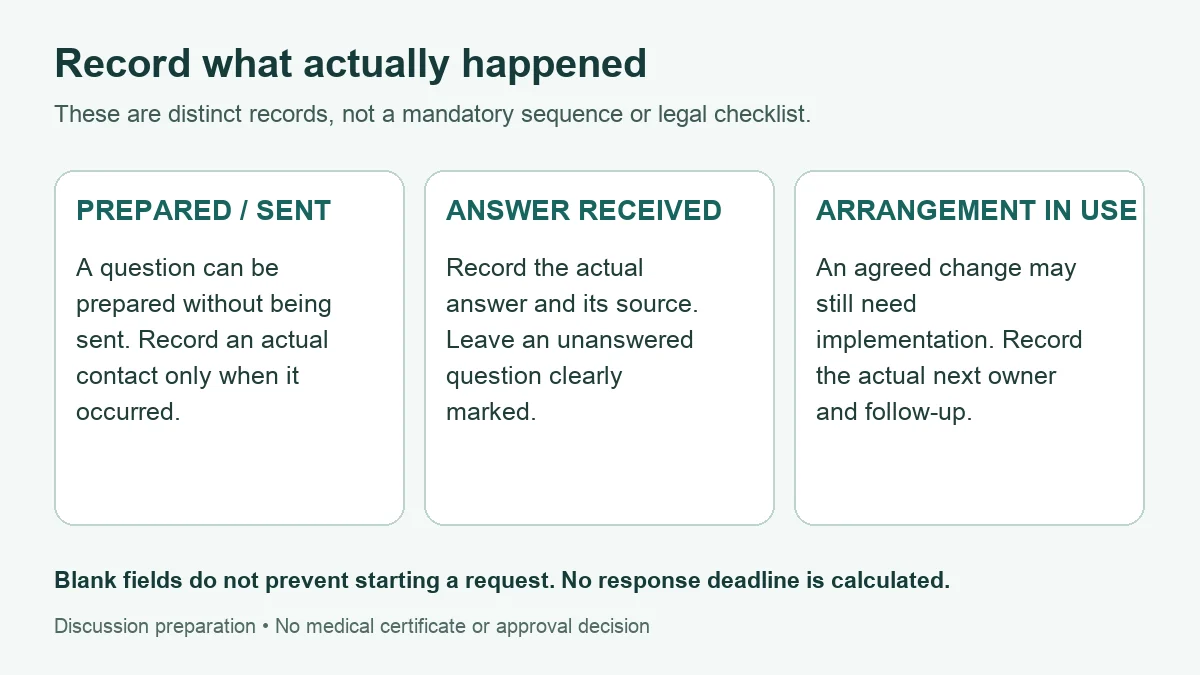
A request and a supporting medical note perform different jobs. The request communicates a need for a work change related to a medical condition. Documentation, when reasonably needed, supports relevant disability and accommodation questions. A request may already have begun before a clinic appointment or a particular form is completed.
EEOC guidance, questions 6–8, limits documentation requests to relevant information and explains circumstances in which additional documentation cannot be demanded, including when adequate information is already available. If a request is unclear or a document is described as insufficient, ask what specifically remains unanswered. Do not assume either that no health information is ever needed or that complete medical records should be supplied.
Preparing a note should not become a new hurdle. An empty field here is a discussion prompt, not a missing legal prerequisite. Do not invent a review date, choose a restriction or delay a request to make the form appear complete. A designated confidential process may be available; ask how appropriate supporting information should be provided.
The practical order is not a mandatory sequence: describe the actual barrier, clarify what information is needed, obtain appropriate professional input when necessary, and record the response. No phrase in this guide guarantees that an accommodation is reasonable, effective or approved.
Six essential checks before using a doctor note template
Bring the job facts and identify their source
Use the actual job description and your account of how tasks occur. Note uncertainties about essential and marginal duties rather than deciding those issues with the tool. A desk call, an inventory task and a handling task can involve different barriers. Describe the task, setting and available flexibility in ordinary language.
Separate an observation from a clinical restriction
“I had difficulty remaining seated during a meeting” describes an experience. “I must change position at a fixed interval” is a different claim and should not be created from an illustrative number. Record approximate timing only if already known. No timed sitting, walking, lifting or symptom-provoking test is needed for the note.
Keep the professional assessment separate from your proposal
Bring existing individual instructions and the employer’s actual question, if one exists. The professional decides what assessment and supported information are appropriate. A workstation idea is a proposal, not a prescription or a proven solution. Do not label self-reported difficulty as clinician-confirmed evidence.
State duration and uncertainty accurately
If a need is ongoing, intermittent, temporary or uncertain, preserve that explanation. A reassessment date does not automatically mean the limitation ends then. Do not make a long-term need sound temporary or choose a short trial merely to improve approval odds. Record the source of the actual duration or review advice.
Clarify documentation scope and confidential routing
Ask the designated contact what relevant information is needed and, if applicable, what was missing from an earlier note. Keep the clinical preparation memo private. Do not automatically forward its contents to a manager, submit complete medical records or treat every field as a required disclosure. This tool cannot authorize a release.
Record what was actually answered and arranged
Distinguish a prepared question, submission, receipt, actual answer and implementation. Record the responsible role and the real follow-up arrangement or unknown. A sent message is not an approval; an approved adjustment is not proof it has been put in place. The tool sets no legal response deadline and does not resolve a dispute.
Compare barriers and possible adjustments without a tier system
There is no ranking here from easier equipment requests to “higher-tier” leave or remote work. The appropriate discussion concerns the actual barrier and effectiveness. EEOC explains that employers may consider effective alternatives; this is not a rule that an employee must request the smallest change first. See EEOC’s accommodation selection explanation.
| Barrier described from actual work | Possible discussion, not a prescription | Question still to resolve |
|---|---|---|
| Difficulty maintaining one position during calls or meetings | Position flexibility, meeting arrangements or workstation options. | Which option addresses the barrier in this role, and what professional input is needed? |
| Difficulty during handling tasks already experienced | Equipment, task organization or other changes the parties can assess. | What are the actual task demands and supported limits? Do not invent a weight. |
| Symptoms or treatment needs affect scheduling | Schedule changes or leave may be topics for the individual process. | What relevant information and actual arrangements are needed? No universal duration applies. |
| A proposed alternative differs from the original request | Clarify how the alternative would address the same barrier. | Has effectiveness been discussed, and what remains unresolved? A less costly option is not automatically effective. |
Neither equipment, remote work, leave nor a particular break pattern is automatically appropriate for sciatica. The table selects no option and predicts no outcome. Do not change an individual treatment or activity plan based on these discussion examples. If new health concerns arise, clinical assessment takes priority over note wording.
Two fictional preparation note examples
These are fictional employee-authored examples, not signed medical notes. They demonstrate source labels and unanswered questions. No maximum sitting time, lifting limit, approval likelihood or legal outcome is invented. The example buttons in the tool replace current entries.
Example A: desk-work difficulty with no specific documentation request
| Source / purpose | Fictional preparation wording |
|---|---|
| My job account | Calls and report preparation are part of the role. Meeting flexibility needs discussion. |
| My observation | Remaining in one seated position has been difficult during work already experienced. No timed tolerance test or exact maximum has been established. |
| Professional advice | No specific restriction is recorded. Ask what assessment and supported information are appropriate. |
| Employer request / next question | No specific documentation request has been received. Ask who handles confidential supporting information and what is needed, if anything. |
This note can prepare a clinical conversation without pretending to be the clinical conclusion. The person does not need to discover an exact sitting limit or finish every field before explaining a workplace need. A possible position-change arrangement remains a question, not a standard sciatica schedule.
Example B: physical-task clarification with an existing professional document
| Source / purpose | Fictional preparation wording |
|---|---|
| My job account | The role includes handling and inventory tasks. Essential versus marginal task status requires clarification. |
| My observation / proposal | Difficulty during handling tasks was already noticed. Discuss equipment or task organization without performing a lifting test. |
| Professional advice | Reference the actual document privately. Preserve its real duration or uncertainty; do not generate a new limit or certificate. |
| Documentation question | The designated contact requested a task-related clarification. Confirm the specific gap and record the actual answer when received. |
This note does not recommend sending the whole preparation record to HR. Select appropriate relevant information through the designated process. If there is a dispute, repeated unexplained rejection or possible retaliation, seek individualized advice rather than repeatedly changing medical language to sound more acceptable.
Free employee-authored preparation note tool
The tool creates a private discussion memo with three sections: your work and observations; reported clinical advice and questions; the employer’s actual documentation request and follow-up. Entries described as professional advice remain your unverified account. There is no letterhead, clinician signature, disability determination or approval score.
Try fictional examples online; download the offline copy before adding actual health or employment notes. The live website may use site services. The offline HTML file contains no ads, analytics, external assets or automatic network requests. No account or email is required, and the tool does not automatically save entries. Exported files contain your notes; keep them private.
Build a note, copy it, download text or print/save PDF. Blank fields are listed as optional preparation prompts, not legal requirements. The tool does not read the meaning of the text, validate medical or legal sufficiency, decide what to disclose, or transmit anything. A completed note is not a reason to delay needed care or advice. If it does not load, use the role table and six checks on paper.
ADA note preparation: my work, clinical questions and documentation request
Build an employee-authored preparation note. Keep your observations, reported professional advice and the employer’s actual request separate. No medical certificate, legal opinion or accommodation approval is generated.
For actual health notes, download the offline tool first. Try the fictional example here. The offline copy contains no site ads, analytics or external assets and needs no account.
Offline copy. This file contains no ads, analytics, external assets or automatic network requests.
The tool uses no network requests or browser storage. Unsaved changes can be lost on refresh or close. Exported files contain your entries; keep them private. Avoid names, identifiers and pasted medical records.
Start with the fictional example or download a blank offline copy.
If the tool does not load, use paper: actual work and observations; real professional advice and questions; requested documentation and actual follow-up. Blank fields are not a reason to delay a request or care.
My employee-authored preparation note
Unverified personal notes for discussion. This is an employee-authored discussion aid, not a doctor note, signed professional statement, disability determination or legal sufficiency test. Review what is appropriate to share and use the designated confidential process.
Guide: living.kioptrix.com/ada-accommodations-for-sciatica-doctor-note-wording/
Common doctor note and ADA documentation questions
Does a doctor note guarantee an accommodation?
No. This guide makes no approval or response-speed prediction. A professional document and an employer’s actual decision are separate matters.
Must I wait for a completed note before asking?
No. EEOC describes plain-language requests that need not be written. Supporting information, when needed, is a separate part of the individual process. This tool is optional.
Should I copy a weight, sitting interval or review period?
No. Use existing observations and actual professional advice. Unknowns can stay unknown, and a review date is not automatically the end of an ongoing need.
Does “doctor note” mean only an MD may provide information?
Not necessarily. JAN describes appropriate health or rehabilitation professionals. The information needed and the professional’s relevant expertise matter; the tool does not choose the author.
Is leaving out the diagnosis always sufficient?
No blanket rule fits every case. Avoid unnecessary disclosure while clarifying the relevant information actually needed. The preparation note does not establish legal sufficiency or permission to release information.
What if the employer wants more information?
Ask what specific question remains and bring that request to the appropriate professional. JAN explains the importance of targeted clarification. Do not automatically supply complete records or invent a limit to fill a gap.
Can the tool write the doctor note for me?
No. It produces an employee-authored preparation memo. A statement you enter as professional advice remains a personal account; it is not a new authenticated certificate or professional recommendation.
For the broader request conversation, see Back Pain Accommodation Requests. This page focuses on clinical preparation and source separation, not a promise that wording will change an employer’s decision. For work-plan observations, see Sit-Stand Work Planning; it does not supply a universal sitting schedule.
Sources, corrections and when the note should wait
- EEOC: Small Employers and Reasonable Accommodation, issued March 1, 1999: plain-language requests and effective accommodation options. This is agency guidance, not a sciatica-specific approval formula.
- EEOC: Reasonable Accommodation and Undue Hardship, issued October 17, 2002, especially questions 6–9: relevant documentation and alternatives. The page carries an ADAAA notice because the disability definition was broadened after publication; use current context rather than treating old examples as a coverage test.
- JAN: Requests for Medical Documentation and the ADA: scope, appropriate professionals and targeted clarification. General technical assistance, not validation of this tool.
- ADA.gov: Introduction to the ADA: disability and employment framework. Individual application and other applicable laws require appropriate advice.
Care comes before paperwork. New or worsening neurological symptoms need appropriate clinical assessment. NHS sciatica guidance identifies emergency examples including new urine-passing/control or bowel-control problems, numbness around the genitals/anus, bilateral sciatica, and severe or worsening weakness or numbness in both legs. Use local emergency services when indicated and follow any individual postoperative instructions. This is not an exhaustive list. Do not wait for a work note or complete this form first.
Editorial correction and source check: October 28, 2026. Removed approval-oriented claims, contradictory advice about temporary versus ongoing needs, illustrative restriction numbers and the invented accommodation-tier table. Replaced the retained body with role separation, six preparation checks, two fictional examples and the employee-authored note tool. Removed duplicate and keyword-only images and the prior embedded video. The new representative image is AI-generated fictional consultation artwork, not a signed note, real clinician or clinical/legal review.
No independent clinical or legal review, clinical validation or user study is claimed. Functional testing of the tool does not establish legal sufficiency, clinical benefit or suitability. Our background and editorial approach.