
Considering a rollator for lumbar spinal stenosis raises two different questions: what your walking symptoms mean, and which support fits your needs. Feeling easier while holding a shopping cart is worth describing to a clinician. It does not by itself diagnose stenosis, show that a rollator is suitable or promise pain-free walking.
Get to the practical part: read what cart relief can and cannot mean, use the six assessment checks, see the fictional worked example, or open the assessment and teaching workspace. Download the offline copy before entering actual health notes; no account or email is required.
Scope: caregiver-written preparation for adults discussing walking difficulty, suspected or diagnosed lumbar spinal stenosis, and a possible mobility aid. It supports an assessment conversation, not a diagnosis, device prescription or walking clearance. Follow existing clinical restrictions and the instructions for the actual device. No independent clinician review is claimed.
On this page
Shopping cart relief: a useful observation, not a rollator prescription
Lumbar spinal stenosis involves narrowing around nerves in the lower back. Symptoms can include leg pain, tingling or weakness. Some people feel better sitting or leaning forward, including while holding a cart; AAOS describes how this position can increase space available for nerves. That is clinical background, not an instruction to bend farther or alter walker handles. AAOS lumbar spinal stenosis guide.
A shopping trip also changes pace, rest, support and activity. Record what was actually noticed instead of assigning the change to one cause. Do not repeat a difficult walk, release support, push a faulty cart or provoke symptoms to complete a form. An assessment can consider the whole history and examination, including explanations other than stenosis.
| Evidence or observation | What it supports | What it does not establish |
|---|---|---|
| “My legs felt easier while holding the cart.” | An everyday experience to describe, with the setting and any missing details. | A diagnosis, a safe walking distance or the right device. |
| Nadeau and colleagues, 2013: observational study of 53 people with neurogenic or vascular claudication. | Symptom combinations were more informative than individual features for distinguishing the two groups. | A home test, a validated personal probability score or proof of rollator effectiveness. |
| A device feels comfortable briefly. | One point to discuss during a professional assessment. | Fit for every task, reliable brake use or suitability on another surface. |
The 2013 study concerns differentiating symptom patterns, not testing whether a rollator cures spinal stenosis. Its small, selected sample and clinical setting limit generalization. This page does not turn the study’s likelihood ratios into a self-diagnosis calculator. Symptoms that seem familiar can still need a different assessment.
Urgent symptoms take priority: new loss of bladder or bowel control, numbness around the saddle/private area or rapidly developing severe leg weakness requires urgent medical assessment. Do not wait for an equipment appointment or worksheet. Use local emergency services for an emergency. AAOS describes cauda equina symptoms as a medical emergency.
What a rollator assessment should connect
A rollator is a wheeled walking frame, commonly with hand brakes and often a seat. Mobility aids differ in how they move and what the user needs to control. A diagnosis or body-height measurement alone cannot answer whether a particular aid works for your everyday tasks. Start with the problem the aid is intended to address and the professional’s recommendation.
The NHS walking-aid guide highlights fit, indoor or outdoor use, ability to lift a frame, seating and folding for transport. Its access and funding information is specific to its health system. Check local arrangements rather than assuming that a device is supplied or covered wherever you live.
| Bring this question | Why it belongs in the assessment | Record the professional explanation |
|---|---|---|
| Can I operate this brake design? | Hand strength and learning brake use matter. | Controls reviewed, teaching given and questions remaining. |
| Does the frame and seat fit me? | Handle adjustment, seat comfort and rated capacity are model-specific. | Exact recommended model, settings and manual reference. |
| Can it be used on my actual routes? | Doorway space and the surfaces encountered matter. | Routes discussed and tasks requiring assistance or another plan. |
| Who handles folding and transport? | A useful device still needs a workable storage and travel arrangement. | Who does what, with any unresolved lifting or loading issue. |
| What teaching do I need? | Turning, sitting, standing and brake use need appropriate instruction. | What was explained or practised with the professional. |
| Who reviews a problem? | Fit and equipment problems need a contact route. | Clinical review, supplier/service contact and follow-up arrangement. |
Source: Alberta Health Services physiotherapy guidance for four-wheeled walkers. It specifically advises following the recommended walking aid, learning hand-brake use and asking for fitting help. Its illustrated technique is general information, not a substitute for individualized teaching. This article supplies questions, not a universal handle setting or transfer routine.
A familiar sensation from leaning on a cart should not become a reason to lower handles or force a posture. Tell the therapist what felt different, then ask how the recommended device should be fitted for you. If you have been given weight-bearing restrictions, bring them to the assessment rather than assuming any wheeled frame is suitable.
Six essential checks before choosing or changing a rollator
1. Describe an event already noticed
Use ordinary language: where you were, what you were doing, which symptoms or difficulties occurred and what changed. Label guesses about time or distance as estimates. “I did not notice” is different from “it did not happen.” No extra walking test is needed for this preparation note.
2. Separate the person’s report from a helper’s observation
The person may describe pain, heaviness or fatigue. A companion may have noticed pauses, leaning or assistance. Record both with their source, without having the companion infer pain intensity or a diagnosis. Share the notes privately with the person’s permission.
3. List the places and tasks that matter
Describe home routes, doors, thresholds, outdoor ground, rest needs and transport. Record existing information; ask how any needed measurements or demonstrations should be obtained safely. A route being familiar does not settle whether a different aid will suit it.
4. Ask what aid and fitting the professional recommends
Record the actual device, reason for its recommendation, settings or limits explained and the current manual reference. Leave the model unselected if assessment has not happened. Ask about an alternative if an important need remains unresolved; this tool does not rank products.
5. Make the teaching specific
Ask the professional to explain the tasks needed for your situation, including controls and any assistance. Write down what you understood and what needs repeating. A box saying “taught” is not a competence test, and a short online article cannot certify independent use.
6. Keep review and equipment contacts visible
Separate a clinical change or difficulty using the aid from a repair or maintenance question. Record the service and supplier routes, the plan while an issue is unresolved and the agreed review arrangement. Do not continue a hazardous test just to describe a fault more precisely.
Keep assessment and shopping logistics distinct. This guide is about observations, device assessment and teaching. Our shopping-support guide covers who handles groceries, a cart, checkout and transport, with alternatives to improvising support. The cart is not a substitute for an assessed mobility aid; a recommended aid still needs a separate practical outing plan.
Worked example: cart relief, but no device recommendation yet
Fictional illustration only, not a patient case or a recommended aid. A person says their legs felt easier while holding a cart during ordinary shopping. A companion saw pauses and leaning. Neither measured the distance or separated the effects of rest and pace. A rollator has not been recommended yet, and no brake teaching has occurred.
| Section | Example entry | What remains open |
|---|---|---|
| Person’s report | “My legs felt easier while holding the cart. I do not know why.” | Clinical interpretation of the walking symptoms. |
| Companion observation | “I saw pauses and leaning; I cannot measure the pain.” | Keep this separate from the person’s symptoms. |
| Assessment needs | Narrow doorway, outdoor threshold and car loading need discussion. | No clearance, width or handling ability has been guessed. |
| Device and teaching | No model selected; questions about controls, turns and assistance. | Professional recommendation, fitting and individualized teaching. |
| Follow-up | Ask the relevant clinical / therapy service to arrange assessment. | Actual contact arrangement and review date. |
The useful result is a more precise conversation, not a diagnosis or a purchase recommendation. Select Load fictional example below to see the three sections. Its blank-field prompts cannot interpret every sentence: a filled field saying “not arranged” can still describe an unresolved issue. Review the words, not just whether fields contain text.
Free rollator assessment and teaching preparation tool
This original workspace keeps three records together: an everyday observation, assessment questions about tasks and environments, and professional advice / teaching. It lists blank arrangements and the selected teaching status. It does not estimate disease probability, select a model, score safe walking, approve an activity or send notes to anyone.
Rollator assessment and teaching preparation workspace
Separate what was reported, what a companion observed and what the professional has actually recommended. Build an assessment-preparation note without diagnosing spinal stenosis, selecting a device or approving walking.
For actual health notes, download the offline tool first. Try the fictional example here. The offline copy contains no site ads, analytics or external assets and needs no account.
Offline copy. This file contains no ads, analytics, external assets or automatic network requests.
The tool uses no network requests or browser storage. Unsaved changes can be lost on refresh or close. Exported files contain your entries; keep them private. Avoid names, identifiers and pasted medical records.
Start with the fictional example or download a blank offline copy.
If the workspace does not load, use the article’s six checks and example to make three private sections: everyday observation, assessment questions, and professional advice / teaching.
Your assessment and teaching brief
Unverified personal notes for discussion. This is not a diagnosis, device recommendation, competence certificate or walking clearance.
Guide: living.kioptrix.com/rollator-for-lumbar-spinal-stenosis/
Use the workspace in five steps
- Try the fictional example online. For real notes, download the standalone offline HTML file and open it in your browser. It contains the tool without site ads, analytics or external assets.
- Record the person’s words, the helper’s observation and the context separately. Use experiences already noticed; do not recreate symptoms or unsafe situations.
- List the environments, handling concerns and questions you want discussed. Keep the device and professional-advice sections unconfirmed until a recommendation is actually explained.
- After assessment, record the advice, teaching questions and contact routes. Build a brief and review its three sections before sharing privately by an agreed route.
- Copy, download text or print for a readable snapshot. Downloading offline HTML retains the current entries for reopening and editing. There is no autosave; export a fresh copy after changes and keep completed files private. Avoid names, identifiers and pasted records.
Questions about rollators, symptom relief and teaching
Does cart relief prove lumbar spinal stenosis?
No. It is one reported experience. Describe the symptoms and context to a clinician, including what is unknown. The study above examined clinical symptom patterns and does not validate a home diagnostic test.
Does this page recommend a rollator for everyone with stenosis?
No. The appropriate support depends on assessment, tasks and instructions. A stenosis label does not supply a particular model, setting or permission to change an existing aid.
Should I make the handles lower to copy a shopping cart posture?
Do not use a symptom observation as a fitting instruction. Tell the therapist what felt different and ask for the correct fit and technique for the recommended device.
What if I cannot use the brakes reliably?
Report the difficulty and ask the assessor to review the aid and teaching plan. Do not assume a different brake or another frame is suitable without appropriate advice. Do not use an unsafe demonstration to complete the record.
Can a rollator seat be used like a wheelchair?
A standard four-wheeled walker is not a wheelchair. Follow its manual and the professional’s instructions; do not have someone push you while you sit on it. Alberta’s walker safety guidance addresses this distinction.
What should I keep after assessment?
The exact model and manual reference if prescribed or recommended, the advice and limits explained, teaching questions, assistance arrangements, supplier contact and review route. Keep clinical notes separate from a product advertisement or a remembered demonstration.
Sources, applicability and editorial review
- AAOS: Lumbar spinal stenosis: condition background, posture-related symptoms and urgent neurological symptoms. It does not certify rollator suitability.
- Nadeau and colleagues, Canadian Journal of Surgery (2013): an observational study of 53 people comparing neurogenic and vascular symptom patterns, not a device-treatment trial.
- NHS: Walking aids, wheelchairs and mobility scooters, reviewed April 8, 2026: equipment considerations and UK access context, not a universal funding promise.
- Alberta Health Services: How to choose and use a four-wheeled walker: physiotherapy guidance, content current November 14, 2023; page also lists a January 2024 revision. General fitting and teaching background, not instructions tailored to every patient or model.
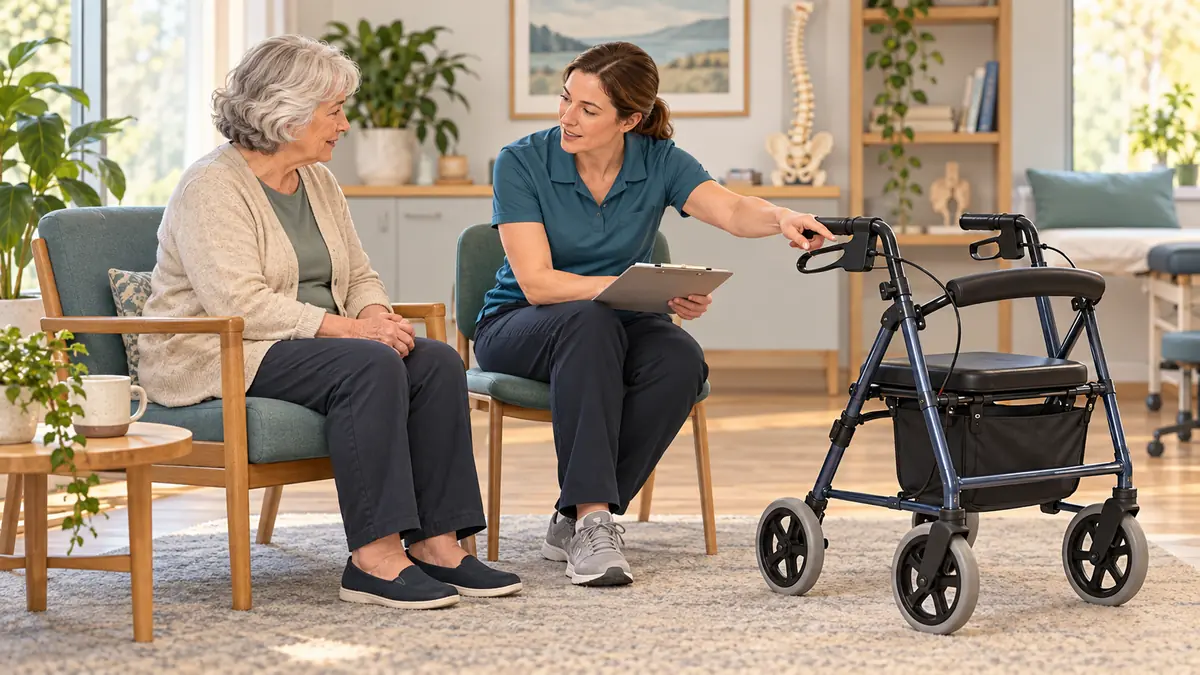
Editorial and source check: October 28, 2026. Rebuilt around observation, mobility assessment and teaching, with a fictional example and an original preparation workspace. The representative image is AI-generated editorial artwork, not a real patient, product endorsement or promise of relief. This family-caregiver resource has no independent clinician review, clinical validation of the tool or patient usability study. Functional testing does not establish medical effectiveness or device suitability. Our background and editorial approach.