
This site is written from a family-caregiver perspective. The operator is not a medical professional. This article provides general education and preparation prompts rather than an individual assessment.
A self-check cannot establish “text neck”
Use these prompts to prepare questions and arrangements. They do not diagnose a condition, determine coverage or clear an activity.
- What to record
- How symptoms began, usual phone tasks, other activity and any headache, weakness or sensory change.
- What to ask
- What assessment is appropriate, and which task changes are worth trying within the care plan?
- Next action and owner
- Discuss unresolved symptoms with a clinician; do not use a posture score to rule out other causes. Write down who will act and when to follow up.
Keep personal records private. You can use the visit preparation organizer to arrange questions; do not post identifying health information in comments.

The Hidden Cost of “Just a Minute”
Neck pain that appears during phone use is worth noticing, but it does not establish a phone-related diagnosis. This guide explains which observations to record, how to try a comfortable setup, and when symptoms need medical assessment.
Text Neck Reality Check
“Text neck” is an informal label. Screen timing, headache, or rounded shoulders cannot reliably separate one cause of neck pain from another. A change in posture may alter comfort without identifying the underlying problem.
Use observations to describe symptoms, not to diagnose yourself.
Table of Contents
What “text neck” is and why it feels different
Phone use can be an aggravating activity. Similar discomfort can also arise during desk work, sleep, driving, or other activities. Describe the pattern without assuming the screen explains every symptom.
Symptoms may change during phone use, but that association does not prove tissue damage or exclude another cause. Neck pain can involve muscles, joints, nerves, stress and other factors; “text neck” is an informal description, not a distinct diagnosis confirmed by three symptoms.
Biomechanical models describe forces under specific assumptions. They do not tell you whether an individual posture will cause pain, tissue damage, or a need for treatment.
- Phone timing is an observation, not a diagnosis.
- Sleep, strain and other causes can overlap with symptoms during phone use.
- Comfort and recovery vary; no rapid result is promised.
Quick reality check: If your pain is severe, progressive, or paired with numbness/weakness, skip the internet and get evaluated.
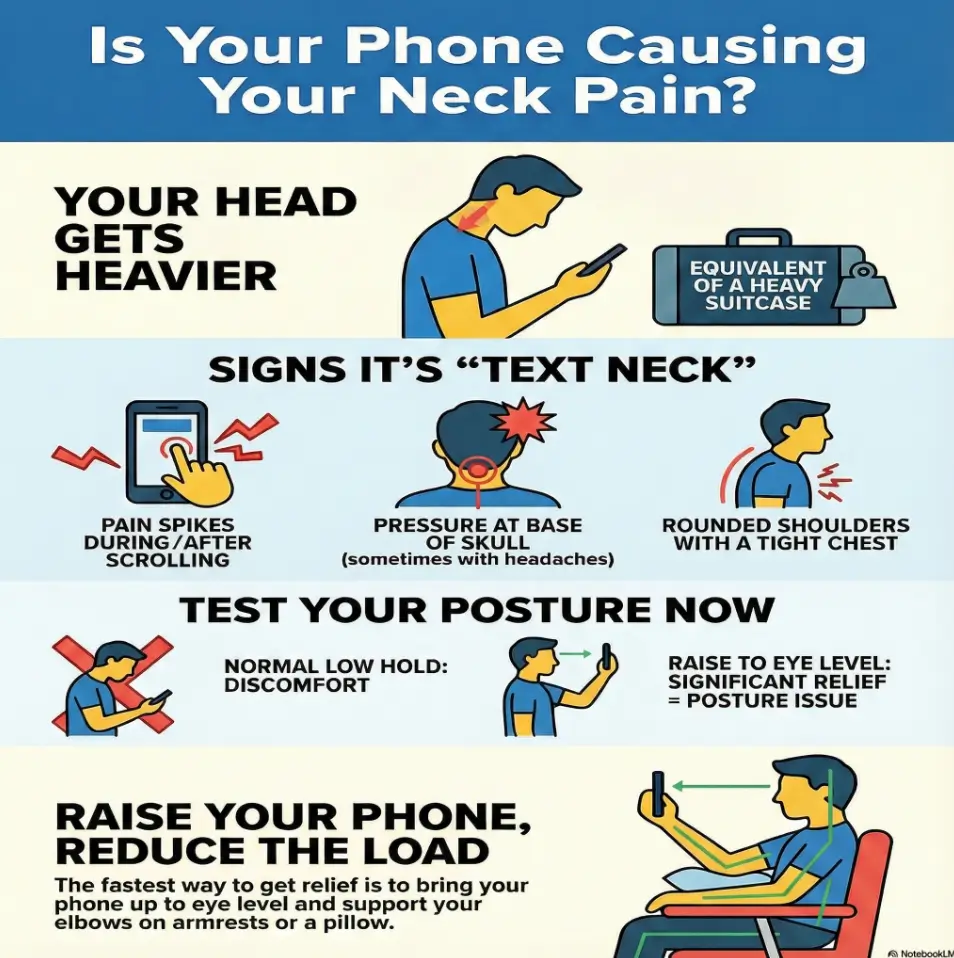
Three observations to record, not a diagnostic checklist
These three observations may help you explain your symptoms to a clinician. None is specific to phone use, and there is no validated three-symptom test in this article.
Symptom 1: The “screen-time spike” (pain rises during or after scrolling)
Note when discomfort starts during or after using the phone, how long it lasts, and whether it occurs during other activities. There is no universal 15–30-minute threshold.
Symptom 2: The “top-of-neck + headache combo” (suboccipital pressure)
Record headache or pressure near the base of the skull if it occurs, but do not assume it comes from the neck or screen. A sudden extremely painful headache, or headache with neurological symptoms or fever and a stiff neck, needs emergency assessment.
Symptom 3: The “posture echo” (your shoulders and chest are in on it)
Shoulder or upper-back discomfort can be useful to mention. Its presence does not prove a posture-chain diagnosis or rule out a nerve, joint, or other problem.
- Record your actual symptom timing
- Track skull-base pressure vs side-of-neck soreness
- Check if shoulders/chest feel “involved”
Apply in 60 seconds: Raise your phone to eye level for 10 breaths and see if symptoms ease.
- Builds during phone use
- Skull-base pressure + tight traps
- Rounded shoulders, tight chest
- Improves with screen breaks
- Triggered by event (sleep, strain)
- Localized soreness, less timing-linked
- May improve with rest/heat
- Less tied to shoulder/chest posture
A comfortable observation without provoking symptoms
This is a comfort observation, not a diagnostic test. Do not reproduce a painful position, force a chin tuck, or delay care to finish the steps.
- Neutral reset (10 seconds): Stand tall. Let arms hang. Eyes forward. Breathe slowly.
- Observe: note the activity you were doing when symptoms appeared. You do not need to recreate it.
- Try a comfortable alternative: put the phone down or support it at an easier viewing height. Let your shoulders relax without forcing the neck.
- Compare (10 seconds): Rate discomfort 0–10 in each position.
A change in comfort may identify a position worth adjusting, but a two-point pain change is not a validated test for phone-related neck pain. Do not deliberately provoke pain to complete this comparison.
- If comfort improves: record the useful adjustment. It still does not diagnose the cause.
- If comfort does not change: do not infer a diagnosis from that result. Seek advice if symptoms persist or concern you.
- If symptoms worsen: stop the movement rather than forcing it or repeating it with a smaller range.
The useful outcome is a clear observation you can report, not a pass/fail score.
Why different causes of neck pain can overlap
Let’s protect you from a common trap: labeling everything as text neck because you own a phone. Sometimes neck pain is… just neck pain.
During other activities: overlapping observationss often show up like this:
- Sleep-triggered: you wake up with a stiff side after a weird pillow angle.
- One-side strain: you carried a bag on one shoulder for an hour, then paid the tax.
- Acute crank: you turned your head fast, sneezed, or did a “small” movement that felt huge.
- Age/structure flare: arthritis or disc irritation can flare without phone timing.
These patterns overlap. Neck pain after sleep, a strain, or another condition can also change during phone use. The distinction between “text neck” and “normal” neck pain should not be used to decide that symptoms are harmless.
For a practical example, someone with discomfort after sleeping may also find phone use uncomfortable. That observation can guide a comfort adjustment, but cannot establish that the phone is delaying recovery.
Warning signs and when to seek assessment
Check the warning signs before trying exercises or buying equipment. Cost planning comes after determining how urgently symptoms need assessment.
- No if you have weakness, numbness/tingling that’s spreading, loss of balance, fever, unexplained weight loss, or pain after major trauma.
- No if pain is severe and unrelenting, or wakes you nightly for multiple nights.
- For mild, stable symptoms: a comfortable change of activity may be reasonable, but does not certify that self-management is safe.
- Movement is not a clearance test: being able to rotate your neck does not rule out a condition needing care.
Seek emergency care for a sudden severe headache, headache with fever and stiff neck, or sudden neurological symptoms such as facial droop, speech trouble or limb weakness. Significant trauma also requires urgent assessment. New or worsening arm symptoms or balance difficulty needs prompt advice. The checklist cannot certify that self-management is safe.
If you need care, ask about network status, deductible, copay and authorization requirements. Do not delay urgent assessment to obtain an estimate.
- A symptom checklist cannot clear you for self-treatment.
- Red flags deserve evaluation
- Ask about deductible and prior authorization early
Apply in 60 seconds: Write down your top 2 symptoms and the exact trigger (screen-time, sleep, strain).
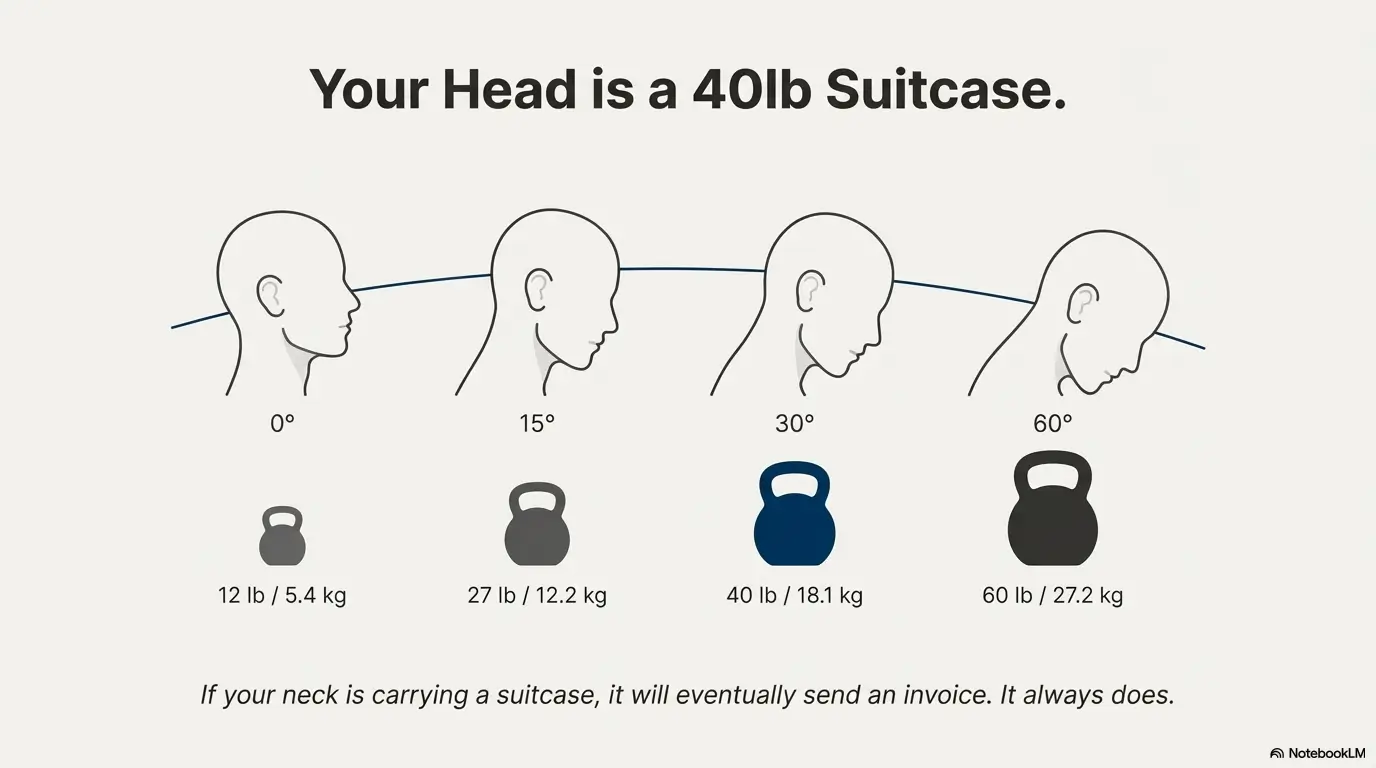
Illustrative neck-force model (angle → force)
This is not a medical device. It’s a behavior mirror. The point is to make posture visible, because invisible problems stay expensive.
Hansraj’s 2014 paper used a computer model to estimate cervical forces at different head angles. The slider illustrates those model values, with interpolation between anchors; it does not measure your neck, diagnose pain or predict damage. Pounds here describe force, not pressure.
Show me the nerdy details
This slider uses anchor points commonly taught in posture education based on a well-known biomechanics estimate. It’s not measuring you. It’s showing the likely direction of load change as angle increases—useful for habit change, not diagnosis.
A larger model force is not a measured load on your neck or an injury threshold. Do not use the slider to decide whether you need imaging or treatment.
Decision card: home adjustments or medical advice
Use symptom severity, progression, daily function, and warning signs to decide when to seek advice. A home setup trial is optional and should not delay appropriate care.
- Pain is screen-timed and improves with breaks
- No red flags; symptoms stable
- You can stop an adjustment if it aggravates symptoms.
- You understand that warning signs take priority over cost planning.
- Numbness/weakness, radiating arm pain, or worsening symptoms
- Symptoms are disrupting sleep or daily function.
- Symptoms persist or worsen despite reasonable changes.
- You need documentation for work/insurance
Neutral next step: Save this card and ask any provider for an itemized estimate before you commit.
- Home adjustments are optional for mild, stable symptoms.
- Evaluation is for red flags or stalled progress
- Ask for itemized estimates
Apply in 60 seconds: Decide your lane (A or B) and write it down. That alone reduces dithering.
Seven comfort and activity checks to consider
Most advice fails because it says “improve posture” like posture is a personality trait. Here’s the trusted-operator version: change the environment so good posture is the default.
1) Raise the phone (yes, it’s that simple)
Try a comfortable viewing height if you resume phone use. Stop if it worsens symptoms. This is a setup suggestion, not a report of a successful 48-hour treatment trial.
2) Support your elbows
Unsupported arms pull your shoulders up and forward. Rest elbows on armrests or a pillow. Cheap fix, big return.
3) Avoid forced neck positioning
Do not force a chin-tuck position. If a clinician recommends an exercise, ask for a comfortable range and instructions appropriate to your symptoms.
4) Two-minute chest opener (doorway stretch)
Do not assume chest tightness is the cause of your neck symptoms. Ask for an individual exercise plan if movement is painful or you are unsure what is appropriate.
5) Upper-back extension (the missing link)
An upper-back support may make some positions more comfortable. Do not use a rolled-towel exercise to force a painful movement or treat an unconfirmed diagnosis.
6) Micro-break rule: 20 seconds every 10 minutes
A timer can remind you to change activity. The example of 20 seconds every 10 minutes is a planning choice, not a proven way to prevent pain.
7) Rebuild strength (not just stretch)
If strengthening is appropriate, a qualified clinician can help select exercises and progression. A generic online routine cannot determine which muscles need treatment.
- Do today: raise phone + elbow support.
- If movement is uncomfortable: seek advice before adding exercises.
- If exercise is recommended: follow an individual progression.
Illustrative scenario: avoiding a product-first assumption
Example only, not a treatment testimonial
Illustrative scenario, not a patient history: a person buys a pillow because neck discomfort appears after scrolling. The symptoms continue, so they note when the discomfort occurs and whether there are arm symptoms or other warning signs.
They try a comfortable screen position, reduce the aggravating activity, and seek advice if symptoms persist or worsen. The lesson is to gather useful information rather than repeatedly buying products or stretching harder. No recovery result is implied.
Costs to confirm and questions before booking
This is not about chasing the cheapest option. It’s about avoiding the expensive pattern: paying for services that don’t change the load, while your phone habit keeps cashing checks against your neck.
| Service | Price to confirm | Notes |
|---|---|---|
| Telehealth consult | Request a current itemized estimate | Often cheaper than in-person; ask if it counts toward deductible. |
| Physical therapy session | Request a current itemized estimate | Cash-pay varies; insurance may require prior authorization or referral. |
| Chiropractic visit | Request a current itemized estimate | Ask what’s included (adjustment vs therapies) and the total plan cost. |
| X-ray | Request a current itemized estimate | Imaging centers can be cheaper than hospital outpatient departments. |
| Cervical spine MRI | Request a current itemized estimate | Huge variation; ask for cash price and radiology fee details. |
Neutral next step: Save this table and confirm today’s cash price and your plan’s deductible before scheduling.
- Your insurance card (and whether you’ve met your deductible)
- Symptom notes: trigger, duration, 0–10 pain, any arm symptoms
- What you have tried and whether comfort or function changed.
- Work setup details: laptop height, phone habits, commute time
- Ask clinics: “Do you bill time-based codes like therapeutic exercise or manual therapy, and what’s my expected out-of-pocket?”
Show me the nerdy details
Time-based rehab billing often uses 15-minute units. That’s one reason estimates can swing: the “per visit” charge may hide how many units are billed. You don’t need to memorize codes, but you should ask for an itemized estimate.
An optional observation plan, without a recovery deadline
This is an optional observation plan, not a 14-day treatment protocol. Make one comfortable change at a time. Warning signs or worsening symptoms need earlier care; do not wait for the plan to end.
Start: choose one comfortable adjustment
- Choose a comfortable screen height; no timed posture hold is required.
- Elbows supported whenever you’re scrolling
- 20-second break every 10 minutes
If symptoms remain stable: review comfortable movement
- Comfortable movement only; no required two-minute hold
- Do not force upper-back movement with a towel
- Move within a comfortable range; stop if symptoms worsen
If exercise is appropriate: agree on a plan with a clinician
- Ask whether neck exercises are appropriate for your symptoms.
- Ask for an individual exercise range, dose and progression.
- Stop exercises that worsen symptoms or cause new arm symptoms.
- Start with a comfortable device position.
- Review comfort without imposing an exercise deadline.
- Progress only with exercises suitable for you
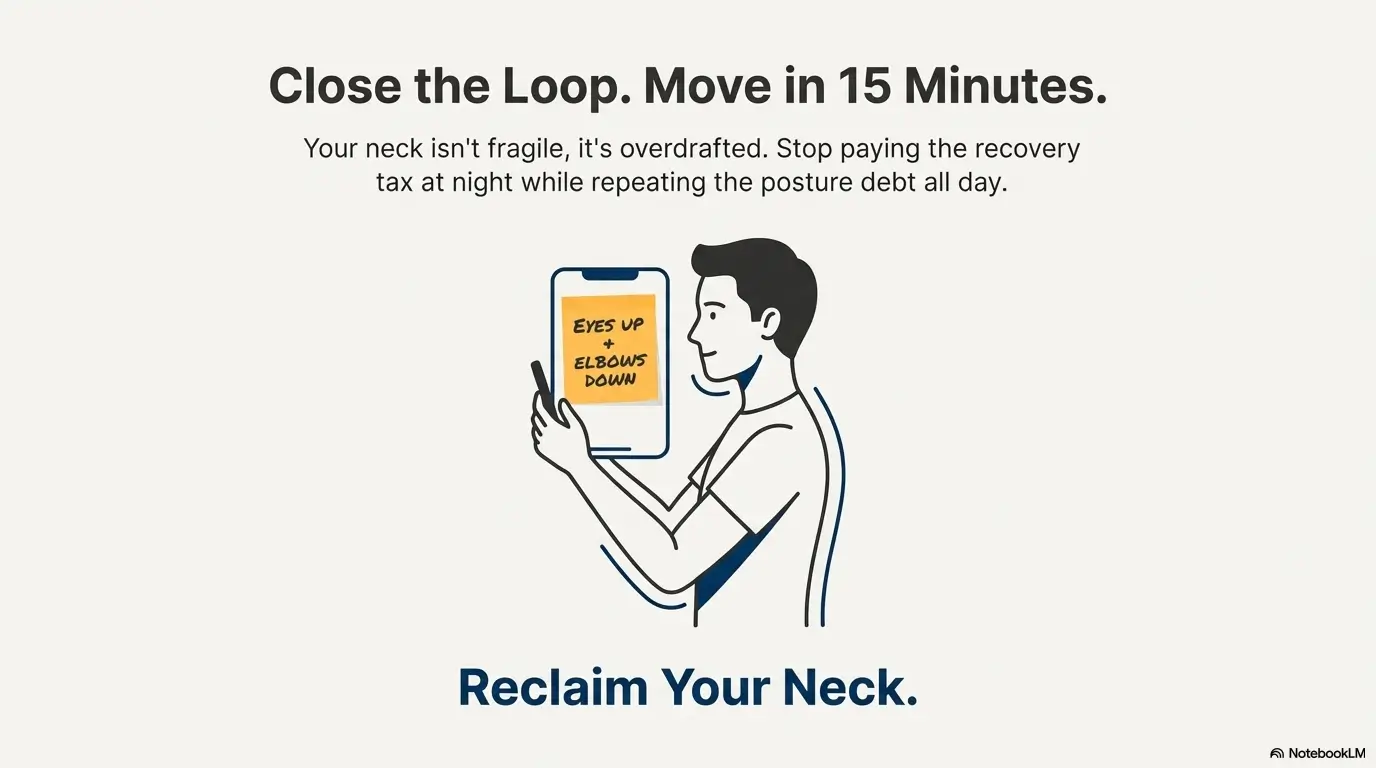
Apply in 60 seconds: Put a sticky note on your phone: “EYES UP + ELBOWS DOWN.”
Check whether your comfort and daily function are improving, without requiring a fixed pain-score change by day seven. Persistent or worsening symptoms warrant assessment; warning signs need earlier care.
FAQ
1) Can text neck cause tingling in the arm or hand?
Tingling can happen if nerves are irritated, but it’s also a reason to be cautious. If tingling is new, worsening, or paired with weakness, get evaluated rather than assuming it’s “just posture.”
Apply in 60 seconds: Note where tingling travels (thumb vs pinky) and whether it changes with neck position.
2) How long does it take to feel better if it’s truly phone-posture related?
Response varies. A comfortable position change may help, but there is no reliable promise of recovery within 24–72 hours or lasting improvement within 10–14 days.
Apply in 60 seconds: Commit to eye-level phone use for your next 3 scrolling sessions.
3) Do I need physical therapy, or can I manage this myself?
Mild, stable symptoms may be easier with comfortable activity changes. Persistent, worsening, or concerning symptoms need assessment. A clinician can determine whether physical therapy or another approach is appropriate; phone timing alone cannot make that decision.
4) Will an MRI “prove” text neck?
An MRI does not measure your phone habits. Whether imaging is useful depends on the clinical assessment and the question it is intended to answer. Ask what a result would change about the care plan.
5) What’s the best pillow for text neck?
No pillow establishes or treats every cause of neck pain. Choose comfortable support rather than assuming an “ergonomic” label guarantees a result. Persistent symptoms need advice rather than repeated product purchases.
6) My neck hurts even when I’m not on my phone—could the phone still matter?
It may be one aggravating activity, but pain away from the phone does not confirm a phone-related cause. Record the broader pattern and get assessed for persistent, worsening, or concerning symptoms.
Conclusion: close the loop and move in 15 minutes
Describe what happens during phone use without treating the timing as proof of the cause. Keep comfortable adjustments, stop aggravating movements, and seek assessment when indicated.
Put the phone down if using it hurts. Record the symptom location, duration, and any arm symptoms. For more detail about bedtime support and device use, see the guide to neck discomfort while using a phone in bed. For planned non-emergency appointments, check coverage and request an estimate; do not let price checks delay urgent care.
Targeted trust and safety review: 17 October 2026. Removed first-person treatment claims and diagnostic implications from symptom comparisons; reframed the exercise schedule as optional observations. Earlier safety update: 13 October 2026. Sources: NHS neck-pain guidance, NHS headache warning signs, and Hansraj’s 2014 biomechanical model. The story is illustrative; symptom comparisons and routine timing do not diagnose the cause or guarantee recovery.
Targeted editorial update: October 21, 2026. Added a topic-specific record, question and follow-up guide and revised the title and search description. Existing useful material was retained; this update is not a complete medical, legal or insurance review. Confirm individual instructions, current prices and benefits with the relevant service.