
Laundry with sciatica can be difficult at one specific moment: collecting clothes from a floor basket, picking up the basket, or reaching into a machine. A different lifting pose does not answer every problem. This guide helps you describe the difficult moment, discuss a task change and distinguish a proposal from the actual arrangement and any observation afterward.
Use the practical parts: compare task demands and change questions, follow the six checks, read two fictional examples, or open the task-change record tool. Copy, download text, print or download an offline tool. No account or email is required; use the offline copy before entering actual health notes.
Scope: caregiver-written preparation for adults discussing laundry handling and existing sciatica or mobility advice. It is not an individual lifting assessment, exercise program or appliance-installation guide. Follow current restrictions and device instructions, including postoperative advice where relevant. No independent clinical review is claimed. Do not repeat a difficult task to complete this page.
On this page
Start with the difficult laundry moment, not a lifting pose
“Laundry hurts” may conceal several different problems. The floor collection point, basket pickup, machine opening and handover to a helper are not the same task. Describe which moment was difficult during ordinary activity and what was already arranged. An observation is useful without proving whether the pain came from bending, a particular tissue or the basket itself.
This article does not choose a golfer’s lift, squat or hip hinge from pain location or a diagram. It supplies no universal no-twist rule, basket height, load limit or number of repetitions. If an individual movement or handling method has been taught, record the actual instruction and ask about unresolved tasks rather than replacing it with an online recipe.
The aim is to ask whether a demand can be removed, changed or handled by an appropriate helper. A proposed change can create another issue, such as obstructed access or a task that nobody has agreed to perform. Keep the unresolved question visible. A different arrangement and a comfortable moment are not proof of carrying safety or treatment benefit.
Laundry task demands and change questions: a comparison table
Choose one row that matches the problem already noticed. The change column lists discussion topics, not instructions to modify a room or test a new setup. Keep current advice and the actual person, equipment and space in view.
| Moment in the laundry task | What to describe | Change question to discuss |
|---|---|---|
| Collecting and sorting clothes | Where clothes collect and what is difficult to reach or retrieve. | Could the collection process or location change, and who would arrange it? |
| Picking up or placing a basket | Basket shape, access, grip needs and where the lift begins or ends. | Can the lift be removed or assigned to help rather than choosing a pose? |
| Loading the machine | Machine access, laundry placement and tasks that are not covered by transport help. | Which part needs help or assessment before relying on a new arrangement? |
| Unloading the machine | The difficult reach or transfer already noticed and the scope of existing help. | Does the proposed support include unloading, not just moving the basket? |
| Transfer toward drying | Intermediate placement, route and who handles that transition. | Can this transition be reorganized without creating a new unassessed carrying task? |
| Putting clean items away | What remains after transport, including access to storage. | Who completes this stage, and which details need a separate discussion? |
For stairs, use Laundry on Stairs With Sciatica. For the folding station, see Folding Laundry With Sciatica: Workstation Fit and Support. The focus here is basket pickup and machine access: identifying one difficult moment and recording a proposed change, actual agreement and remaining uncertainty. It is not another route-handover worksheet.
What the evidence supports, and where it stops
HSE’s manual-handling overview describes avoiding hazardous handling where possible, assessing unavoidable work and reducing risks. It notes that load weight matters but there is no specific legal weight limit. This is a workplace framework in Great Britain, not a household rule or a medical prescription for sciatica. HSE manual-handling overview.
The detailed HSE assessment considers the task, load, environment and individual capability, including posture, distance, repetition, surfaces and underlying health conditions. Those topics help organize a description of a task; they do not validate a personal lifting method or this record tool. Do not import worker risk filters or body-weight calculations as clinical clearance. HSE task-assessment guidance.
NHS occupational-therapy information describes examining everyday activities that are difficult and looking for other ways to do them. That supports asking about a task-focused review instead of trying to solve every problem with a basket or a posture rule. Access and referral arrangements vary; UK service information is not a worldwide entitlement. NHS: occupational therapy.
| Resource or record | Useful for | Does not establish |
|---|---|---|
| HSE handling framework | Questions about whether and how a task should be changed or assessed. | An individual safe load, height or movement prescription. |
| NHS occupational-therapy information | Understanding why daily-task difficulties may merit practical assessment. | A specific product, home modification or guaranteed service. |
| Your task-change note | Separating what was proposed, actually arranged and already observed. | Causation, treatment success or readiness to do more. |
| NHS sciatica guidance | Clinical background and situations needing medical help. | A personalized laundry technique or permission to test symptoms. |
Six essential checks for a laundry task-change record
Name one moment already experienced
Choose collection, basket pickup, loading, unloading or another specific stage. Describe an ordinary event, not the result of a new challenge. Approximate context is acceptable. You do not need to measure reach, load a basket, touch a painful area or repeat the movement to make the description useful.
Record the current arrangement and actual instructions
Include the basket, machine access, available space and help already known. Put individual clinical or device instructions beside this description, with their source and date if available. Mark missing or unclear advice as a question. Do not infer that an activity is unrestricted because no instruction is recorded in the form.
Describe a change as a proposal first
Specify which demand you hope to remove, move or delegate. Avoid a vague instruction such as “lift better.” A proposed collection location may need review for access and stability; this article does not prescribe a height. Do not balance a basket on an improvised support or modify an appliance to satisfy the worksheet.
Keep the actual agreement and responsible role separate
Record what was actually arranged, who will implement it and any conditions. Practical help is different from clinical advice. Someone agreeing to transport a basket has not necessarily agreed to load or unload a machine. A discussion is not the same as an arrangement, and an entry is not independent confirmation.
Use ordinary observations without running a test
If a change was actually arranged and an ordinary experience has already occurred, note what happened and what remains difficult. Leave the observation blank if the change has not happened. Do not keep trying until pain appears, compare lifting poses or turn the record into a capacity test. A perceived improvement does not prove why it happened.
Arrange review and backup for the unresolved stage
Record the actual contact route and review arrangement, or leave them unconfirmed. Specify which stage still needs help and what happens if that help is unavailable. A comfortable task does not independently authorize a heavier basket, longer session or different technique. Ask the relevant professional about changing instructions.
Two worked examples: a change can leave another task unresolved
Both examples are fictional. They demonstrate record-writing, not a treatment, approved setup or patient outcome. No one repeats a lift or uses pain to select a movement. The useful output is a clearer question and an accurate distinction between a proposal and an actual arrangement.
Example A: clothes are collected from a floor basket
| Part of the record | Fictional entry |
|---|---|
| Difficult moment | Retrieving clothes from the current floor collection point was difficult in ordinary laundry. |
| Current arrangement | No alternative location or supporting surface has been assessed. |
| Proposed change | Discuss a different collection arrangement and who could set it up or collect clothes. |
| Actual agreement | No new arrangement is agreed; access and stability questions remain open. |
| Observation and review | No post-change observation exists. Backup and review details still need confirmation. |
The example does not replace the floor basket with a prescribed height or assume that a raised surface is suitable. The optional observation stays blank. The question is whether an appropriate arrangement can remove the difficult retrieval step, not which pose to practise before the next appointment.
Example B: basket transport is covered, but machine unloading is not
| Part of the record | Fictional entry |
|---|---|
| Difficult moment | Unloading remains difficult even though someone moves the basket. |
| Actual arrangement | The helper’s recorded role covers basket transport only. |
| Proposed change | Discuss separate support or a review of access for machine unloading. |
| What was already observed | During ordinary laundry with the transport arrangement, unloading remained difficult; no cause was inferred. |
| Remaining question | Who covers unloading and the unresolved stage, and when will the arrangement be reviewed? |
Transport help has not failed merely because it does not solve a different stage. The record preserves its limited scope and identifies the machine-access question. It does not assume the person can now unload alone or recommend a replacement appliance, reacher or lifting technique.
Free laundry task-change record tool
Use one record per difficult moment, not a complete household inventory. Select the task, describe the existing arrangement, then separate the proposal, actual agreement and responsible role. The post-change observation is optional. Unknowns are acceptable. You can use the table and examples on paper if the tool is unavailable.
The output reads blank notes and the selected change status only; it does not interpret the text, resolve contradictory advice, verify help or assess symptoms. It supplies no technique, height, load or readiness score. Try either fictional example online. Download the offline tool before entering actual health notes; there is no automatic saving.
The offline file has no site ads, analytics, external assets or automatic network requests. The live webpage may include site services. Exports contain your entries; keep them private and review before choosing to share through an appropriate channel. The tool does not send a request or book care. Do not wait to finish a record before seeking needed help.
Laundry task-change record: one difficult moment
Separate the current task, a proposed change, the actual arrangement and any ordinary observation afterward. This tool organizes your words; it does not select a lifting technique, prescribe a setup or approve a task.
For actual health notes, download the offline tool first. Try the fictional example here. The offline copy contains no site ads, analytics or external assets and needs no account.
Offline copy. This file contains no ads, analytics, external assets or automatic network requests.
The tool uses no network requests or browser storage. Unsaved changes can be lost on refresh or close. Exported files contain your entries; keep them private. Avoid names, identifiers and pasted medical records.
Start with the fictional example or download a blank offline copy.
If the workspace does not load, write three headings on paper: current task; proposal and actual agreement; optional observation and review. Do not repeat a difficult task to complete a record.
Your laundry task-change record
Unverified personal notes for discussion. This is not a lifting prescription, clinical assessment, causal test or clearance to do more.
Guide: living.kioptrix.com/pick-up-laundry-with-sciatica/
Questions about laundry handling, observations and symptoms
Which lift is best for laundry with sciatica?
This page cannot select a movement for you. Describe the difficult moment and existing instructions to the relevant professional. A picture, pain-location quiz or completed form does not establish that a squat, hinge or golfer’s lift is suitable.
Should I raise the basket to a particular height?
No universal height is prescribed. Access, stability, the task and individual needs matter. A new location or surface is a proposal to review, not an instruction to improvise a support.
Can I test a lighter basket to prove the change works?
Do not use this record as a load or pain-threshold test. It accepts ordinary observations already noticed, and the observation field can stay blank. Functional testing of the website is not clinical testing of a task.
What if a helper only moves the basket?
Record that scope accurately and identify whether loading, unloading or another stage remains unresolved. Do not assume the agreement covers every stage or that a missing stage defaults to you.
Does an agreed change or less pain mean I can do more?
No automatic progression follows. The tool verifies neither safety nor the cause of a change in symptoms. Follow actual instructions and ask how the plan should be reviewed.
When should I seek clinical advice instead of changing the setup?
Seek appropriate advice for worsening or activity-limiting symptoms rather than another laundry trial. NHS sciatica guidance describes when medical review is needed. NHS sciatica guidance.
Emergency warning examples: NHS sciatica guidance advises emergency assessment for sciatica on both sides, severe or worsening weakness or numbness in both legs, numbness around the genitals or anus, or new problems passing or controlling urine or controlling bowel movements. Use the appropriate local emergency service; the record tool does not assess urgency. NHS urgent symptom guidance.
Sources, applicability and editorial review
- HSE: Manual handling at work, updated March 25, 2024. Workplace framework in Great Britain, not clinical laundry clearance.
- HSE: Assess manual handling you cannot avoid, updated April 1, 2025. Task, load, environment and individual-capability questions; no validation of this household tool.
- NHS: Occupational therapy, reviewed October 18, 2023. General everyday-task assessment and UK access context. The displayed next-review date has passed; no recent clinical review is claimed.
- NHS: Sciatica, reviewed December 3, 2024. Clinical background and warning signs, not a movement prescription.
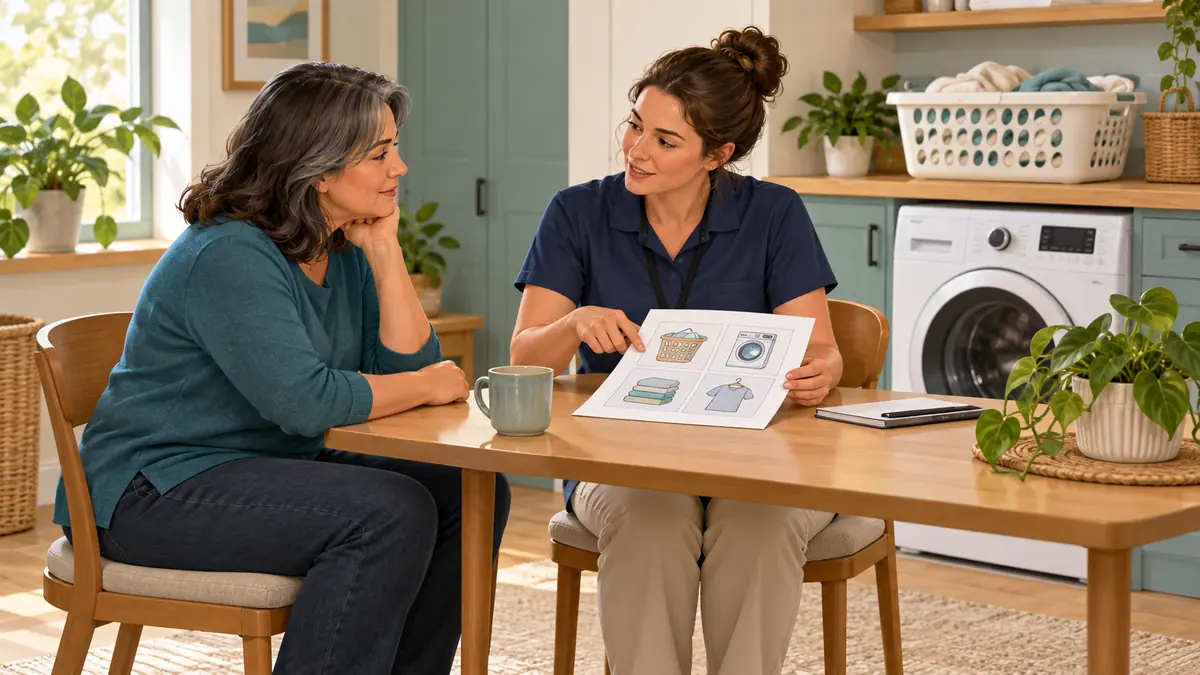
Editorial and source check: October 28, 2026. Rebuilt around basket pickup, machine access and a task-change record. Both examples are fictional. The representative image is AI-generated editorial artwork, not a real patient, lifting demonstration or proof that a particular setup is suitable. This caregiver-written resource and original tool have no independent clinical review, clinical validation or patient usability study. Functional checks do not establish treatment benefit or task safety. Our background and editorial approach.