
This guide is written from a family-caregiver perspective. The site operator is not a medical professional. It organizes practical information and questions; it does not provide an individual diagnosis, treatment plan or activity clearance.
There is no single correct folding-table measurement
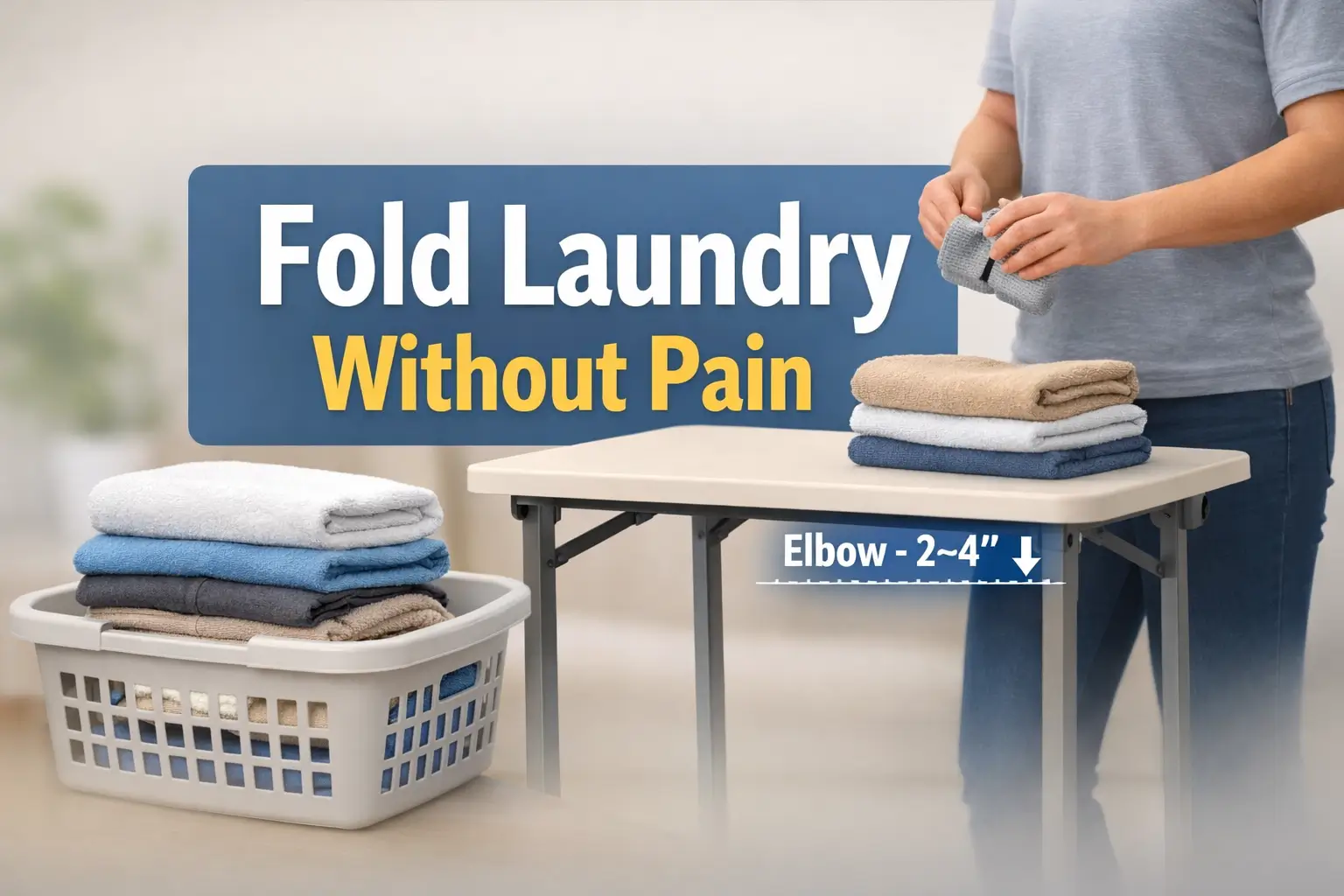
A surface must fit the person, chair or standing arrangement and the task. An elbow-minus-two-to-four-inches formula is not a medical prescription for sciatica, and turning the trunk does not by itself prove that a workstation is wrong. Comfort and access require individual consideration.
Build a manageable work area
Keep laundry and finished piles within usable reach, preserve a clear walking route and avoid balancing boards on unstable supports. A stable existing table may be more practical than an improvised height increase. Have another person handle loads that conflict with current restrictions.
Use feedback without diagnosing the mechanism
Notice which parts of the task are difficult and discuss persistent symptoms with the treating team. Do not repeatedly adjust and test until pain appears. If home tasks cannot be managed, ask about occupational therapy support rather than trying to solve every symptom with furniture geometry.
Find usable reach without a height formula
Preparation prompts only: these do not diagnose a condition, rank urgency or clear an activity.
- What to record
- Available surfaces, chair access, reach to laundry, piles and any relevant restrictions.
- What to ask
- Can this station be adjusted without creating unstable surfaces or obstructing movement?
- Next action and owner
- Keep supplies reachable and arrange help with difficult handling; elbow-minus-inches is not a prescription for leg pain. Write down who will act and when to follow up.
Keep personal records private. The visit preparation organizer can help arrange questions; do not post identifying health information in comments.
Further information
Editorial rewrite: October 21, 2026. Replaced the previous body, removed unsupported experience or outcome claims, and separated practical planning from individual clinical decisions. This is an editorial update, not a medical-professional review.