

A spine surgeon gap exception is a plan-specific exception that may apply in-network benefit treatment to specified out-of-network care. A request asks for a decision; it is not the decision itself. Even a written exception does not, by itself, establish every provider’s payment terms, final patient responsibility or the scope of applicable billing protections.
Start with the document-role comparison, use the six essential checks, or build a record and consultation question cards. Two explicitly fictional examples show how to record a limited decision and a later site/date change. Unknown information stays unknown; this guide offers no approval formula or financial safety score.
This is general U.S. insurance education from a family-caregiver-run site. The operator is not an insurance, legal, financial or medical professional. It focuses on preservice commercial/job-based plan questions, rather than Medicare, Medicaid, workers’ compensation or every plan type. Your treating team determines appropriate care and clinical urgency. Do not postpone emergency or needed care to finish a financial worksheet.
Table of Contents
Gap exception, authorization and payment agreement: compare the documents
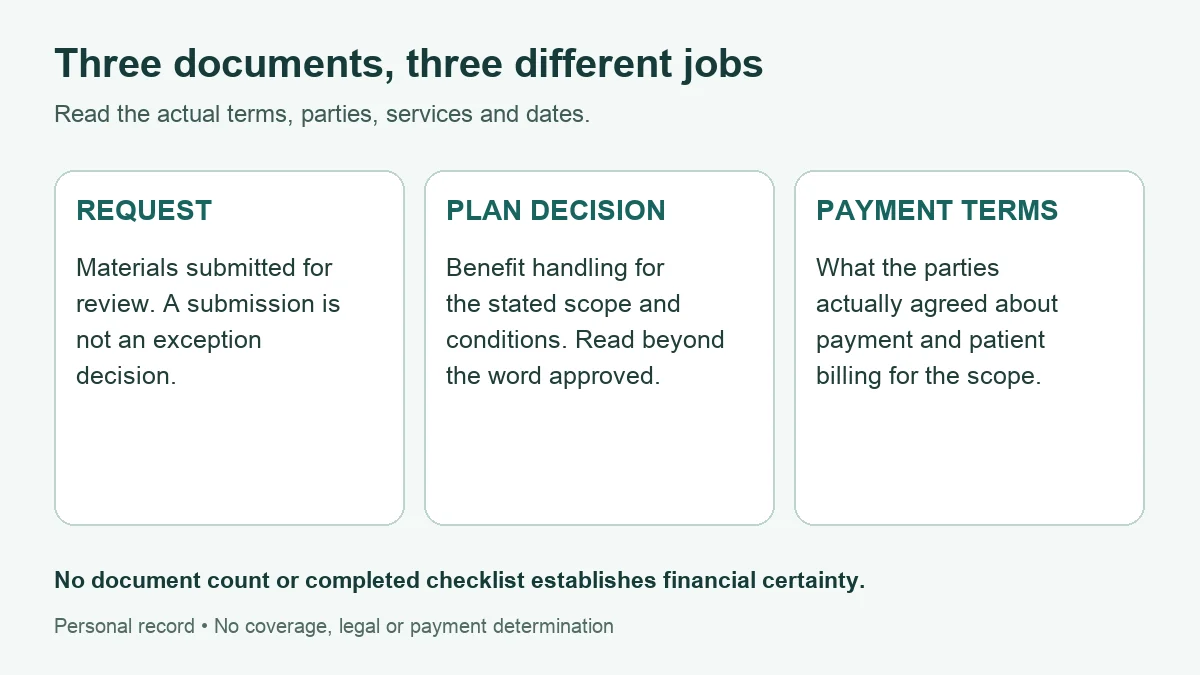
Use the document’s actual title, author, date, conditions and status. “Approved” in a phone conversation can refer to different work. Ask which decision was made and request the corresponding written explanation. These records do not follow one universal sequence; your plan may require related steps in a particular order.
| Record | What to identify | What it does not establish by itself |
|---|---|---|
| Exception request / submitted materials | What was requested, who submitted it and what submission is actually recorded. | A decision, payment contract or approval of the requested scope. |
| Prior authorization | Named service, clinical-review decision, conditions and applicable dates. | A promise that the plan will cover the cost or that every biller is in network. |
| Network gap exception decision | Benefit treatment, named clinician/location, service and period actually addressed. | An agreement by every provider to accept payment in full or inclusion of every related service. |
| Provider payment / single-case agreement | Actual parties, agreed terms, scope and patient-billing provisions, if such an agreement is used. | An agreement merely because it was requested, or automatic coverage of other providers and dates. |
| Applicable billing protection | Relevant setting, service, plan and notice/consent circumstances. | A rule determined by how many documents are present or fields are filled. |
HealthCare.gov’s general preauthorization definition explains that authorization is not a promise of coverage. It is not a spine-specific exception policy. Ask the plan and provider what their own terms mean rather than relying on a document label alone.
Who can answer each gap exception question?
| Contact | Question to take to that contact | Keep the boundary clear |
|---|---|---|
| Plan / designated administrator | Which process, benefit, network, decision scope and actual deadlines apply? | A company on the insurance card may administer a plan; identify the governing plan documents. |
| Treating clinician / referring team | What care is clinically needed, what access concern requires clinical explanation, and how urgent is it? | Do not invent specialty requirements, deterioration or medical-necessity language to support a request. |
| Surgeon / facility billing or contracting | Who bills, what estimate includes, what payment terms actually exist and how deposits are credited. | An office’s scheduling update is not an insurer decision. |
| Appropriate consumer assistance | Which review or billing-protection route fits the actual issue and plan? | A prepared question card is not a complaint, appeal or legal determination. |
Use official contact details from your plan, current notice or provider’s verified channel. Keep identifying policy, health and account details in private records. If an office cannot answer, ask which office owns the question and record that referral. Silence is not confirmation.
Six essential gap exception checks before relying on a document
Identify the current stage and request owner
Record whether you are preparing a request, have submitted it, have an additional-information request or have received a decision. Obtain the current plan instructions and the responsible office. Do not use a checklist of open questions as an eligibility test. There is no universal number of calls, distance or waiting period in this guide that guarantees an exception.
Record access facts and separate clinical judgment
Keep the plan’s suggested provider list and its date. For contacts actually made, note a private provider label, date, whether new patients are accepted, the appointment information given and the exact response. Distinguish no answer from unavailable care. Ask the treating team about clinical suitability; a directory entry, travel concern or preferred surgeon does not alone decide eligibility.
Match the exact clinician, facility and services
Compare the planned care with the actual decision’s wording. Ask the office for the service description and relevant codes if available; do not select or invent codes yourself. Record surgeon, facility, separate services and follow-up as separate questions. A decision naming one participant does not automatically establish the status of the rest. Missing names do not themselves establish denial or absence of legal protection.
Separate benefit handling from provider payment terms
Ask the plan which cost-sharing rules and conditions apply. Separately ask the relevant provider what payment terms are agreed and whether any additional patient billing is permitted for that scope. A single-case agreement may address negotiated terms; its name alone does not prove the contents. If a contract or applicable law prohibits a charge, ask for an explanation or correction rather than assuming the charge is owed.
Keep validity, filing deadlines and changes distinct
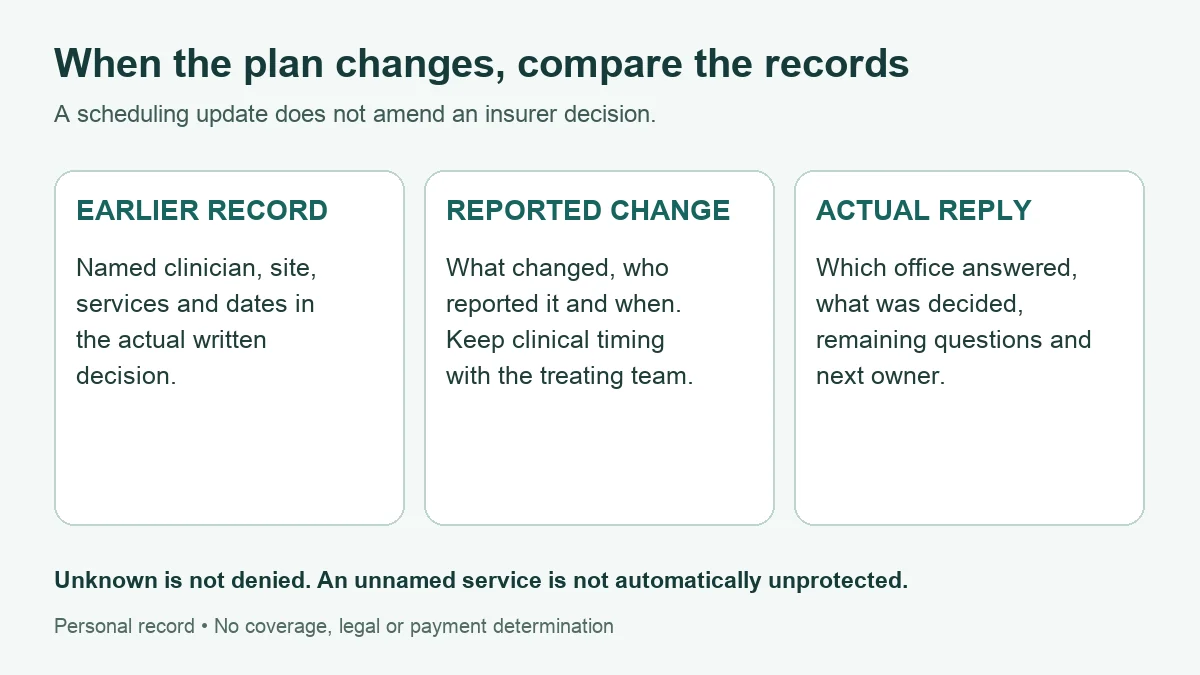
Record the actual service/validity dates from the document. In a different field, record any stated appeal-filing or response deadline and its source. A call-back date is not a filing deadline. If the date, site, provider or service changes, compare old and new details and ask which documents need correction or extension. The tool calculates no deadlines and treats a scheduling change as a change to review, not an amended approval.
Record actual answers and the next responsible office
Keep the question asked, whether it was actually sent, the reply received, its role/source/date and what remains unresolved. Do not copy a prepared request into the answer field. If the reply conflicts with another document, identify the conflict precisely. Ask the treating team about clinical timing separately; financial uncertainty is not clinical clearance or a recommendation to delay care.
A concrete insurer example illustrates why plan instructions matter: the UnitedHealthcare commercial Network Gap Exception Request Form calls for a prior-authorization case reference, referring professional information and relevant clinical documentation; it also asks for expected services and dates. This is one insurer’s published form, not a universal rule or proof that your current plan uses it. Confirm the applicable version and process with your plan.
Check the care setting before interpreting billing protection
CMS’s insured-patient billing-rights guide describes protections for covered nonemergency care connected with an in-network hospital, hospital outpatient department or ambulatory surgical center. The same federal nonemergency protections do not automatically extend to an ordinary doctor’s office or an out-of-network facility. Plan type and circumstances matter.
For qualifying care, protected ancillary categories such as anesthesia, pathology, radiology and assistant-surgeon services cannot use the notice-and-consent exception. Certain other out-of-network care, including a chosen treating surgeon in qualifying circumstances, may involve a valid notice-and-consent process. A general financial-responsibility signature is not automatically that process. Ask about the specific form and applicable rules; the tool does not decide validity or advise a signature.
Do not infer that every unnamed provider needs a separate gap exception, or that an unnamed service is unprotected. A legitimate in-network deductible or coinsurance may still apply to protected care. Ask how the decision, payment terms and protections fit together for the actual service. The absence of a privately negotiated agreement does not erase a legal protection.
Two fictional examples: limited scope and a changed plan
These are invented writing examples, not patient stories, typical outcomes or promises of approval, processing speed or savings. Replace labels with your own non-identifying notes only when supported by actual records. The tool’s example buttons replace the current entries.
Example A: the decision addresses the surgeon, but questions remain
| Record category | Fictional entry | Useful next question |
|---|---|---|
| Document / stage | Letter A is a received plan exception decision, not merely a submitted request. | Which conditions and scope does the complete letter state? |
| Benefit wording | The letter records in-network benefit treatment for Surgeon A and a described service. | Does this language address only benefit handling? |
| Payment / other services | No payment-terms reply is recorded; facility and other services are not described in the excerpt. | Which actual payment terms and protections apply? Which office can clarify each service? |
| Actual follow-up | Questions are prepared. No additional answer has been received. | Who owns each question, and what follow-up arrangement is actually agreed? |
A useful question card reads: “Letter A names Surgeon A and the described service. I have not recorded a provider payment agreement or an answer about the other services. Please clarify the applicable terms and protections for this scope.” It does not say those services were denied, that a balance bill is lawful or that care must be postponed.
Example B: scheduling reports a different site and date
| Record category | Fictional entry | Useful next question |
|---|---|---|
| Earlier decision | Letter B names Surgeon B, Site A and the earlier service date. | What are its actual validity and location conditions? |
| Reported change | Scheduling reports Site B and a later date. | Which authorization, exception or payment terms need updating? |
| Actual reply | Scheduling confirmed the change; the plan has not answered about the new scope. | Does the earlier decision apply, or is a corrected decision needed? |
| Clinical timing | The treating team must address the care timeline separately. | If timing is clinically urgent, which plan process should the team use? |
The record should preserve both versions and the real answer when it arrives. Do not overwrite the earlier scope and make it appear that the insurer already accepted the change. This example invents no deadline, extension, clinical urgency or favorable decision.
Free gap exception record and consultation question tool
Use the form to separate stage, source documents, scope, benefit wording, payment terms, protection questions and actual replies. Blank fields produce suggested questions for the appropriate office, not a completeness score or a finding that a legal requirement is missing. Filling every field does not validate any information. You can use only the sections relevant to your situation.
Try fictional examples online; download the offline copy before entering real health or insurance notes. This live site may use site services. The downloaded HTML tool contains no ads, analytics, external assets, browser storage or automatic network requests. It needs no account or email. Entries are not saved automatically; exported files contain your entries and should be kept private. Avoid names, member IDs, account numbers and pasted complete documents.
Build the record, copy it, download text or print/save PDF. Editing any input hides the old output until it is rebuilt. Review what is appropriate to share through official channels; the tool sends nothing and does not submit a request, appeal or complaint. If it does not load, use the same headings on paper.
Gap exception record and consultation question cards
Keep request stage, written decision, provider payment terms and actual replies separate. Generate questions from unrecorded fields; no approval, coverage or bill is decided.
For actual health or insurance notes, download the offline tool first. Try the fictional example here. The offline copy contains no site ads, analytics or external assets and needs no account.
Offline copy. This file contains no ads, analytics, external assets or automatic network requests.
The tool uses no network requests or browser storage. Unsaved changes can be lost on refresh or close. Exported files contain your entries; keep them private. Avoid names, identifiers and pasted medical records.
Start with the fictional example or download a blank offline copy.
If the tool does not load, use paper: document type and stage; actual scope and terms; changes; actual reply; unresolved question and next owner. Unknown stays unknown.
My gap exception record and question cards
Unverified personal record for discussion. This record is not an insurer decision, provider agreement, legal opinion or instruction to sign, pay or postpone care. A filled field is not proof; an empty field is not a denial or loss of protection.
Guide: living.kioptrix.com/out-of-network-spine-surgeon-gap-exception/
Choose the next route from the actual problem
| What actually happened | What to clarify | Possible contact |
|---|---|---|
| No request yet / more information requested | Current process, specific missing materials and who submits them. | Plan request owner and referring/treating office. |
| Formal denial received | Actual reasons, review instructions, applicable filing deadline and needed documentation. | Plan appeal contact; appropriate assistance if unclear. |
| Benefit decision received; payment terms unresolved | Whether an agreement is being negotiated and what it actually covers. | Plan and provider contracting/billing; this is not automatically a clinical appeal. |
| Care plan changed | Compare the changed scope with each relevant document. | Scheduling, treating team and plan/request owner. |
| A bill has arrived | Match the bill, processed claim explanation, relevant terms and protection question. | Biller, plan and applicable billing assistance; do not treat the worksheet as a debt decision. |
HealthCare.gov explains internal appeals and external review in general. Do not assume every contracting or network dispute qualifies for the same external-review route. Use the actual decision notice and governing plan instructions. A request for clarification does not necessarily preserve a formal appeal deadline.
For job-based coverage, the Department of Labor’s health-benefit claim guide explains the importance of plan documents and claims/review procedures. Ask the administrator which rules govern your plan, including whether the arrangement is insured or self-funded. The company handling calls may be an administrator; the card’s brand alone does not identify the regulator. HR/benefits can help locate documents and contacts without receiving your entire medical record.
If timing is clinically urgent, ask the treating team and plan about the appropriate expedited process and supporting information. A nearby scheduling date alone does not establish clinical urgency. For unresolved questions, HealthCare.gov lists consumer assistance and job-based-plan help. The appropriate route depends on the plan and issue; this tool neither chooses a regulator nor calculates a filing deadline.
For a deposit request, ask what the amount covers, how it is credited and the actual cancellation/refund terms. Its size does not prove approval, danger or debt. Obtain clarification from the relevant office and discuss care timing with the treating team rather than using this record to decide whether to pay or delay care.
Gap exception questions readers commonly ask
Does a gap exception guarantee no balance bill?
No such guarantee follows from the label alone. Read the benefit decision, actual payment terms and applicable protections together. A benefit-level exception and a provider’s agreement about payment are separate questions. A disputed or prohibited charge is not automatically owed.
Is a single-case agreement the same document?
It may be related, but ask what the actual agreement does, who agreed and which services and dates it covers. Do not mark it received just because an office requested or is negotiating it.
Do all supporting providers need separate exceptions?
Do not assume that. Network arrangements, covered service scope and applicable protections differ. Ask about each relevant component without concluding that a missing name means denial or no protection.
Can this tool write a medical-necessity letter or appeal?
It prepares personal records and questions. The treating professional supplies clinically supported information; the plan’s actual process determines what is required. The output is not a medical statement, completed appeal or evidence that a filing occurred.
What if every field is filled?
That only means entries are present. The tool cannot verify a document, agreement, reply or right. Keep uncertain entries marked and resolve conflicting answers with the appropriate office.
What if I already have an unexpected bill?
Preserve the relevant decision and agreement, then match the bill and processed claim records. The separate unexpected-bill guide below discusses billing questions; use current official help for your specific rights and review route.
This page focuses on preservice exception scope and payment-term records. The related Unexpected Spine Procedure Bills guide addresses separate billers and billing-protection questions. For later rehabilitation estimates, the PT copay and coinsurance tool separates conditional estimates from actual claim responsibility and credited payments. Neither page determines your plan’s decision.
Sources, correction record and review limits
- HealthCare.gov: Preauthorization — general definition and limit of authorization; not a spine-specific policy.
- UnitedHealthcare: Commercial Network Gap Exception Request Form — one insurer’s published form, including clinical documentation and scope fields. Confirm current plan applicability.
- CMS: Know your medical bill rights when using insurance — care settings, notice/consent and protected categories; not an individual determination.
- HealthCare.gov: Appealing a health plan decision and Department of Labor: Filing a Claim for Your Health Benefits — general review routes and plan-document context.
- HealthCare.gov: Consumer help with insurance — assistance routes, including job-based plans.
Editorial correction and source check: October 28, 2026. Replaced the retained body and removed the unsupported coverage-tier ladder, approval-persuasion framing, unverified personal experience and unlabeled success story. Replaced generic sources mislabeled as spine-specific guidance, repeated images and the embedded video with primary sources, a new representative illustration and two explanatory diagrams. The new examples are fictional; the record tool generates questions rather than an approval or risk score.
The representative image is AI-generated fictional artwork; diagrams are editorial explanations, not actual insurer documents. This guide has not received independent insurance, billing, legal or clinical review, real-patient validation or a user study. Functional checks cannot establish eligibility, accuracy of an individual claim, savings or legal protection. Our background and editorial approach.