
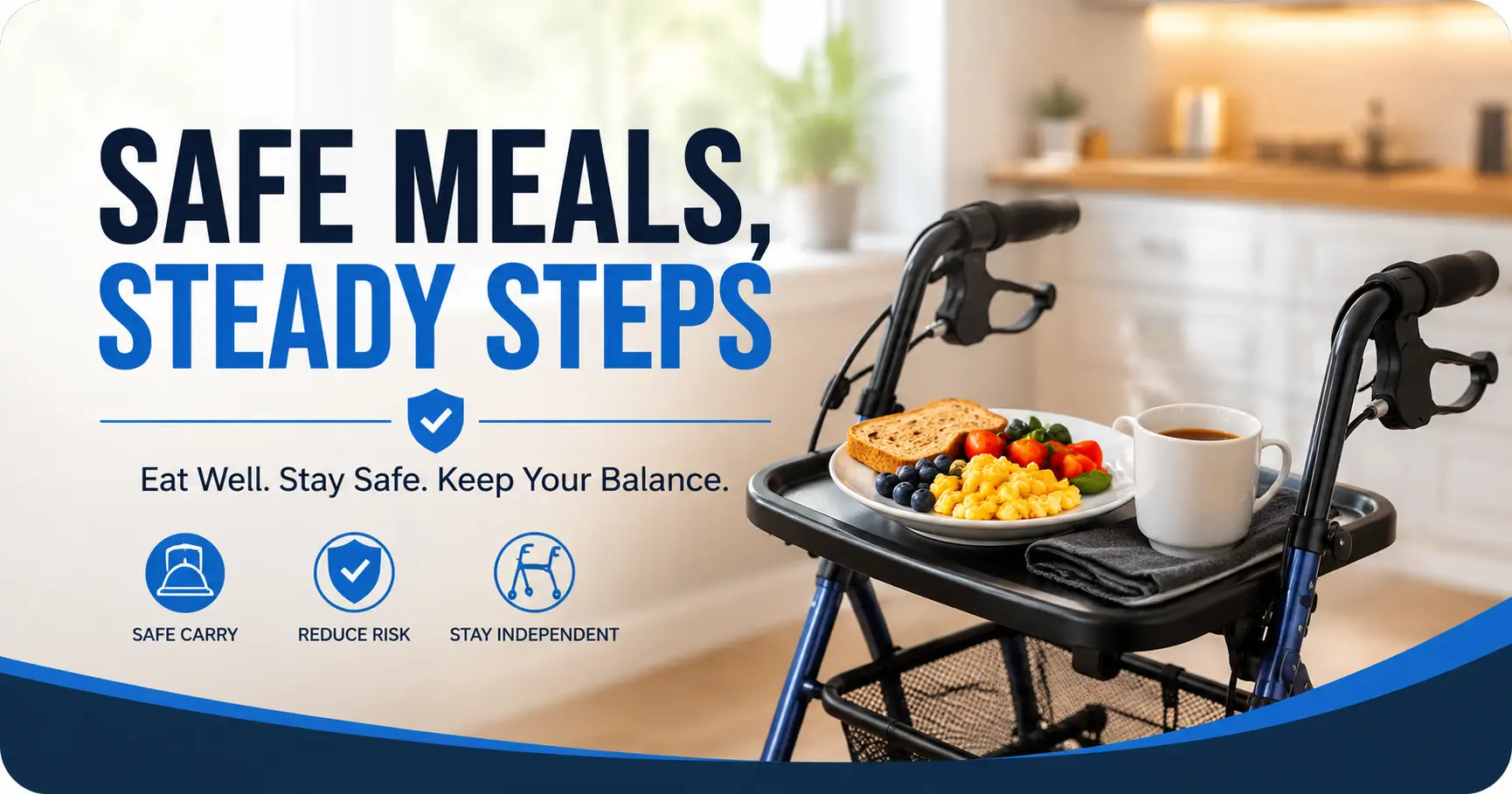
Quick answer: If you need a walker for support, keep your hands available for the technique you have been taught. A meal brought to an accessible table may be more suitable than carrying it yourself. A tray or caddy is an option only when it fits the exact walker and your therapist has assessed the task; it is not an automatic solution.
Start with the help you need
Consider the whole meal: preparing it, moving it, approaching the table, sitting down and clearing up. Being able to walk across a room does not establish that carrying a loaded tray is appropriate. Tell your occupational therapist (OT) or physical therapist (PT) about fatigue, dizziness, recent falls, limited vision, hand pain and any movement or weight-bearing restrictions.
After surgery, use the walking aid and assistance prescribed by your team. Do not switch to a smaller device, take one hand off for a plate, or replace the walker with a kitchen trolley to make the task fit. If you are non-weight bearing, ask for a specific meal arrangement before trying to carry anything.
MedlinePlus knee-replacement discharge guidance explains why hands may be needed for balance and why help with cooking and other daily tasks can be necessary. Your own discharge instructions take priority.
Compare meal-transport options
| Option | What it can solve | What still needs checking |
|---|---|---|
| A helper brings the meal | Removes the need to walk with the food. | Who is available at each meal, including drinks and clearing up? |
| An accessible eating surface near preparation | May reduce the distance food needs to travel. | Can you approach, sit and leave using the method and assistance taught? |
| Manufacturer-compatible tray or caddy | May carry a light meal for an assessed user. | Exact model, attachment, load limit, walking technique, turning and table access. |
| Basket or pouch | May hold suitable small, closed items. | Whether the load affects control or obstructs the device; an open plate is not a good fit for a pouch. |
Kingston and Richmond NHS guidance describes the Buckingham caddy for people assessed as needing that equipment. It excludes use on steps, through narrow doors and in cluttered settings. Its stated load limit belongs to that product, not every walker accessory. The Trust’s kitchen trolley guidance also says a trolley must not replace a walking aid.
Check the device before buying an accessory
- Record the walker make, model and type: pickup frame, wheeled walker or rollator.
- Ask which accessories the manufacturer permits and what the accessory’s load limit includes.
- Check whether attachment changes access to handles, brakes, folding parts or your position inside the frame.
- Ask the therapist how the loaded task affects the technique you use. A pickup frame has to be lifted; a rollator has different control and braking requirements.
- Keep the instructions, supplier contact and return terms. A product described as universal still needs a compatibility check.
Do not balance food on an improvised board or an unapproved rollator seat. Do not use a lid as proof that hot-liquid transport is safe: containers can leak, and steam or spills can burn. Ask a helper to move very hot food or drink while the arrangement is being resolved.
Make one practical meal plan
A caregiver can inspect the empty route and describe corners, thresholds, doors, floor clutter and the eating surface without asking the patient to demonstrate an uncertain movement. Do not run an independent empty-plate walking test. Any practice should be chosen and taught by the therapist with the required assistance; an empty rehearsal cannot clear a loaded task.
- Name the meal and destination. For example: breakfast from the kitchen counter to the dining table.
- Name the unresolved step. Carrying, opening a door, turning, sitting or managing a drink may need different help.
- Agree the arrangement. Record who brings the meal, which assessed equipment is used and what happens when the usual helper is unavailable.
- Confirm before changing it. Recheck after a change in symptoms, restrictions, walking aid, accessory or layout. Extra trips are not automatically better when fatigue or turning is difficult.
Use the Home Safety Checklist to organize household questions, or the apartment preparation guide to plan essential spaces. Neither is a safety assessment.
Common questions
Can I carry a plate in one hand?
If the walker is needed for support, do not remove a hand to carry the meal. Arrange another method with your therapist or helper.
Does a secure tray make carrying safe?
No. Compatibility is only one part of the decision. Your support needs, the load, the route and the complete task still matter.
What if I live alone?
Discuss meals before discharge or before changing the routine. Ask who can provide the assistance you actually need and what alternative is available if those needs cannot be met at home.
What if I become dizzy or the walker tips?
Stop the carrying task, obtain help and report the change to your care team. Do not add another accessory to compensate for an unstable device or new symptoms.
Updated October 26, 2026: integrated the equipment and assessment limits throughout the article and removed independent route-test instructions. Written from a family-caregiver perspective; general education, not individual medical advice or an independent medical review. Background and editorial approach.