
This site is written from a family-caregiver perspective. The operator is not a medical professional. This article provides general education and preparation prompts rather than an individual assessment.
Describe the change from before surgery
Use these prompts to prepare questions and arrangements. They do not diagnose a condition, determine coverage or clear an activity.
- What to record
- Actual operation and date, symptoms before and after, medicines, prior review and current daily difficulties.
- What to ask
- What causes need reassessment, and who coordinates the next plan?
- Next action and owner
- Contact the surgical or treating team about changes; do not treat persistent pain as proof that a person or operation has failed. Write down who will act and when to follow up.
Keep personal records private. You can use the visit preparation organizer to arrange questions; do not post identifying health information in comments.

Persistent pain after back surgery needs reassessment
Failed back surgery syndrome (FBSS) is a broad label for persistent or new pain after spine surgery. It does not identify a single cause or establish that a surgeon made an error. New symptoms need assessment; the label should not be used to dismiss them.
The next step is an assessment of what has changed, what the original operation was intended to address and whether there is a problem requiring prompt treatment.
Seek emergency assessment now for new difficulty passing urine, loss of bladder or bowel control, numbness around the genitals or anus, or new severe or rapidly worsening leg weakness. Fever, wound changes or severe persistent pain needs prompt clinical advice. Do not wait to finish a diary or obtain insurance approval. NHS back pain guidance explains emergency warning symptoms.
Use this guide to prepare for a clinical review. The treatment options are topics for discussion, not a sequence that every patient should follow.
Editorial note: This is general education, not a personal surgical history or a verified patient testimonial. A named clinician has not independently reviewed this article. U.S. insurance questions are separate from clinical suitability.
Describe symptoms clearly without trying to diagnose their cause yourself.
Table of Contents
Micro-CTA: Use the note tool only for preparation. It cannot select an intervention.
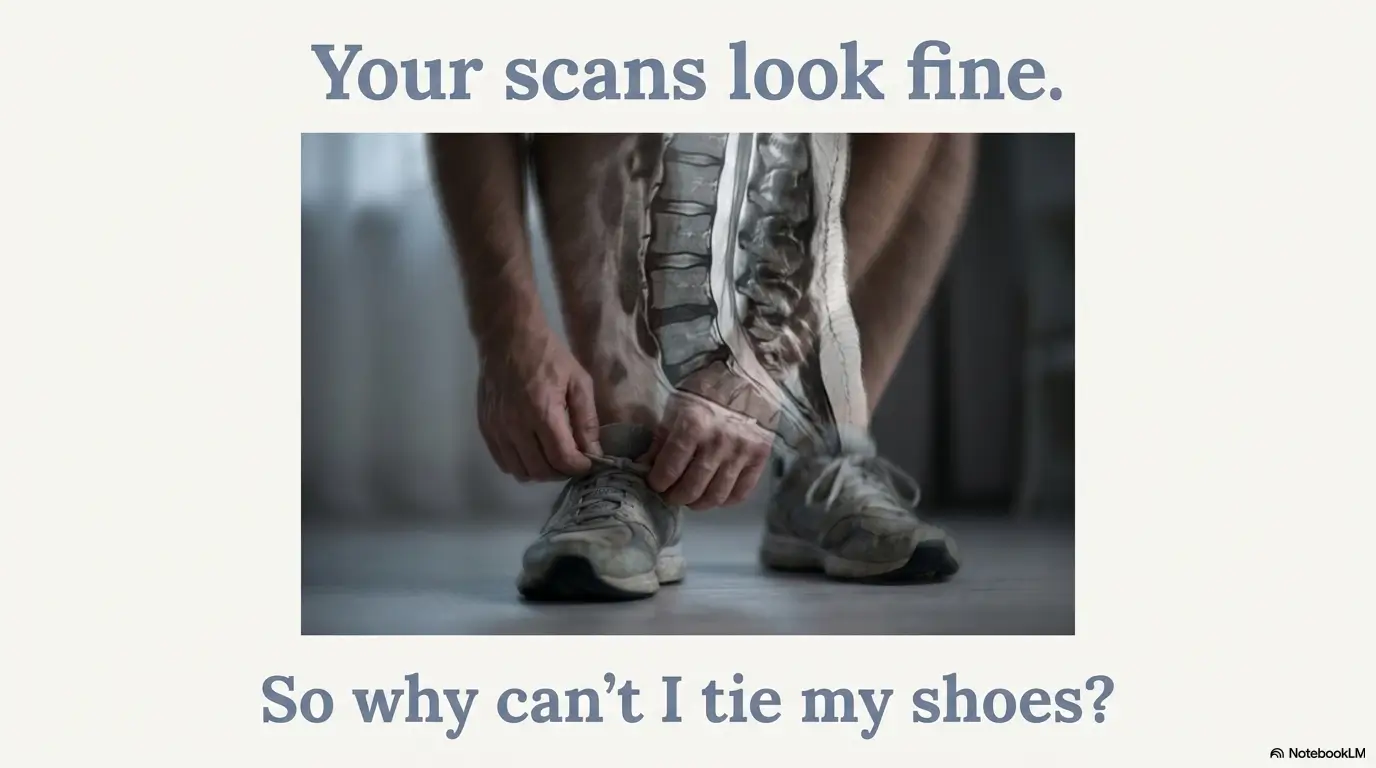
What failed back surgery syndrome really means (without the guilt)
Persistent pain deserves assessment and support. “Failed” describes an unsatisfactory outcome, not a failure of effort or character by the patient.
Ask what is known about the cause, what remains uncertain and what additional assessment could change the plan.
- Time-to-apply today: 10–15 minutes to outline your symptom pattern and triggers.
- Operator mindset: Treat this as a troubleshooting project with multiple hypotheses, not a moral trial.
- Small win: Bring a one-page summary to your next consult.
- New pain can be a new mechanism
- Old pain can be a new sensitivity pattern
- Good decisions start with accurate buckets
Apply in 60 seconds: Write your top 3 triggers and top 3 relief factors before your next appointment.
1. The label does not identify the cause
An operation may have several goals, such as relieving nerve compression, stabilizing a segment or protecting function. Review the documented goals with the treating team before interpreting persistent symptoms.
Ask whether your current symptoms are the same as before surgery, returned after a period of improvement or began afterwards. Each history raises different questions; none establishes the cause by itself.
Ask the clinician to use the most specific explanation supported by the findings. A broad label is not a substitute for a diagnosis or a reason to automatically repeat treatment.
- Ask for the assessment and follow-up plan in writing.
- Number that matters: Track your walking tolerance in minutes, not just pain scores.
2. Describe what changed after surgery
Describe back pain, leg pain, burning, tingling, numbness and weakness separately. New weakness or bladder and bowel changes should not wait for routine symptom tracking.
A treatment proposed for one pain problem may not address another. Ask what diagnosis supports the proposed treatment and what result would make it worthwhile.
A useful note records what you feel, when it began, what changes it and what you can no longer do. A diary supports the examination; it is not a diagnostic test.
- 2-minute tracking trick: Rate leg pain and back pain separately every evening for a week.
- Micro-contrast: If heat helps but bending worsens, that’s a different clue than if walking triggers electric shocks.
Show me the nerdy details
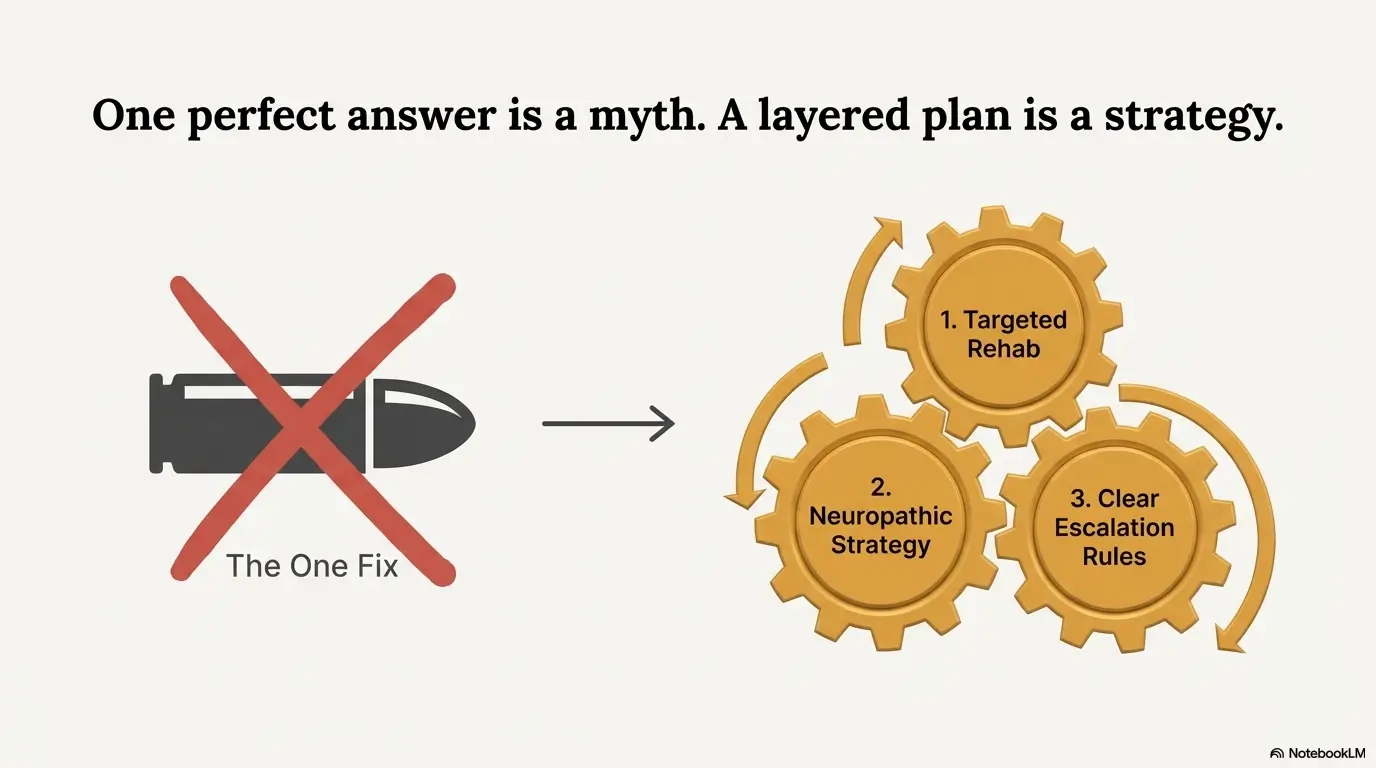
Persistent postsurgical pain can involve a blend of structural factors (residual or recurrent compression, instability, adjacent segment changes) and neurophysiologic factors (central sensitization, altered pain processing). Many specialists now treat FBSS as a multi-driver condition requiring layered diagnostics and staged treatment rather than a single “fix.”
3. Interpret imaging with the clinical assessment
If the scan does not explain your symptoms, ask what further clinical assessment is needed. A report that sounds reassuring does not mean the symptoms are unimportant.
Imaging must be interpreted with the history and examination. Ask which finding is relevant and what evidence supports treating it. Do not assume either that every abnormality causes pain or that an unexplained symptom is harmless.
Ask: “Which findings explain the current symptoms, and what could remain unexplained even after another procedure?”
- Number to anchor: Note your “pain onset time” during walking (e.g., 6–10 minutes).
- Ask for the assessment and follow-up plan in writing.
4. Ask for a coordinated care plan
Before another intervention, ask for the reason, expected benefit, alternatives, risks and a review plan. There is no guaranteed next procedure that resolves every persistent pain problem.
A coordinated plan may involve the surgical team, pain specialist, physiotherapist and other clinicians as appropriate. Ask who coordinates care so advice and prescriptions do not conflict.
Agree on practical goals and a review point. Report new symptoms without waiting for the planned review.
- Time-saver: A written plan with review dates and escalation criteria can reduce repeated decision-making during a flare.
- Ask for the assessment and follow-up plan in writing.
5. Clarify U.S. costs and coverage
If you’re reading this, you’re likely balancing pain with life logistics: work, family, energy, and the financial drag of repeat appointments. In the US, costs vary widely by region, facility type, and insurance design. The most stressful surprises often come from currency you can’t see in advance: prior authorization delays, out-of-network imaging, or device-related co-insurance.
Request a written estimate separating professional, facility, imaging and device charges where applicable. Confirm whether follow-up, programming, rehabilitation or possible removal would be billed separately.
Before a major next step, request clinical and cost explanations you understand. Confirm applicable benefits, network status and authorization. Cost checks must not delay emergency assessment.
- Numbers that keep you sane: Your deductible and out-of-pocket max are decision-grade data.
- Micro-CTA: Ask your insurer for a benefits summary tied to the exact procedure code your clinician plans to use.
6. Ask for support with coping and care
Tell the team if pain, poor sleep, worry or difficulty concentrating makes it hard to manage care. These concerns deserve support; they do not establish that pain is imaginary.
A short appointment summary, written instructions and help from a trusted person may make the process easier. Ask what support is available.
Ask for clarification when a plan feels difficult to understand or follow. Do not interpret difficulty coping as a reason to dismiss a new physical symptom.
- Ask for the assessment and follow-up plan in writing.
- Practical number: Limit your pre-consult research window to 20–30 minutes.
7. Agree on a flare and urgent-care plan
Ask how to manage a flare and how to recognize a change that requires assessment. A flare plan should not assume that every worse day is part of the usual pattern.
Request clear instructions about permitted activity, prescribed medicines, who to contact and when to seek urgent help. Do not change doses or exceed postoperative restrictions on the basis of this article.
Record what changed and what you tried as instructed. Seek urgent help first when warning symptoms occur, then provide records if available.
- Emergency rule: New urinary retention or loss of bladder/bowel control, saddle numbness, or new severe or rapidly worsening leg weakness needs an emergency department now. Do not wait 24 hours. Fever, wound changes or severe persistent pain needs prompt clinical advice.
- Ask for the assessment and follow-up plan in writing.
- Build a two-speed weekly protocol
- Track triggers and relief reliably
- Escalate based on pre-set rules
Prepare: Save your team’s contact details and the written instructions for routine questions, urgent calls and emergencies.
Five areas to discuss after reassessment
The five areas below are not five guaranteed remedies or a ladder to climb. Some may be inappropriate, overlap or require a different priority after assessment.
Option 1: Targeted re-evaluation and diagnosis refinement
Ask whether the surgical history, neurological examination and existing imaging adequately explain the current symptoms. Further tests should answer a specific question that could change management; the number and timing of appointments vary.
- Assessment timing: Ask what needs evaluation and when.
- Why it matters: A sharper diagnosis makes every next step more cost-effective.
Option 2: An individualized non-surgical care plan
Ask about an individualized rehabilitation and medicine review, including expected benefits, adverse effects and activity restrictions. A programme should fit the operation, current symptoms and personal goals rather than a generic exercise schedule.
- Functional metric: Walking distance or sitting tolerance in minutes.
- Ask for the assessment and follow-up plan in writing.
Option 3: Interventional pain procedures (selective, not impulsive)
If an injection or another pain procedure is proposed, ask about its exact purpose, evidence, risks and alternatives. Agree when benefit and adverse effects will be reviewed; a response cannot by itself prove a pain source.
- Decision clarity: Ask what result would change the next step.
- Review timing: Agree when to assess the particular procedure and medication.
Option 4: Neuromodulation (like spinal cord stimulation)
Spinal cord stimulation uses an implanted system to deliver electrical stimulation. It requires specialist assessment and ongoing care. The NICE TA159 recommendations concern selected chronic neuropathic pain despite appropriate care, with multidisciplinary assessment and a successful trial. They are not a self-eligibility checklist or a U.S. insurance policy. In a 2022 placebo-controlled crossover trial of 50 people with chronic radicular pain after lumbar surgery, burst stimulation did not significantly improve disability compared with placebo. A 2023 follow-up of the same trial also found no significant disability advantage over the earlier placebo period; loss to follow-up and the non-randomized follow-up comparison limit interpretation. These findings do not evaluate every device, stimulation mode or indication. Ask how current evidence applies to the exact proposal, alongside infection, lead problems, revision, removal and ongoing maintenance. A successful trial cannot guarantee lasting benefit.
- Operator note: Request a clear explanation of trial goals and success thresholds.
- Practical number: Agree on goals and review criteria with the specialist; there is no universal percentage that establishes success.
Option 5: Revision surgery (when the driver is clearly surgical)
Revision can be appropriate when there is a clear structural problem that correlates with your symptoms—such as recurrent compression, progressive instability, or hardware-related issues. The risk profile can differ from first-time surgery, so decision discipline matters even more. If you’re weighing procedures, this primer on lumbar fusion vs decompression helps clarify what each option is designed to accomplish.
- Pre-op discipline: Ask what specific symptom is expected to improve, and what might not.
- Ask for the assessment and follow-up plan in writing.
Preparation questions before another intervention
This preparation checklist cannot establish eligibility for an intervention. Ask about every uncertainty; do not count answers to decide whether treatment is safe or appropriate.
- Yes/No: My current pain pattern is clearly documented (daily notes for 7–14 days).
- Yes/No: I can describe distinct back vs leg symptoms and their triggers.
- Yes/No: I know my insurance plan’s deductible and out-of-pocket max for the current plan year.
- Yes/No: I have confirmed whether my surgeon, facility, and imaging center are in-network.
- Yes/No: I can state one goal that is functional, not just numeric (e.g., “walk 20 minutes,” “sit through a meeting”).
Next step: Ask the clinical team to resolve any question about diagnosis, consent or safety. Missing insurance information must not delay emergency assessment.
Neutral close: Save this checklist and confirm coverage details on your insurer’s official portal.
Prepare a symptom discussion note
This tool only turns the choices into an appointment note. It does not classify the cause, prioritize treatment or assess urgency.
Neutral close: Use this result to frame questions and confirm the next diagnostic step with your clinician.
Questions about revision surgery and neuromodulation
Revision surgery and spinal cord stimulation address different questions. Ask why either is being considered and what reasonable alternatives remain; this is not a choice that symptom categories alone can settle.
- A specific structural problem clearly matches your symptoms.
- You have objective changes like progressive neurologic findings.
- The surgeon can name the exact symptom expected to improve.
- Higher procedural intensity.
- Potentially longer recovery curve.
- Requires tight insurance and facility checks.
- Persistent neuropathic pain with limited structural targets.
- What can a trial establish, and what remains uncertain afterwards?
- Goals focused on function restoration, not perfection.
- Ask about trial, implant, follow-up and removal requirements.
- Device and coverage details matter.
- Discuss pain, function, adverse effects and durability of benefit.
- Mechanism match beats hope-based escalation
- Define success in function
- Get written estimates and coverage clarity
Apply in 60 seconds: Ask your clinician to state the single main hypothesis and the single main expected outcome of the next step.
Hypothetical example: preparing for a consultation
Hypothetical consultation example—not a patient testimonial: A person brings the operative report, imaging dates and a short description of symptoms before and after surgery. They ask which findings explain the current problem and what remains uncertain.
The clinician explains the proposed assessment and follow-up. The person asks about alternatives, risks, costs and whom to contact if symptoms change. This example predicts no outcome.
A trustworthy place to cross-check your understanding
When you’re dealing with a high-stakes decision, it helps to anchor your thinking in a neutral, patient-focused resource and compare it with what your clinician is recommending.
A region note for readers outside the US
Funding, referrals and waiting arrangements differ by country and service. Ask your local clinical team and payer what applies. A detailed diary does not guarantee faster access and must not delay urgent assessment.
Quote-prep list for insurance and specialist comparisons
For U.S. insurance, confirm the proposed service and actual plan requirements rather than relying on generic prices or assumed coverage.
- Your current plan summary with deductible and out-of-pocket max.
- The exact facility name and location for the proposed procedure.
- The clinician’s suggested procedure name and any preliminary codes they can share.
- Whether pre-authorization is required and typical review time.
- Any prior imaging and operative notes you can securely provide.
Neutral close: Save this list and request a written estimate before you commit to a new invasive step.
Infographic: Your 15-minute next-visit brief
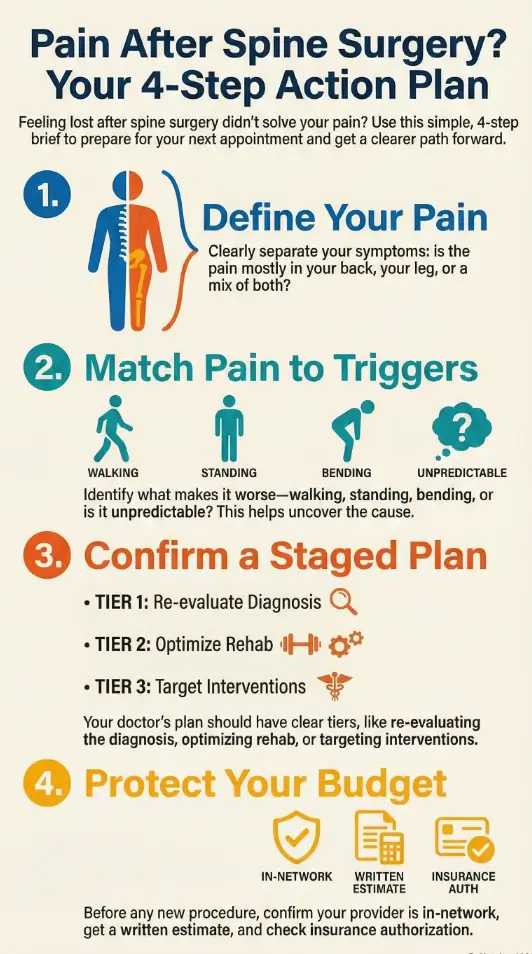
Use this appointment checklist to organize information, not to select a treatment tier.
- Back-dominant
- Leg-dominant
- Mixed
- Walking/standing
- Bending/lifting
- Unpredictable
- Re-evaluate
- Optimize rehab
- Target interventions
- In-network check
- Written estimate
- Prior authorization
Use: Bring these questions to your appointment and ask what should happen next and why.
The five options in one clean map
Ask about the purpose and limitations of each proposed component of care:
- Refine diagnosis → when the story doesn’t match the scan yet.
- Individualized non-surgical care → when function can still be rebuilt stepwise.
- Selective interventions → when a targeted test-and-treat plan is legitimate.
- Neuromodulation → when neuropathic pain dominates and a trial makes sense.
- Revision surgery → when a clear structural driver is named and mapped to symptoms (see fusion vs decompression comparison).
Two more trustworthy places to sanity-check the big picture
If you want a neutral baseline from large, well-established health organizations, these are solid starting points for general back pain and persistent postsurgical pain discussions. Use them to cross-check language and prepare better questions rather than to self-diagnose.
- Separate back vs leg symptoms
- Define a measurable function target
- Confirm coverage and facility status early
Apply in 60 seconds: Ask for a written plan that names the top hypothesis and the next two contingencies if it doesn’t hold.
FAQ
Is Failed Back Surgery Syndrome a real diagnosis or just a catch-all label?
It’s a real clinical label, but it’s broad. It describes persistent or new pain after spine surgery, not a single cause. The practical task is to refine the “why now” mechanisms for your specific case. Apply in 60 seconds: Write one sentence separating your back pain from leg pain and bring it to your next visit.
Does FBSS mean my surgeon made a mistake?
Not necessarily. Many surgeries correctly address one target but can’t prevent every future pain driver. The most useful question is what your surgery was expected to improve and whether that specific goal was met. Apply in 60 seconds: Ask your surgeon to restate the original surgical goal in one sentence.
When should I consider a second opinion?
A second opinion can help clarify the reasoning for a major procedure when timing allows. New or worsening neurological symptoms need prompt assessment rather than waiting for another routine appointment. Ask for relevant records and check how to share them securely.
Are injections worth trying again?
Ask why another injection is proposed, what the previous one achieved, what risks apply and what would happen if you decline. Neither repeat treatment nor diagnostic certainty is automatic.
How do I know if I’m a candidate for spinal cord stimulation?
Candidacy requires specialist and multidisciplinary assessment; a home checklist cannot establish eligibility. Ask about evidence for the exact device and diagnosis, alternatives, trial goals and long-term maintenance. A successful trial does not guarantee lasting benefit.
What if my MRI looks ‘fine’ but I still can’t function?
Ask what the history and examination show, whether further investigation is needed and how symptoms will be reviewed. A symptom log provides context; it is not stronger evidence than the clinical assessment or a reason to wait through new warning signs.
Next steps for your clinical review
Persistent pain after surgery needs a clear explanation of the next assessment and treatment choices, including uncertainty. No checklist or online tool can choose the right intervention for you.
Ask what the next step is expected to achieve, what may remain unchanged and when the plan will be reconsidered.
Prepare a short symptom summary and one practical goal, then ask for a coordinated plan. Use emergency care for warning symptoms rather than completing paperwork first.
Editorial corrections reviewed: October 16, 2026. Emergency and postoperative advice links to NHS decompression guidance. Device selection and evidence are discussed using NICE TA159, the 2022 burst-stimulation trial and its 2023 follow-up. These sources address different populations and questions; this is not a complete review of every treatment.
Targeted editorial update: October 21, 2026. Added a topic-specific record, question and follow-up guide and revised the title and search description. Existing useful material was retained; this update is not a complete medical, legal or insurance review. Confirm individual instructions, current prices and benefits with the relevant service.