
This site is written from a family-caregiver perspective. The operator is not a medical professional. This article provides general education and preparation prompts rather than an individual assessment.
Use the actual operation and instructions
Use these prompts to prepare questions and arrangements. They do not diagnose a condition, determine coverage or clear an activity.
- What to record
- Discharge advice, wound or neurological concerns, walking and home-support needs and scheduled review.
- What to ask
- Which recovery instructions apply to me and what change should be reported before the next appointment?
- Next action and owner
- Follow the individual plan rather than a step-count target; arrange review for new or worsening symptoms. Write down who will act and when to follow up.
Keep personal records private. You can use the visit preparation organizer to arrange questions; do not post identifying health information in comments.

After lumbar spinal stenosis surgery, walking and pain need to be reviewed against your individual operation and discharge instructions. There is no single step target or calendar that establishes whether recovery is normal.
This guide helps you describe symptoms, prepare follow-up questions and check rehabilitation arrangements. It does not predict recovery or authorize you to increase activity.
Editorial note: This is general information, not a personal recovery account. Examples are hypothetical. Decompression alone and surgery that includes fusion can have different restrictions; follow your surgical team’s written plan.
If a new symptom concerns you, contact the team rather than waiting to collect enough diary entries. Use the record below as a communication aid, not a self-assessment of safety.
Start with the discharge plan and the symptoms that need urgent attention.
Table of Contents
This placeholder helps keep the page stable while content and ads load.

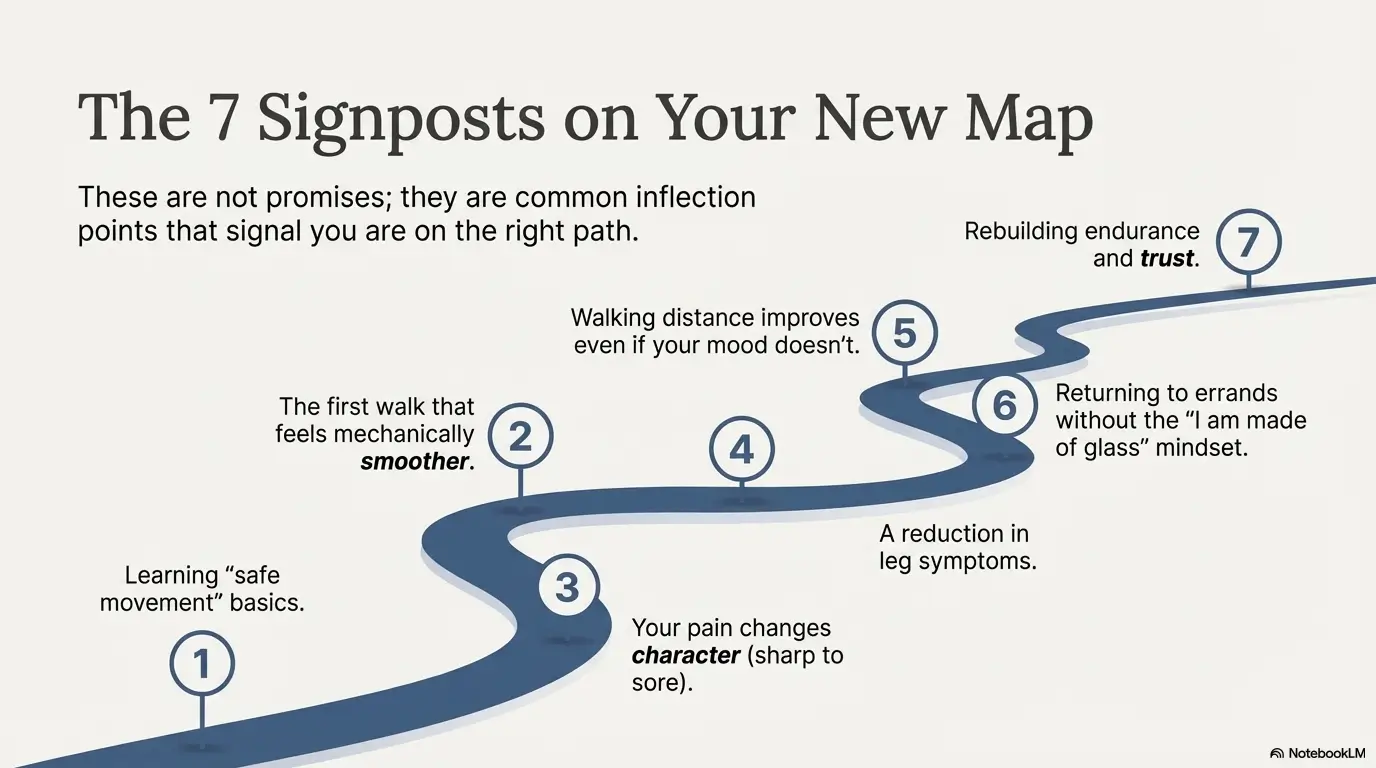
Seven recovery topics to discuss with your team
A calendar can help organize follow-up, but it cannot clear someone to walk further, drive or return to work. Ask which limits apply to your exact procedure.
The seven topics below are things to discuss and record, not milestones that every patient must achieve. Lack of improvement needs review, and a good step count does not override a new warning symptom.
- Topic 1: The movement and assistance instructions you were given.
- Topic 2: Walking distance or minutes within permitted limits.
- Topic 3: Pain location, character and changes.
- Topic 4: Any leg symptoms, weakness or numbness.
- Topic 5: What is improving and what remains difficult.
- Topic 6: Assistance needed for ordinary tasks.
- Topic 7: The next clinical review and unanswered questions.
- New symptoms still matter after a period of improvement.
- Tracking “pain type” can be more useful than pain intensity alone.
- Step counts cannot establish safety or predict recovery.
Apply in 60 seconds: Write down today’s pain type (nerve, muscle, incision, fatigue) next to your steps.
Walking and pain snapshot record
Record a snapshot to share with your clinician. A single pain score and step count cannot measure a trend or tell whether recovery is normal. Compare entries over time without overriding new warning signs.
Result: Enter your numbers and press the button.
New urinary retention, loss of bladder/bowel control, saddle numbness or rapidly worsening weakness means emergency assessment now. Fever, wound changes or severe persistent pain needs prompt clinical advice. This log does not assess safety.
Early recovery: movement and help at home
Before leaving hospital, ask how to stand, turn, walk and use any recommended aid. Confirm whether you need assistance at home.
Ask for the initial walking plan in writing, including how much to do, when to stop and when to contact the team.
- Walking plan: follow the distance, frequency and assistance instructions you were given.
- Record fatigue if it affects activity or self-care.
- Record any change in strength, balance or the help needed.
- Can I stand using the same safe sequence each time?
- Do I know my permitted walking limits and stop rules?
- Do I know whom to contact if symptoms change?
Neutral note: Save this checklist and confirm your specific restrictions with your surgeon’s office.
Show me the nerdy details
The nursing or rehabilitation team can help with early mobility. Use the technique and level of assistance they recommend instead of copying another patient’s routine.
Follow-up: reviewing pain and daily activity
At follow-up, describe changes since discharge, including pain, weakness, numbness and wound concerns. A date on the calendar cannot classify a symptom as harmless.
If an ordinary task causes a new or worsening symptom, ask the team whether the activity plan needs review. Do not assume it is an expected rehabilitation flare.
- Report changes in the location or character of pain.
- Ask before adding activity outside your plan.
- Time saver: a two-minute notes habit beats vague memory.
- Do not assume a new symptom is a normal phase.
- Ask your team how to pace permitted activities.
- Track triggers like sitting, stairs, or car rides.
Record: What you were doing, what changed, how long it lasted and whom you contacted.
Show me the nerdy details
Ask which changes the team expects, which need a call and whether your pain plan needs reassessment.
Increasing activity within your recovery plan
When the team recommends increasing activity, ask for specific limits and a review point. Do not use this article to set a weekly increase.
Walking, dressing and other activities can have different demands. Ask for help with a task that remains difficult rather than treating it as a test of recovery.
- Increase walking only as instructed by your team.
- Report a new limp, weakness or balance difficulty.
- Confirm when the physiotherapist will review the plan.
- Increase only according to your surgical team’s plan; a 24-hour soreness rule is not clearance after every procedure.
- New or worsening leg symptoms need prompt advice; do not wait for two consecutive days.
Neutral note: Save this card and confirm your increase rules with your physical therapist.
Show me the nerdy details
Ask the physiotherapist how to use any walking aid and which activities are appropriate for you.
Planning errands and more demanding activities
Before resuming errands or more demanding activity, confirm the restrictions that still apply. Feeling better does not by itself establish clearance.
If work, travel or rehabilitation access creates difficulty, tell the team early so the plan can be adjusted.
- Discuss the activities you hope to resume.
- Ask which restrictions still apply.
- Time saver: a weekly “mini-report” for your clinician.
- Change activity only within your team’s instructions.
- Ask how to balance permitted activity and rest.
- Do not use errands as self-directed recovery tests.
Before an errand: Ask whether it is appropriate and what help, transport or rest arrangements are needed.
Symptoms that need advice or emergency assessment
Describe the location, onset and character of pain as well as its intensity. A pain score alone cannot determine whether a complication is present.
Ask about expected symptoms: Your discharge instructions should explain what to expect and what needs review. New, worsening or concerning pain should not be dismissed because it resembles a symptom on a general recovery list.
Emergency assessment now: New urinary retention or loss of bladder/bowel control, saddle numbness, or new severe or rapidly worsening leg weakness. Do not wait for an after-hours callback or a two-week trend. Fever, wound redness/discharge, spreading numbness or severe persistent pain needs prompt contact with the surgical team; use emergency care if seriously unwell.
- Two-minute check: “Is this pain new, stronger, or different?”
- Operator trick: write the exact phrase you’ll use on the phone.
- Confidence booster: keep your medication names and doses accessible.
- Your last 7 days of step counts or walking minutes.
- Your top 2 triggers (sitting, stairs, driving).
- Your medication names and doses.
- One example of a “good day” and a “bad day.”
Neutral note: Save this list and confirm what your clinic wants you to bring.
Show me the nerdy details
When contacting the team, describe when the symptom started, what changed and any effect on walking, strength, sensation or bladder and bowel function. Do not delay urgent help to finish a log.
Rehabilitation arrangements and U.S. insurance questions
Confirm your rehabilitation referral and appointment arrangements before discharge when possible. If access or payment is a barrier, ask the clinical team about suitable alternatives.
The insurance checklist below concerns U.S. benefit questions. It does not establish medical suitability or guarantee coverage.
- Covered visits and any review requirements.
- Network providers and referral requirements.
- Copay, coinsurance and applicable deductible.
- Covered equipment and supplier requirements.
- Authorization process and expected timing.
These are benefit questions, not five official insurance tiers. Confirm your actual plan terms; national health insurance systems use different rules.
| Item | Why it matters | What to request |
|---|---|---|
| Visit limit | Determines pacing and program design | Written count of covered sessions |
| Prior authorization | Can delay care | Approval timeline and criteria |
| Network rules | Affects out-of-pocket exposure | In-network PT list near you |
Neutral note: Save this table and confirm the current fee and benefit details on your insurer’s official page.
For care outside the United States: Ask your hospital and insurer or public health system about local referral, rehabilitation and payment arrangements. This guide does not compare national access to care.
Hypothetical example: preparing to go home
Hypothetical preparation example—not a patient testimonial
A person preparing to leave hospital asks the rehabilitation team to demonstrate safe walking and transfers, then writes down the recommended assistance and activity limits.
At home, they record changes and follow the contact instructions for new symptoms. This example shows how to prepare; it does not promise a recovery result or a particular time to independence.
Questions for your surgical team
Use these questions to clarify the plan. Their answers should come from the team responsible for your postoperative care.
- Walking plan: “What’s my safe weekly increase rule for distance or minutes?”
- Pain interpretation: “Which specific symptoms should trigger a same-day call?”
- Imaging clarity: “If symptoms plateau, what is our decision path for next steps?”
- Rehab structure: “How many PT sessions do you expect I’ll need, and what’s the home equivalent?”
- Work and driving: “What functional markers matter more than the calendar?”
- Ask for simple increase rules.
- Ask for red-flag definitions in plain language.
- Ask how to handle plateaus.
Apply in 60 seconds: Copy these questions into your phone notes before your next visit.
Show me the nerdy details
Ask the team to explain the reason for your particular restrictions, when they will be reviewed and who can authorize changes.
Recovery discussion map
Confirm safe mobility, assistance and wound care.
Ask: What help is needed at home?
Discuss symptoms, function and the current plan.
Ask: What needs reassessment?
Confirm the permitted changes and stop rules.
Ask: Who can authorize progression?
Discuss the specific demands and restrictions.
Ask: What clearance is required?
Remember: Your surgeon’s protocol is the final authority for your body.
Using a symptom record without delaying care
A change in pain needs context. Do not decide that a new sharp, burning or different symptom is a sign of progress without discussing it with the team.
A diary can support a scheduled review. It must not create a rule to wait 10–14 days before reporting new or worsening symptoms.
- Discuss worry about being behind without comparing yourself with another patient.
- A change in pain needs context and may need clinical review.
- Ask for support if fear or difficulty is limiting ordinary tasks.
- Walking minutes or steps today
- Top trigger (if any)
- Pain type in one word
Neutral note: Save this template and share it with your PT if you hit a plateau.
Returning to work, driving, and travel without a setback spiral
Returning to work, driving and travel requires procedure-specific advice. Wound appearance or walking distance alone cannot establish readiness.
Ask for written guidance that covers your job demands, travel plans, medication effects and any ongoing movement restrictions.
- Ask which work tasks and sitting periods are appropriate.
- Agree on any staged return with the team and employer.
- Travel tip: plan micro-walks every stop if your clinician approves.
- Walking gains don’t automatically equal sitting gains.
- Plan breaks before you need them.
- Do not use work or travel to test your recovery limits.
Before returning: Confirm the approved tasks, breaks, transport and review date with your clinical team and employer as appropriate.
Show me the nerdy details
Ask the team to address activities separately rather than assuming that clearance to walk also means clearance to sit for long periods, lift or drive.

How to compare PT options without wasting weeks
Compare rehabilitation services using the clinical referral and your actual coverage. Ask how the provider coordinates with your surgeon and handles new symptoms.
- Ask for a written plan: number of sessions, home program, and escalation criteria.
- Confirm network status: before your first visit when possible.
- Look for clarity: you want measurable goals, not vague optimism. If you’re weighing care models, this explainer on chiropractor vs physical therapy can help you choose the right starting lane.
- Do they specialize in post-spine rehab?
- Does the home plan match your operation and current restrictions?
- Do they track walking tolerance and symptom change?
Neutral note: Save this checklist and confirm your plan’s visit rules with your insurer.
Reviewing everyday function at follow-up
Later reviews can include ordinary daily activities, ongoing symptoms and whether further assessment is needed. There is no required week when pain should become predictable.
Keep describing what has improved, what has not and what remains difficult. Ask what the next review will address.
- Describe both improvement and persistent difficulty.
- Discuss readiness for the errands you need to do.
- Clarify warning signs and follow-up plans.

FAQ
1) How far should I walk?
Ask your team for the plan for your operation and current condition, including assistance, limits and stop rules. Another person’s distance or a general online milestone is not your target.
2) Can pain fluctuate?
Symptoms can vary, but variation does not establish that a symptom is safe. Follow your discharge advice and contact the surgical team about new, worsening or concerning symptoms rather than waiting for a two-week trend.
Get emergency assessment immediately for new urinary retention or loss of bladder/bowel control, saddle numbness or rapidly worsening leg weakness. Contact the surgical team promptly for fever, wound changes, spreading numbness or severe persistent pain; do not wait for a two-week trend.
4) How do I handle insurance limits on physical therapy?
Ask for your exact visit count, prior authorization rules, and in-network options. If visits are limited, request a home program that’s structured and measurable. Apply in 60 seconds: Call your insurer and confirm your current plan-year PT visit allowance in writing or via your member portal.
5) Can pushing harder speed recovery?
Do not exceed your team’s activity instructions to chase a step target. Ask before changing distance, frequency, exercise or lifting.
6) What if surgery included fusion?
Confirm the exact operation and the restrictions that apply. Do not apply a decompression-only timetable to fusion recovery. Ask when walking, work, driving and other activities will be reviewed.
Conclusion
Use your individual recovery plan and clinical follow-up rather than a universal milestone list. A symptom record can help communicate changes, but it cannot diagnose progress.
Write down the team’s contact details, permitted activities and the next review date. Ask about anything unclear before increasing activity.
Editorial corrections reviewed: October 16, 2026. The NHS lumbar decompression guidance, reviewed March 10, 2026, describes recovery and symptoms needing advice. The snapshot tool below only displays entered values; it does not diagnose recovery or authorize activity. No named clinician review is claimed.
Targeted editorial update: October 21, 2026. Added a topic-specific record, question and follow-up guide and revised the title and search description. Existing useful material was retained; this update is not a complete medical, legal or insurance review. Confirm individual instructions, current prices and benefits with the relevant service.