
This site is written from a family-caregiver perspective. The operator is not a medical professional. This article provides general education and preparation prompts rather than an individual assessment.
Use one total without double counting
Use these prompts to prepare questions and arrangements. They do not diagnose a condition, determine coverage or clear an activity.
- What to record
- Medical estimates, patient-share estimates, household costs, dates and which items are already included in a package.
- What to ask
- Are these amounts gross charges, allowed amounts or estimated patient responsibility, and do they overlap?
- Next action and owner
- Keep each cost category distinct and use current plan information; a medical out-of-pocket limit does not cap every household recovery expense. Write down who will act and when to follow up.
Keep personal records private. You can use the visit preparation organizer to arrange questions; do not post identifying health information in comments.

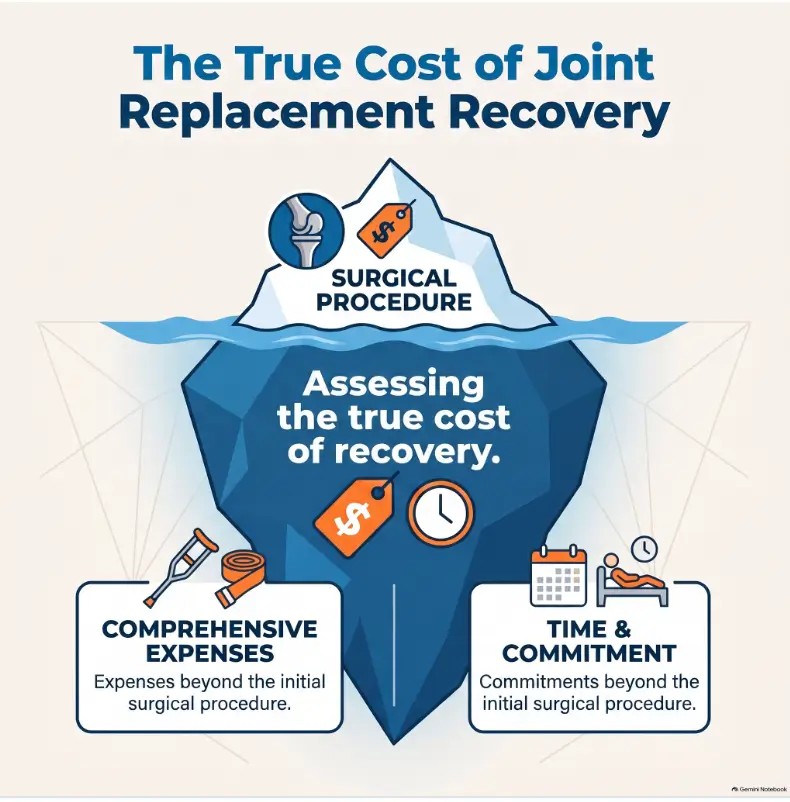
A surgery bill alone does not capture the household cost of recovering from a joint replacement. A useful budget combines your medical out-of-pocket spending with noncovered equipment, transportation, home assistance, home changes, and income lost during recovery. Your insurance structure, network, remaining deductible, and whether surgery and rehabilitation fall in the same plan year can substantially change the total.
Before buying equipment or budgeting from a hospital’s headline price, get your insurer’s estimate for the full episode of care and make a separate list of expenses insurance may not touch. That distinction prevents a common planning error: treating the price of the operation as the price of recovery.
Table of Contents
The Number You Actually Need to Calculate
For personal budgeting, the most useful figure is your incremental household recovery cost, meaning money the joint replacement causes you to spend that you would not otherwise have spent.
Total incremental household recovery cost = patient-paid medical costs for surgery and follow-up, including covered rehabilitation, medicines, and equipment + additional expenses outside those medical bills + lost income. Count each expense once: do not add a therapy copay or covered equipment payment again if it is already included in your medical out-of-pocket total.
This is different from the hospital’s total charge, the insurer’s negotiated amount, or the total amount paid to doctors and facilities.
Monthly insurance premiums deserve separate treatment. If you would have paid the premium whether or not you had surgery, it is usually not an incremental recovery expense. Include it only if you are calculating your entire annual health-care budget rather than the extra cash cost caused by the replacement.
The Six Cost Buckets That Make Up Recovery
The cleanest way to estimate recovery is to stop looking for one universal joint-replacement price and build the total from the expenses that can actually reach your household.
| Cost bucket | What may appear | What to verify |
|---|---|---|
| Surgery episode | Surgeon, facility, anesthesia, imaging, laboratory work, implants and related services | Which providers bill separately and which are in network |
| Medical follow-up | Postoperative visits, wound care, imaging, unexpected evaluations | Copays, coinsurance and whether follow-up is bundled into a surgical payment |
| Rehabilitation | Outpatient PT, home health, skilled nursing or other rehabilitation | Visit cost, authorization, network, visit limits and care setting |
| Medications and equipment | Prescriptions, walker, cane or other ordered equipment | Drug benefit, DME rules, rental versus purchase and supplier network |
| Daily-life support | Transportation, meals, cleaning, pet care, temporary assistance | Which costs are genuinely necessary and which can be covered by family or existing resources |
| Work and complication costs | Unpaid leave, reduced hours, extra appointments or additional treatment | Available paid leave, disability benefits and insurance treatment of additional care |
The surgery estimate deserves its own audit because one procedure can produce bills from several organizations. A written orthopedic surgery estimate is more useful when you compare it with the actual provider list rather than assuming one quote covers everyone.
If bills start arriving from unfamiliar names after surgery, the issue may be ordinary multi-provider billing rather than duplicate billing. Reviewing why orthopedic care can generate bills from multiple providers can make the reconciliation process much easier.
Your Insurance Math Changes the Answer More Than the Sticker Price
For someone with commercial insurance, four numbers usually matter more than the hospital’s published charge: remaining deductible, cost-sharing after the deductible, remaining out-of-pocket maximum, and the amount of care that will actually count toward that maximum.
A plan’s out-of-pocket limit is not a ceiling on everything recovery may cost. For example, HealthCare.gov explains that a Marketplace plan’s limit applies to covered care subject to the plan’s rules and does not include premiums, noncovered services, many out-of-network expenses, or certain amounts above the plan’s allowed charge. You can verify the current distinction in the HealthCare.gov explanation of out-of-pocket limits.
That means reaching your medical out-of-pocket maximum can stop additional cost-sharing for qualifying covered care while taxis, grab bars, meal delivery, private assistance or unpaid leave continue draining the household budget.
Check whether recovery crosses into a new plan year
A late-year operation creates a particularly easy budgeting trap. If surgery occurs near the end of one plan year and physical therapy continues after the new plan year begins, deductibles and other annual cost-sharing may reset according to your plan.
Ask the insurer to estimate the surgery and the expected rehabilitation schedule separately. If therapy uses copays for some visits and coinsurance for others, this guide to physical therapy copays versus coinsurance can help you identify which number you need from the plan.

Illustrative Example: Why a Medical Ceiling Is Not a Recovery Ceiling
Illustrative example only: suppose a person has an insurance plan with a $3,000 deductible, 20% coinsurance for the relevant covered services, and a $6,500 out-of-pocket maximum. Before surgery, the person has already paid $1,000 toward the deductible and $1,200 toward the out-of-pocket maximum.
Assume the allowed amount for covered, in-network surgery and recovery care is $40,000. The remaining deductible is $2,000. Without the out-of-pocket maximum, the simplified calculation would be $2,000 plus 20% of the remaining $38,000, or $9,600.
But only $5,300 remains before this hypothetical plan’s $6,500 out-of-pocket maximum is reached. Assuming every service is covered, in network and counts toward that limit, the additional medical out-of-pocket spending would therefore stop at $5,300.
| Additional covered medical cost | $5,300 |
| Additional noncovered equipment and household items, outside the medical total | $800 |
| Transportation and temporary help | $1,200 |
| Lost income | $2,000 |
| Total incremental household recovery cost | $9,300 |
|---|
The $800, $1,200 and $2,000 figures are assumptions, not typical prices. The point is the accounting method: first calculate insured medical exposure, then add the expenses outside the insurance contract.
Reconcile covered equipment before adding the outside-insurance column. In this example, the $800 equipment-and-household line must consist entirely of additional costs outside the $5,300 insured medical total. A covered walker’s coinsurance belongs in the medical total; an uncovered household purchase can belong in the separate line. Verify each item instead of assuming all equipment falls outside insurance.
Hypothetical correction: if $150 of that $800 line is actually covered equipment cost sharing already counted within the $5,300, remove the duplicate $150. The additional household line becomes $650 and the recovery total becomes $9,150, not $9,300. This changes the accounting, not the underlying insurance benefit. Label each row with the provider, item, and whether it is already included in another estimate.
If You Have Original Medicare, Use Different Cost Rules
Original Medicare does not use the same annual out-of-pocket structure as a typical Marketplace plan. Original Medicare by itself has no yearly out-of-pocket limit, although Medigap, Medicaid, employer or retiree coverage can change what a beneficiary actually pays.
For 2026, Medicare lists a $1,736 Part A inpatient hospital deductible for each benefit period and a $283 annual Part B deductible. Many Part B services then generally carry 20% coinsurance when Medicare’s assignment rules are satisfied. Current amounts and benefit-period rules are available on Medicare’s official cost page.
The patient’s cost can also change depending on whether the replacement is performed as inpatient hospital care or as an outpatient procedure. Medicare’s Procedure Price Lookup lets beneficiaries check current national-average payment estimates for eligible outpatient procedures, including total hip and total knee replacement. Treat that result as the surgery component, not a prediction of the entire recovery bill.
| Original Medicare recovery item | General 2026 cost structure | Important condition |
|---|---|---|
| Inpatient hospital care | Part A deductible applies; additional daily coinsurance begins for longer stays | Patient must actually be admitted as an inpatient |
| Outpatient physical therapy | Generally 20% of the Medicare-approved amount after the Part B deductible | Therapy must be medically necessary and meet Medicare requirements |
| Covered home health services | $0 for covered home health services | Eligibility and home-health requirements must be met |
| Medicare-covered DME | Generally 20% of the Medicare-approved amount after the Part B deductible | Medical necessity, ordering and supplier requirements apply |
| Skilled nursing facility care | Cost depends on benefit-period day and eligibility | Original Medicare’s qualifying-stay and skilled-care rules generally apply, subject to exceptions |
One especially useful fact for rehabilitation budgeting is that Medicare does not impose a fixed annual dollar limit on medically necessary outpatient physical therapy. Cost-sharing can still accumulate, however. The current rules are described on Medicare’s physical therapy coverage page.
Rehab Setting Can Change the Post-Surgery Budget Dramatically
The cost question after discharge is not simply, “How many weeks of therapy will I need?” It is also, “Where will that recovery happen?” Home-based recovery, outpatient therapy and facility-based rehabilitation have different coverage conditions and household costs.
A recommendation for skilled rehabilitation should be evaluated clinically first. From the financial side, ask whether the facility is covered, whether prior authorization is required, what your daily or per-stay cost will be, and what happens if continued care is no longer considered medically necessary. A comparison of rehabilitation options after surgery can help organize those questions before discharge.
Do not assume that “home health” means Medicare or another insurer will pay for someone to stay in the home all day. Under Medicare, qualifying home health can cover specified skilled services and limited aide services under defined conditions, but Medicare does not pay for 24-hour home care, meal delivery, unrelated homemaker services, or custodial personal care when that is the only care needed.
This creates a genuine spending decision. If the remaining problem is meal preparation, laundry or supervision rather than skilled medical care, the cheaper solution may be family scheduling, temporary household services, equipment or shorter blocks of paid assistance rather than continuous private care.
Equipment and Home Help: Buy Only What Solves a Real Bottleneck
Joint-replacement shopping can quietly turn into a miniature home-furnishing project. Not every recovery aid needs to be purchased, and not every item recommended online is medically necessary for every patient.
Before buying, divide the list into three groups: equipment your clinical team says you need, convenience items that solve a specific problem in your home, and items you are considering only because they appear on generic surgery lists.
- Check coverage first. A medically necessary walker or other qualifying durable medical equipment may be covered differently from ordinary household products.
- Ask whether the item can be borrowed or rented. Short-term use rarely requires ownership when a safe alternative is available.
- Match equipment to the home. A product that does not fit the bathroom, doorway, bed or chair setup is poor value even if it is popular.
- Compare equipment with paid labor. A modest home change may sometimes reduce repeated caregiver hours, while other households may benefit more from temporary human help.
If you are deciding where limited recovery dollars will do the most work, the comparison between home equipment and caregiver hours is more useful than buying every item on a postoperative checklist.
How to Compare Estimates Before Surgery
A surgical estimate is useful only if you know what it excludes. The fastest way to expose gaps is to ask the facility and insurer to identify the organizations expected to submit claims.
Ask for these items in writing where available: surgeon, facility, anesthesia, assistant surgeon if expected, implant-related charges, pathology or laboratory services when applicable, imaging, postoperative visits, physical therapy, durable medical equipment and expected post-acute care.
Then ask the insurer three questions: “Are all expected providers in network?”, “Does any part require prior authorization?”, and “What is my estimated remaining out-of-pocket exposure for covered in-network care through the end of this plan year?”
Hospital price-transparency data can help with comparison, but a hospital’s posted charge or negotiated rate is not automatically your personal bill. Your benefit design still matters.
If you are uninsured or intentionally self-paying
Federal protections are different when you are not using insurance. In most scheduled-care situations, uninsured or self-pay patients can request a written good faith estimate of expected charges. CMS advises that surgery may involve estimates from more than one provider or facility.
Keep every estimate. Under the current federal patient-provider dispute process, a self-pay or uninsured patient may be able to dispute a bill from a provider or facility when the billed charge is at least $400 above that provider’s good faith estimate and the other eligibility requirements are satisfied. The deadlines and conditions are explained in CMS guidance for patients not using insurance.
When Paying More Is Actually Justified
Spending more makes sense when the extra cost solves a material recovery problem rather than merely adding comfort or branding.
| Situation | Lower-cost option may be enough when | Paying more may be rational when |
|---|---|---|
| Home equipment | A borrowed, covered or basic item safely meets the need | Fit, stability or home layout makes the cheaper option unsuitable |
| Transportation | Family or ordinary transport is medically appropriate | Mobility limitations require a safer accessible service |
| Home assistance | Tasks can be scheduled among family or handled with temporary services | Safe transfers, supervision or care needs exceed what informal help can provide |
| Rehabilitation | The clinically appropriate covered setting meets the patient’s needs | A higher level of care is medically recommended and the expected benefit justifies the added exposure |
Clinical decisions about rehabilitation intensity, mobility aids and safe discharge belong with the treating professionals. The consumer decision is narrower: determine which recommended needs are covered, what remains unpaid, and whether a less expensive safe way exists to meet that same need.

FAQ About Joint Replacement Recovery Costs
Does my out-of-pocket maximum cap the entire cost of recovery?
No. It may cap qualifying covered medical spending under your plan’s rules, but it generally does not turn transportation, noncovered services, many out-of-network expenses, household help or lost income into covered expenses. Build those costs separately.
What happens if surgery is in December and physical therapy continues in January?
Your new plan year’s deductible and cost-sharing may begin again. Before scheduling a late-year surgery, ask the insurer how the expected postoperative visits and therapy will be processed on each side of the plan-year boundary.
Does Medicare pay for a caregiver at home after joint replacement?
Medicare may cover qualifying home health services when its eligibility requirements are met, but that does not equal unlimited personal caregiving. Medicare generally does not cover 24-hour home care or custodial personal care when that is the only service a person needs.
Does a bundled surgery estimate automatically include anesthesia and rehabilitation?
Do not assume it does. Ask for the bundle’s exact provider list, covered services and time period. Anesthesia, outside clinicians, rehabilitation or later services may be billed separately depending on the arrangement.
Your 10-Minute Recovery Cost Check
Open your insurance portal or call the number on your insurance card and write down five figures or answers: your remaining deductible, remaining out-of-pocket maximum, surgery cost-sharing, therapy cost-sharing, and network status of the surgeon and facility.
Next, create a second column called “outside insurance.” Add only expenses that are realistically likely for your household, such as transportation, necessary equipment, temporary help and lost wages. Leave uncertain items blank rather than inventing a number, then get a quote or decide whether the expense can be avoided.
That two-column sheet gives you a far better working estimate than the hospital price alone. It also tells you where the next phone call matters: the insurer for medical exposure, the rehabilitation provider for therapy costs, or the household for practical support.
This article provides general U.S. cost-planning information. Treatment needs, medical necessity and safe discharge decisions require clinical judgment, while coverage and payment decisions depend on the specific insurer or public program.
Last updated: October 14, 2026
Targeted review: October 17, 2026. Clarified the example’s equipment categories and added a duplicate-cost reconciliation. Other sections retain their stated review scope.
Targeted editorial update: October 21, 2026. Added a topic-specific record, question and follow-up guide and revised the title and search description. Existing useful material was retained; this update is not a complete medical, legal or insurance review. Confirm individual instructions, current prices and benefits with the relevant service.
For the distinction between a medical out-of-pocket limit and other spending, see HealthCare.gov: out-of-pocket limit.