
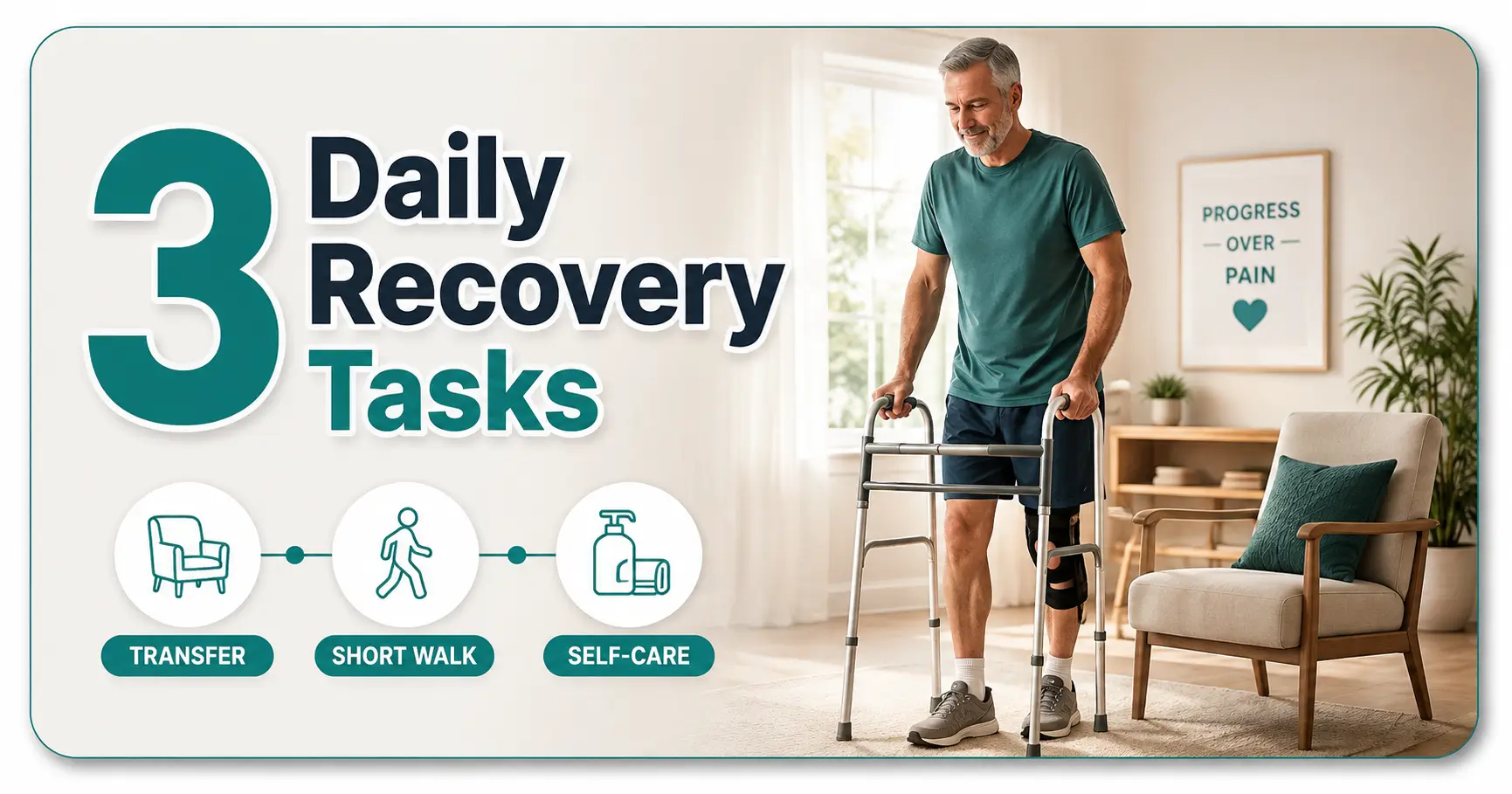
A practical at-home recovery framework
The 3 Daily Tasks That Reveal Recovery Progress
Recovery after orthopedic surgery rarely moves in a straight, cinematic line. One morning the hallway feels shorter. That afternoon, the same few steps may feel as if someone quietly lengthened the floor. A pain score can record discomfort, but it may not show whether standing required less help, turning felt steadier, or brushing your teeth took less out of you.
A more useful home check begins with three ordinary activities already permitted by the care team: one transfer, one short walk, and one self-care task. Repeating the same activities under comparable conditions helps patients and caregivers notice changes in assistance, control, effort, and recovery time without staging a miniature fitness test in the living room.
This guide shows how to choose those tasks, record them in three lines, avoid misleading comparisons, and recognize symptoms that matter more than any daily score. The goal is not to prove toughness. It is to make tomorrow’s conversation with a surgeon or physical therapist clearer than today’s guesswork.
See quieter gains
Notice less assistance, better control, and shorter recovery periods.
Reduce guesswork
Use repeatable tasks instead of comparing unrelated activities.
Know when to stop
Separate ordinary fluctuation from symptoms needing prompt attention.
Progress is often less dramatic than pain relief, but far more useful: a steadier stand, a safer turn, one less helping hand. 🌿
Snapshot
Who it is for: Adults recovering at home after orthopedic surgery and the family members helping them. What it solves: The difficulty of recognizing functional improvement when pain changes from hour to hour. What you can do next: Choose three approved activities, define assistance clearly, and begin a simple trend log without adding extra exercise.
Table of Contents

Before You Use the Check: The Recovery Plan Comes First
Safety and scope
This article offers an observation framework, not a medical assessment, rehabilitation program, or instruction to increase activity. It cannot determine whether a symptom is normal for your operation. Follow the surgeon’s discharge plan and the physical therapist’s instructions for weight bearing, movement precautions, braces, mobility aids, wound care, medication, and supervision.
Who can use this framework
The three-task check is intended for people who have already been cleared to perform basic movement at home. The selected activities should be ordinary parts of the existing recovery plan, not new tests invented for the sake of measurement.
For example, a patient may already be getting out of a particular chair with supervision, walking from the bedroom to the bathroom with a prescribed walker, and washing at the sink. Those activities can become observation points because they are already happening.
Who should not use it without direct guidance
Do not attempt the check independently when the patient has been told to remain in bed, avoid standing, use hands-on assistance, or wait for professional supervision. It is also unsuitable when there is no established safe transfer method, the home environment is unstable, or the patient cannot reliably follow precautions.
- Do not remove a sling, brace, immobilizer, walker, cane, crutches, or other prescribed support to “see how it goes.”
- Do not change weight-bearing status based on a strong morning.
- Do not test stairs, showers, low furniture, or outdoor surfaces unless they are already approved.
- Do not repeat a task after dizziness, a near fall, unusual weakness, sharp pain, or a failed attempt.
Caregivers observe; they do not become substitute therapists
A caregiver can note how much help was required, whether instructions had to be repeated, and what happened afterward. That does not mean pulling the patient upright, catching body weight without training, or changing the method taught by the rehabilitation team.
When the recommended assistance technique is unclear, ask the therapist to demonstrate it again. A written record is useful only when the activity itself is safe.
Pain Scores Miss This: Function Can Shift Quietly
Pain intensity and practical ability may move differently
Pain can change with medication timing, sleep, swelling, stress, constipation, appetite, positioning, and the previous day’s activity. A single number may therefore rise on a day when movement control is improving, or fall on a day when the patient remains unsteady.
That does not make pain unimportant. It means pain is one signal among several. A fuller functional pain assessment asks what the discomfort prevents, changes, or requires the patient to do differently.
Pain-free is not the daily target
The immediate aim after many orthopedic procedures is not zero pain. It is safe participation within the restrictions set for that stage of healing.
A patient may still report soreness while needing fewer verbal cues to stand, placing the mobility aid more accurately, or recovering more quickly after a bathroom trip. These are modest changes, but recovery is often built from modest changes stacked carefully.
Four functional signals worth watching
- Assistance: Was the patient independent, supervised, verbally cued, or physically helped?
- Control: Was the movement steady, coordinated, and consistent with precautions?
- Effort: Did the activity look or feel easier, harder, or about the same?
- Recovery time: How long did it take to settle afterward?
Key takeaway
Do not ask only, “Did the task happen?” Ask, “How much help did it take, how controlled was it, and what did it cost the patient afterward?”
The Three-Task Recovery Check at a Glance
The method is deliberately small. Tracking every exercise, symptom, meal, medication, nap, and household activity can turn recovery into a second administrative job. Three repeatable tasks are usually enough to reveal whether daily function is changing.
The daily three-task loop
Task 1
One approved transfer
Use the same bed or chair when practical. Watch help, attempts, pauses, and balance after standing.
Task 2
One familiar short walk
Keep the route and prescribed aid consistent. Watch foot clearance, turns, pauses, and supervision.
Task 3
One essential self-care task
Choose an approved activity that matters in daily life. Note adaptations, help, and the after-effect.
For every task, record the same four markers: assistance, control, effort, and recovery time.
Choose tasks that can remain comparable
The best task is not the hardest one the patient can complete. It is an ordinary, approved activity that can be observed under reasonably similar conditions for several days.
A high, firm chair is not comparable with a deep sofa. A clear daytime hallway is not comparable with a dark route crowded by laundry baskets. When the setup changes, record the change rather than pretending the result belongs in the same column.
Define assistance before the first entry
| Assistance level | What it means in the log |
|---|---|
| Independent | The patient completed the approved task safely using prescribed equipment, without another person directing or touching them. |
| Supervision | Another person remained close for safety but did not provide cues or physical help. |
| Verbal cueing | The patient needed reminders about sequence, precautions, positioning, or equipment. |
| Light physical help | The caregiver provided the type of hands-on assistance taught by the care team. |
| Substantial physical help | The patient could not safely complete much of the task without significant assistance. |
| Stopped | The activity ended because of symptoms, instability, a safety concern, or an instruction in the recovery plan. |
These labels are observational, not clinical grades. Use the terms your therapist prefers when different wording has been provided.

Task 1: Repeat One Approved Transfer
Use the same transfer whenever practical
A transfer is the movement from one position or surface to another, such as rising from a chair, moving out of bed, or sitting down on a toilet. Choose one method already approved and taught by the rehabilitation team.
Keep the surface, footwear, mobility aid, and expected assistance as consistent as possible. A familiar chair with stable arms may provide a cleaner comparison than rotating among the dining chair, sofa, recliner, and edge of the bed.
Measure help, pauses, attempts, and control
Instead of timing the entire transfer, write down what actually changed. Did the patient need one reminder rather than four? Did they place the walker correctly before moving? Was there a second attempt? Did they lower into the chair with control rather than dropping the final few inches?
- Hands-on assistance required
- Number and type of verbal reminders
- Extra rocking or repeated attempts
- Use of prescribed armrests, grab points, or mobility aid
- Ability to pause safely after standing
The clue hidden in the first five seconds
Finishing the rise is not the end of the observation. The first few seconds after standing can show whether the patient is stable enough to proceed.
Watch for a sudden grab at furniture, backward sway, knees softening, incorrect placement of the walker, blank staring, or a need to sit immediately because of dizziness. Do not continue into the walking task when standing itself is not secure.
Task 2: Walk the Same Short Route
Consistency makes the comparison useful
Choose a short indoor route already used in ordinary life, such as the bed-to-bathroom path or a trip from the favorite chair to the kitchen doorway. The route should be level, clear, well lit, and appropriate for the patient’s instructions.
Use the prescribed walker, cane, or crutches every time. Removing the aid to test independence changes the task and may add risk without producing useful information.
Watch walking quality before distance or speed
Walking farther is not automatically walking better. A patient can cover extra ground by rushing, leaning heavily on the walker, dragging a foot, or arriving exhausted.
- Does each foot clear the floor safely?
- Is the prescribed aid positioned as instructed?
- Does posture remain reasonably controlled?
- Are turns deliberate rather than hurried?
- How many rest stops or reminders are needed?
- Does supervision stay the same, increase, or decrease?
For a closer look at why pace can mislead, see this guide to walking speed during recovery. When turning is the weak point, review the home setup and technique questions in safe walker turns at home.
Do not add distance just to beat yesterday
Changing the route turns an observation into an endurance challenge. It also makes it difficult to tell whether greater fatigue came from poorer tolerance or simply from doing more.
Any progression in distance, frequency, speed, stairs, or surface should follow the recovery plan. The daily check should sit quietly inside normal activity, not compete with it.
Remove household trip traps before the walk
- Move loose cords and charging cables away from the route.
- Remove unsecured throw rugs or follow the safety plan provided for them.
- Keep pets and pet toys out of the walking path.
- Improve lighting at doorways, corners, and the bathroom entrance.
- Do not use unstable furniture as a substitute for a prescribed mobility aid.
- Keep the floor dry and clear of bags, shoes, and delivery boxes.
Nighttime walking deserves its own plan because sleepiness, medication effects, and poor lighting can change the task. A dedicated night bathroom path after knee surgery can help you inspect lighting, obstacles, and aid placement before bedtime.
Key takeaway
Keep the route boring. Same path, same prescribed aid, same safety setup. Boring data is often the most revealing data.
Task 3: Complete One Essential Self-Care Activity
Choose a task that matters in ordinary life
Self-care reveals abilities that a short walk may not. It can involve balance, reaching, sequencing, hand use, endurance, attention, and the ability to follow precautions at the same time.
Choose one activity that is explicitly permitted and easy to repeat. Depending on the procedure, examples might include washing the face, brushing teeth, putting on a loose shirt, using prepared grooming supplies, or completing an approved bathroom routine.
Track independence without rewarding risky shortcuts
Completion does not count as progress when the patient ignores movement precautions, balances against a rolling chair, twists against instructions, or avoids asking for needed help.
Safer participation matters more than cosmetic independence. Record whether supplies were prepared, adaptive tools were used correctly, and help was requested before control was lost.
Small adaptations still count as progress
A reacher, shower chair, dressing tool, raised surface, pump dispenser, or carefully arranged tray may allow a task to be completed safely. Using an approved adaptation is not cheating. It is often the bridge between dependence and safe participation.
Record the adaptation so the comparison remains honest. “Brushed teeth independently while seated with supplies prepared” is more useful than writing only “independent.”
Match the task to the operation and its restrictions
A suitable self-care task after knee surgery may be unsuitable after shoulder, wrist, spine, hip, ankle, or hand surgery. The task must respect the limits of the operated area and any restrictions affecting reaching, bending, lifting, twisting, or weight bearing.
When equipment or caregiver time is becoming a daily question, compare the decision factors in home equipment versus caregiver hours. The cheapest purchase is not always the least expensive solution, and buying equipment without checking fit or technique can create a new obstacle.
The Hidden Signal: What Happens After the Task
A successful task can still cost too much
A patient may complete the route or grooming task and still experience a long period of exhaustion, increased swelling, dizziness, nausea, shakiness, or a sharp symptom increase afterward. The final step of the task does not tell the whole story.
This is why the recovery window belongs in the log. It helps distinguish an activity that was completed comfortably from one that consumed the rest of the morning.
Record the recovery window
- Did breathing return to its usual resting pattern promptly?
- Did the patient need to sit or lie down immediately?
- How long did it take for effort and symptoms to settle?
- Was there unusual swelling, dizziness, nausea, or weakness?
- Did the task interfere with the next scheduled activity?
You do not need a stopwatch unless the care team has requested timed observations. Plain descriptions such as “settled after a few minutes,” “needed a long rest,” or “still worse at lunch” are often enough to show a pattern.
Compare delayed symptoms, not only immediate performance
Add a brief later check when the patient commonly experiences delayed swelling, fatigue, or pain. This does not require constant monitoring. A single note later in the day can reveal whether the task was tolerated differently than it first appeared.
Key takeaway
Performance is the visible half of the task. The after-effect is the quieter half, and it may explain why tomorrow feels easier or harder.
One Good Day Can Fool You: Read the Multi-Day Trend
Several comparable days beat one heroic performance
Recovery data is noisy. Sleep, therapy appointments, medication changes directed by the clinician, hydration, appetite, bowel problems, visitors, and yesterday’s activity can all affect today’s result.
Look across several comparable entries rather than treating each morning as a verdict. Less help, better control, fewer prompts, or a shorter recovery period may show improvement even when the overall pace remains slow.
Look for less help, not merely faster movement
Speed is seductive because it produces a neat number. It can also reward rushing. Unless the clinician has requested a timed test, movement quality and safety usually deserve more attention in a home observation log.
A transfer that takes slightly longer but requires no physical help may represent a more meaningful change than a fast transfer completed with poor control.
A flat day is not automatically a setback
A temporary plateau can be part of recovery. A repeated downward pattern across several tasks, especially when paired with worsening symptoms or increasing assistance, deserves attention.
Use the guidance in understanding a recovery plateau at home to separate an uneventful flat patch from changes worth discussing with the care team. Do not wait for a trend when a red flag appears.
Short Story: The faster walk that was not better
On the fourth morning after surgery, Elaine crossed the hallway faster than she had the day before. Her son wrote “better” in the notebook and felt the small lift that comes when a difficult week finally seems to turn.
At lunch, however, Elaine was still in the recliner. She had rushed the turn, leaned hard on the walker, and skipped the pause she normally took after standing. Her knee was more swollen, and she felt too drained to complete her usual sink routine.
The next day, they changed the log. Instead of recording only whether the walk was faster, they noted supervision, turning control, rest stops, and recovery time.
Nothing magical happened. The hallway remained the same length. But the record became honest enough to help: slower and steadier was sometimes the stronger day.
Show me the nerdy details
The value of repeated tasks comes from reducing unnecessary variation. When the chair, route, equipment, instructions, and assistance expectations stay reasonably stable, changes in performance are easier to interpret.
This is not a validated clinical outcome measure. It is a structured observation method. A surgeon or therapist may use formal tests, procedure-specific milestones, range-of-motion measurements, strength assessments, gait analysis, or standardized functional scales that cannot be replaced by a home log.
Build a Three-Line Recovery Log You Will Actually Use
Write one line per task
The best recovery log is not the one with the most fields. It is the one that survives a tired Tuesday.
- Transfer: Assistance, control, attempts, and symptoms after standing.
- Walk: Route, prescribed aid, pauses, turning quality, and supervision.
- Self-care: Completion level, adaptations, assistance, and after-effect.
Add one sentence for context
Record anything that could explain an unusual result without writing a full diary. Examples include poor sleep, a therapy session, reduced appetite, a long appointment, constipation, visitors, or a clinician-directed medication change.
A useful entry might read: “Chair transfer required supervision and one reminder; bathroom walk was steadier but needed a rest afterward; washed face seated without help. Slept poorly after a late appointment yesterday.”
Good, better, and professionally supported setups
| Setup | What it includes | Best fit | Budget impact |
|---|---|---|---|
| Good | A paper notebook, pen, existing prescribed equipment, and one clear route | Patients with a straightforward plan and reliable caregiver communication | No new purchase may be needed |
| Better | Large-print log sheet, clipboard, prepared supply station, improved lighting, and clearly parked mobility aid | Homes where organization, vision, or nighttime movement creates friction | Usually limited to basic household or safety supplies |
| Professionally supported | Therapist review of transfers, home-safety assessment, equipment fitting, or caregiver training | Repeated near falls, unclear technique, complex precautions, or high assistance needs | Fees and coverage vary; confirm benefits and costs before scheduling |
A notebook is enough when the task method is clear, the environment is safe, and the log is helping communication. Paying for equipment or professional help may be worth considering when fit, technique, caregiver strain, or repeated safety problems cannot be resolved with simple organization.
Turn the log into a useful appointment summary
Bring a short pattern, not a stack of unfiltered notes. Highlight the date the change began, which tasks were affected, whether assistance increased, and what symptoms appeared afterward.
A structured doctor visit summary template for caregivers can help compress the week into a page the clinician can scan quickly.
Mistakes that make the log less useful
- Changing the chair, route, footwear, or assistance rules every day
- Recording only speed or distance
- Hiding caregiver help to make the patient appear independent
- Repeating a failed task immediately
- Comparing recovery with another patient’s timeline
- Using the log to justify changing restrictions without approval
When to Seek Help: Red Flags Override the Daily Score
The daily check is never a reason to delay care. Follow the procedure-specific discharge instructions, including the phone numbers and symptom thresholds supplied by the surgical team.
Seek emergency help for possible pulmonary embolism
Call emergency services for unexplained difficulty breathing, chest pain that worsens with a deep breath or cough, coughing up blood, a rapid or irregular heartbeat, severe lightheadedness, fainting, or another sudden breathing or circulation emergency.
Do not continue the walking check, drive the patient yourself when emergency transport is needed, or wait to see whether the next log entry improves.
Get prompt medical advice for possible deep vein thrombosis
New swelling in one limb, unexplained tenderness or pain, unusual warmth, redness, or discoloration may require prompt evaluation, particularly after surgery or reduced mobility. These signs can have more than one cause, and a home observation cannot diagnose a blood clot.
Report wound and recovery changes
- Increasing incision redness, warmth, swelling, separation, bleeding, or drainage
- Drainage that becomes thick, discolored, foul smelling, or otherwise concerning
- Fever at or above the threshold stated in the discharge instructions
- New or progressively worsening pain that is not controlled as instructed
- A sudden decline in the ability to stand, walk, or complete an activity that had been manageable
- Repeated vomiting, inability to keep fluids down, or other symptoms identified in the care plan
Stop after a fall or sudden neurological change
Do not resume the three-task check after a fall, fainting episode, new confusion, sudden weakness, new numbness, a severe balance change, a head injury, or an inability to bear weight that was previously possible. Follow the discharge plan and seek urgent or emergency evaluation as the symptoms require.
| What happens | What to do |
|---|---|
| Sudden breathing difficulty, chest pain, coughing blood, severe lightheadedness, or fainting | Call emergency services immediately. |
| New one-sided limb swelling, warmth, tenderness, redness, or discoloration | Seek prompt medical evaluation according to the care team’s instructions. |
| Worsening wound changes, fever, uncontrolled pain, or sudden functional decline | Contact the surgical team promptly using the discharge instructions. |
| Dizziness, instability, unusual weakness, or near fall during a task | Stop, place the patient in a safe position, and follow the clinician’s guidance. |
| A mild variation without red flags | Record the context and compare several days, while following the existing plan. |
Key takeaway
A red flag cancels the experiment. Stop the task, protect the patient from further injury, and use the emergency or clinical instructions appropriate to the symptom.
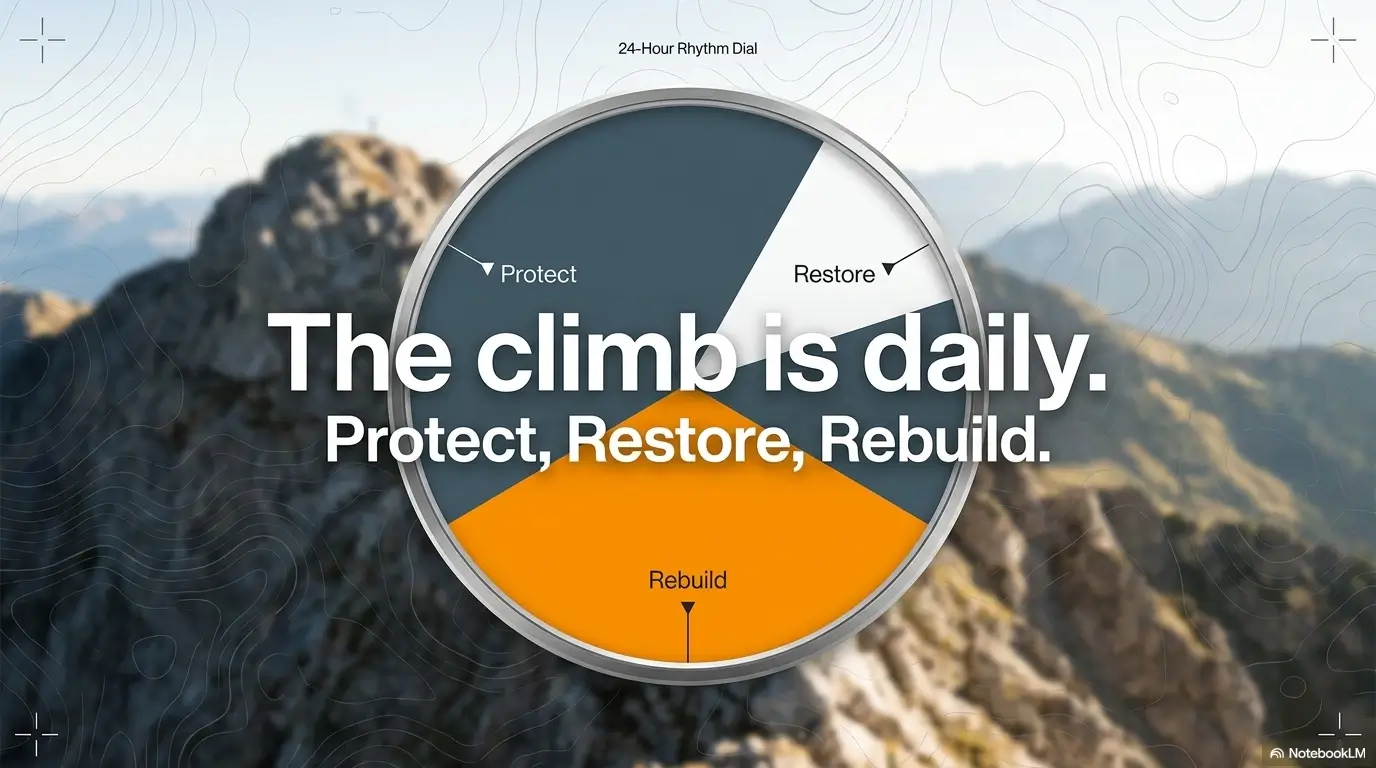
Frequently Asked Questions
Should all three tasks be performed on the first day home?
Only when all three activities are already permitted and the required assistance is available. The framework does not create permission to stand, walk, or perform self-care.
Some patients may initially track only one or two approved activities. Add another task only after the care plan allows it.
Does increased pain always mean recovery is worsening?
No. Pain may fluctuate with swelling, sleep, medication timing, positioning, therapy, or activity. However, new, severe, uncontrolled, or progressively worsening pain should be discussed with the care team according to the discharge instructions.
Should each recovery task be timed?
Not routinely. A stopwatch can encourage rushing and make a patient feel graded. Assistance, control, pauses, symptoms, and recovery time are usually more useful for informal home observation unless the clinician has requested a timed measure.
Can the framework be used with a walker, cane, or crutches?
Yes, when the device has been prescribed or approved and the patient has been taught how to use it. Keep the same aid in the task rather than removing it to test independence.
How many days are needed to recognize a trend?
Review several comparable days rather than searching for a universal number. Procedure type, recovery stage, complications, baseline function, and therapy schedule all affect how quickly a pattern becomes meaningful.
Red flags should be reported immediately. Do not wait several days to see whether an urgent symptom forms a pattern.
What if walking improves but self-care becomes harder?
Mixed results can be informative. The self-care task may require different joints, more reaching, greater balance, longer standing, or more mental sequencing. Fatigue, upper-body restrictions, medication effects, poor supply placement, or an unsuitable adaptation may also be involved.
Record the difference and raise it with the therapist rather than increasing practice on your own.
Should the patient continue when feeling dizzy?
No. Stop the activity and help the patient reach a safe position using the technique provided by the care team. Follow the discharge instructions for dizziness, faintness, blood-pressure concerns, or medication effects.
Should the log be taken to follow-up appointments?
Yes. A concise log can help the surgeon or therapist understand what happens between visits. Mark the date of any noticeable change and summarize the direction of assistance, control, effort, and recovery time.
The log supports the clinical conversation. It does not replace examination, imaging, formal testing, or professional judgment.
Choose Tomorrow’s Baseline Tonight
You do not need a new app, a color-coded dashboard, or an elaborate binder. You need three approved activities and a shared understanding of what safe assistance looks like.
The 15-minute setup
- Write down one approved transfer using a familiar bed or chair.
- Select one short, clear route already used with the prescribed mobility aid.
- Choose one permitted self-care task that matters in daily life.
- Define the assistance labels the patient and caregiver will use.
- Clear hazards, improve lighting, and park equipment where it can be reached safely.
- Place a notebook and pen nearby.
- Write the surgical team’s routine, urgent, and emergency contact instructions where both patient and caregiver can find them.
Run the check once, then return to recovery
Observe the tasks during ordinary daily activity. Do not repeat them throughout the day to produce a better score. The purpose is to notice recovery, not to interrogate it.
Tomorrow’s useful question is wonderfully plain: Did the same small pieces of life require less help, more control, or a shorter recovery period? Write the answer honestly, then let the day continue.
Your next step
Before bed, choose the chair, the route, and the self-care task. Clear the path. Define assistance. That small preparation turns tomorrow from a vague impression into a safer, more useful observation.
Last reviewed: 2026-09