
Written from a family caregiver perspective. The operator cares for an older mother with rheumatic, spinal and knee problems and is not a medical professional. This article offers general information, not individual clinical clearance.
READER WORKSHEET · Use your own information
Recovery check-in message builder
Prepare a short check-in to download and send yourself.
Add your working notes
Keep names, account numbers, member IDs, and other identifying details out of this worksheet.
Complete your worksheet to organize the next step.
How to use the result: This page does not send messages or monitor replies. A check-in is not an emergency response service.
This worksheet does not save entries between visits or send them to a provider. Download before leaving; your downloaded file may contain your notes. It is a planning aid, not medical advice or a safety assessment.
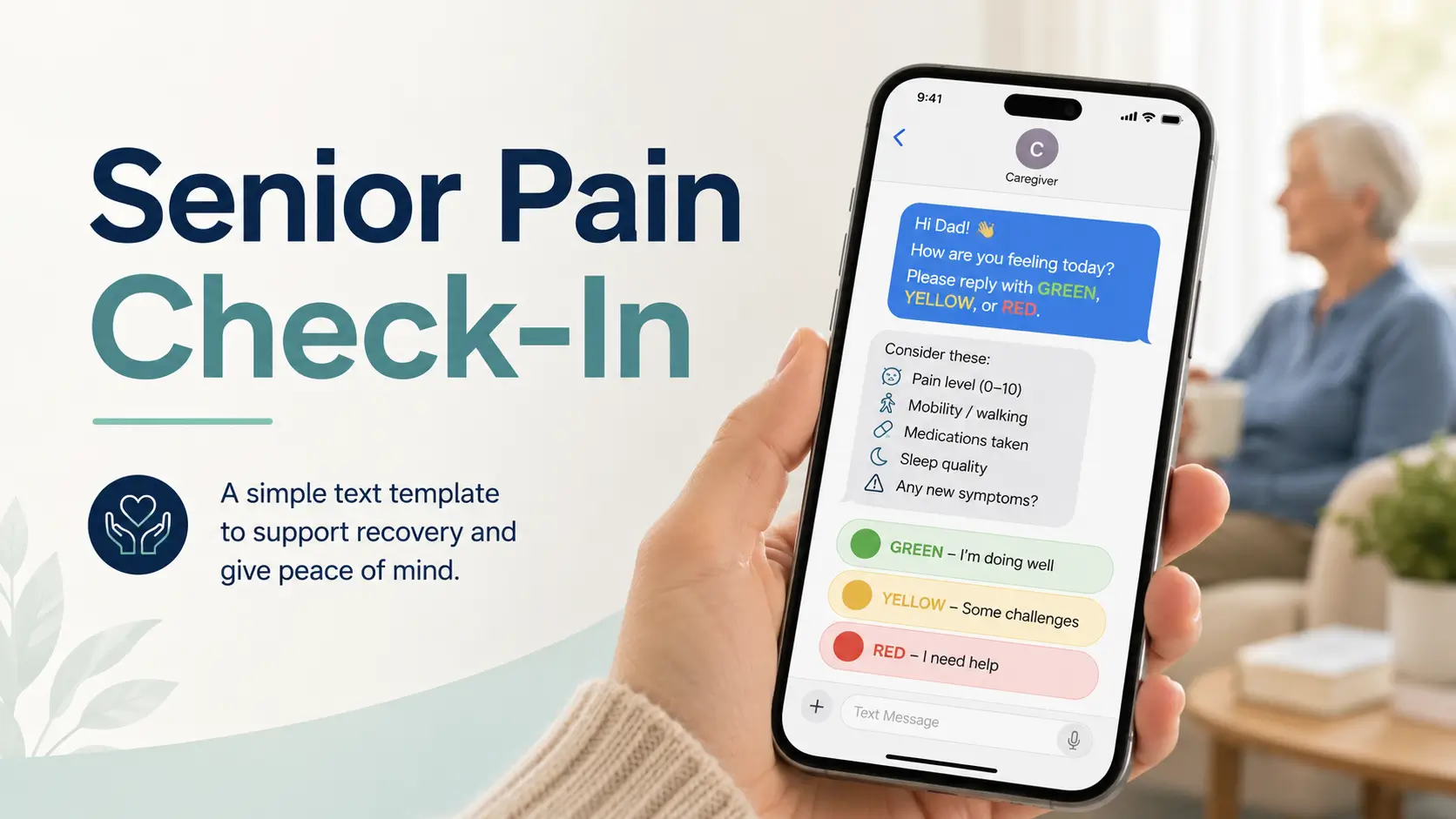
Senior recovery communication guide
Text Message Check-In Template for Senior Pain Recovery
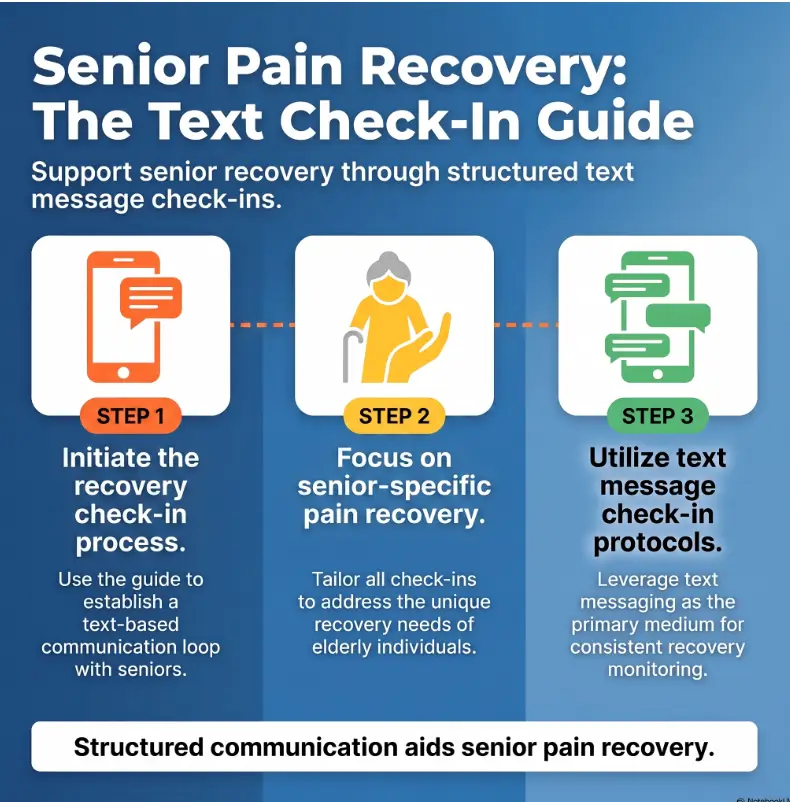
A reply that says “I’m fine” can feel reassuring. It can also conceal a missed dose, a difficult walk to the bathroom, a fall, or a new confusion the older adult does not know how to describe. A better check-in does not interrogate. It gently turns a vague moment into a few observable facts.
The most useful message is short enough to answer with tired hands, yet structured enough to reveal whether pain is improving, function is slipping, medication has become confusing, or texting should stop and urgent help should begin.
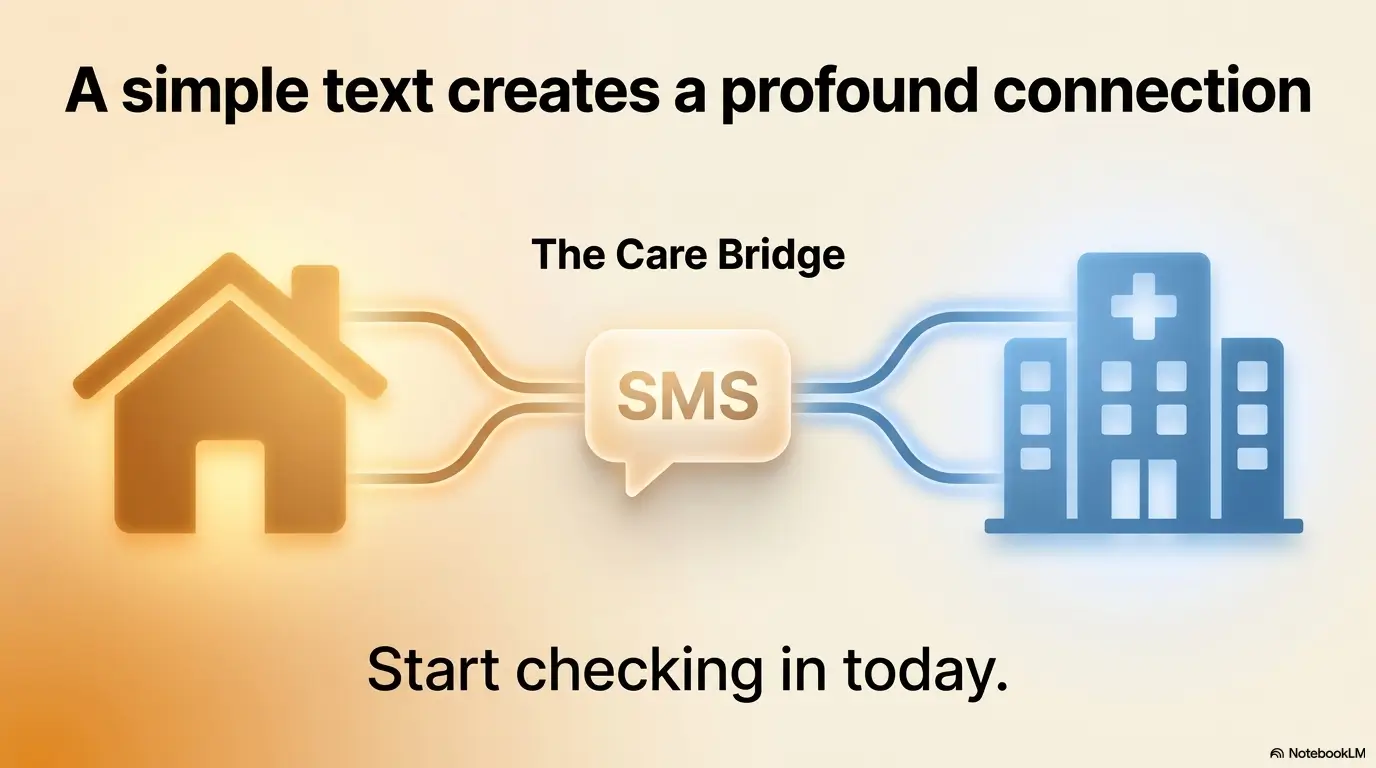
This guide gives families, adult children, and home-care aides a ready-to-copy template, a no-reply plan, and a calm decision system. The aim is not to turn a phone into a clinic. It is to make the next sensible action easier to see.
Copy-ready
A five-question text that takes about a minute to answer.
Action-ready
GREEN, YELLOW, RED, and NO-REPLY pathways.
Senior-respectful
Specific questions without surveillance or medical guesswork.
One clear message today can prevent a fog of assumptions tomorrow. 📱
Snapshot
Who this is for: adult children, spouses, family caregivers, and home-care aides supporting an older adult after surgery, injury, or a painful health episode. What it solves: vague updates, missed warning signs, medication uncertainty, and unanswered texts. What you can do next: save one short template, add the patient’s discharge instructions, and assign a response to every answer category.
Table of Contents
Before You Text: Know When a Message Is Too Thin
Safety / medical disclaimer
This article supports communication and symptom tracking. It cannot diagnose a complication, confirm that a medication is safe, or replace discharge instructions, a clinician, a pharmacist, Poison Control, or emergency services. Follow the older adult’s written care plan first. Do not stop, double, combine, split, or reschedule medication unless a qualified professional directs it.
A text is for stable, everyday recovery
A structured check-in works best when the older adult is awake, able to use the phone, medically stable, and expected to recover at home. It can help an adult child in another state notice a change without making six separate phone calls before breakfast.
It is especially practical for families who have already agreed on the questions, the reply time, and what will happen if the response is concerning.
- Adult children checking on a parent after surgery
- Spouses coordinating pain recovery at home
- Family caregivers who cannot visit every day
- Home-care aides recording changes between visits
- Families sharing limited updates through an agreed caregiver group chat
- Older adults who prefer predictable questions instead of long conversations
For larger families, a clear communication structure can reduce duplicated calls and conflicting instructions. A separate guide to creating a caregiver group chat after surgery can help define who posts updates and who makes decisions.
A text is not an emergency assessment
Do not wait for a neat numbered reply when the person has trouble breathing, chest pain, fainting, sudden confusion, unusual difficulty waking, severe sudden pain, uncontrolled bleeding, or another apparent emergency. MedlinePlus lists breathing problems, changes in mental status, chest discomfort, fainting, and sudden severe pain among warning signs that may require immediate medical help.
Texting is also too thin when the person has fallen and may be injured, cannot safely reach the bathroom, has no food or water within reach, or sounds markedly different from their usual baseline.
Key takeaway
Use texting to collect a small, repeatable snapshot. Use a phone call, an in-person check, the clinical team, or emergency services when the situation is unstable, unclear, or rapidly changing.
Set the rules before the first message
Agree on response actions before the first message. A RED message describing an emergency requires immediate emergency activation, with local access arranged in parallel; do not wait for a callback or a neighbor’s assessment. Use ordinary callback and no-reply timing only when there is no specific reason to suspect immediate danger.
- Who sends the daily message
- What time the reply is expected
- How long the caregiver will wait before calling
- Which symptoms go to the clinician
- Which symptoms require 911
- Who can physically check the home
- Who has permission to receive health updates
- Which discharge instructions must be quoted in the message
The Five-Question Senior Pain Check-In Template
Copy this 60-second message
Hi [Name], here is your quick recovery check-in. Please reply with:
1. Pain now: 0 to 10
2. Compared with yesterday: Better, same, or worse?
3. New symptoms: Any trouble breathing, chest pain, dizziness, confusion, unusual sleepiness, weakness, numbness, or fall?
4. Medicine: Taken as directed? Any missed dose, possible extra dose, or new side effect?
5. Daily function: Can you safely stand, walk, drink, eat, and use the bathroom?
Finish with GREEN, YELLOW, RED, or UNSURE.
GREEN: Managing okay
YELLOW: Please call me
RED: I need urgent help
UNSURE: Please call so we can decide
Keep the emergency instruction separate and unmistakable:
For trouble breathing, chest pain, fainting, sudden confusion, inability to wake normally, or another emergency, call 911 instead of waiting for my reply.
Add one patient-specific line
A generic template becomes far more useful when it includes the actual instructions from the surgeon, emergency department, physical therapist, primary care clinician, or pharmacist.
Your recovery team asked us to call if: [insert the exact instruction from the written care plan].
Do not replace the blank with an internet average. Fever guidance, wound concerns, activity limits, oxygen instructions, and pain expectations may differ by procedure and medical history.
Make the reply easier than ignoring it
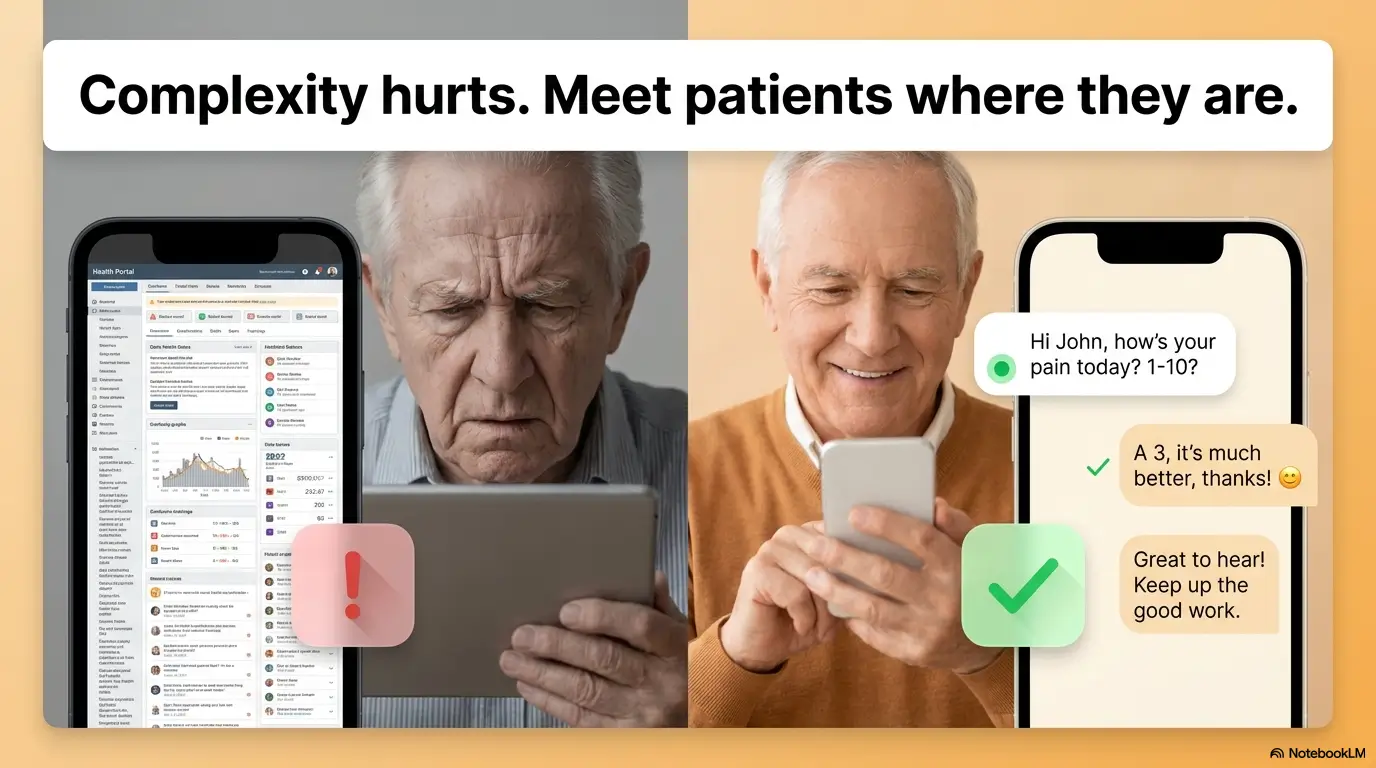
A recovering person may be tired, nauseated, wearing a sling, dealing with tremor, or trying to type through stiff fingers. A beautiful paragraph can become a small brick wall.
- Number the questions.
- Ask for one fact per line.
- Offer short choices such as better, same, or worse.
- Allow voice-to-text or a phone call as alternatives.
- Use the same order each day.
- Avoid sending extra family conversation in the same thread.
1. Pain
How strong is it now?
2. Trend
Better, same, or worse?
3. Symptoms
Anything new or alarming?
4. Medicine
Any missed or extra dose?
5. Function
Can basic tasks be done safely?
Next action
GREEN, YELLOW, RED, or UNSURE
Pain Scores Need a Second Lens: Function
Ask what changed, not only how much
A pain score can be useful, but it is not a complete biography of the day. A six after physical therapy may tell a different story from a six while lying still. The direction and context matter.
- Better than yesterday
- About the same
- Gradually worse
- Suddenly worse
- Better at rest but worse with movement
- Improved after the prescribed treatment
- Waking the person repeatedly at night
The National Institute on Aging advises describing where pain occurs, when it began, how it feels, what improves or worsens it, what other symptoms are present, and how treatments affect it.
A family that needs a more detailed record can use a functional pain assessment or a simple morning stiffness tracker rather than crowding every detail into one text.
Choose one function question
Function translates pain into ordinary life. It tells you whether the person can move through the day or is quietly shrinking the day to avoid discomfort.
- Can you get out of bed safely?
- Can you walk to the bathroom?
- Can you prepare or reach a drink?
- Can you eat a small meal?
- Can you take a comfortable deep breath?
- Can you complete the movement prescribed by your clinician?
- Did pain stop you from doing something you managed yesterday?
Key takeaway
A stable pain number does not always mean a stable recovery. Compare what the person can safely do today with what they could do yesterday.
Illustrative planning example
Illustrative example, not a reported patient case: a household has an unanswered question about consent and preferred contact method. The useful next step is to record the uncertainty, identify who can answer it and agree on a follow-up action, rather than assume that a familiar routine is suitable.
The “I’m Fine” Reply That Needs One More Question
Translate reassurance into observable facts
“Fine” may mean pain is controlled. It may also mean “I do not want to worry you,” “I do not want to go back to the hospital,” or “I am too tired to explain.” Do not argue with the answer. Make the next question easier.
Glad to hear from you. Are you able to walk, drink, eat, use the bathroom, and take your medicine normally today?
Another useful version is:
What is one thing that is easier today, and one thing that is harder?
Notice contradictions in the reply
- “Pain is okay, but I stayed in bed all day.”
- “I took everything, but I cannot remember when.”
- “Nothing happened, but I fell earlier.”
- “I am only tired,” followed by unusual difficulty staying awake.
- “Walking is fine,” followed by “I have not gone to the bathroom since yesterday.”
- A message that is unusually confused, incomplete, or unlike the person’s normal writing.
Sudden confusion or difficulty arousing a person can be an emergency warning sign, particularly when it is new or accompanied by abnormal breathing, weakness, or another abrupt change.
Protect dignity while seeking clarity
Older adults have the right to be the main voice in their own recovery. Ask permission before starting a daily routine, agree on who sees the messages, and let the person answer clinical questions whenever they are able.
The National Institute on Aging’s caregiver guidance recommends allowing the older adult to answer a doctor’s questions unless the caregiver has been asked to answer. The same principle works at home: support the conversation without taking possession of it.
- “Would a morning text or evening call feel better?”
- “Would you like your sister included in updates?”
- “Which questions feel useful rather than intrusive?”
- “Would an emoji reply be easier on difficult days?”
Red Flags: When Texting Ends
Call 911 for a possible emergency
The following are general warning signs, not a complete list for every patient. When any symptom appears severe, sudden, or life-threatening, follow the emergency plan rather than waiting for another message.
- Trouble breathing or severe shortness of breath
- Chest pain or pressure
- Fainting or loss of consciousness
- Sudden confusion or inability to recognize people
- Inability to wake the person normally
- New weakness, numbness, slurred speech, or poor coordination
- Uncontrolled bleeding
- Severe or rapidly worsening pain
- A serious fall, head injury, or suspected fracture
- Blue or gray lips, gums, or fingertips
- A suspected overdose with slowed breathing or unresponsiveness
A fall can cause a fracture or head injury. A head injury while taking a blood-thinning medicine needs prompt medical assessment even if the person initially feels well. Do not wait for a visible wound or new symptoms; use emergency services for difficulty waking, new confusion, seizure, weakness, or speech or walking problems.
Families concerned about hazards at home can review a broader older-adult fall risk guide, but a safety article should never delay an urgent assessment after a concerning fall.
Call the recovery team promptly
Some changes may not look like a 911 emergency but still deserve timely professional guidance.
- Pain that is not improving as expected
- Increasing swelling or a new wound concern
- A new medication side effect
- Repeated vomiting or difficulty keeping fluids down
- New trouble walking or completing prescribed activity
- Constipation, urinary difficulty, or another problem named in the care plan
- Questions about whether a missed dose should be taken
- Any symptom specifically listed in the discharge paperwork
Do not invent universal thresholds
A generic article cannot safely decide the right temperature, blood pressure, oxygen reading, swelling limit, wound appearance, or pain score for every older adult. The meaningful threshold may depend on the procedure, diagnosis, medications, heart or lung conditions, and the clinician’s plan.
Copy the actual trigger from the discharge instructions into the text template. When the paperwork is vague or contradictory, ask the recovery team to clarify it in plain language and write the answer down.
Show me the nerdy details
A check-in message is a tiny repeated measurement system. Its value comes from consistency, not from pretending the answers are precise medical data.
The strongest signal is often a change from the person’s own baseline: new confusion, less walking, poorer fluid intake, a different writing pattern, or pain that changes suddenly. Comparing one patient with another can create noise because recovery schedules, medications, and functional starting points differ.
The GREEN, YELLOW, and RED labels are communication shortcuts, not clinical categories. Each family should connect them to the patient’s written instructions and a named action.
Check Medication Without Playing Pharmacist
Ask about what happened
The caregiver’s role is to identify possible problems and connect the person with the right help. It is not to redesign the medication plan by text.
- Did you take the medicine according to the label?
- Did you miss a dose?
- Is there a chance you took an extra dose?
- Did you take a medicine from the wrong bottle?
- Did a new symptom begin after a dose?
- Are you unusually dizzy, confused, nauseated, or sleepy?
- Are you having trouble opening, reading, or distinguishing the containers?
When medication timing or containers are repeatedly confusing, review a dedicated guide to monitoring medication confusion and ask a pharmacist which organization method is appropriate for the exact prescriptions involved.
Avoid improvised dosing advice
- Do not suggest doubling a missed dose.
- Do not recommend stopping a prescription suddenly.
- Do not combine pain relievers without professional confirmation.
- Do not share another person’s medicine.
- Do not assume an over-the-counter product is compatible with prescriptions.
- Do not crush, split, or repackage a medicine unless a pharmacist confirms it is appropriate.
Key takeaway
The safest caregiver message is “Let’s confirm that with the pharmacist or prescriber,” not “Here is what I think you should take.”
Add an opioid-safety branch when relevant
Prescription opioids can cause life-threatening breathing problems. Severe sleepiness, slowed or difficult breathing, unresponsiveness, or inability to wake normally requires emergency action. The FDA also advises patients and caregivers to discuss naloxone when opioids are prescribed.
If you are very hard to wake, breathing slowly, or unable to respond, this is an emergency. Call 911 and follow the naloxone instructions provided by the clinician or pharmacist.
Naloxone is temporary emergency treatment. The FDA advises calling 911 and remaining with the person even when naloxone has been given and the person wakes up.
Possible extra dose? Get specific help
The risk from an extra dose depends on the medicine, strength, amount, timing, symptoms, and the person’s health. Guessing from a search result or a relative’s previous experience is not a safe shortcut.
In the United States, call Poison Control at 1-800-222-1222 promptly for a possible extra dose, wrong medicine, or poisoning, even if no symptoms have appeared. Call 911 immediately for unconsciousness, seizure, abnormal breathing, collapse, or another life-threatening sign. Do not wait for the next check-in.
Choose the Right Timing, Privacy Level, and Tool
Send the message when it can reveal something
Random messages produce random snapshots. A roughly consistent time makes changes easier to notice, provided the schedule matches the person’s routine and care plan.
- Shortly after waking
- Before the first planned activity
- After physical therapy or prescribed exercise
- At a medication interval identified by the clinician
- Before the primary caregiver becomes unavailable overnight
- After a known high-effort task, such as bathing or climbing stairs
The goal is not round-the-clock surveillance. It is one or two useful windows. As independence returns, agree on when twice-daily messages become daily messages and when routine check-ins can end.
Compare free and paid support options
A free text template may be entirely sufficient for a stable older adult with reliable phone use and nearby help. Paid tools or services become worth comparing when missed replies are common, the person lives alone, fall risk is high, or caregivers cannot provide consistent coverage.
| Setup | What it includes | Best fit | What to verify before paying |
|---|---|---|---|
| Good: Free phone routine | Saved text template, daily call backup, paper contact list | Stable recovery, reliable phone use, nearby family | No purchase needed; test the no-reply plan |
| Better: Shared coordination system | Shared calendar or log, one family coordinator, medication list, visit notes | Several caregivers or a longer recovery | Privacy controls, ease of use, duplicate-alert prevention |
| Best: Added response support | Personal emergency response option, scheduled home-care visits, professional medication review where appropriate | Living alone, repeated falls, cognitive difficulty, limited nearby support | Monthly cost, cancellation terms, response process, cellular coverage, who receives alerts |
More technology is not automatically safer. A complicated app that nobody opens is decorative plumbing. The best setup is the simplest one that reliably produces the needed action.
Protect private health information
- Ask permission before adding relatives to a group chat.
- Share only the details each person needs.
- Avoid posting medication lists in a large family thread.
- Do not forward wound photographs or clinical documents without consent.
- Keep account passwords and door codes out of ordinary text threads.
- Choose one person to summarize updates instead of circulating screenshots.
A separate doctor visit summary template for caregivers can hold detailed clinical notes, while the daily text remains brief.
Questions to ask a paid provider
- What exactly happens after a missed check-in or alert?
- Is a live person available, and during which hours?
- Who contacts emergency services?
- Can family members receive alerts without seeing unnecessary health details?
- Does the service work during a power or internet outage?
- Are equipment, installation, monitoring, and cancellation billed separately?
- Can the system be paused when recovery ends?
- Does the service replace any part of the clinician’s plan? The correct answer should usually be no.
Build a No-Reply Protocol Before You Need It
Silence is not a GREEN response
A missed reply can mean a nap, a dead battery, a forgotten message, a hospital visit, confusion, a fall, or an emergency. The text alone cannot tell you which.
The right response depends on the expected reply time, the person’s known risk, whether they live alone, and whether anything concerning happened earlier that day.
Use a four-step escalation ladder
- Send one simple follow-up. “Just checking that you saw my message. Please reply with any word or emoji.”
- Call the person. Do not send six increasingly anxious texts while avoiding the obvious next step.
- Contact the designated nearby person. This may be a spouse, neighbor, relative, building manager, or home-care aide who agreed in advance.
- Escalate according to the known risk. Contact emergency services when there is reason to suspect a fall, overdose, breathing problem, altered consciousness, or immediate danger.
Key takeaway
Decide the waiting period and escalation order before discharge day. Anxiety is a poor architect, especially when the phone goes silent.
Create a one-page contact ladder
| Contact | Name or number to record | When to use it |
|---|---|---|
| Older adult | Preferred phone and backup phone | First call after a missed reply |
| Nearby keyholder | Neighbor, relative, or building contact | Physical check when agreed and appropriate |
| Recovery team | Surgeon, clinic, or home-health line | Non-emergency recovery concerns |
| Pharmacy | Dispensing pharmacy number | Medication instructions and side-effect questions |
| Poison Control | 1-800-222-1222 in the U.S. | Possible medication error or poisoning |
| Emergency services | 911 in the U.S. | Possible life-threatening emergency |
Turn Replies Into GREEN, YELLOW, or RED Decisions
GREEN: The plan appears manageable
- Pain is stable or improving.
- No new warning symptoms are reported.
- Medicine was taken as directed.
- Basic activities remain possible.
- The reply sounds consistent with the person’s normal communication.
A GREEN reply does not prove that nothing is wrong. It means the answers fit the agreed home-recovery plan and no escalation trigger has appeared.
YELLOW: A conversation is needed
- Pain is gradually worsening.
- A new side effect has appeared.
- Walking, eating, drinking, or toileting is becoming harder.
- Medication instructions are unclear.
- The older adult sounds different from baseline.
- A non-urgent symptom listed in the discharge paperwork has appeared.
Call rather than continuing a complicated text exchange. Listen for breathing, speech clarity, alertness, and whether the person can describe what happened. Contact the recovery team when the care plan says to do so or uncertainty remains.
RED: Texting stops
- An emergency warning symptom is present.
- A serious fall or injury is suspected.
- A possible overdose has caused concerning symptoms.
- The person is suddenly confused or cannot be awakened normally.
- The person directly asks for urgent help.
- The caregiver has a strong, specific reason to believe immediate danger exists.
Follow the emergency plan. Do not require the older adult to finish the questionnaire, prove the severity of the symptom, or wait for another relative to vote.
UNSURE is a valid answer
People do not always know whether dizziness is ordinary, whether a medication was duplicated, or whether pain is worse enough to matter. “UNSURE” creates room for uncertainty without forcing the person to classify their own medical risk.
| Reply | Meaning | Agreed next action |
|---|---|---|
| GREEN | Managing within the current plan | Continue and check again at the agreed time |
| YELLOW | A change or question needs discussion | Call and consider the recovery team |
| RED | Urgent help may be needed | Follow emergency instructions immediately |
| UNSURE | The person cannot confidently classify the situation | Call now and decide using the care plan |
| NO REPLY | Status is unknown | Use the prearranged escalation ladder |
Frequently Asked Questions
What should I text an older adult recovering from surgery?
Ask for the current pain level, whether it is better or worse than yesterday, any new warning symptoms, medication problems, and the ability to complete basic activities. End with a simple action label such as GREEN, YELLOW, RED, or UNSURE.
How often should I check on an older parent in pain?
Use the discharge plan, the older adult’s preferences, and the known risk level. Some families begin with morning and evening check-ins, then reduce the frequency as mobility and independence improve. A person with unstable symptoms needs clinical guidance, not simply more texts.
Is a 0-to-10 pain scale reliable for seniors?
It can be useful when the person understands the scale and uses it consistently, but it should be paired with pain trend, location, symptoms, and function. For someone with cognitive or communication difficulties, clinicians may recommend a different assessment approach.
What should I ask when someone says, “I’m fine”?
Ask one neutral activity question: “Can you safely walk, drink, eat, use the bathroom, and take your medicine normally today?” Specific activities often reveal more than asking the person to defend or revise the word “fine.”
When does worsening pain require medical attention?
Follow the patient’s written instructions. Sudden severe pain, pain with breathing difficulty, chest pain, fainting, new weakness, sudden confusion, or another emergency symptom may require 911. Pain that is gradually worsening or not following the expected recovery pattern should be discussed with the treating team.
What should I do when an older adult misses a check-in?
Send one simple follow-up, call the person, contact the agreed nearby helper, and escalate according to the known risk. Do not assume silence means the person is sleeping safely.
Can I ask about pain medication by text?
Yes. Ask whether it was taken as directed, whether a dose was missed, whether an extra dose may have been taken, and whether a new side effect appeared. Do not provide improvised dosing instructions. Contact the pharmacist, prescriber, Poison Control, or emergency services as appropriate.
How can I check in without sounding controlling?
Ask permission, offer a choice of text or call, agree on the time, and explain what will happen with the information. Keep the message brief and allow the older adult to speak for themselves.
Should several family members receive the updates?
Only with the older adult’s permission and a clear reason. Choose one coordinator when possible. Too many recipients can create conflicting advice, duplicate calls, and unnecessary sharing of private health information.
Save and Test the Template in 15 Minutes
Complete this one-time setup
- Copy the five-question template into the caregiver’s phone.
- Replace the name and remove any question the care team says is inappropriate.
- Add the exact warning signs and instructions from the discharge paperwork.
- Assign one action to GREEN, YELLOW, RED, UNSURE, and NO REPLY.
- Record the clinician, pharmacy, nearby helper, Poison Control, and emergency contacts.
- Send a practice message while everyone is awake and available.
- Ask the older adult whether the message feels clear, respectful, and easy to answer.
Make one concrete promise
When you answer, I will read your message by 9:30 a.m. If I cannot respond, Maya will be available. If you reply RED or do not answer by our agreed time, I will follow the plan we made together.
That promise closes the loop. The older adult knows the message will not disappear into a silent phone, and the caregiver knows what comes next.
The 15-minute next step
Save the template now, add one instruction from the official care plan, and test the no-reply sequence once. The safest routine is not the longest one. It is the one everyone understands before the difficult day arrives.
Last updated: October 14, 2026
Agree on what happens after the text
Use these prompts for a private note or your next care-team conversation. Record what is known and mark unanswered questions; completing this table does not establish safety, independence or treatment eligibility.
| Record or clarify | Question and next action |
|---|---|
| Consent and preferred contact method | What does the person want to share, with whom, and by text or voice? |
| A message that needs a response | Who has accepted responsibility for reading it, and when? |
| No reply or a concerning reply | What local contact and emergency plan will be used? An unread text is not monitoring. |
Keep the person’s own report separate from a helper’s observation. Share only with consent and only with people who need the information. Do not put identifying health details in public comments. The visit preparation tool can organize questions; it cannot assess symptoms or approve a task.
Background resource: NHS: falls and getting help. This resource supports general care planning; it does not validate every instruction elsewhere in this article.
Targeted caregiver edit: October 21, 2026. Added the topic-specific handover questions and clarified narrative examples and planning limits. Earlier clinical sections retain their previous review scope; this update is not a full medical review.