
Written from a family caregiver perspective. The operator cares for an older mother with rheumatic, spinal and knee problems and is not a medical professional. This article offers general information, not individual clinical clearance.
Respectful fall-risk conversations
How to Talk About Fall RiskWithout Starting a Fight
You notice a hand reaching for the wall, a pause at the stairs, or a story about “just slipping” that changes slightly each time it is told. You want to protect someone you love. They hear an inspection, a verdict, or the first drumbeat of losing control.
That emotional mismatch is why a sensible conversation about fall risk can ignite over a loose rug. The disagreement is rarely only about balance. It may also contain pride, privacy, fear of medical appointments, concern about cost, and a fierce wish to keep driving, cooking, gardening, showering, or living at home.
This guide gives you calm opening lines, phrases to avoid, a small-step safety plan, and clear signs that the moment has moved beyond conversation and into medical urgency. The aim is not to win one perfect discussion. It is to keep dignity, useful information, and the next door open.
Say it better
Use observation and permission instead of labels or commands.
Choose one step
Turn a large safety debate into a reversible experiment.
Know when to act
Separate routine concern from signs that need urgent care.
The safest conversation protects two things at once: the person’s body and their authorship of their own life. 🪴
Snapshot
Who this is for: adult children, spouses, relatives, and informal caregivers who have noticed falls, near-falls, furniture walking, dizziness, or growing hesitation. What it solves: how to raise the issue without sounding controlling. What you can do next: hold one ten-minute conversation and agree on one practical safety step.
Table of Contents
READER WORKSHEET
Fall-risk conversation planner
Plan a respectful discussion around one task the person wants to keep doing.
Confirm and prepare
Add your working notes
Keep names, account numbers, member IDs, and other identifying details out of this worksheet.
Complete your worksheet to organize the next step. Blank amounts remain unknown.
How to use the result: Avoid using the checklist as proof that someone is unsafe or incapable. Involve appropriate professionals for assessment.
This worksheet does not save entries between visits or send them to a provider. Download before leaving; the downloaded file may contain your notes. It is a planning aid, not a diagnosis, safety assessment, coverage decision, or final bill.
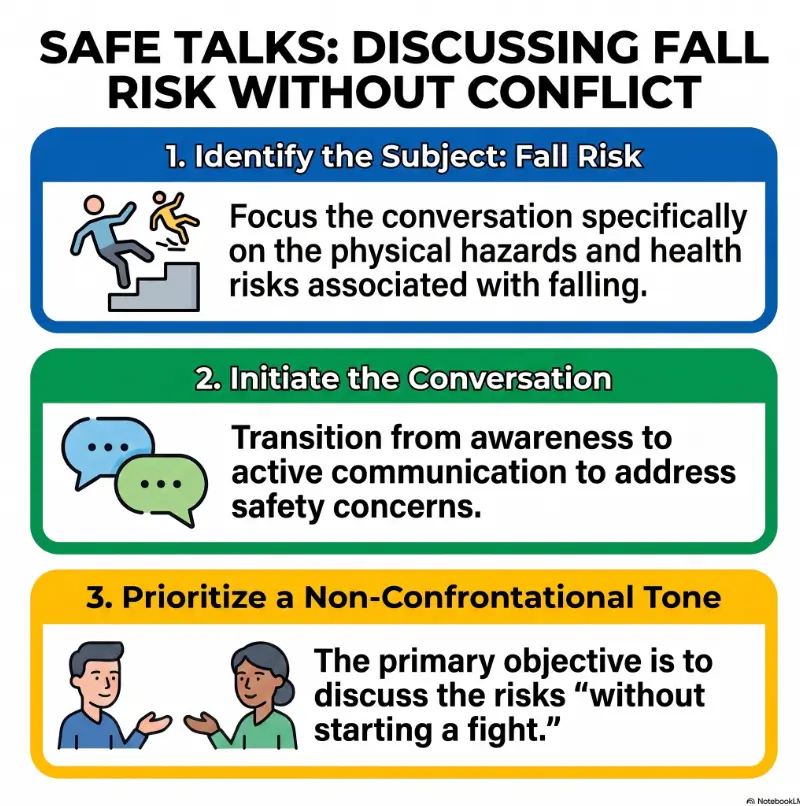
Before You Start: Separate an Emergency From a Conversation
A fall-risk discussion belongs at the kitchen table, not in the middle of a medical emergency. Before choosing the right words, decide whether the person needs immediate help, prompt clinical advice, or a calm preventive conversation.
Safety / Disclaimer
This article provides general communication and fall-prevention guidance. It cannot diagnose the cause of a fall, assess injuries, determine decision-making capacity, or replace advice from a physician, pharmacist, physical therapist, occupational therapist, or emergency professional. Confirm important medical and mobility decisions with a qualified professional who knows the person’s health history.
Call emergency services for danger signs
Call 911 in the United States, 999 or 112 in the United Kingdom, or your local emergency number if the person is badly hurt, cannot get up, loses consciousness, has a seizure, or develops signs of a serious head or neurological injury.
- Increasing confusion, unusual behavior, severe drowsiness, or difficulty waking
- A worsening headache after a blow or jolt to the head
- Repeated vomiting
- New weakness, numbness, slurred speech, poor coordination, or facial drooping
- One pupil appearing larger than the other
- Severe bleeding, suspected hip injury, or possible neck or back injury
- Sudden dizziness, fainting, chest pain, or breathing difficulty
Do not pull someone upright when a head, neck, back, or hip injury may have occurred unless staying in place creates immediate danger. Keep them as comfortable and still as reasonably possible while help is arranged.
Contact a clinician after falls or new unsteadiness
A person who has fallen, nearly fallen repeatedly, or developed new balance problems should tell a healthcare professional. Even a fall without an obvious injury may offer a clue about medication effects, blood pressure changes, vision, pain, foot problems, muscle weakness, an infection, or another medical issue.
A head strike while taking a blood thinner needs prompt medical assessment even if the person feels well. New confusion, worsening headache, repeated vomiting, difficulty waking, seizure, or new weakness/speech difficulty needs emergency help. Do not wait for a calmer family discussion or a seven-day trial.
Use conversation guidance for patterns, not crises
The communication approach in this article is designed for patterns such as reaching for furniture, avoiding stairs, shuffling, rushing to the bathroom, feeling dizzy on standing, or becoming less confident outdoors. For a fuller review of warning patterns, see this guide to fall risk in older adults.
| What is happening? | Best next step | Conversation priority |
|---|---|---|
| Serious injury or head-injury danger sign | Call emergency services | Keep language simple and focus on immediate safety |
| Fall, repeated near-falls, or new unsteadiness | Contact a healthcare professional promptly | Document what happened and request an assessment |
| Gradual hesitation or risky habits without an acute event | Arrange a calm preventive conversation | Ask permission and agree on one small step |
Key takeaway
Do not use a carefully worded family conversation to delay emergency care. First decide which lane you are in: emergency response, prompt clinical review, or prevention planning.
Why “I’m Worried” Can Sound Like “I’m Taking Over”
You may intend “I love you and want you safe.” The other person may hear “I have been evaluating you, and I no longer trust your judgment.” Both meanings can occupy the same sentence.
Fall risk is rarely only about falling
Walking and balance are threaded through daily identity. A conversation about the shower may quietly become a conversation about privacy. A suggestion to stop using stairs may sound like a proposal to abandon the bedroom, garden, or home.
Even a small mobility aid can carry unwanted symbolism. You may see a tool. They may see a public announcement that their body has changed.
Resistance may be self-protection
Denial is not always ignorance. It may protect the person from shame, expense, unwanted attention, or the fear that one concession will trigger ten more. “I’m fine” can mean “I am not ready to let this become the family’s main story about me.”
This does not mean you should ignore risk. It means the route to useful information may run through respect rather than pressure.
Change the goal from winning to learning
A successful first conversation does not require agreement on a walker, home renovation, or specialist appointment. It may simply reveal that the person feels dizzy when standing, cannot see the edge of the stairs at night, or avoids using a cane because it hurts their wrist.
That new information is progress. The argument shrinks when the real problem finally enters the room.
Show me the nerdy details
A fall-risk conversation contains several decisions at once: whether a change exists, what caused it, how serious it is, who should know, what help is acceptable, and what the change might cost in money or independence.
When all of those decisions are compressed into “You need a walker,” the person may reject the entire package. Separating observation, interpretation, preference, and next action reduces the mental load and creates room for consent.
Pick the Moment Before You Pick the Words
The same sentence can feel caring on Tuesday afternoon and humiliating thirty seconds after a stumble. Timing is part of the message.
Avoid embarrassment, adrenaline, and audiences
Do not launch a full safety review while the person is still shaken, angry, or trying to prove they are unharmed. Check for injury, help with the immediate situation, and return to the wider issue later.
Choose a private setting. A restaurant, holiday gathering, or living room filled with siblings can turn concern into a hearing. Few people become more candid when they feel outnumbered.
Choose one goal for the conversation
Before speaking, finish this sentence: “By the end of ten minutes, I hope we can agree to…” Keep the answer small.
- Mention the recent near-fall at the next medical appointment
- Test a night-light for one week
- Ask a pharmacist whether dizziness could be medication-related
- Walk through the bathroom together
- Ask a clinician where and how the prescribed aid must be used; do not limit required use as an experiment
“Make the entire house safe” is a project. “Check the path from bed to bathroom” is a decision.
Use a five-minute window
Formal family meetings can make people brace before the first sentence. A shorter invitation often works better: “Could we talk for five minutes about something I noticed yesterday?”
Set a stopping point and honor it. The person is more likely to reopen the conversation when they learn that saying yes to five minutes does not mean surrendering the evening.
Key takeaway
A good moment is private, calm, brief, and attached to one goal. Do not turn a wobble in the hallway into an unscheduled summit meeting.
Open With Permission, Not a Diagnosis
The opening line determines whether the person expects a conversation or a verdict. Permission gives them a small but meaningful piece of control.
Use the six-word opener
“Can I share something I noticed?”
This works because it does not diagnose, accuse, or demand. If the answer is “not now,” you can ask when would be better, provided there is no urgent safety issue.
Then describe one observable event: “I saw you reach for the wall twice when you walked from the kitchen.” Avoid adding a motive, medical conclusion, or prediction.
Connect safety to what they want to keep doing
Safety becomes less threatening when it serves a valued activity. Ask what the person wants to protect: walking the dog, attending church, shopping alone, staying in their home, using the garden, or visiting friends.
Try: “I know getting outside every morning matters to you. Could we look at anything that would make that feel steadier?”
Illustrative planning example
Illustrative example, not a reported patient case: a household has an unanswered question about one event already noticed. The useful next step is to record the uncertainty, identify who can answer it and agree on a follow-up action, rather than assume that a familiar routine is suitable.
Use this opening script
Conversation script
Permission: “Can I share something I noticed?”
Observation: “You held the counter when you stood up twice this morning.”
Curiosity: “Did you feel dizzy, sore, weak, or uncertain?”
Shared goal: “I want to help you keep moving around the house comfortably.”
Choice: “Would you rather call the doctor’s office or ask the pharmacist first?”
Ask the Question That Keeps Dignity in the Room
Once you have described what you noticed, resist the urge to unload every solution you researched at midnight. Ask a question and leave enough quiet for an honest answer.
Ask what part worries them
- “What part of this worries you most?”
- “Do you feel less steady, or are you more worried about pain?”
- “What would help without making you feel restricted?”
- “Is there a kind of help you would be comfortable trying?”
- “What would make a medical appointment feel worthwhile rather than burdensome?”
The objection may not be the safety change itself. It may be the price, appearance, inconvenience, discomfort, fear of bad news, or concern that relatives will remove more choices afterward.
Listen for clues behind resistance
Statements that sound dismissive may contain useful information:
| What they say | What may be underneath | A useful follow-up |
|---|---|---|
| “I only slipped once.” | Fear that one event will define them | “What do you think caused that particular slip?” |
| “Walkers are for people worse than me.” | Stigma or a poor previous fit | “What would make a support feel useful rather than limiting?” |
| “Doctors always blame my age.” | Prior experience of not being heard | “What would you want the clinician to understand first?” |
| “I cannot afford another appointment.” | Cost uncertainty | “Could we check coverage and likely costs before booking?” |
| “Stop hovering.” | Loss of privacy or constant monitoring | “What kind of check-in would feel respectful?” |
Reflect first, solve second
Before proposing an action, summarize what you heard: “It sounds as though the walker is not the main problem. You are worried that everyone will start treating you as incapable.”
Reflection does not mean you agree that the risk is acceptable. It shows you understand the cost they believe they are being asked to pay.
When pain is changing routines, avoidance itself can become an important clue. This guide on a parent avoiding stairs because of pain can help you separate a practical adaptation from a pattern that deserves clinical review.
Key takeaway
The fastest route to a useful solution is often one extra question. Find the objection beneath the objection before offering equipment, appointments, or rules.
Phrases That Turn Concern Into Combat
Some phrases contain a hidden demotion. They move the older adult from participant to problem, even when spoken with genuine concern.
Replace labels with observations
| Avoid saying | Try instead | Why it works better |
|---|---|---|
| “You are becoming unsafe.” | “I noticed you reached for the wall twice.” | Describes an event without declaring a permanent condition |
| “You are too old to do that.” | “Which part of that task feels least steady?” | Focuses on the task rather than age |
| “You need a walker.” | “Would you be willing to ask which support fits this situation?” | Invites assessment and choice |
| “We are taking your keys.” | “Can we talk about what happened in the parking lot and what would make driving safer?” | Starts with evidence rather than punishment |
| “You never tell us the truth about falls.” | “I want you to be able to tell me without worrying that I will overreact.” | Addresses the emotional cost of disclosure |
| “You cannot live alone anymore.” | “What support would help you continue living here safely?” | Connects help to the person’s goal |
Do not build a family court case
One clear example is more useful than a dossier. Listing six months of missteps can make the person defend their entire competence rather than discuss yesterday’s dizziness.
Avoid recruiting relatives for a surprise intervention. When several family members need to participate, tell the person who will attend, what will be discussed, and what decisions are actually on the table.
Never use housing as a threat
“If you fall again, we are putting you in a home” may produce short-term silence, not honest reporting. The person may begin hiding falls because disclosure now appears to endanger the life they are trying to protect.
Housing and care decisions sometimes do need serious review. They should be based on documented needs, available support, professional input, finances, and the person’s rights and preferences, not used as conversational leverage.
Key takeaway
Describe what happened, not what you believe the event proves about the person. Observation opens a door. A label usually locks one.
Turn Concern Into One Small Safety Pact
A large permanent change invites a large permanent argument. A small, time-limited experiment is easier to evaluate and easier to accept.
Offer a menu, not a mandate
Present two or three reasonable options. Too many choices can feel like homework, while one choice can feel like a command wearing a cardigan.
- Call the primary care office or speak with the pharmacist
- Try a night-light or clear one walking route
- Review the prescribed aid and use plan with a qualified clinician
- Schedule a vision exam or request a balance assessment
- Ask a physical or occupational therapist to review one difficult task
For someone who steadies themselves on counters and furniture, read this guide to furniture walking and fall risk. It can help you discuss why improvised supports may not be reliable without presenting the behavior as a character flaw.
Try a seven-day experiment
For low-risk environmental changes such as lighting or removing agreed clutter, a one-week review can be useful. It does not apply to waiting out new dizziness, weakness, repeated near-falls, or changing prescribed mobility-aid use. Seek assessment promptly for those concerns, and follow existing safety and assistance instructions while preferences are discussed.
- Fewer moments of reaching for furniture
- Less fear during nighttime bathroom trips
- Less pain while walking
- More confidence outdoors
- No dizziness after standing
- Better ability to carry out a valued activity
Use the Notice, Ask, Choose, Check framework
The four-step conversation
1. Notice
Name one observable event without attaching a verdict.
2. Ask
Invite their explanation, concern, and preferred kind of help.
3. Choose
Agree on one small, specific, and realistic action.
4. Check
Review the result without treating the experiment as a loyalty test.
Make the first change easy to reverse
Start with changes that do not require a major purchase or identity shift. Improve lighting, remove one unstable obstacle with permission, rearrange frequently used items, or test a clearer walking route.
Bathrooms often carry both physical risk and emotional sensitivity. The guide to having a shower safety conversation offers language for discussing privacy, grab supports, seating, and assistance without turning bathing into a public family project.
Key takeaway
Ask for a small experiment, not a lifetime contract. A reversible step lets both people gather evidence without pretending the first idea must be perfect.
Compare Free, Low-Cost, and Professional Help
Some fall-prevention steps cost nothing. Others are worth paying for because the wrong fit, missing medical cause, or poorly planned home change can waste money and create new problems.
Good, Better, Best support options
| Level | What it may include | Best for | What to verify |
|---|---|---|---|
| Good: Free DIY review | Write down incidents, improve one walking route, check lighting, prepare questions for a routine appointment | Mild concerns without injury or sudden symptoms | Do not assume a home change explains new dizziness, weakness, or fainting |
| Better: Targeted low-cost help | Pharmacist review, vision check, properly fitted footwear, basic safety items, clinician visit subject to coverage | Recurring symptoms or a clearly identified obstacle | Coverage, copays, return policies, fit, installation, and whether the item addresses the actual problem |
| Best: Individual professional assessment | Medical fall-risk review, physical therapy, occupational therapy, mobility-aid fitting, home safety assessment | Falls, repeated near-falls, complex medical issues, or difficulty with several daily tasks | Credentials, referral rules, insurance authorization, written recommendations, and follow-up plan |
“Best” does not automatically mean most expensive. It means the level that matches the uncertainty and risk. A free lighting change may be exactly right for a dark hallway. It is not a substitute for evaluating new fainting or one-sided weakness.
Know which professional does what
- Primary care clinician: reviews the overall pattern, medical conditions, symptoms, blood pressure concerns, and referrals.
- Pharmacist: reviews prescriptions, over-the-counter medicines, timing, duplication, and possible side effects to discuss with the prescriber.
- Physical therapist: evaluates strength, balance, gait, transfers, endurance, and mobility strategies.
- Occupational therapist: examines how the person performs daily activities and how the home or task can be adapted.
- Eye-care professional: assesses vision changes, prescription needs, and conditions that may affect safe movement.
- Qualified mobility-equipment professional: helps select, size, and adjust an aid based on the person and setting.
A clinician may suggest more than one kind of assessment because falls often have several contributing factors. The aim is not to collect appointments like souvenir magnets. It is to identify the smallest set of useful evaluations.
Questions to ask before paying for help
- What specific problem will this visit, assessment, or item evaluate?
- Does the person need a referral or prior authorization?
- What will insurance cover, and what could be owed personally?
- Will the professional assess the person using the equipment in the real task or setting?
- Is adjustment, installation, training, or follow-up included?
- Can recommendations be provided in writing?
- What signs should trigger a call back or a higher level of care?
Prepare a clean appointment summary
Bring dates, circumstances, symptoms, injuries, and medication information. Avoid vague summaries such as “She is getting worse.” A concise record helps the clinician see timing and patterns.
The doctor visit summary template for caregivers can help you organize the facts without speaking over the patient. When medicine timing or duplicate doses may be involved, use the guide on how to monitor medication confusion and share concerns with the appropriate clinician or pharmacist.
Appointment note checklist
- Date, time, and location of each fall or near-fall
- What the person was doing immediately beforehand
- Dizziness, pain, weakness, urgency, vision change, or loss of awareness
- Any head impact, bruising, or difficulty getting up
- Recent medication, illness, footwear, or routine changes
- The activity the person most wants to preserve
- Questions the older adult wants answered in their own words
Common Mistakes That Make the Next Conversation Harder
Good intentions can quietly teach a person to hide information. Watch for actions that solve today’s worry by damaging tomorrow’s trust.
Changing the home without permission
Removing furniture, rugs, belongings, or routines while the person is away may feel efficient. It can also make the home unfamiliar and communicate that consent is optional.
Explain the concern, ask what matters about the item, and test alternatives. A rug may be replaceable. The ritual, memory, or sense of ownership attached to it is not always so simple.
Mistaking disagreement for incapacity
An adult can understand a risk and still choose differently from their family. Disagreement alone does not establish lack of decision-making capacity.
When cognition, severe confusion, exploitation, or inability to understand consequences is a genuine concern, seek professional evaluation and appropriate legal guidance rather than declaring incapacity during an argument.
Making a mobility aid the symbol of decline
A cane, walker, or rollator should be discussed as a tool for reaching a goal, not as a badge of defeat. The type, fit, height, hand position, environment, and instruction matter.
Do not buy a mobility aid based only on appearance or online ratings and then blame the person when it feels awkward. A poorly matched aid can be abandoned in the coat closet, where it becomes expensive modern sculpture.
Offering ten solutions before hearing one objection
Flooding the conversation with grab bars, shoes, alarms, appointments, exercises, and home-care services can make every option feel compulsory. Start with the person’s explanation, then match one response to it.
- Do not promise daily help you cannot sustain.
- Do not treat the first “no” as permission to ambush later.
- Do not joke about clumsiness, aging, or becoming a burden.
- Do not share private health details with relatives without a valid reason or permission.
- Do not wait for a major injury when near-falls are becoming frequent.
When to Seek Help Now
Respectful conversation is not passive observation. Certain changes deserve immediate action, while others should be raised promptly with a healthcare professional.
Emergency red flags after a fall
- Loss of consciousness or inability to wake normally
- New confusion, agitation, slurred speech, weakness, or numbness
- Seizure or repeated vomiting
- A severe or worsening headache after head impact
- Severe pain, obvious deformity, or inability to bear weight
- Suspected injury to the head, neck, back, or hip
- Sudden inability to speak, see, walk, or move normally
- Chest pain, severe breathlessness, or fainting
Call emergency services rather than driving the person yourself when symptoms may worsen, movement may be unsafe, or urgent treatment could be needed.
Changes to report promptly
- A fall, even when the person believes they were not injured
- Repeated near-falls or grabbing furniture more often
- New dizziness, faintness, weakness, confusion, or balance changes
- A recent medication change followed by unsteadiness or sleepiness
- New difficulty rising from chairs, using stairs, or getting to the bathroom
- Vision changes or trouble judging steps and edges
- Fear of falling that is reducing normal activity
Reduced activity can create a difficult cycle: fear leads to less movement, less movement may contribute to deconditioning, and ordinary tasks begin to feel more uncertain. A clinician or therapist can help identify a safer plan rather than simply telling the person to “be careful.”
Document the moment before memory softens it
Write down what happened soon afterward. Record the time, place, activity, footwear, lighting, symptoms before and after, and whether the person hit their head or needed help getting up.
Use neutral wording. “Foot caught the threshold while turning toward the bathroom” is more useful than “careless again.” Facts travel well between family members and clinicians. Accusations mostly travel in circles.
Fall-Risk Conversation FAQ
How do I tell my elderly parent I am worried about falls?
Ask permission, describe one specific observation, and connect the concern to something your parent wants to keep doing. For example: “Can I share something I noticed? You reached for the wall twice yesterday. Did you feel dizzy or was your knee hurting? I want to help you keep walking to the garden comfortably.”
Avoid beginning with age, competence, or a large solution. The first goal is to understand what happened and agree on one next step.
What should I say when a parent refuses to use a walker?
Ask what they dislike about it. The issue may be stigma, poor fit, discomfort, difficulty using it indoors, or fear that it represents a permanent loss. Try: “What feels most wrong about this walker, and what would a useful support need to do differently?”
Ask a qualified professional to assess the appropriate aid and teach safe use. Do not assume every walker suits every person or environment.
How can I discuss fall prevention without sounding controlling?
Use choice-based language: “Would you rather start with the hallway lighting or ask the pharmacist about dizziness?” Explain your concern without claiming authority over the person’s life.
Keep the conversation private, short, and focused on one issue. Avoid surprise family meetings and threats involving housing, driving, or loss of independence.
What if my parent becomes angry whenever I mention safety?
Lower the pressure and ask what makes the conversation feel threatening. You might say, “I can see this feels like I am trying to take over. What are you most worried I will do?”
Unless there is immediate danger, pause rather than escalating. Return later with one observation and one request. A trusted clinician may also be able to raise the issue in a less emotionally loaded setting.
Should an older adult tell their doctor about a minor fall?
Yes, it is sensible to report falls and recurring near-falls, even when no obvious injury occurred. The circumstances may help a healthcare professional identify medication effects, vision problems, balance changes, pain, blood pressure issues, or environmental hazards.
Seek urgent help sooner when there was a head impact, symptoms are changing, the person cannot get up, or emergency warning signs appear.
How do I suggest a fall-risk assessment without causing embarrassment?
Present it as a way to preserve activity rather than prove decline. Try: “Could we ask what might make walking outside feel more reliable? I would rather get useful advice than guess.”
Let the person help choose the clinician, appointment time, questions, and family involvement.
Can medications contribute to dizziness or fall risk?
Some prescription medicines, over-the-counter products, combinations, or timing patterns may contribute to dizziness, sleepiness, confusion, or blood pressure changes. Do not stop or alter medication independently.
Ask the prescribing clinician or pharmacist to review the complete list, including nonprescription medicines and supplements.
What should families do when an older adult denies falling?
Avoid turning the disagreement into an interrogation. State what you observed, explain why accurate information matters, and promise not to overreact automatically.
Ask whether they stumbled, lowered themselves to the floor, felt faint, or needed support. People may define “fall” differently or fear the consequences of admitting one.
When does fall risk become an emergency?
It becomes an emergency when a fall causes serious injury, the person cannot get up, or there are signs such as loss of consciousness, worsening confusion, repeated vomiting, seizure, slurred speech, new weakness, severe headache after a head impact, or suspected head, neck, back, or hip injury.
Call the appropriate emergency number rather than continuing a family discussion.
Your Next Fifteen Minutes
You do not need a family policy, a shopping list, and a fully booked medical calendar tonight. You need one honest observation and one next step that the older adult can help shape.
Prepare one ten-minute conversation
- Write down one neutral observation, such as reaching for a wall or hesitating at a step.
- Check that the moment is calm, private, and not immediately after an embarrassing event.
- Open with: “Can I share something I noticed?”
- Ask what the person experienced before offering an explanation.
- Connect the concern to an activity they want to keep doing.
- Offer two small options and let them choose.
- Agree on when you will review whether the step helped.
End with a concrete action
A useful ending sounds like this: “We will write down what happened, call the clinic tomorrow, and try the hallway light for seven nights. Then we will decide together what comes next.”
That sentence does not solve every fall risk. It does something more realistic: it replaces secrecy with information, panic with sequence, and control with shared action.
The fifteen-minute promise
Choose one observation, one respectful question, and one reversible action. You are not trying to seize the steering wheel. You are helping make the next bend in the road easier to see.
Last updated: October 14, 2026
A conversation that preserves choice
Use these prompts for a private note or your next care-team conversation. Record what is known and mark unanswered questions; completing this table does not establish safety, independence or treatment eligibility.
| Record or clarify | Question and next action |
|---|---|
| One event already noticed | Can you describe what happened without assigning a diagnosis or motive? |
| The person’s own priority | Which concern or goal do they want to address first? Ask before involving other relatives. |
| One agreed action | Who will arrange the appointment or home review, and when will you revisit the plan together? |
Keep the person’s own report separate from a helper’s observation. Share only with consent and only with people who need the information. Do not put identifying health details in public comments. The visit preparation tool can organize questions; it cannot assess symptoms or approve a task.
Background resource: NHS: falls and getting help. This resource supports general care planning; it does not validate every instruction elsewhere in this article.
Targeted caregiver edit: October 21, 2026. Added the topic-specific handover questions and clarified narrative examples and planning limits. Earlier clinical sections retain their previous review scope; this update is not a full medical review.