

TENS for knee pain claims need a specific question: relief for which condition, measured in what way, and supported by which evidence? General patient information, a product statement, a treatment guideline and an individual report of relief are different sources. A reassuring phrase or quieter knee does not by itself establish worthwhile benefit, personal suitability, healing or permission to change treatment.
Use the claim–evidence–interpretation table, follow seven essential claim-reading checks, read two fictional writing examples, or download the free offline claim-question and actual-answer record. No purchase, treatment trial or activity test is needed to ask a useful question.
This page focuses on what a statement or experience does and does not establish. The separate TENS clinical-discussion guide covers the broader diagnosis, suitability, instructions, use and response conversation. This article does not select a device, prescribe settings or repeat that full use-record checklist.
This is document-based education from a family-caregiver-run site, not a product test, systematic review or individual medical assessment. The operator is not a medical professional; no independent clinical review or validation of this worksheet is claimed. Keep the person’s own pain report intact while distinguishing it from a conclusion about treatment effects.
Table of Contents
New symptoms and device concerns come before claim analysis
Very severe knee pain, inability to move or bear weight, major swelling or changed shape, locking/giving way, or fever/shivering with a hot or red knee needs urgent medical advice. Do not use TENS or a walking test to see whether these concerns settle. See NHS knee-pain contact guidance. For a serious emergency use local emergency services, including 911 in the U.S.; MedlinePlus emergency guidance gives general examples. UK service numbers are not U.S. instructions.
If the cause of pain is uncertain, seek professional advice before using TENS. NHS TENS guidance says not to use it with a pacemaker or epilepsy, or during pregnancy unless a doctor or midwife advises it. It warns against use during sleep, bathing, driving or machinery use, and on irritated, broken, infected or numb skin. These are selected restrictions, not a complete safety checklist; use the actual manual and professional advice.
If skin becomes itchy, irritated or red, NHS advice is to switch the machine off and remove the pads. Do not repeat exposure to prove a reaction or change settings to cover new symptoms. This page supplies no restart instruction. A safety concern needs appropriate help rather than a better argument about benefit. Record preparation must not delay care.
TENS for knee pain: compare the claim with the conclusion
The table uses illustrative statement types, not verified advertisements or accusations about a seller. Preserve the actual words and identify whether they came from general information, a product listing, research, a guideline or an individual. A short accurate quotation and source can be useful; an unlabelled paraphrase can change the meaning.
| Statement or observation | What it actually addresses | Conclusion not established by it alone |
|---|---|---|
| General information describes temporary arthritis pain relief. | A broad description of possible symptom relief. | That TENS is recommended for a particular knee diagnosis or will help this reader. |
| A product is described as drug-free or simple. | A product feature or promotional description. | That it is risk-free, suitable for the person or an adequate replacement for medicines. |
| A guideline recommends for or against an intervention. | A recommendation for the stated population and outcomes, with its own evidence assessment. | A universal rule for every cause of knee pain, device or individual situation. |
| A study reports a pain outcome. | The result, comparison, population and follow-up actually studied. | Improved function, healed tissue or less joint deterioration unless those outcomes are supported. |
| A person reports temporary relief. | That person’s experience in the circumstances described. | A controlled treatment effect, explanation of the pain’s cause, medicine change or activity clearance. |
| An absence of a listed risk is noticed. | Only what the reader recognized in that list. | Completed suitability assessment or permission to try a device. |
A useful interpretation stays close to the claim: “This describes temporary relief; I still need to know whether it is relevant to the diagnosis and goal explained to me.” Do not replace a person’s report with a function-first test, but do not turn that report into evidence for a separate outcome either.
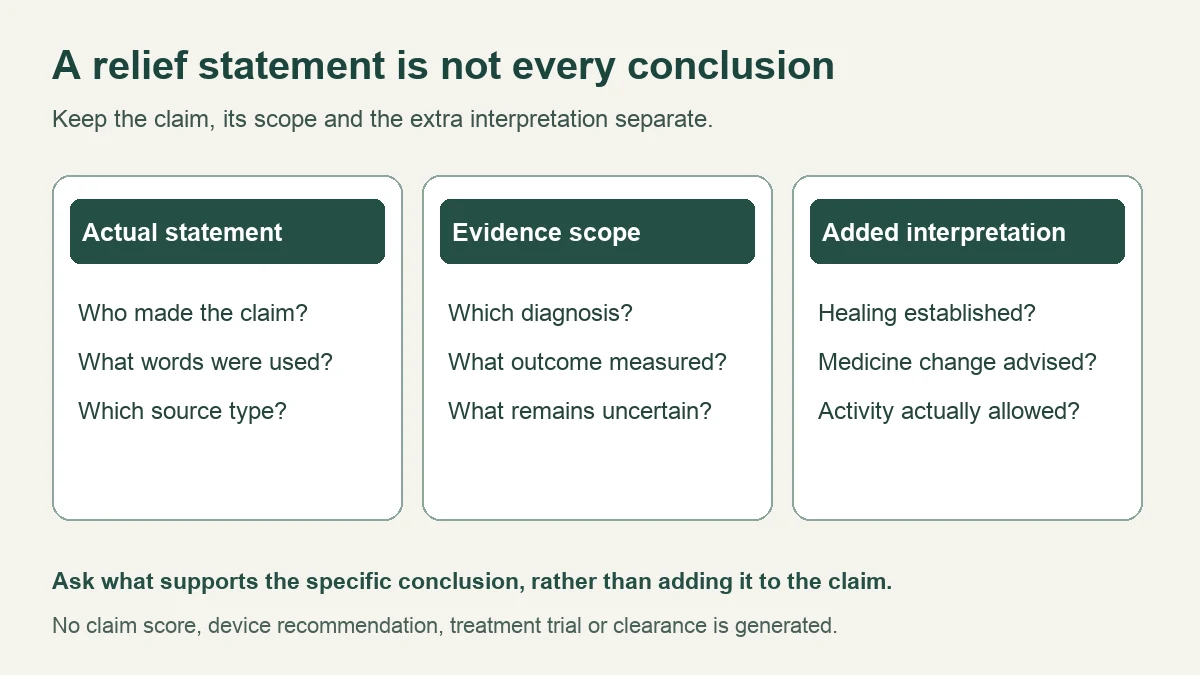
Seven essential checks before accepting a TENS benefit claim
Identify the statement and its source type
Keep the wording, source and known date together. Distinguish a manufacturer description, general patient page, testimonial, study and guideline. None should be silently rewritten as a professional recommendation addressed to the reader. A link attached to a claim is not proof that the linked work supports it.
Check the diagnosis and population
Ask which condition was actually studied or addressed. Knee pain is a symptom, not one diagnosis. A broad reference to arthritis does not identify knee osteoarthritis, an injury or another condition. If the diagnosis is unknown, retain that uncertainty instead of self-classifying to match a favorable claim.
Name the outcome the statement addresses
Pain, function, sleep, medicine use and tissue change are different outcomes. Ask what was measured and over what period, if actually known. A pain result should not be relabelled joint repair or safe stair use. No percentage benefit or duration is estimated by this worksheet.
Retain the actual comparison and uncertainty
If citing research, ask what TENS was compared with, who received it, what other care occurred and what limitations were reported. If those details were not read, record them as unknown. This guide does not appraise an arbitrary paper or compute evidence quality from a title or abstract.
Keep experience separate from causal explanation
Record relief, no change, mixed experience or a concern already noticed. Respect the report without making a claim about why it happened. Other care, timing and circumstances may matter. No baseline quota, repeated session, skin challenge or extra walk is needed to ask the question.
Ask about the unsupported extra conclusion
Write the step you were about to take: considering a purchase, expecting healing, changing medicines or assuming activity is allowed. Then ask what actually supports that conclusion for the diagnosis and goal. The form does not approve a purchase, replace a medicine discussion or prescribe an experiment.
Retain the actual explanation and open question
Keep the question, recipient role, real answer and scope together. An acknowledgement, product-manual explanation and individual clinical answer are different events. Record any agreed next step and what was completed without filling silence with reassurance or an endorsement.
Why general relief information and OA guidelines can differ
The NHS TENS page describes temporary relief that does not work for everyone. It is general information, not condition- or procedure-specific advice. Its broad description does not settle whether TENS is recommended for knee osteoarthritis. The selected documents below illustrate scope and differing recommendations; they are not an exhaustive evidence review.
| Source and scope | Position to preserve | What not to infer |
|---|---|---|
| NICE NG226, 2022, recommendation 1.3.9; osteoarthritis. | Recommends against offering TENS because evidence of benefit is insufficient. | That a report of relief is dishonest, or that this recommendation diagnoses every knee pain. |
| ACR/Arthritis Foundation 2019 guideline, published 2020; knee and/or hip OA. | Strongly recommends against TENS. | Permission to alter a person’s existing treatment independently. |
| AAOS 2021 knee OA guideline, printed page 46. | A limited recommendation permits consideration for pain; its analysis did not favor functional improvement. | Strong endorsement, cartilage repair or equal support for all devices and settings. |
Read the actual sources: NICE recommendation 1.3.9, ACR/AF OA guideline and AAOS knee OA guideline. The AAOS rationale notes inconsistent evidence and downgrading. Do not use the table as a vote or choose the sentence that supports a preferred product. Ask the clinician which evidence and alternatives fit the actual diagnosis, desired outcome and situation.
“Insufficient evidence” is not the same statement as “no person could ever feel relief.” Equally, an individual experience does not override a guideline’s population-level assessment or establish a new treatment recommendation. Keeping those claims distinct allows a more accurate conversation without dismissing the patient or promising benefit.
Dates belong with evidence, but newer does not automatically mean more applicable. Check what population, comparison and outcome the document actually addressed. This article makes no new pooled estimate, treatment ranking or claim that the selected documents are all available research. Unread evidence stays unread in the record.
Relief, healing, medicine decisions and activity permission are different
A reported change in pain is worth discussing in its own terms. It does not establish tissue recovery or identify the cause of symptoms. A person may report relief while another concern remains, and an ordinary task completed does not disprove pain. Avoid both overclaiming benefit and requiring functional loss to legitimize the person’s experience.
A “drug-free” description does not create a medicine-replacement plan. Bring the actual treatment question to the relevant clinician or pharmacist and retain the real individual advice. Do not stop, reduce or reschedule prescribed treatment from a product claim or a favorable session described here.
Likewise, less pain is not a clearance for extra stairs, walking, exercise or chores. Use actual activity instructions and ask about uncertainty. The record needs only events already experienced or non-use; it does not ask readers to demonstrate benefit, prove failure or reproduce an adverse response.
A technical feature or a general safety statement answers a different question from clinical value. Ask the device source about the exact manual or feature and the appropriate professional about the individual diagnosis and treatment question. No automatic equivalence follows between a product explanation, suitability discussion and worthwhile benefit.
Turn a vague TENS claim into an answerable question
| Question type | Specific wording to adapt | Answer status to preserve |
|---|---|---|
| Diagnosis and outcome | “Does this statement address my explained diagnosis and the outcome I care about?” | Actual explanation, not assumed relevance. |
| Evidence scope | “What comparison and result support that conclusion, and what remains uncertain?” | Source actually discussed; unread or unavailable details remain unknown. |
| Extra conclusion | “Does this establish healing, medicine replacement or activity permission, or only a pain outcome?” | Keep separate questions separate. |
| Alternatives | “Which other options deserve discussion for this diagnosis and goal?” | No alternative selected or ranked by the worksheet. |
| Follow-through | “What was actually agreed, who owns the next question and what action occurred?” | Draft, sent, acknowledged and clinically answered are distinct. |
The claim source may be able to provide a document without addressing the person’s care. A clinician may answer the diagnosis question while a technical question remains. Keep each real response with the question it covers. If an answer conflicts with an existing instruction, ask the appropriate team to clarify rather than choosing a statement yourself.
Do not collect more intimate information than the question needs. Avoid public comments, full reports, identifying photographs and private contact details. Share relevant notes through an agreed private route. A claim-checking worksheet does not send a complaint, verify an advertisement, communicate with a clinic or monitor symptoms.
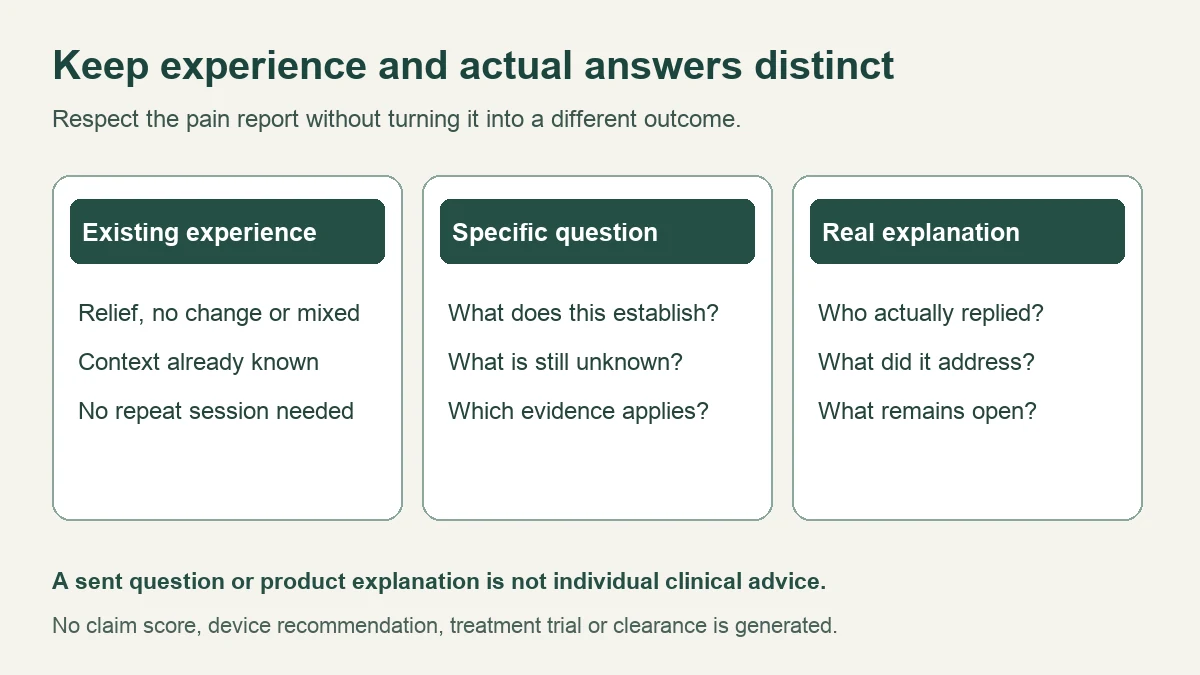
Two fictional TENS claim-reading examples
These are invented writing examples, not actual advertisements, patients, product tests, clinical advice or successful outcomes. Neither chooses a device, diagnoses the reader or supplies a professional answer. They illustrate an inference that remains open, not a reason to buy or begin treatment.
Example A: a general arthritis statement becomes an OA recommendation
| Record | Fictional entry |
|---|---|
| Statement / scope | General information describes temporary arthritis pain relief; a knee OA diagnosis was reportedly explained. |
| Added conclusion | Reader wonders whether the statement means TENS is recommended for their knee OA. |
| Evidence question | Which diagnosis-specific guidance, outcome and alternatives apply? The general statement alone does not answer. |
| Existing experience | Not used. No purchase or trial requested. |
| Actual answer / next step | A question is drafted; sending and professional reply are not claimed. No suitability or benefit conclusion supplied. |
A note could say: “I read a general arthritis-relief statement and may have treated it as a recommendation for my knee OA. Which evidence and alternatives apply to the diagnosis and goal explained to me?” This preserves the source without turning it into individualized advice.
Example B: temporary relief becomes a healing or treatment-change claim
| Record | Fictional entry |
|---|---|
| Actual experience | Temporary relief was reported after use already experienced. No new session requested. |
| Unassessed outcomes | Healing, medicine replacement and activity permission were not established. |
| Added interpretation | Reader wondered whether relief meant the knee had healed or another treatment was unnecessary. |
| Question / contact | Ask what the observation means for the actual care goal. A question was reportedly sent; review is unconfirmed. |
| Actual answer / open issue | No clinical reply supplied. No medicine change, activity clearance or waiting interval inferred. |
A note could say: “The relief I experienced matters to me. I do not know whether it supports any conclusion beyond that experience. What remains uncertain and what individual advice applies to my treatment and activity questions?” A symptom change or safety concern still takes the appropriate care route before a fuller note.
Private TENS claim, evidence question and actual-answer record
Download the offline tool before entering actual health or care details. Use fictional entries here because surrounding advertisements and analytics may be present. The tool itself makes no network requests, uses no browser storage and does not automatically save. The offline copy contains no external assets or automatic network requests.
Begin with one statement. Blank fields generate optional questions, not a truth score, evidence rating or clinical instruction. Omit names, addresses, identifiers, private contacts and full reports. Paper with the same headings is an alternative. Needed care and appropriate advice come before a completed worksheet.
TENS claim, evidence question and actual-answer record
Begin with one statement or interpretation. Blank fields generate optional questions, not a truth score or treatment recommendation.
Download the offline tool before entering actual health or care details. Use fictional entries here; surrounding ads and analytics may be present.
Offline copy. No ads, analytics, external assets or automatic network requests.
The tool makes no network requests, uses no browser storage and does not save automatically. Refreshing may lose entries. Omit names, identifiers, private contacts and full reports. Needed care comes before this record.
Start with the fictional example or download a blank offline copy.
Paper alternative: claim and source; diagnosis and outcome; evidence read; existing experience; interpretation; question; contact; actual explanation; agreed next step and remaining uncertainty.
My TENS claim, evidence question and actual answer
Unverified personal record for discussion. Entries verify no diagnosis, advice, completed change or treatment outcome.
Guide: living.kioptrix.com/tens-unit-for-knee-pain-2/
Build, copy, download text or print/save PDF. Editing hides the previous result until rebuilt. The example buttons replace entries and mark output fictional. Offline exports contain current entries, so keep them private. Refreshing or closing may lose unsaved notes. No actual claim, evidence interpretation, diagnosis or advice is verified by filling every field.
Common questions about TENS for knee pain claims
Does a broad arthritis statement recommend TENS for my knee?
No automatic recommendation follows. Ask which diagnosis, outcome and evidence the statement actually addresses.
Does my relief prove that a guideline is wrong?
Your report should be respected, but it is different from a comparative population-level treatment recommendation. Discuss both without treating either as the other.
Does a limited recommendation mean proven healing?
No. Keep the stated outcome and strength with the source. Do not add unassessed repair or activity conclusions.
Can the tool rate whether a claim is true?
No. It organizes wording, evidence scope, interpretations and questions. It does not independently verify a source or generate a verdict.
Must I try a device before asking?
No purchase, minimum session count or symptom-provoking test is required. Not used is a useful entry.
Where is the individual suitability and use guide?
Use the linked TENS clinical-discussion guide for the broader evidence, suitability, actual instructions and use conversation. This page concentrates on claim interpretation.
Sources, corrections and review limits
Editorial revision and source check: October 30, 2026. The previous short overview is rewritten around claim interpretation. The promotional safety/relief image and duplicated preparation card are replaced. NHS general information is no longer labelled condition- or procedure-specific. No new use programme, electrode map, electrical setting, treatment duration or activity test is supplied. Original URL and publication date are retained.
- NHS TENS information — general temporary-relief information and selected restrictions/skin advice; not an OA treatment recommendation or individual plan.
- NICE NG226, recommendation 1.3.9 — osteoarthritis recommendation against TENS because benefit evidence is insufficient.
- ACR/Arthritis Foundation 2019 guideline, published 2020 — knee/hip OA recommendation against TENS.
- AAOS knee OA guideline, 2021, printed page 46 — limited pain recommendation and its evidence rationale; not proof of healing or functional clearance.
- NHS knee-pain warnings and MedlinePlus emergency guidance — selected symptom education, not a complete triage instrument.
This is a focused document comparison, not a comprehensive systematic review or direct test of a device or advertisement. No independent professional review, reader-outcome study, verified clinical answer or validated claim-rating tool is claimed. The new representative image is an AI-generated fictional evidence discussion; diagrams explain information distinctions. Qualified review and independent reader usability research would strengthen this resource.