

Knee replacement pain management in the first month starts with your actual discharge plan, what happened at home and the surgical team’s real answer. Pain, sleep, swelling, side effects and help with daily life all matter. This guide helps you organize a concern and confirm whether an instructed change was actually carried out; it does not classify your recovery as normal or tell you to change treatment.
Use the six essential checks, compare discharge instructions, actual use, changes and barriers, read two fictional examples, or build a private pain-management and implementation record. You may ask for help with incomplete notes or uncertain timing. A complete medicine list, several days of notes or an activity trial is not a prerequisite for assessment.
Emergency help comes before this record. After surgery, new chest pain, sudden breathing difficulty, coughing blood or collapse needs emergency assessment; a lung clot can occur without obvious leg symptoms. Call 911 for U.S. emergencies. CDC blood-clot guidance. Serious slowed or difficult breathing, severe sleepiness or inability to wake/respond while using opioids also needs emergency help. If you suspect overdose and have naloxone, give it and obtain emergency help immediately even if the person improves. FDA opioid-overdose guidance.
Seek prompt surgical-team or direct clinical assessment for new calf pain or swelling, wound drainage, fever or chills, spreading redness, or worsening pain. Symptoms need not all occur together. If the team cannot be reached, obtain appropriate direct assessment rather than waiting for a routine callback. A single concerning change matters; do not test whether rest, ice or less activity makes it disappear first. NHS knee-replacement complication guidance. These are selected warnings, not a complete triage checklist.
This is U.S.-focused educational preparation from a family-caregiver-run site. The operator is not a medical professional. The article is not an individual assessment, prescription, emergency decision tool or independent medical review. Record the actual operation, including total or partial replacement if known. General total-replacement information does not establish instructions for every procedure or patient.
Table of Contents
Knee replacement pain management: six essential checks
| Check | Actual information to keep | Question to clarify |
|---|---|---|
| 1. Discharge plan | Procedure and current instruction source, including conflicting wording. | Which instruction applies to the actual situation? |
| 2. Actual use | Medicines, wound care, movement, cooling and assistance actually used or received. | What differed from the plan, and what remains unknown? |
| 3. Existing change | Pain, sleep, swelling, side effects or other concern already noticed. | What needs assessment or explanation now? |
| 4. Barrier | Understanding, access, equipment, assistance or another practical difficulty. | What support is actually available? |
| 5. Real clinical answer | Who reviewed the concern and what they actually instructed. | Which point is still unanswered? |
| 6. Change implementation | Explanation, supplies/help and instructed change actually carried out. | Who owns the remaining action or review? |
These checks organize a conversation. They are not a recovery score, a symptom ladder or a treatment sequence. The first month defines the article’s focus; it does not create week-specific expectations or a safe waiting period. A better morning, worse evening or stable-looking trend cannot clear a new concern.
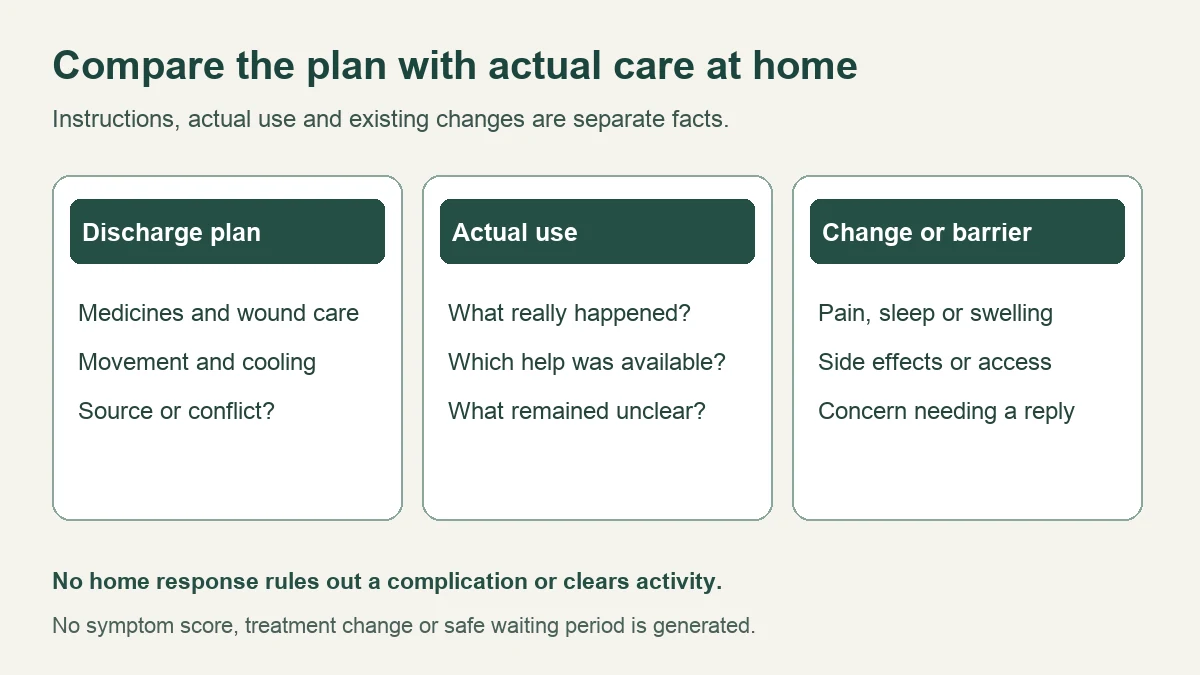
Compare discharge instructions, actual use, changes and barriers
| Area | Instruction and actual use | Change or barrier to communicate |
|---|---|---|
| Pain medicines | Actual name, label/discharge wording and use if known; distinguish scheduled from as-needed instructions. | Inadequate relief, unclear wording, missing supply or an unwanted effect. No dose is inferred. |
| Clot-prevention treatment | Actual medication/device instructions and use, kept separate from pain relief. | Missed/uncertain use, access difficulty or a concern needing a real clinical answer. |
| Wound and dressing | Actual care and bathing instructions; what was really done. | Drainage, spreading redness, unclear dressing advice or unavailable help/supplies. |
| Movement and assistance | Actual weight-bearing, aid, exercise and help instructions; activity already performed. | Unable to follow the plan safely, missing assistance or conflicting instructions. |
| Cooling and swelling measures | Actual device, skin protection, placement and use instructions if supplied; what happened. | Unclear setup, skin concern, lack of help or a change already observed. No duration is generated. |
| Sleep and daily-life burden | Existing pain, rest, sleep disruption and everyday support needs. | What remains difficult and what help was requested or actually received. |
Use existing information rather than reconstructing a perfect schedule. Unknown names, times or instructions can remain unknown until clarified. A difference between the plan and actual use is information to discuss, not a judgment about effort. Do not create a new medicine schedule, cooling duration or walking target from this table.
The purpose of the comparison is to show the team where the plan and real life no longer match. For example, “help was planned” and “help was present” are different facts. “A prescription was issued” and “the medicine was obtained and taken according to clarified instructions” are also different facts. Neither a prescription nor a handout proves implementation.
Keep medicine instructions separate from actual use and relief
AAOS total-knee-replacement education advises taking medicines as directed and discussing nonprescription products and supplements with the doctor. Home medicines can have different purposes, including pain relief and clot prevention. Do not treat a blood thinner as pain medicine or assume that less pain means another prescribed medicine is no longer needed.
Bring the actual label and discharge wording through your clinical service’s appropriate private route if clarification is needed. Ask the prescriber or pharmacist about a discrepancy instead of choosing the instruction that seems easiest. Keep scheduled and as-needed wording distinct; this guide supplies no automatic opioid schedule, extra pre-exercise dose, missed-dose correction or stopping/tapering plan.
Record benefit and burden together: relief, sleep, nausea, constipation, dizziness, unusual sleepiness or difficulty using the plan safely. A symptom does not prove that a medicine caused it, and persistent pain does not by itself establish that the dose should increase. Ask about the actual concern and who should review it. Emergency breathing or responsiveness concerns must not wait for a routine medication discussion.
A useful question is: “Here is the instruction I received, what I actually used and what I noticed. Which instruction applies, and what should I do about the unresolved problem?” No particular symptom vocabulary or pain score is required. The person’s account remains important even without a recognizable timing pattern.
Review swelling, wound care and movement without home diagnosis
Early swelling can occur after replacement. AAOS also advises reporting new or severe swelling and describes wound and clot warning signs. General recovery education does not decide whether an individual warm or swollen knee is expected. Improvement after cooling, elevation, rest or movement does not rule out a complication.
Describe a change already noticed and its timing if known, without assigning it to surgical pain, swelling pain, exercise soreness or overactivity. New calf symptoms need assessment; do not reduce tomorrow’s activity and compare evenings to decide whether they are important. The same principle applies to wound changes and other concerning symptoms. No next-day response rule or several-day trend clears treatment.
Ask the team to explain the actual movement, assistance, exercise, wound and cooling instructions. If they are unclear, conflicting or impractical, retain the question and seek clinical clarification. This page does not increase or reduce exercise, authorize complete rest, select an aid or instruct a new position. Do not push through a significant concerning response to finish a task or produce a log.
Observations about movement may matter alongside pain and sleep, but function does not automatically outrank comfort, side effects or treatment burden. Being able to walk does not erase a concern; difficulty walking does not tell this worksheet why it happened. The team assesses the individual situation, including whether safe assistance or further examination is needed.
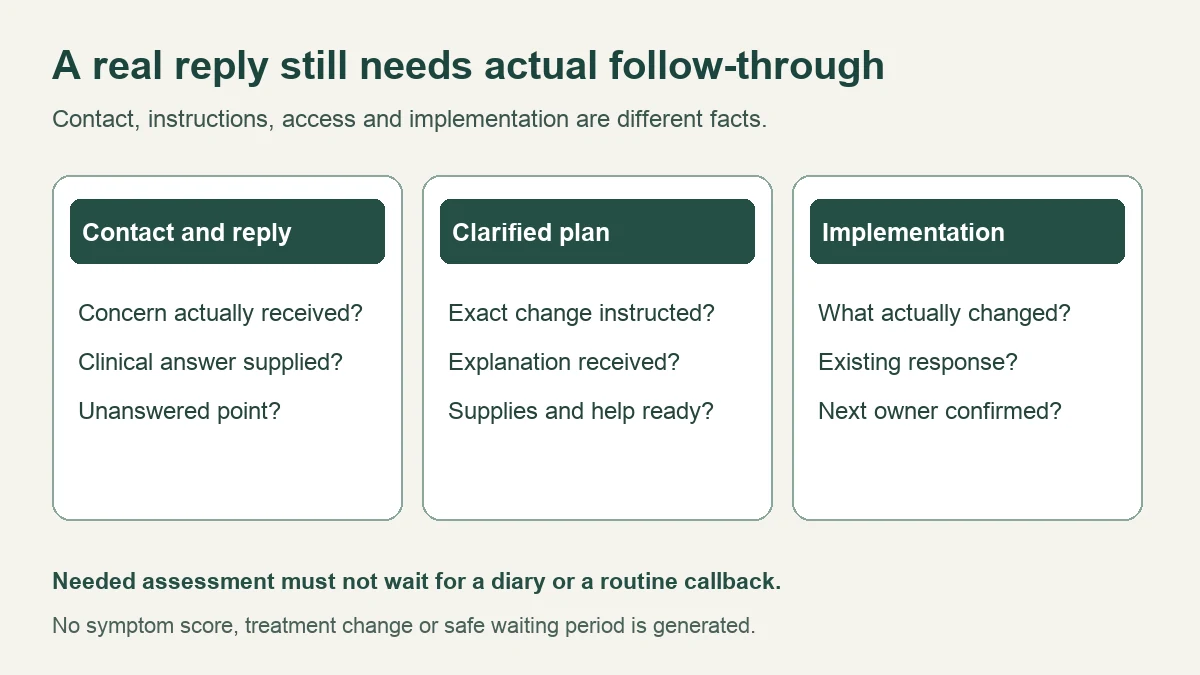
Separate contacting the team from receiving a clinical answer
| Event | Record the actual fact | Do not assume |
|---|---|---|
| Question prepared | Concern and intended recipient. | That anyone has received or assessed it. |
| Contact attempted / received | Actual channel, recipient and acknowledgment, if known. | That a portal receipt or receptionist reply is clinical advice. |
| Clinical answer received | Author/role, what was assessed and actual instructions. | That a later change or unanswered concern is covered. |
| Direct assessment sought | Where care was sought and what actually occurred, without identifying details in this tool. | That a request, arrival or booking equals completed assessment. |
| Pending point | Unanswered issue and actual clinical contact arrangement. | That silence means the symptom is safe or can wait. |
Use the actual discharge contact route, including any after-hours instructions. New urgent concerns need appropriate assessment even if a message has already been sent. No reply deadline or safe waiting interval is supplied here. If a person cannot be reached, the unanswered message is a gap to address, not reassurance.
The surgeon’s team, therapist, prescriber, pharmacist and scheduling office have different roles. Record the actual scope of the answer rather than treating them as interchangeable. A therapist’s exercise discussion does not establish that a wound concern received surgical review. Administrative confirmation does not replace a clinical answer about a new change.
A supporter can help retain instructions and communicate with the patient’s permission and within the agreed role. Keep the patient’s own priorities visible. Do not assume that the supporter knows the medicine schedule, can provide physical assistance or has accepted an ongoing task simply because they attended an appointment.
Confirm instructed changes, support and actual implementation
A change discussed is not necessarily a change instructed. Retain the real author, wording and scope, including which prior instruction was clarified or replaced. If a conflict remains, ask the relevant clinical team rather than combining directions yourself. Do not use this record to rewrite a prescription or exercise program.
| Implementation fact | What to retain | Unconfirmed gap |
|---|---|---|
| Instruction | Actual change and source; which previous wording was addressed. | Discussion only, wording missing or conflict unresolved. |
| Explanation / access | Teaching, medicine, equipment or assistance actually received. | New sheet, issued prescription or planned help without confirmation. |
| Actual action | What was really done under the clarified plan, if known. | Implementation not observed or not yet recorded. |
| Existing response | Benefit, burden or new concern already noticed. | No causal conclusion and no required trial interval. |
| Next owner | Actual review/contact advice and who accepted the next action. | No owner or arrangement confirmed; no deadline invented. |
If the instructed plan cannot be used because a medicine, device or helper is unavailable, tell the appropriate clinical/support contact what is missing. Do not invent a substitute to complete the worksheet. Record help requested separately from help offered, accepted and actually provided. Needed assessment must not wait for access, insurance answers or proof that a change failed.
This guide connects first-month knee-surgery discharge instructions, actual pain-management use and the surgical team’s reply. The therapy-plan review guide focuses on an existing program across sessions and its goals. The post-therapy change guide focuses on an individual episode and contact. They do not supply recovery milestones or choose treatment for a postoperative concern.
Two fictional first-month knee-recovery writing examples
These are invented documentation examples, not real patient stories, prescriptions or outcomes. Neither example concludes that symptoms are expected or that treatment is effective. Example buttons replace entries and identify output as fictional. Use unknown or pending where the real facts are unavailable.
Example A: inadequate relief and unclear medicine instructions
| Area | Fictional entry |
|---|---|
| Discharge / actual use | Scheduled versus as-needed wording unclear. Exact medicine, dose and use details not supplied; none invented. |
| Existing concern / barrier | Pain relief feels inadequate and sleep is disrupted. Instruction conflict needs clarification. |
| Contact / real answer | Question prepared about applicable instructions and inadequate relief; not yet sent. No clinical answer supplied. |
| Change / implementation | No change confirmed or authorized by this example. Actual clinical clarification and next owner remain to be obtained. |
The useful question is: “Which instruction applies, and how should this unresolved pain-control concern be assessed?” The example does not convert as-needed medicine to scheduled use, add a dose before exercise or decide that another night of observation is safe.
Example B: new calf concern, prompt assessment sought
| Area | Fictional entry |
|---|---|
| Existing change | New calf pain and swelling reported; no diagnosis assigned. |
| Action actually recorded | Prompt direct assessment sought rather than waiting for a diary or routine callback. Assessment completion remains unconfirmed. |
| Actual clinical answer | No findings or instructions supplied. Seeking care is not a completed evaluation. |
| Next record | Retain real assessment and instructions when received. New chest pain, breathing difficulty or collapse requires emergency help, not a routine message. |
The record does not test whether ice, rest or a different walking amount improves the calf symptoms. It does not claim that a clot was found or ruled out. The purpose is accurate communication without allowing a worksheet to delay care.
Private pain-management, real-answer and implementation tool
Download the offline copy before entering actual health or medicine details. Use fictional notes on this page because surrounding ads or analytics may be present. The tool makes no network requests, uses no browser storage and does not automatically save. The downloaded copy contains no external assets or automatic network requests. Keep completed files private.
Use one current concern and its related plan. Omit names, contact details, insurance identifiers and full clinical documents. Unknown, not asked and not yet confirmed are valid. Blank fields produce optional questions, not a symptom or recovery score. Paper using the same headings is an alternative; you never need to finish the form to ask for help.
Knee replacement pain management, real-answer and change-implementation record
Connect actual discharge instructions and use with existing changes, barriers, clinical replies and confirmed changes actually carried out. No symptom is scored or treatment selected.
Download the offline tool before entering actual health or medicine details. Use fictional entries here; the surrounding page may contain ads and analytics.
Offline copy. No ads, analytics, external assets or automatic network requests.
This tool makes no network requests, uses no browser storage and does not automatically save. Refreshing may lose entries. Keep exports private and omit identifying details. Needed assessment must not wait for a diary or a routine answer.
Start with the fictional example or download a blank offline copy.
Paper alternative: discharge instructions; actual medicines; clot prevention and wound care; movement; observations; barriers; contact; actual reply; change; support; implementation; next owner.
My knee recovery, real-answer and implementation record
Unverified personal record for discussion. Entries verify no prescription, safety, clinical answer or implementation.
Guide: living.kioptrix.com/knee-replacement-pain-management/
Build the record, then copy, download text or print. Editing a field hides the old output until rebuilt. Offline exports retain current entries, so keep them private; refreshing or closing may lose unsaved work. The tool sends nothing and verifies no prescription, clinical answer, safety or implementation.
Common questions about first-month knee pain management
Does the week after surgery tell me whether pain is normal?
No. The month is the scope of this guide, not a pass/fail calendar. Describe current concerns and seek the appropriate actual assessment without waiting for a trend.
Can improvement after ice rule out a clot or infection?
No. A response to a home measure is not diagnostic clearance. New or concerning changes need assessment rather than a home trial.
Should I change medicine or activity while using this record?
This record makes no treatment change. Obtain actual clarification of instructions and unresolved concerns; do not push through significant concerning symptoms to finish it.
Do I need three days of notes?
No. Start with what is already known. Incomplete recall and an unfinished diary do not make a concern less legitimate or justify delaying assessment.
Does a new prescription mean the plan was implemented?
No. Keep issued instructions, explanation, access, actual use and observed response separate.
Does the article cover partial and total replacement identically?
No. Record the actual operation. The AAOS source concerns total replacement; the treating team must clarify instructions appropriate to your procedure and situation.
Sources, corrections and review limits
Sources checked: October 30, 2026. This revision removes week-based recovery tiers, arithmetic/activity-burst prompts, a three-day record expectation, symptom-based home adjustment rules, function-first language and the unverified patient anecdote. Repeated decorative images and the unverified instructional-video embed are replaced by topic-specific illustrations and documentation examples.
- AAOS: Activities After Total Knee Replacement — total-replacement home recovery, medicine and wound instructions and warning signs. Not an individual prescription or a protocol for every partial replacement.
- NHS: Complications of a knee replacement — selected urgent postoperative changes. UK service routes are not U.S. contact or coverage rules.
- CDC: About Venous Thromboembolism — clot warnings, prompt/immediate assessment and the need for diagnostic testing; not home symptom clearance.
- FDA: Naloxone discussion and opioid-overdose guidance — emergency recognition and response; not a postoperative dosing or tapering schedule.
This is document-based editorial education, not independent medical review or a tested clinical decision instrument. No real patient experience, treatment outcome or usability study is claimed. The fictional representative image is illustrative. The record helps preserve existing information and real replies; it cannot determine a cause, replace examination or promise recovery.