

When physical therapy does not feel helpful, ask for a review of the actual goal, current instructions, treatment received and concerns already observed. A plateau alone does not establish failure. Goals may include recovery, relief, maintenance or preventing decline, according to the actual plan. Your pain, sleep, function and treatment burden all matter. The useful outcome is an explanation and a plan you understand, with any agreed change actually implemented.
Use the six essential review checks, compare goals, instructions, actual performance, observations and barriers, read two fictional examples, or build a review and implementation record. There is no required number of sessions, week threshold, improvement percentage, function-count score or universal flare window before seeking needed assessment.
Urgent or emergency concerns must not wait for a routine therapy review or diary. With back pain, new difficulty urinating or bladder/bowel control changes, numbness around the genitals or anus, symptoms such as weakness or numbness in both legs, chest pain or pain after a serious accident need emergency assessment. Use appropriate local emergency services, including 911 for U.S. emergencies. NHS back-pain warnings.
A suddenly very painful, swollen or hot joint needs urgent assessment even without fever. New one-sided leg pain and swelling needs prompt assessment for a possible clot. Sudden breathing difficulty, chest pain, coughing blood or collapse can require emergency care. Do not continue a provoking activity to finish a log or wait for a routine appointment. These are selected examples, not a complete triage list. Joint-infection guidance, DVT guidance and pulmonary-embolism guidance.
This is U.S.-focused education from a caregiver-run site, not individual medical, exercise or insurance advice. The operator is not a medical professional. Your therapist and relevant medical team assess the actual concern and instructions. The worksheet does not decide whether to continue, stop or change treatment. An incomplete account or inability to explain a pattern does not make your concern less legitimate.
Table of Contents
Physical therapy plan review: six essential checks
| Check | Actual information to retain | Question to clarify |
|---|---|---|
| 1. Goal | What the team actually explained, with the source. | What are we trying to achieve or maintain? |
| 2. Instructions | Current treatment/home plan and unclear wording. | Which instruction needs explanation or review? |
| 3. Actual delivery | Clinic treatment received and home activity actually performed. | Does the plan record reflect what actually happened? |
| 4. Observations and barriers | Pain, sleep, function, burden and difficulties already noticed. | Which concern or support need remains unresolved? |
| 5. Real answer | Review received and therapist/medical explanation actually given. | What was addressed and what is pending? |
| 6. Change implementation | Change agreed, teaching received and actual implementation. | Who owns the next action, and what remains unconfirmed? |
These are discussion categories, not a treatment sequence or a validated effectiveness scale. Start with existing information; no full diary, successful home trial or perfect recall is required. Do not test a task or repeat an exercise to establish whether the program is helping.
Compare goals, instructions, actual performance and barriers
| Area | Record the actual information | Keep the interpretation open |
|---|---|---|
| Treatment goal | Relief, recovery, maintenance or decline prevention only as explained. | No improvement does not automatically establish failure; an unclear goal is a question. |
| Clinic and home instructions | Actual wording, source, restrictions and unclear or conflicting point. | A general exercise label does not establish dose or personal suitability. |
| Actual performance | What was actually received or performed, including omissions or differences if known. | A difference is information, not a compliance score or proof of why symptoms persist. |
| Existing observations | Pain, sleep, ordinary function, benefit, burden and timing if remembered. | No single dimension automatically outweighs the others or diagnoses a cause. |
| Practical barrier | Pain, access, teaching, equipment, time, communication or another difficulty. | A barrier is a reason to seek clarification/support, not a character judgment. |
| Requested help | What was asked, actually offered and received. | Support requested or a replacement handout is not completed teaching or implementation. |
Keep the planned activity separate from the actual activity. A clinic session, a home instruction sheet and what happened at home are different facts. You can write that details are unknown. Do not guess a dose, frequency or exercise name to make the record look complete, and do not invent treatment failure to obtain imaging or another service.
Describe burden as well as benefit. Pain relief matters even if function has not changed; function or stability may matter even when pain persists. Distress, sleep disruption and practical limitations belong in the discussion. MedlinePlus pain information describes multiple dimensions of assessment rather than a function-first hierarchy.
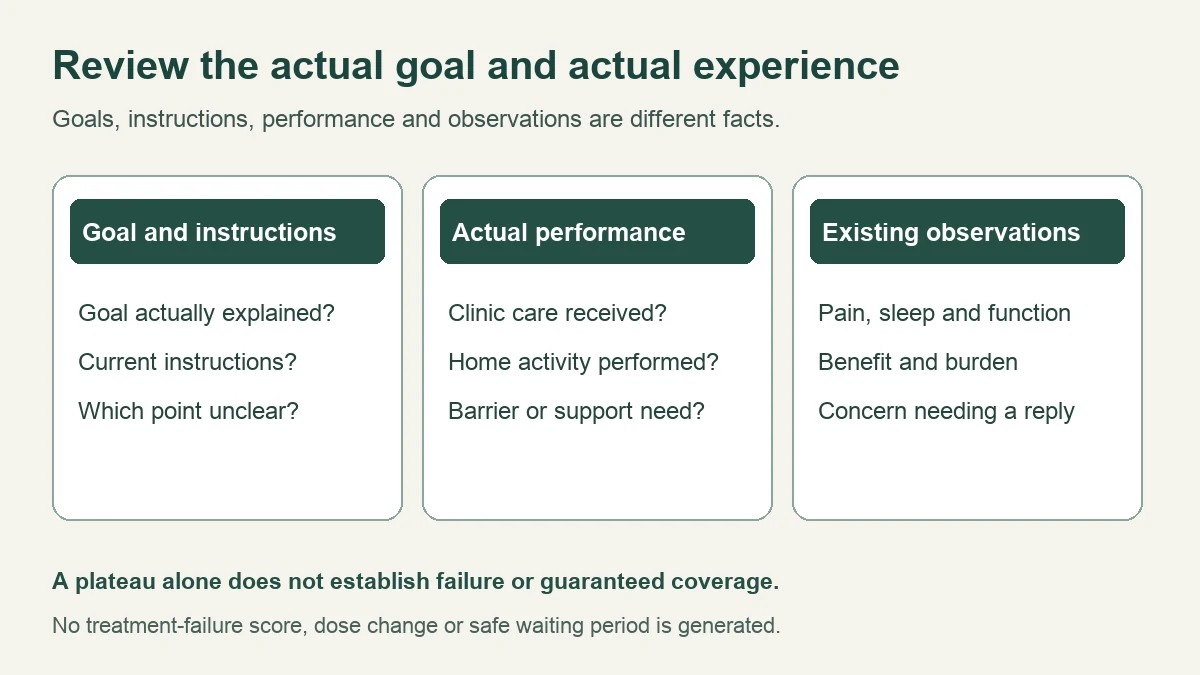
Clarify the actual goal without turning a plateau into a verdict
Ask which goal is being reviewed and what the treating team expected to observe in your particular plan. If the explanation is incomplete, record that gap. A program intended to maintain function cannot be judged solely by whether a new task became possible, and a partial benefit does not erase an unresolved concern or burden.
For Medicare, CMS Jimmo guidance explains that covered skilled therapy does not turn solely on potential for improvement; the need for skilled care and other applicable requirements matter. This is a coverage principle, not proof that every plateaued program is effective, that your current care should continue unchanged or that another block of visits will be covered. Keep the clinical review and actual insurance answer separate.
A change in symptoms, poor understanding, lack of access or mismatch between instructions and daily circumstances may need review. The article cannot identify which factor caused the response. Do not select wrong diagnosis, wrong dose or poor effort from a checklist; retain the clinical explanation actually given and any uncertainty.
Record existing experience without testing or changing the program yourself
Use events already observed: what happened during the actual clinic/home activity, what happened afterward if remembered and what remains concerning. You do not need a precise percentage, a fixed number of affected tasks or several weeks of notes. Unknown timing is preferable to a guessed threshold.
There is no universal soreness duration that clears an exercise or decides an injury here. Report repeated or concerning changes to the appropriate team and preserve its condition-specific advice. Do not keep provoking a movement to see whether it settles within a set window. Needed urgent assessment comes before routine reporting.
The worksheet does not authorize more exercise, less exercise, total rest, a medicine change, a new device or stopping all care. Ask the treating team to clarify the actual plan and conflicting instructions. If a task is provoking a significant concerning change, do not push through it to complete the record; seek appropriate clinical advice or urgent assessment as needed.
A note can say: “These were the instructions I received. This is what actually happened and this is the concern or barrier. Which goal are we reviewing, and does the plan need clarification or reassessment?” A polished description is not required. You may ask for help even if you cannot identify a trigger.
Ask for a review and preserve the real therapist or medical answer
| Event | Record what actually happened | Do not assume |
|---|---|---|
| Question prepared | Concern and intended recipient. | That a contact has occurred. |
| Contact made | Actual recipient/channel and acknowledgment if received. | That the concern has been clinically reviewed. |
| Clinical review received | Actual therapist or medical explanation and its scope. | That an unanswered concern or later change has been addressed. |
| Administrative answer | Scheduling, records or insurance information actually supplied. | Treatment advice, clinical effectiveness or safe waiting. |
| No or partial response | The pending point and actual contact arrangement known. | That silence means the program is appropriate or concerns can wait. |
A therapy-plan review and a medical reassessment can involve different roles. Ask who should address the specific unresolved question and how information will be shared with the relevant team. Do not assume an orthopedic specialist is always required or that a therapist’s message establishes a completed medical review.
If a new assessment, imaging, medication review, another service or a procedure is discussed, retain its actual purpose, reasons and conditions. The article assigns no low/moderate/high waste risk and no universal treatment ladder. A named option is not a recommendation for you. Ask what question it addresses and who owns the next step.
Confirm agreed changes, teaching and actual implementation
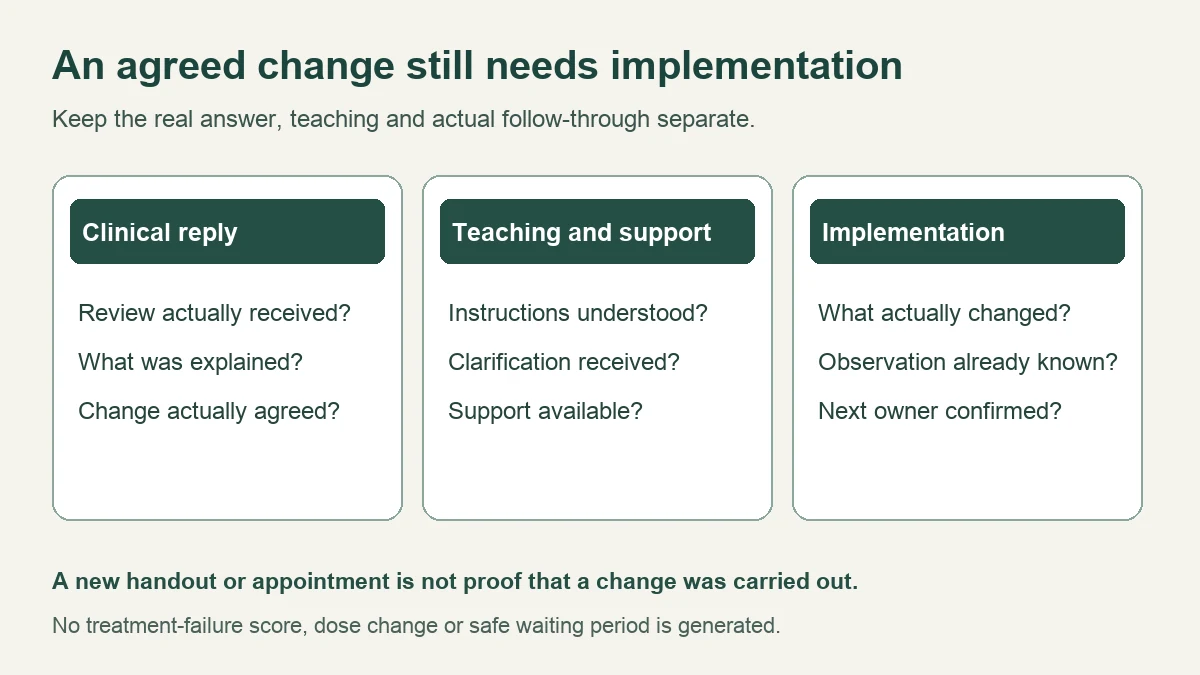
For a proposed change, record who proposed it, what was actually agreed and the instructions supplied. A discussion is not an agreement; an agreement is not implementation. If wording is unclear or conflicts with an existing restriction, ask for clinical clarification rather than choosing between instructions yourself.
Record teaching or explanation actually received, whether you understood it and what still needs help. Do not rehearse a painful movement just to certify understanding for this worksheet. A new handout, video link or booking does not prove that the plan was explained or that support was available.
| Change-related fact | Actual confirmation to retain | Remaining question |
|---|---|---|
| Change proposed / agreed | Author, scope and real instructions. | Was this only discussed or actually agreed? |
| Education / support | Clarification or assistance actually received. | Which point is still unclear or impractical? |
| Implementation | What was actually done differently and by whom, if known. | Has the agreed arrangement actually occurred? |
| Observation afterward | Effects already noticed without testing the change for this record. | What concern needs a real response? |
| Next review / contact | Actual responsible role and contact/review advice. | Who handles a pending question or barrier? |
There is no fixed implementation trial or safe waiting interval here. Retain the actual review arrangement without treating it as reassurance about a new concern. Appropriate assessment must not wait for a complete log, routine callback, insurance answer or demonstration that a change has failed.
This page reviews an existing physical therapy program across sessions and the follow-through of agreed changes. Our post-therapy change guide concerns an individual episode and contact; our MRI discussion guide concerns the imaging conversation. The referral-status guide addresses specialist access and current clinical contact. None establishes a treatment-failure threshold.
Two fictional therapy-review and implementation examples
These are invented documentation examples, not real patient stories, instructions or recovery outcomes. They do not establish that treatment worked or failed. Example buttons replace entries and mark generated output fictional. Unknown and pending remain valid.
Example A: partial relief, actual goal still unclear
| Area | Fictional entry |
|---|---|
| Goal / delivery | Actual goal unclear; some prescribed care reportedly received, with details not supplied. No adherence rating. |
| Observation | Some pain relief reported, but remaining concern and treatment burden still need discussion. No percentage invented. |
| Question / actual review | Goal-and-response question prepared, not sent. No review or effectiveness conclusion supplied. |
| Next owner | Record the actual goal explanation, unresolved concern and agreed next owner; no failed-treatment label. |
This example does not assume that maintenance is the goal or that partial relief is enough. Those points need the actual clinical explanation and the patient’s concerns. No further trial is required by the example.
Example B: instruction barrier, change implementation unconfirmed
| Area | Fictional entry |
|---|---|
| Instructions / performance | Home wording unclear and a practical barrier affects part of the plan. Actual activity differs; no exercise dose invented. |
| Request / actual answer | Clarification and review requested; receipt or clinical review unconfirmed. |
| Change / teaching | Possible change discussed, but exact instructions and agreement not confirmed. No teaching recorded. |
| Implementation / next owner | No change confirmed as implemented and no response outcome supplied. Clinical clarification and an implementation owner remain to be confirmed. |
A plan that was not understood or practically available should not be counted as a successful trial or blamed on the patient. This record identifies the information and support gap without diagnosing why pain persists or supplying a replacement program.
Private therapy review, real-answer and implementation tool
Download an offline copy before entering actual health or therapy details. Use fictional notes on this page because surrounding ads or analytics may be present. The tool makes no network requests, uses no browser storage and does not automatically save. Its offline file has no external assets or automatic network requests. Keep completed copies private.
Use one current program and related concern per record. Omit names, account identifiers and complete reports. Unknown, not asked, pending or not applicable according to an actual answer are valid. A paper note with the same headings works; a complete form is not a prerequisite for help.
Physical therapy plan review, real-answer and change-implementation record
Connect actual goals and instructions with real performance, existing observations, the clinical answer and agreed changes actually implemented. No treatment is scored or selected.
Download the offline tool before entering actual health or therapy details. Use fictional entries here; the surrounding page may contain ads and analytics.
Offline copy. No ads, analytics, external assets or automatic network requests.
The tool makes no network requests, uses no browser storage and does not automatically save. Refreshing may lose entries. Omit names, identifiers and full records; keep exports private. Needed assessment must not wait for this form, a diary or an insurance answer.
Start with the fictional example or download a blank offline copy.
Paper alternative: goal; instructions; actual performance; barrier; observations; contact; review; actual answer; agreed change; teaching; implementation; next owner.
My therapy plan, real-answer and implementation record
Unverified personal record for discussion. Entries verify no clinical goal, treatment instruction, effectiveness or implementation.
Guide: living.kioptrix.com/physical-therapy-not-helping-orthopedic-pain/
Build again after editing, then copy, download text or print. Offline exports include current entries; closing or refreshing may lose unsaved notes. Blank items create optional questions rather than urgency or treatment-failure points. Nothing is submitted, prescribed or clinically verified.
Common questions about physical therapy plan review
Does a plateau mean therapy failed?
Not automatically. Clarify the actual goal, benefit, burden and current concern with the team. This page does not decide effectiveness or continued coverage.
How many weeks or sessions should I complete before asking for review?
No universal threshold is supplied. Bring existing concerns and actual instructions; needed assessment must not wait for a diary or fixed treatment block.
Should I increase, reduce or stop exercise?
The tool makes no such decision. Ask the treating team about actual instructions and concerning changes; do not push through a significant concerning response for a log.
Does lack of improvement mean Medicare will stop paying?
CMS says skilled-care coverage is not based solely on improvement potential; other requirements still apply. Actual coverage needs the relevant service and plan answer.
Does a new instruction sheet prove the change was implemented?
No. Record the explanation and support actually received, what was really done and the next responsible role.
Does a program review mean MRI or surgery is next?
No universal progression applies. Preserve the actual clinical explanation and any proposed assessment purpose without a treatment or cost hierarchy.
Sources, corrections and review limits
Sources checked: October 30, 2026. This revision removes the weeks/function-count calculator, unsupported waste-risk ranking, pain-versus-function hierarchy and unverified reader outcome story. It separates goals, actual instructions, performance, observations, barriers, clinical replies and implementation of changes.
- CMS: Jimmo Settlement — Medicare skilled-care coverage and maintenance principles; not a verdict on individual treatment effectiveness or guaranteed coverage.
- MedlinePlus: Pain — multiple dimensions of pain reporting and clinical assessment; not a function-first measure.
- NHS: Back pain, septic arthritis, DVT and pulmonary embolism — selected warning-sign education. UK sources do not set U.S. access or insurance rules.
- AAOS: Low Back Pain and ACR: Low Back Pain — background for that body region and specific scenarios, not an all-body physical therapy review protocol. No exercise dose, waiting period or treatment sequence is derived from them here.
This is document-based editorial education, not independent medical review or testing of a clinic’s treatment. The record is not a validated clinical decision instrument. Actual clinicians assess the concern; relevant offices and plans explain their own requirements. No diagnosis, timing, cost saving, coverage or recovery outcome is predicted.