

An orthopedic visit with a parent works better as a shared conversation than a transfer of control to an adult child. Ask which question the parent wants addressed, what help they want and what they prefer to discuss privately. Then separate the actual clinical answer from practical support that someone has really agreed to provide. This guide records those distinctions; it does not assess decision-making ability or create authority to act for anyone.
Use the six essential companion checks, compare participation and sharing roles, read two fictional writing examples, or build the parent agenda, actual-answer and support-acceptance record. Its focus is this particular orthopedic appointment and its agreed follow-up, rather than a general pain-monitoring or home-care plan.
This is U.S.-focused education from a family-caregiver-run site. The operator is not a medical, legal or insurance professional. The parent’s preferences, actual clinical advice and the service’s applicable procedures matter. Age, hearing difficulty, memory concerns or needing transport do not by themselves authorize an adult child to answer, access records or make decisions. Needed assessment must not wait for a completed worksheet or family agreement.
Table of Contents
Orthopedic visit with a parent: six essential companion checks
| Check | Record what is actually known | Question to agree or clarify |
|---|---|---|
| 1. Parent agenda | Their own question, priority and words. | What would you most like explained today? |
| 2. Companion scope | Attendance, notes, speaking help and private time wanted. | What help would you like, and what would you rather do yourself? |
| 3. Communication and sharing | Support requested and actual office arrangements. | What needs arranging so you can take part comfortably? |
| 4. Actual answer | Question asked, clinician explanation and uncertainty. | What remains unclear, and would you like it explained again? |
| 5. Support acceptance | Wanted practical task, proposed helper and actual acceptance. | Is this help wanted, feasible and actually agreed? |
| 6. Completion and next owner | What was arranged or completed; real reply and remaining task. | Who agreed to do what next, and what support remains unfilled? |
These are preparation categories, not a test of the parent or a required order of care. Unknown, not discussed and pending are acceptable. No one has to complete a form to deserve care. Keep the parent involved to the extent they want and can participate, and ask the service about appropriate support or representation when that is uncertain; the worksheet cannot decide it.
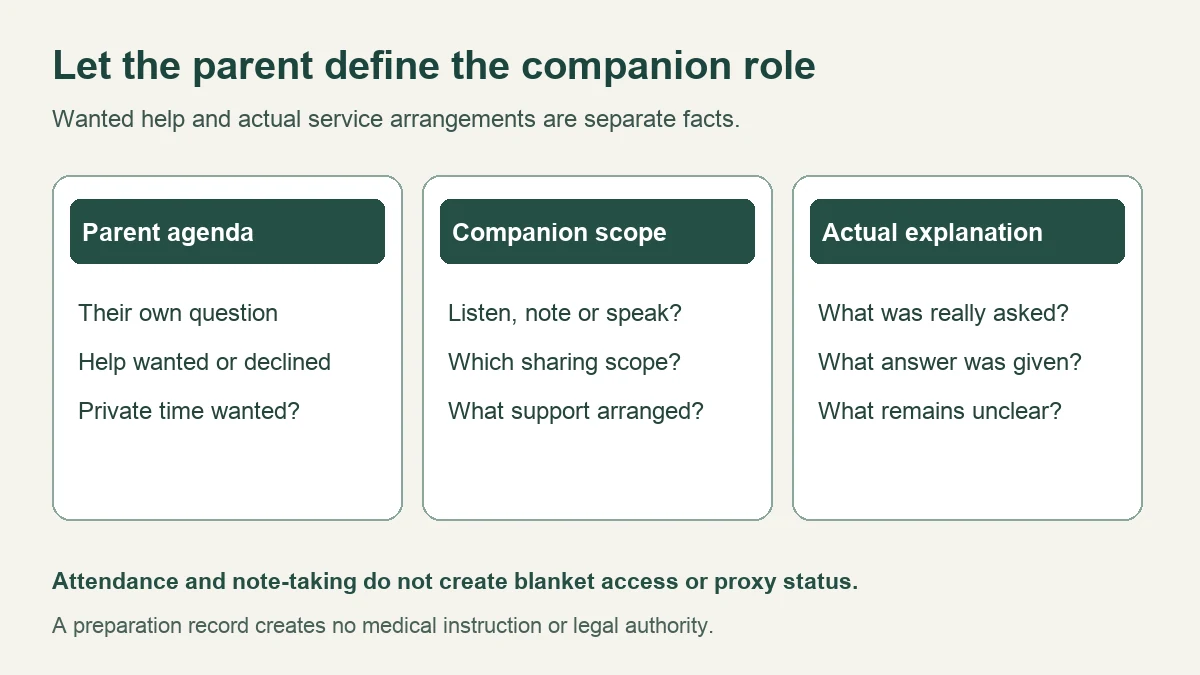
Separate wanted participation, information sharing and decision authority
NIA’s appointment-companion guidance encourages letting the older adult answer, including them in the conversation and respecting private discussion. Apply that as support, not a demand that someone speak without help. Ask which tasks are wanted rather than assuming that accompanying a parent means taking over the visit.
| Role or permission question | What to clarify | What this record does not create |
|---|---|---|
| Attend the consultation | Whether the parent wants the companion present and for which parts. | Permission to answer every question or remain during private discussion. |
| Take notes or supplement history | What help the parent wants and how sources will be identified. | A more authoritative account than the parent’s own report. |
| Hear relevant information during the visit | Parent preference and the actual service’s sharing arrangements. | Blanket disclosure of every detail. |
| Contact the team or access a portal later | Actual permitted route, scope and office requirements. | Independent access from a note-taking role or shared family relationship. |
| Make a decision for the parent | Applicable authority and assessment explained by appropriate professionals. | Proxy status, a power of attorney or a finding about decision-making ability. |
HHS explains that HIPAA permits relevant family communication in specified circumstances, including agreement, no objection or professional judgment. It does not automatically require a provider to disclose information to every relative. The detailed HHS family-communication FAQ limits sharing to information relevant to the person’s involvement. This is not a blanket right to a record or to decide treatment.
Do not turn this into a rule that every conversation needs a signed waiver. Ask the office which actual procedure applies to attendance, later calls or record access. Likewise, do not use silence or presence as your own proof of unlimited permission; professional rules and judgment apply. Record preferences and verified arrangements without announcing a legal conclusion.
If preferences change, revisit the arrangement. Ask whether the parent wants a private part of the visit. If help or representation is needed because participation is difficult, involve the appropriate service rather than judging capacity from age or completing a home test. This guide supplies no substitute decision-maker selection or consent assessment.
Prepare communication and existing material without replacing the parent’s account
Ask what communication support the parent wants. An interpreter, hearing or vision support, accessible written information or another arrangement may need advance discussion with the office. A family member should not be assumed to replace whatever professional communication support is needed. NIA includes communication support in its appointment preparation advice; actual arrangements still need confirmation.
Keep three sources distinct: the parent’s words, the helper’s observations and the clinician’s explanation. For example, a parent may describe severe pain while a helper reports that a daily task was completed. Those statements do not automatically conflict; functioning does not invalidate pain. Preserve both without deciding who is more credible. Mark approximate dates and later recollections honestly.
For this orthopedic appointment, relevant existing material may include prior visit summaries, reports or image access, current activity/device instructions and questions about change. Ask the service what it needs and what it actually received. A report available to the family does not prove the clinician can access the images. No new test, painful task or repeated treatment is required to make the notes complete.
With appropriate permission, help bring an accurate medicines list rather than relying on memory. FDA recommends recording medicines and supplements, amounts, timing and relevant prescription information. Ask the clinician or pharmacist about uncertainties; do not guess an unclear dose or independently change treatment. FDA medication safety for older adults. Keep the actual list private rather than entering it on a public webpage.
Capture the actual orthopedic explanation and the question still unanswered
Write what was actually asked and what was really explained, with the source. A question prepared in advance is not necessarily discussed. A proposed test or treatment is not the same as a completed service or an instruction to begin it. Leave a missing answer marked rather than filling it with a generic guideline or a family member’s expectation.
| Orthopedic discussion | Useful actual-answer note | Point to clarify if unresolved |
|---|---|---|
| Assessment and uncertainty | What the clinician explained and what remains uncertain. | Which question does the current assessment answer? |
| Activity or support device | Actual instruction, date/source and scope. | Is any wording about activity or device use unclear? |
| Medicines | Actual explanation of any change and who manages it. | Which clinician or pharmacist should clarify the real plan? |
| Rehabilitation or procedure proposal | What was actually recommended and its stated purpose. | What was proposed, agreed, ordered or scheduled? |
| Test results and reassessment | Who checks/explains results and what follow-up advice was received. | Which role owns an outstanding explanation or reassessment? |
Ask the parent whether the explanation matches what they understood and whether they want clarification. A restatement can identify unclear wording without turning the moment into a memory test. Ask the clinician for clarification or appropriate written information; a companion’s polished summary is not proof of understanding or informed consent.
Keep conflicting instructions with their sources and ask the relevant professionals to reconcile them. The article creates no exercise progression, medicine change, brace schedule or loading permission. Preserve the actual contact and return advice. New or concerning symptoms need appropriate assessment without waiting for a family discussion, a routine reply or a complete record.
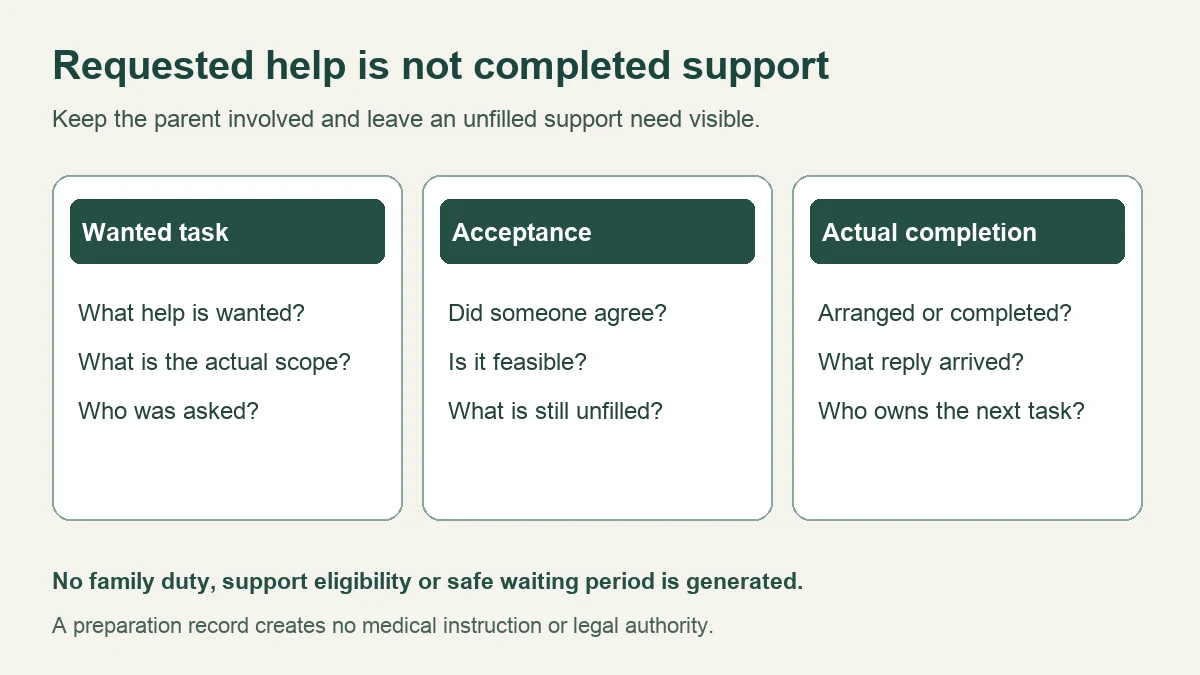
Support requested is not support accepted or completed
Separate a clinical instruction from a practical task. “The clinician recommended follow-up” is different from “the parent wants help booking it,” which is different again from “a helper has accepted and completed that task.” This is the central distinction that makes the companion record useful after the orthopedic visit.
| Status | What to record | Avoid assuming |
|---|---|---|
| Wanted by the parent | Task and scope of assistance desired. | That help is wanted simply because the family thinks it is useful. |
| Proposed to a helper | Who was asked, what was requested and whether an answer exists. | That naming someone assigns responsibility. |
| Accepted and feasible | Actual agreement, practical limits and any remaining gap. | That a family relationship creates an obligation or capacity to perform the task. |
| Arranged or completed | What actually happened and what remains outstanding. | That accepting transport means the appointment was booked or attended. |
| Unable to proceed / changed | The real barrier, parent preference and actual contact or reply. | That failure to secure help makes the parent or helper uncooperative. |
If no one can accept a wanted task, leave the support gap visible. With the parent involved as appropriate, ask the relevant service about possible practical assistance and record the real answer. Availability and eligibility are not promised. Do not create a care delay while trying to allocate every task or push a helper into a clinical responsibility they cannot perform.
A next-action note should distinguish a proposed owner from an actual agreement. If a plan changes, update the practical arrangement and preserve relevant clinical instructions rather than rewriting them. Confirm the private sharing route and scope before circulating summaries among relatives. A family group chat is not automatically an authorized destination for all clinical details.
Two fictional parent-led companion writing examples
These invented examples show documentation, not clinical or legal decisions. They contain no real parent, permission, instruction or outcome. Example buttons replace entries and mark the output fictional. No one’s decision-making ability or treatment choice is assessed.
Example A: parent speaks, companion takes notes
| Record area | Fictional entry |
|---|---|
| Agenda / wanted help | Parent wants to ask their own question and requests note-taking only. Companion is not asked to answer for them. |
| Sharing / private time | Private discussion remains available. Later phone or portal access has not been arranged. |
| Sources / actual answer | Keep parent words and helper observations separate. Question prepared; no real clinician answer supplied. |
| Next action | Record actual clarification and wanted assistance. No proxy authority or task clearance generated. |
The example does not make the parent prove independence or forbid help. It preserves the specific role requested and leaves a later communication arrangement unconfirmed until it is actually established.
Example B: transport help wanted, but no helper has accepted
| Record area | Fictional entry |
|---|---|
| Parent priority / task | Parent wants assistance arranging recommended follow-up and transport. No clinical instructions are supplied by the example. |
| Acceptance / feasibility | First proposed helper cannot commit; no alternative helper has accepted. |
| Completion / actual reply | No booking or transport completed. Question about practical support prepared, not sent; no assistance confirmed. |
| Next owner | With the parent involved, record actual service replies and a feasible owner agreed. No waiting advice, family duty or support eligibility inferred. |
The useful result is a visible support gap and an accurate question. It is not a judgment about family commitment or permission to postpone needed assessment.
Private parent agenda, actual-answer and support-acceptance tool
Download the offline tool before entering real health, family or personal information. Use fictional entries here because the page may contain ads and analytics. The tool uses no network requests, browser storage or automatic saving. Its offline file contains no external assets or automatic network requests. Keep completed copies and exports private.
Use one appointment or follow-up discussion per record. Unknown, not discussed, pending and declined are valid statuses. Omit names, identifiers and complete records. The record is a discussion aid, not a consent document, portal authorization, legal instrument or capacity assessment. A paper note using the same headings works.
Parent agenda, companion scope, actual-answer and support-acceptance record
Keep wanted help, sharing preferences, real answers and support actually accepted distinct. This record creates no clinical or legal authority.
Download the offline tool before entering actual health or family details. Use fictional entries here; this page may contain ads and analytics.
Offline copy. No ads, analytics, external assets or automatic network requests.
No network requests, browser storage or automatic saving. Refreshing may lose entries. Omit names, identifiers and full records; keep exports private. Needed care must not wait for a family agreement or complete record.
Start with the fictional example or download a blank offline copy.
Paper alternative: parent priority; wanted help; sharing scope; communication support; sources; existing material; question; actual answer; support task; acceptance; completion; next owner.
My parent agenda, actual-answer and support record
Unverified personal record for discussion. Entries verify no preference, permission, clinical instruction or support arrangement.
Guide: living.kioptrix.com/orthopedic-pain-management-4/
Rebuild after edits, then copy, download text or print the summary. Offline downloads include current entries; closing or refreshing can lose unsaved notes. Blank fields add optional questions, not a compliance score. Nothing is sent, booked or assigned by the tool. Needed care must not wait for this form or a family agreement.
Common orthopedic companion questions
May I answer every question because I brought my parent?
Attendance does not automatically authorize speaking for the parent. Ask what help is wanted, keep the parent included and clarify actual service arrangements.
Does permission to take notes give me portal or later phone access?
No automatic access follows. Ask about the actual permitted scope and office procedure; this worksheet creates no legal right or authorization.
What if our accounts of pain differ?
Identify parent report and helper observation separately, including timing and uncertainty. Do not use preserved function to dismiss pain or force the accounts to match.
What if the parent needs communication support?
Ask what would help and contact the service about appropriate arrangements. Do not infer decision-making inability from age, language, hearing or vision difficulty.
What if a helper cannot accept a task?
Keep the gap visible and seek appropriate practical help with the parent involved. A request is not a duty, and the record promises no service availability.
How is this different from the other parent-care guides?
It focuses on this visit: wanted companion roles, actual explanations and support explicitly accepted and completed. The parent pain check-in guide concerns everyday conversation; the older-parent support guide addresses broader daily assistance.
Sources and review limits
- NIA: Taking someone to a doctor’s appointment — companion communication and preparation; not individual clinical advice.
- HHS: Family members and friends; HHS family-communication FAQ — relevant information sharing under HIPAA, not blanket proxy or record-access authority.
- FDA: Medication safety tips for older adults — accurate medicines information and questions for professionals, not caregiver-directed changes.
Source check and editorial update: October 30, 2026. Expanded the parent-led preparation guide with role/sharing distinctions, actual orthopedic explanations, requested versus accepted support, completion status and two fictional examples. Preserved the original URL, publication date, author and category. No unsupported personal or clinical experience is claimed.
This caregiver-created organizer has not been independently clinically or legally reviewed or validated with real readers. It claims no improved clinical outcome, legal authority or guaranteed support. The featured image is AI-generated fictional artwork; diagrams show record distinctions rather than permission or decision pathways. Our background and editorial approach.