

A hinged knee brace does not provide stair clearance. The actual prescription, individual weight-bearing and stair teaching, and the real rail, landing, aid and help arrangement answer different questions. Feeling supported, receiving a brace or having a relative nearby does not establish that the staircase fits the person’s plan.
This page helps compare those instructions with the actual environment and record performance already experienced, observations, contact and the real answer. Use the plan-versus-actual comparison, two fictional writing examples or free offline brace and stairs record. It supplies no hinge angle, wearing schedule, leg sequence or stair test.
Get help for concerning symptoms before completing a record. New chest pain or sudden difficulty breathing needs emergency help, particularly with leg pain or swelling. Use local emergency services, including 911 in the U.S. where needed; do not drive yourself. New calf/thigh pain or one-sided swelling needs urgent medical assessment, rather than a routine fit message. See NHS blood-clot contact guidance; its UK service numbers are not U.S. instructions.
Blue/white or cold toes, persistent numbness or pins and needles, or severe pain that is out of proportion or not relieved by prescribed pain treatment needs immediate medical assessment. Do not test movement or walking to reproduce it. Rubbing/blister-like discomfort, skin damage, wet discharge, fever with knee symptoms, a broken device or another fit problem needs prompt contact through your brace/care team. UCLH’s brace-specific guidance explains these concerns. Do not use a routine appointment or a generic waiting period to delay urgent help.
Follow actual individual instructions and seek appropriate help for a fall or new loss of function rather than another stair attempt. This is general education from a family-caregiver-run site, not an examination, diagnosis or professional device fitting. The sources include hospital range-of-motion brace instructions; these are not universal instructions for every sports brace, injury, operation or reader.
Table of Contents
Six essential checks for a hinged knee brace stair discussion
| Check | Information to separate | Useful question |
|---|---|---|
| 1. Actual device and purpose | The named device and reason given by the prescribing team versus a product category. | What is this brace intended to do for this person? |
| 2. Actual written instructions | Hinge/lock, wearing and permitted handling instructions with source/date. | What is unknown, conflicting or outside the teaching received? |
| 3. Individual mobility teaching | Weight-bearing, aid, stair education and required assistance actually given. | What conditions does the taught plan cover? |
| 4. Real stairs and support | Rail, direction, landing, turning space, aid and trained help actually available. | How does the home situation differ from the teaching setting? |
| 5. Existing performance and observation | What happened, stopped or was not attempted; fit or symptom changes already known. | What needs review without another trial? |
| 6. Contact and real reply | Question, actual contact, received answer, scope and next owner. | Which point remains unanswered and who will clarify it? |
The six checks organize information, not readiness. Completing every row does not approve a staircase or verify the instructions. A partial record can still explain a concern. Do not invent a setting, restriction or lead-leg sequence because a field is blank. Ask for clarification with what is already known.
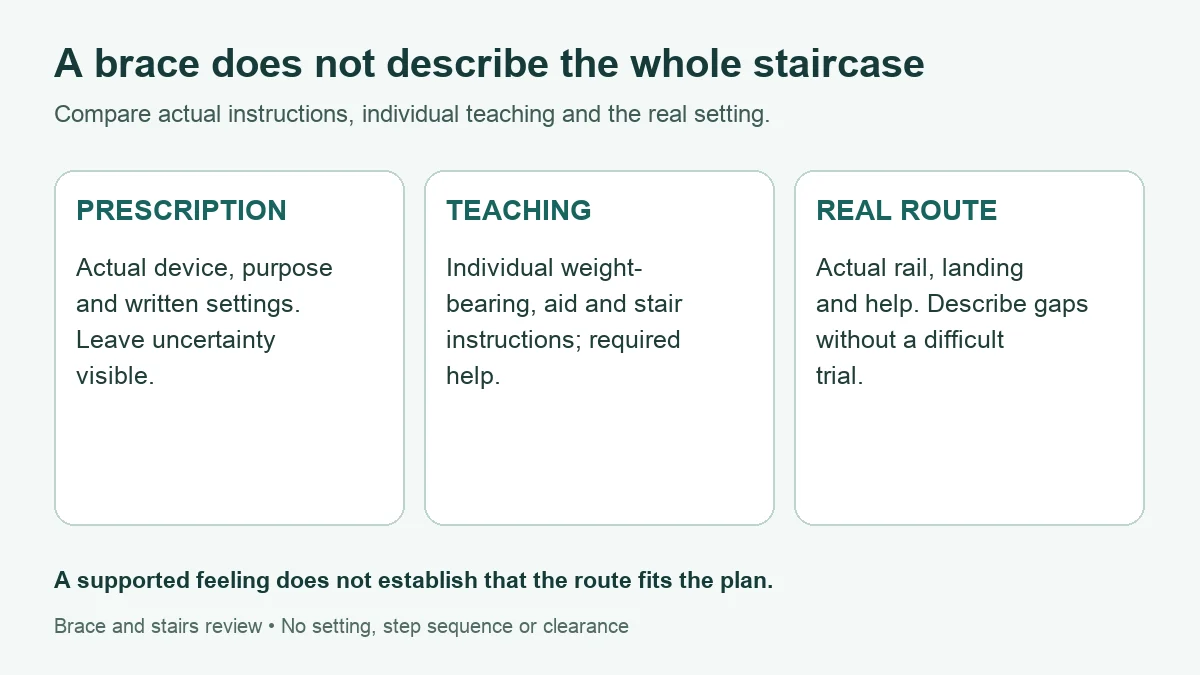
Compare the brace prescription, teaching and actual stair conditions
Keep the prescription and the real environment side by side. A plan demonstrated with one rail, adequate landing space and particular help may not describe a different home staircase. Going up and coming down are distinct contexts: describe the rail available in each direction rather than assuming the same arrangement applies. No direction or rail side is recommended by this article.
| Topic | Actual instruction / education | Actual condition / gap to report |
|---|---|---|
| Device and settings | Named hinged knee brace, purpose, written lock/range and source/date. | Instructions unavailable, conflicting wording or a device difference; do not infer a setting from a photograph. |
| Weight-bearing and walking aid | The individual instruction and aid actually prescribed or taught. | What aid is available and what remains unclear? A brace label does not supply weight-bearing permission. |
| Stair method and direction | The person-specific teaching and conditions, without adding a generic sequence. | Rail position going up/down, step or threshold details already known, and differences from teaching. |
| Landing and route | Space and practical constraints addressed in the individual plan. | Turning space, doors, lighting or obstacles known from the empty route; no difficult stair trial needed. |
| Assistance and alternative | Required help, trained person and alternative actually advised. | Actual availability; a proposed same-floor arrangement or different aid is not automatically agreed or appropriate. |
| Actual event and reply | An event already experienced or not attempted, observation and answer received. | What differed, who was contacted, what was answered and what remains unresolved? |
A helper can describe the empty route, with consent, without asking the recovering person to climb it. If useful, share relevant measurements or a photograph through the team’s agreed channel, avoiding identifying details. Do not change a rail, add equipment or move an obstacle in a way that creates a new hazard from a blog suggestion. Ask the appropriate team about the actual arrangement.
If required help is unavailable or the route differs, explain the gap and ask about a workable individual arrangement for essential needs. Do not substitute an untrained person, different walking aid or improvised method to complete a trip. An alternative should address access to necessary facilities; the record does not prescribe transfers, carrying a person or an equipment purchase.
Hinge settings, strap teaching and symptoms are different questions
Do not independently unlock a hinge or change its range to match a video, another patient or the next step. Keep any permitted changes exactly within the professional instructions received for the actual device. If an instruction is unclear, retain its wording, date and source and ask for clarification instead of choosing a setting yourself.
That is different from reapplying or adjusting straps in the way the relevant team has actually taught and permitted. A blanket “never touch a strap” rule may conflict with such education; “tighten it more” is also not a general solution. Follow the actual device instructions and training and ask the fitter about slipping, pressure or unresolved questions. This article supplies no strap order, tightness measurement or padding modification.
UCLH’s leaflet separates a dial set by the team from instructions for straps on the brace described there. Kingston’s leaflet concerns a prescribed range-of-movement brace after injury or surgery. These sources illustrate why device-specific instruction matters; neither provides permission to copy a different device’s fitting, removal, hygiene or wearing schedule. See Kingston and Richmond: Hinged knee brace.
Use the individual skin-check and care instructions actually provided. Record rubbing, a skin change, slippage or an existing change in sensation as an observation, not a diagnosis of poor circulation or proof the brace is too tight. Do not remove a prescribed brace outside instructions just to inspect for this worksheet, add material or keep walking to see whether a problem persists. Use the appropriate contact route for symptoms, especially the urgent signs above.
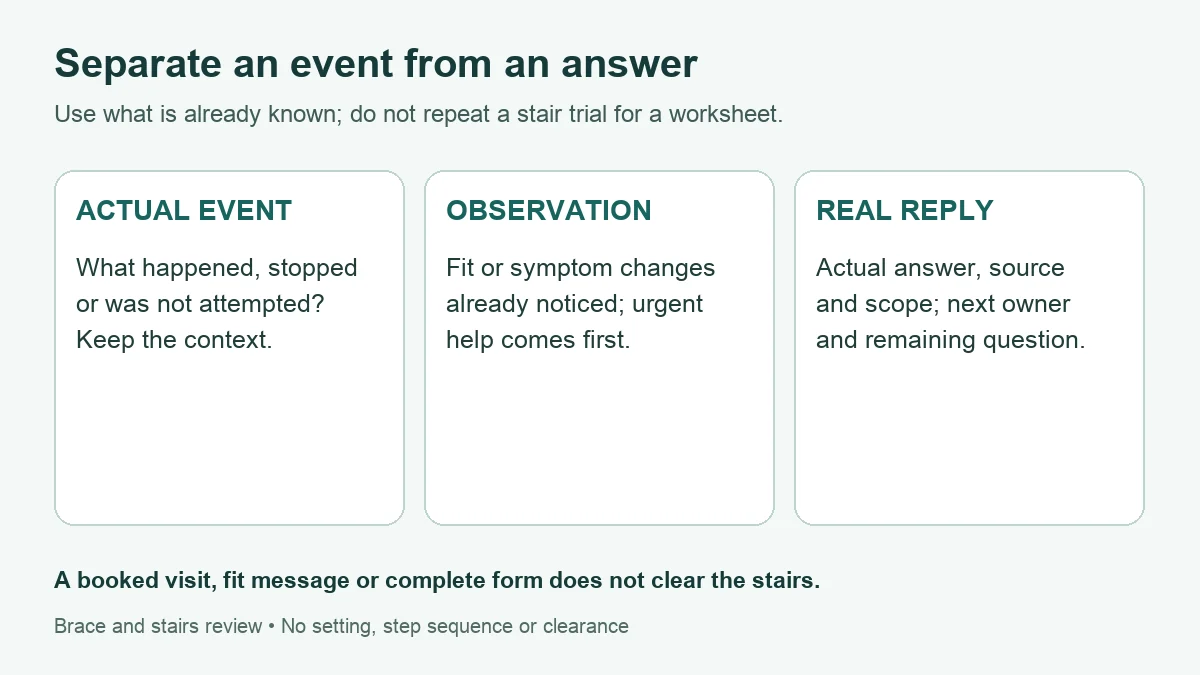
Who answers the brace, stair and practical questions?
| Role | Information to bring | Boundary |
|---|---|---|
| Prescribing / fracture / surgical team | Device purpose, actual instructions and a clinical change or conflicting advice. | An online worksheet cannot establish a diagnosis or new restriction. |
| Orthotist / fitter / relevant brace service | Actual device, fit problem, instruction source and handling education received. | Fit advice may not address the real staircase or new medical symptoms. |
| Physiotherapist / relevant mobility team | Weight-bearing instructions, stair layout, aid, actual help and differences from teaching. | The article provides no lead-leg sequence or assessment of stair ability. |
| Person / caregiver / helper, with consent | Actual availability, observations genuinely witnessed and practical barriers. | Do not invent observations, lift the person on stairs or substitute for required training. |
| Urgent / emergency service | New concerning symptoms needing timely assessment. | Do not wait for a routine equipment question or a completed log. |
Record what the answer actually covers. An answer about putting the brace on may leave the stair question open; a stair appointment may leave the device-setting question unanswered. A question prepared, question sent, appointment booked and actual answer received are separate facts. If a response conflicts with another instruction, ask the relevant team to resolve it.
The NHS moving and handling guide supports seeking appropriate training and assessment for helping another person move. It is background for the caregiver role, not a source of knee-brace settings or a stair technique. Its UK social-care pathways do not establish services or funding for readers elsewhere.
The companion prescribed-support overview explains the limits of a brace and individual instructions. This page has a narrower practical purpose: comparing those instructions with the real route and keeping performance, observations and replies distinct. Use the record without repeating a stair trial to prove failure.
Two fictional brace-and-stairs writing examples
These are invented writing examples, not patient stories, professional instructions or successful outcomes. No angle, weight-bearing limit, leg order or clearance is supplied. Loading an example replaces tool entries. Use fictional information on the live page and an offline copy for private notes.
Example A: the brace arrived, but instructions are unclear
| Record | Fictional entry |
|---|---|
| Actual device | A hinged knee brace was received; its exact purpose and current instructions need clarification. |
| Unanswered items | Written hinge/lock instructions, individual weight-bearing advice and stair teaching are not supplied. |
| Actual performance | No stair trial requested or recorded. No setting inferred from appearance. |
| Contact / reply | Questions were submitted to the relevant team. Reply pending; no actual professional answer supplied. |
Writing example: “Receiving the brace has not answered the separate settings, weight-bearing and stair questions. Which current instructions apply to my actual device and situation, and who will teach the stair plan? The questions have been sent; the reply is pending.” This example does not recommend changing settings or attempting a step.
Example B: the home staircase differs from the taught setting
| Record | Fictional entry |
|---|---|
| Teaching | A personal plan is referred to, but its exact instructions and conditions are not supplied here. |
| Actual environment | The home rail arrangement and landing differ; the help expected by the plan is unavailable at the proposed time. |
| Actual performance | Stairs not attempted; no difficult route climbed for measurements or repeated to demonstrate a problem. |
| Question / answer | A question about the real route, support and appropriate alternative was prepared. Actual contact not recorded; no answer received. |
Writing example: “The home rail and landing arrangement and actual help do not match the teaching setting. We have recorded the difference rather than treating the plan as implemented. Who can clarify the arrangement and an appropriate alternative for essential needs? An answer has not been recorded.” No substitute aid or successful stair use is inferred.
Free brace, stairs, performance and real-reply record
The tool has 11 optional fields for the device, actual settings, individual education, real route, support, differences, actual performance, observations, contact, real answer and next owner. Blank items produce optional clarification questions. Full fields remain unverified; no score, angle, step sequence or permission is generated.
Download the offline HTML tool before entering actual health or personal information. Try fictional examples on this page. The live site may use site services. The downloaded file has no ads, analytics, external assets, automatic network requests or browser storage and needs no account or email. Nothing is sent or automatically saved. Keep completed exports private and share through an agreed channel with consent.
Build a record, copy it, download text or use browser print/save PDF. Editing hides the previous result until rebuilt. Avoid names, addresses, identifying contact details and complete medical records. If the tool is unavailable, use paper without delaying appropriate help. Do not fill gaps with a stair, balance or walking test.
Hinged knee brace: stairs, performance, observation and real-reply record
Keep the actual prescription, individual teaching, real stair conditions, existing performance and the answer received distinct. This organizer gives no stair clearance, device setting or step sequence.
Download the offline tool before entering actual health or personal notes. Try fictional examples here. The offline copy has no site ads, analytics or external assets.
Offline copy. This file has no ads, analytics, external assets or automatic network requests.
The tool uses no network requests or browser storage and does not save automatically. Refreshing or closing may lose entries. Exports contain notes; keep them private. Avoid names, addresses, identifying contact details and full medical records. Do not delay urgent or emergency help for a record.
Start with the fictional example or download a blank offline copy.
If the tool does not load, use paper: device; actual settings; individual teaching; real stairs; aid/help; differences; actual performance or not attempted; existing observation; contact; real answer; next owner. Do not delay care for a form.
My brace, stairs, performance, observation and real-reply record
Unverified personal record for discussion. Entries are unverified notes, not medical advice, verified instructions or permission to use stairs.
Guide: living.kioptrix.com/hinged-knee-brace-for-stairs/
Common questions about the brace and stairs record
Does feeling stable in the brace mean I can use stairs?
No. A feeling of support does not establish that the prescription, teaching and real route fit. Do not test an unstable knee on steps to obtain a clearer answer.
Which leg should lead, and what hinge angle should I use?
This guide supplies neither. The actual device, condition, weight-bearing instruction, aid and help can affect the individual plan. Ask the appropriate team about missing instructions rather than borrowing a sequence or setting.
Can I adjust the straps?
Use only the handling and adjustment instructions actually taught and permitted for the device. This is different from independently changing a prescribed hinge setting. New symptoms or an unresolved fit problem need the appropriate contact, not a generic tightening rule.
What if the home rail or help differs from training?
Describe the actual difference without a difficult trial and ask the relevant team to clarify or reassess the plan and appropriate alternative. A different aid or relative nearby does not automatically replace the required support.
Does the complete record verify my prescription or clear stairs?
No. It organizes unverified entries and questions. Preserve the actual reply, source and scope; leave an unanswered question visible. Urgent symptoms need appropriate care before completing a record.
Sources, editorial correction and review limits
- UCLH: Hinge Knee Brace — Advice for Patients — care and warning signs for patients given a hinge brace; device and individual instructions matter.
- Kingston and Richmond: Hinged knee brace — prescribed range-of-movement brace information; not a universal sports-brace or stairs protocol.
- NHS: DVT — blood-clot symptom and contact guidance; UK service numbers have local scope.
- NHS: Moving, lifting and handling someone else — caregiver training and assessment background, not device settings.
Source check and editorial update: October 29, 2026. Added brace-specific evidence and contact guidance, distinguished hinge changes from individually taught strap handling, and added prescription/education/actual-route comparisons, two fictional examples and a private offline record. The original URL, publication date, author and category are retained.
Written from a family-caregiver editorial perspective. No independent orthopaedic, orthotic or physiotherapy review, clinical validation, real-reader usability study or improved outcome is claimed. Functional checks establish tool behavior only. The hero is AI-generated fictional artwork; body diagrams organize records and show no stair technique. Our background and editorial approach.