

A brace purchase and an HSA payment need separate records. Start with the actual device purpose and use instructions. Then connect the expense evidence, any insurance or other compensation, existing HSA payments and later changes. A retail “HSA eligible” label, card acceptance or a completed worksheet does not establish clinical suitability or tax qualification.
Use the six essential record checks, clinical and financial role comparison, two fictional writing examples, or free brace and HSA record tool. This guide helps organize facts and questions. It selects no product, prescribes no wearing schedule and calculates no tax-free or reimbursable amount.
New symptoms must not wait for a receipt search or HSA answer. New numbness, weakness, increasing swelling, skin injury or colour/temperature changes need appropriate clinical advice. Cold, pale/blue fingers or toes, severe escalating pain or loss of movement can need emergency assessment. Stop an unsafe activity and seek help rather than testing how long you can tolerate it. For a prescribed stabilizing device, use the treating team’s urgent contact and actual removal instructions; this article cannot tell you whether it is safe to remove or alter it. This is not an exhaustive triage list.
This is general education from a family-caregiver-run site, not individual medical, tax, insurance or legal advice. The operator is not a professional adviser. HSA discussion concerns U.S. federal rules; individual circumstances and applicable tax-year guidance require review. The clinical sources below illustrate specific device contexts, not a universal brace plan. An incomplete record does not prevent seeking care or assistance.
Table of Contents
Brace and HSA records: 6 essential checks
| Check | Record what actually exists | Question if missing |
|---|---|---|
| 1. Device and instruction | The real item, purpose discussed, actual wearing/removal instructions, source and date. | Which treating or orthotics contact can clarify the purpose and instructions? Do not infer them from symptoms or a product ranking. |
| 2. Expense evidence | Relevant incurred/purchase/payment dates, itemized receipt, amount and payment route. | What does the evidence describe, and which dates remain unclear? Keep full identifiers privately. |
| 3. HSA timing | Actual establishment information and the source used to confirm it. | Does a timing issue need clarification? An online worksheet cannot establish the legally relevant date. |
| 4. Other compensation | Each insurance, FSA or other payment, its amount, status and relation to this same expense. | Is it paid, denied, pending or unknown? A pending response is not zero compensation. |
| 5. Existing HSA payment and deduction history | Direct HSA payment, later HSA reimbursement and same-expense itemized-deduction information. | Has this amount already been paid or used elsewhere? Separate a question sent from an answer received. |
| 6. Later changes and reply | Return/refund/exchange, later compensation and actual custodian or adviser guidance. | What changed, which original event is affected, and what handling was actually explained? No correction method is assumed. |
These six checks are a recordkeeping framework, not an eligibility score or prerequisites for receiving help. A field containing text is not verified evidence. If you cannot locate a receipt or account detail, mark it unconfirmed and ask the relevant source. Do not buy, wear or continue using a device to qualify for a tax benefit.
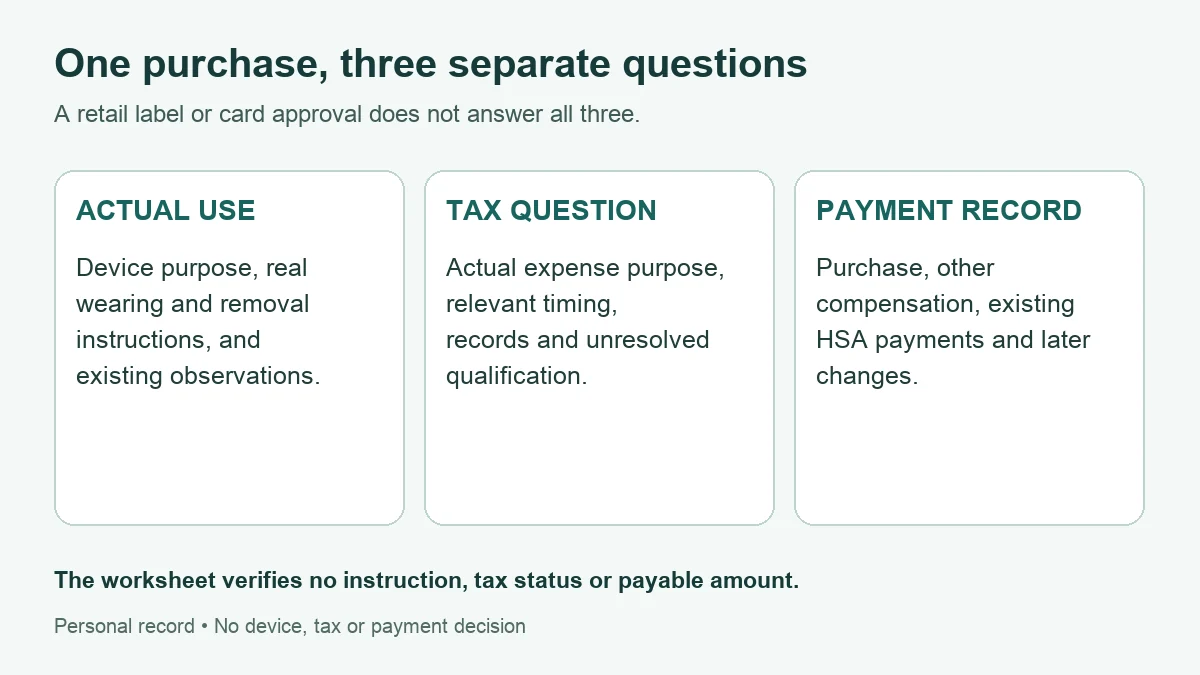
Separate clinical suitability, tax qualification and payment
| Question | Relevant information / role | What must not be inferred |
|---|---|---|
| Is this device appropriate for me? | Actual assessment and device purpose discussed with the treating or orthotics team. | A tax label, price, product review or symptom description does not choose a safe device. |
| How should it be worn, adjusted or removed? | The actual prescribed instructions, product-specific information and relevant team. | Comfort or confidence alone is not clearance to change settings, loading or wear time. |
| Is this a qualified medical expense? | Actual medical purpose, applicable IRS rules and qualified tax help for uncertainty. | A retailer or payment-card approval is not an IRS determination. |
| What has already paid for the same expense? | Receipts, insurer/other-account answers and actual HSA transactions. | A purchase price is not automatically an unreimbursed amount. |
| What does a later change require? | Original purchase/payment plus actual refund or later compensation records; custodian process and tax advice. | A refund does not erase the earlier transaction, and an ordinary new contribution is not automatically a correction. |
No single contact answers every question. The clinician can explain a clinical purpose without deciding federal tax treatment. A retailer can provide an itemized receipt or return confirmation without prescribing use. A custodian can explain its transaction process without replacing an individual tax determination. Preserve the scope of each answer.
Keep actual brace instructions ahead of generic shopping advice
For a prescribed brace, record the purpose, permitted activities, wearing and removal instructions, settings if applicable, skin-care guidance and review contact actually supplied. Do not borrow another person’s wearing schedule or infer a restriction from pain onset. If instructions conflict or you do not understand them, ask the treating or orthotics team to clarify rather than resolving the conflict with a general blog rule.
For a self-selected support, tell the relevant professional what it is and what has already happened. The absence of a prescription does not by itself establish either suitability or unsuitability. This guide does not convert a symptom pattern—such as swelling, instability or pain during typing—into a compression, rigid-bracing or offloading recommendation. Product terminology varies and cannot replace an assessment.
University Hospitals Sussex’s splint advice addresses a specific hand-splint context, including following the supplied wear plan and reporting problems. North Tees and Hartlepool’s humeral-brace leaflet concerns fracture management and distinguishes certain sling movements from removing the brace. These are examples of why device-specific instructions matter. Neither is a general permission to remove, tighten, shorten use or change a different device.
Record existing observations, including benefit, no change, discomfort, skin concerns or difficulty using the device. Also record the clinical reply actually received. Do not provoke symptoms, walk longer or repeat an activity to test a form. There is no universal 20-minute, two-hour or next-morning clearance test here. A medical need for longer use is not evidence of poor judgment or psychological dependence.
Keep the practical question specific: “These are the instructions I received, and this is the change I have already noticed. What should I do now, and which instructions apply?” If urgent symptoms occur, seek the appropriate care service without waiting to compile a perfect log or obtain a financial answer.
What the IRS sources establish—and what they do not
IRS Publication 969 (2025) describes HSA distributions and recordkeeping. In general, qualifying expenses must be incurred after HSA establishment and must not be compensated by insurance or otherwise. Records must support qualified use, no prior payment/reimbursement from another source, and no itemized deduction of the same expense. State law affects when an HSA is established. Relevant family-member rules also apply; do not assume every household purchase qualifies.
For a qualifying expense paid personally, later HSA reimbursement can generally be possible with the required records and conditions. Paying directly from the HSA is already a distribution; do not treat it as a new personal expense to reimburse again. Tax-free use and reporting are different questions: distributions are reported on Form 8889. A record tool does not file that form or decide an individual tax result.
IRS Publication 502 (2025) explains medical-expense concepts and itemized deductions. General-health benefits alone do not establish a medical expense. Its Schedule A deduction calculation is not the calculation for HSA tax-free distributions. A product-page screenshot may describe an item, but it does not independently prove medical purpose or all HSA conditions.
Keep contribution eligibility separate from expense qualification and payment history. The ability to add new HSA funds is a different question from how an existing account’s distribution is treated. This guide supplies no contribution limit, annual eligibility calculation, investment advice or instruction to move money. Check the guidance applicable to the actual tax year and use qualified help for a disputed case.
Build a traceable purchase, compensation and HSA history
| Record type | Useful evidence / entry | Avoid |
|---|---|---|
| Item and actual purpose | Product description and actual purpose information; keep any relevant clinical document privately. | Writing a purpose merely to make a product look tax eligible. |
| Expense and payment | Itemized receipt, dates, actual amount, payment route and a private evidence reference. | Assuming purchase date, incurred date, statement posting date and reimbursement date always mean the same thing. |
| Insurance / other source | Actual paid amount or pending/unknown status, date, source and expense component. | Counting a pending claim as zero or treating an insurer estimate as actual payment. |
| HSA transactions | Direct payment or later reimbursement, actual amount/date and expense linked. | Recording the same distribution under two names and treating it as two available benefits. |
| Deduction information | Actual confirmation about the same expense’s itemized-deduction history. | Assuming no overlap because a different year or account is involved. |
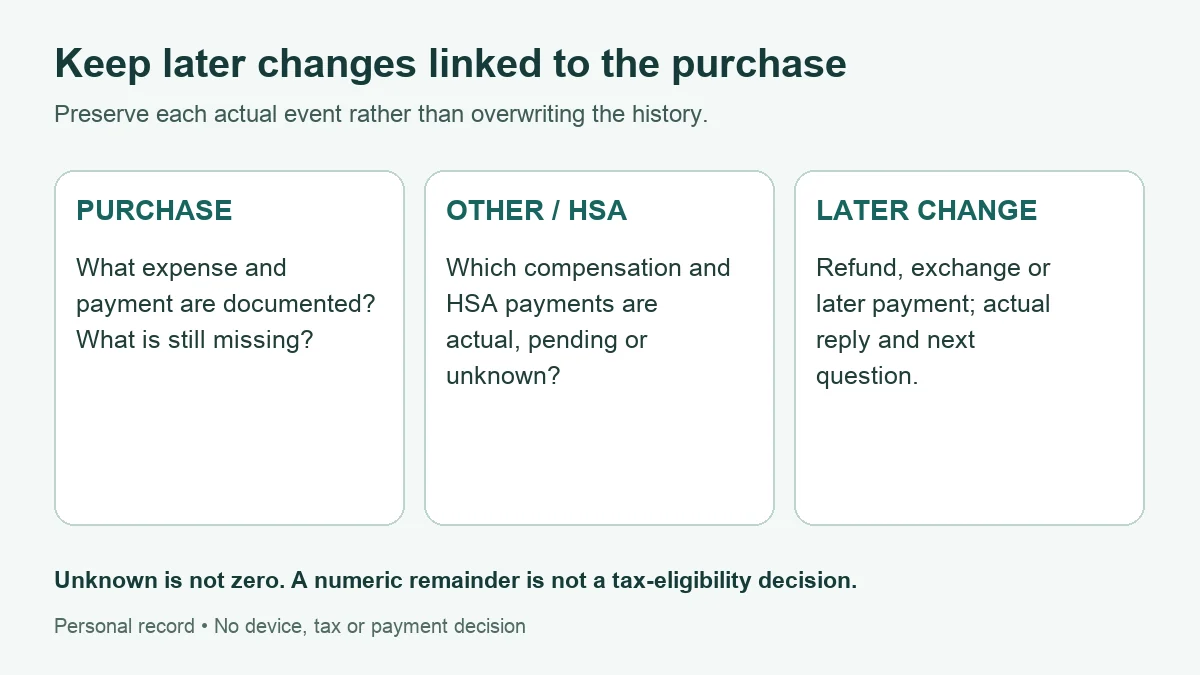
| Later event | Return, exchange, refund or later payment linked to the original record. | Deleting the earlier event or assuming the net amount settles tax treatment. |
Use one private reference for each purchase and connect each later event to it. For example, a “purchase” note, a subsequent “insurance payment” note and a later “HSA transaction” note should remain distinguishable, with their actual dates and source records. A reference is an organizing aid, not proof that the underlying facts are correct. Avoid putting full account numbers, policy identifiers or medical documents in a public form.
Do not label a simple subtraction as an “eligible reimbursement amount.” Even when purchase and other-payment figures are known, medical purpose, establishment timing, existing HSA payment, deduction history and later changes may still matter. If a source is unknown, show the uncertainty rather than presenting a precise available balance. The tool below deliberately does not calculate a payout.
A helpful contact question is: “This is the item and expense record. These payments are confirmed; these remain pending. This is any existing HSA transaction and subsequent change. Which actual record or issue needs clarification?” Keep the reply’s role, source, date and scope. A message sent is not a response, and an unanswered question does not become confirmation over time.
Returns, refunds and later compensation need a new entry
If a product is returned, exchanged or later reimbursed from another source, preserve the original purchase and HSA transaction and add the actual change. Record whether the event is requested, pending or completed; the amount and destination if confirmed; and which expense it concerns. A return request is not a completed refund. A later payment can change the facts you relied on earlier.
Ask the HSA custodian about the process it actually supports and qualified tax help about appropriate treatment and reporting. Keep the actual answer, required evidence and any stated timing. This guide supplies no universal redeposit method, correction deadline or amended-return instruction. Do not assume a normal new contribution fixes a previous distribution. No money is moved by the record tool.
A return decision and a clinical device decision also differ. If a prescribed item is uncomfortable or damaged, ask the treating/orthotics team about safe handling and continued support needs. A seller’s return authorization does not establish whether changing or stopping a prescribed device is medically appropriate. Conversely, a clinical instruction is not proof that a seller has completed a refund.
Two fictional examples of an incomplete or changed record
These are invented writing examples, not real purchases, patient cases, tax advice or evidence of savings. They show how to preserve uncertainty without inventing an approval or payment amount.
Example A: personal payment, insurance response pending
| Record | Fictional entry |
|---|---|
| Purchase | Paid from personal funds; the real receipt and amount would be retained privately. |
| Actual instructions | No use plan is supplied by this example. The real treating-team instructions remain the source. |
| Other compensation | Insurance response pending; no actual payment amount confirmed. |
| Other unresolved facts | HSA establishment information, existing transactions and same-expense deduction history still need checking. |
| Question / result | What was actually paid by another source, which expense does it cover, and what other conditions need clarification? No reimbursement amount or eligibility is generated. |
Writing sample: “I have a purchase receipt and paid personally. The insurance response is pending, so I have not treated it as zero. I need the actual payment result and the relevant account and record information before treating a number as available for HSA reimbursement.”
Example B: refund reported after an HSA payment
| Record | Fictional entry |
|---|---|
| Original event | An HSA payment for this expense is reported; the actual statement would establish its amount and date. |
| Later event | A return/refund is reported. Its completed status, amount, destination and original purchase reference need the actual records. |
| Actual answer | No correction instruction from the custodian or tax adviser has been received. |
| Question | Given the actual transaction and refund facts, what handling, evidence and reporting apply? |
| Result | Both events stay in the history. No repayment, new contribution, tax correction or filing is performed or assumed. |
Writing sample: “Please review the original HSA payment and the later refund record as separate linked events. What process and documentation apply to these facts? I have not assumed an ordinary new contribution is the appropriate correction.”
Free brace instructions, purchase and HSA record tool
The tool organizes actual instructions and observations, purchase evidence, other compensation, existing HSA payments, deduction questions, later changes and real replies. Empty fields produce optional questions. Full fields remain unverified notes. It does not choose a brace, prescribe use, approve an expense, calculate a reimbursement or file a tax document.
Try fictional examples here. Download the offline HTML copy before entering actual medical, account or tax notes. The live website may use site services. The downloaded tool contains no ads, analytics, external assets, automatic network requests or browser storage. It needs no account or email. Entries are not automatically saved. Completed exports contain your entries and should be kept private.
Use non-identifying summaries and private document references rather than names, account numbers, claim identifiers or full records. Build the record, copy it, download text or print/save PDF through your browser. Editing hides the stale output until rebuilt. Nothing is submitted, claimed or paid. If the tool does not load, use paper with the same headings; do not delay care to complete a worksheet.
Brace instructions, purchase and HSA record
Keep actual use instructions, purchase evidence, other compensation, HSA payments and later changes separate. No device choice, tax qualification or payable amount is generated.
For actual health or insurance notes, download the offline tool first. Try the fictional example here. The offline copy contains no site ads, analytics or external assets and needs no account.
Offline copy. This file contains no ads, analytics, external assets or automatic network requests.
The tool uses no network requests or browser storage. Unsaved changes can be lost on refresh or close. Exported files contain your entries; keep them private. Avoid names, member or claim identifiers, full notices and medical records.
Start with the fictional example or download a blank offline copy.
If the tool does not load, use paper: actual instructions; purchase evidence; other compensation; HSA payments; later changes; actual replies and questions. Do not delay care to finish a record.
My brace instructions, purchase and HSA record
Unverified personal record for discussion. These are unverified personal notes, not clinical advice, a tax determination, a reimbursement request or proof of eligibility. Filled fields verify no instruction, amount or record.
Guide: living.kioptrix.com/orthopedic-braces-and-supports-hsa-eligible/
Common brace and HSA record questions
Does “HSA eligible” mean this brace is right for me?
No. Clinical purpose and use instructions belong with the relevant clinical team. Retail labeling or card acceptance does not decide tax qualification. Keep the four questions—suitability, use, expense qualification and payment history—separate.
Must every brace have a prescription?
Do not assume a universal prescription requirement or a universal exemption. The actual item and circumstances matter. Ask the appropriate professional about clinical use and qualified tax help about a disputed expense; do not obtain a device just to create documentation.
Can I use this worksheet as proof of tax eligibility?
No. It is an organizing aid. Statements entered into a form are not independent verification; retain underlying evidence and actual answers privately.
What if insurance has not answered?
Mark the response pending. Do not convert uncertainty into zero compensation or a payable HSA figure. The tool prepares questions and moves no money.
Should I shorten wear time to avoid dependence?
Follow the actual prescribed plan and ask the relevant team about concerns. Long-term prescribed use is not automatically a problem. This article supplies no reduction schedule or functional test.
Does a refund erase the earlier HSA payment?
Preserve both events and seek appropriate process and tax guidance. The worksheet decides no correction method and performs no repayment or filing.
What if I have missing records or conflicting replies?
Mark the gap or preserve both actual replies with their sources. Ask the contact responsible for the specific issue. A complete worksheet is not required before asking for care or assistance.
Sources, corrections and review limits
- IRS Publication 969 (2025) — HSA distribution and recordkeeping framework; use the guidance applicable to the actual tax year.
- IRS Publication 502 (2025) — medical-expense concepts and itemized deductions; its deduction calculation is not an HSA payout calculation.
- University Hospitals Sussex: Splint advice — specific splint instructions and problem-reporting context; not a universal brace schedule.
- North Tees and Hartlepool: Humeral Brace — prescribed fracture-device context; not generic removal or adjustment advice.
Editorial correction and source check: October 29, 2026. Replaced symptom-to-product selection, unsupported price-tier and dependence claims, generic timing checkpoints, conflicting shopping instructions and mocking language. Removed duplicate images and the embedded video. The new framework separates actual device instructions, tax questions and transaction history, including later changes. The original URL is retained.
The hero is AI-generated fictional editorial artwork. Body diagrams illustrate recordkeeping, not a treatment pathway, tax approval or real transaction. No independent clinical, tax, insurance or legal review or real-user outcome validation is claimed. Functional tool checks do not establish those outcomes. Our background and editorial approach. For broader payment-route questions, see the orthopedic HDHP quote guide; account payment does not itself establish insurer credit.