

A joint injection consultation cost estimate should identify the visit you booked and what happens if the proposal changes. Consultation, imaging and an injection are different services. A proposal is not a service already performed, and a quote is not a final bill. Start with the booked appointment, then record any new clinical explanation, changed estimate, actual service and real reply separately.
Use the six essential checks, same-day billing comparison, two fictional writing examples, or free appointment-change record. This guide helps you ask focused questions; it does not decide whether you need an injection, whether waiting is safe, what you consented to, or what a payer must cover.
Urgent symptoms must not wait for a routine consultation or a price comparison. Sudden severe joint pain with swelling, warmth or skin-colour change, difficulty moving or bearing weight, or feeling unwell needs urgent medical assessment. Fever may be absent in joint infection. If you are very unwell, have major trauma or another emergency, use emergency care. This is not a complete triage list. NHS septic arthritis guidance explains the joint-infection warning context; use the appropriate local care service, not a worksheet, to assess symptoms.
This is general U.S.-focused education from a family-caregiver-run site. Its operator is not a medical, insurance, legal or financial professional. Clinical suitability, informed consent, benefit coverage and billing are separate questions for the relevant professionals. The examples below are fictional and the form submits nothing. You do not need a completed record before asking for care or financial help.
Table of Contents
Joint injection consultation cost: 6 essential checks
| Check | Question to ask | Record without assuming |
|---|---|---|
| 1. Booked purpose | What exactly is scheduled: consultation, evaluation with possible testing, or a planned procedure? | The actual appointment description, source and date; unclear wording stays unclear. |
| 2. New proposal | What additional test or procedure is being proposed today, and why? | The clinician’s actual explanation. A scheduler’s description is not a clinical recommendation. |
| 3. Clinical discussion | What benefits, risks, alternatives and timing issues should I understand? | Questions asked and real answers received. The form does not decide suitability or certify informed consent. |
| 4. Changed estimate | Does the original quote include the new proposal? Which items remain separate or unknown? | Consultation, relevant tests, procedure, medication, guidance, facility and follow-up only as applicable; no invented additions. |
| 5. Relevant billers and plan | Which entities and location will bill, and what did the actual payer say about this service? | Source/date/conditions for network, coverage, authorization and member-cost answers; no payment guarantee. |
| 6. Actual result and next question | What was actually performed or arranged, and what remains unanswered? | Keep proposed, performed, paid and processed distinct; record the relevant contact and actual follow-up agreement. |
These are preparation questions, not six conditions you must satisfy before receiving care. If the plan changes in the examination room, describe what you understood was booked and ask for the new clinical explanation and cost scope. An unanswered price question does not establish that waiting is medically appropriate. Tell the team about affordability or access barriers and ask for help with the actual options.
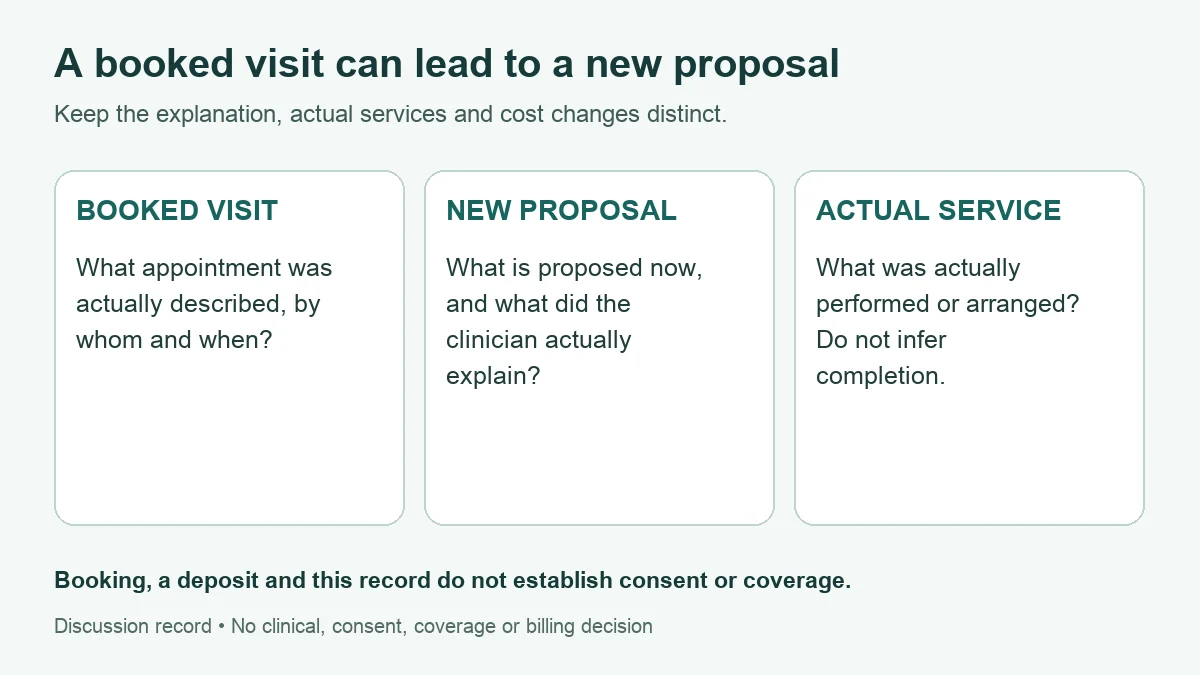
Booked visit, same-day proposal and actual services are different
| Situation | What needs clarification | What does not follow automatically |
|---|---|---|
| Consultation on a separate date | The evaluation estimate, relevant billers and whether any tests are planned or merely possible. | A consultation does not guarantee a later procedure or establish its price. |
| Evaluation plus imaging today | Why imaging is proposed, whether existing images can answer the question, and which imaging/reading components are included or separate. | New-patient status does not establish a universal imaging requirement. Do not order a scan to complete a cost plan. |
| Evaluation plus injection today | The clinical explanation, applicable consent process, exact proposed service and changed quote. Ask billing how any separate evaluation charge is supported under the applicable payer rules. | Same day does not automatically mean one charge or two; booking or paying a deposit is not proof of consent. |
| Evaluation without injection | What was evaluated, what care or follow-up was actually recommended, and what the visit estimate covered. | No injection does not mean the evaluation was wasted or guarantee future savings. |
| Proposal changed but not yet carried out | What remains proposed, which answers are pending and what the treating team actually advised about timing. | A proposal, quote request or unanswered message is not a performed service or confirmed arrangement. |
A focused clinical question is: “I understood this was a consultation. What is now being proposed, what is its purpose, and what should I understand about the options and timing?” A separate billing question is: “Which parts of that proposal are included in the original estimate, and which have a separate or unconfirmed member amount?” Keep both answers in their own words rather than turning a cost answer into medical advice.
Same-day evaluation charges: ask for an explanation, not a code verdict
A separately scheduled consultation can have its own charge. On the day of a procedure, the relevant question is what distinct evaluation work was actually done and how the applicable payer treats it. Do not assume that being a new patient automatically supports an additional evaluation charge, or that any same-day charge is automatically wrong.
CMS’s 2026 Medicare NCCI Policy Manual, Chapter I, section D explains that routine work for a minor procedure and the decision to perform it are generally included in the procedure payment. Significant, separately identifiable evaluation work can support separate reporting with modifier 25 when the applicable conditions are met. New-patient status alone is insufficient. This is Medicare coding context, not a ruling on every payer or your bill.
Ask the billing office: “What distinct service does this amount describe, what was included in the procedure work, and which payer rule applies?” The clinician and billing team must explain the actual work and applicable rules. This article and its record tool do not assign codes, establish medical necessity, judge fraud or determine whether a charge is payable.
If a bill later arrives, keep the itemized bill, estimate and explanation of benefits in your private records. Compare service dates, descriptions, billing entities, payment already made and processed member responsibility. Ask about a discrepancy through the relevant billing or insurer channel. The record tool is not a dispute submission and calculates no legal deadline.
Record added, included, separate and unknown costs
| Possible component — only if relevant | Useful question | How to record the reply |
|---|---|---|
| Consultation / evaluation | What does the visit estimate cover, and what assumptions could change? | Original scope, quoted MEMBER amount, source/date and conditions. |
| Imaging and interpretation | Is imaging proposed or already performed? Is the reader included, and can the team review existing material? | Clinical purpose separately from imaging and reading quote scope. No assumption that old images eliminate testing. |
| Injection procedure / medication / guidance | What exact service is proposed and which components are included? | Actual description from the team; bundled items recorded once, exclusions and unknowns visible. |
| Facility or other separately billing entity | Is a separate bill expected at this actual location, and from whom? | The actual answer. Hospital affiliation alone does not establish a particular charge or cost ranking. |
| Follow-up | What follow-up is actually recommended, and is its quoted scope included? | A real care recommendation and estimate, not an invented course of visits. |
| Payment / benefit conditions | Is this a deposit, self-pay price, estimated member liability or processed amount? | Keep payment routes and quote assumptions separate; unknown is not zero. |
Add only non-overlapping quoted member amounts for the same defined scope and payment route. If any relevant component remains unknown, call the result a known quoted subtotal and list the gap. Do not add a raw provider charge to estimated member liability, add insurance and cash alternatives together, or count a bundled item twice. The tool intentionally generates no total from free-text notes.
For example, an invented $120 visit estimate and a separate $40 quoted member component have a $160 known quoted subtotal only if they do not overlap. If another relevant component is unconfirmed, $160 is not a complete price. These are arithmetic examples, not typical consultation prices or a suggested budget threshold. The record is useful even when no amount is available.
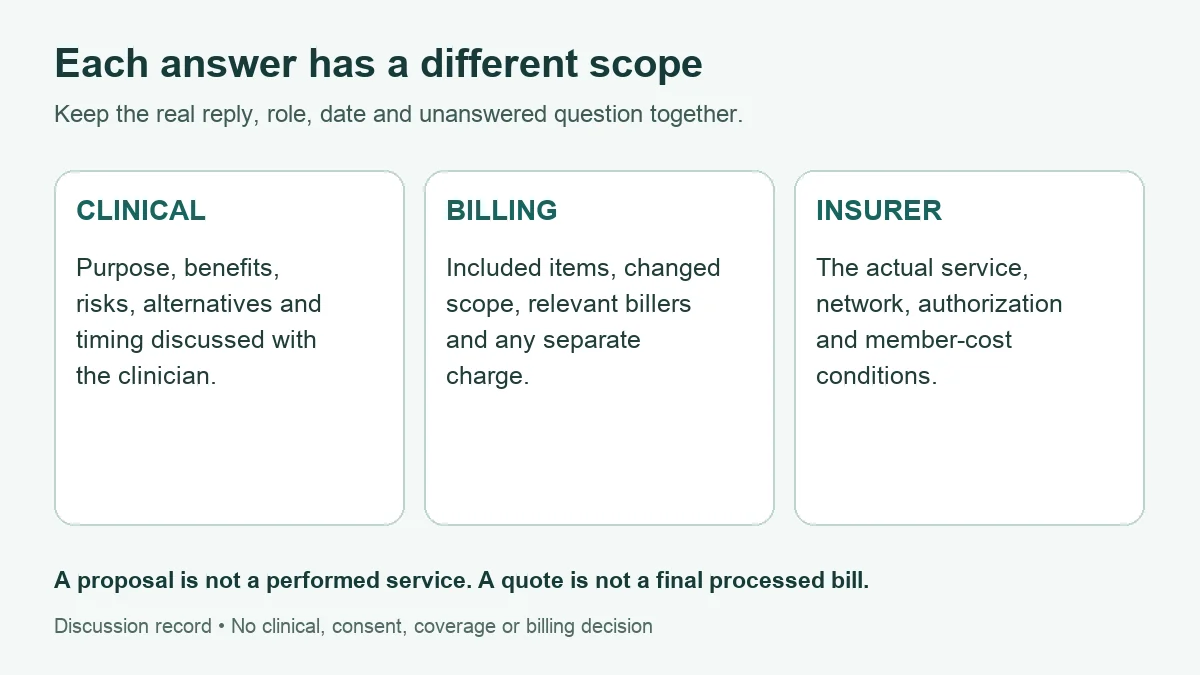
Keep clinical, scheduling, billing and insurer answers separate
| Relevant role | Question in that role’s scope | Do not infer |
|---|---|---|
| Treating / proposing clinician | What is proposed, why, what are the options and timing, and what instructions apply to me? | A clinical recommendation does not establish coverage or price. The worksheet does not replace the consent discussion. |
| Scheduling office | What appointment is booked, what did the description include, and what actual scheduling arrangement exists? | A reserved slot does not prove a procedure will occur or that clinical consent was given. |
| Estimate / billing team | What is included, which entity bills each component, what changed, and what does a separate evaluation charge describe? | A quote is not a final processed claim or proof of payer approval. |
| Insurer / applicable benefits contact | For the actual service, entities and location, what coverage, authorization, network and cost-sharing terms apply? | An authorization or telephone estimate is not a guarantee of payment. |
| Financial-assistance contact | What assistance or payment arrangement is actually available, and what information is needed? | Asking does not guarantee assistance; incomplete notes do not disqualify you from seeking help. |
“We take your insurance” is not enough to establish in-network status or member cost for every biller. Record the actual plan response and assumptions, including relevant benefit balances if supplied. A payment using HSA funds is not itself a processed insurance claim. For the broader payment-route comparison, see the orthopedic HDHP quote guide. This article focuses on changes to the appointment itself.
A useful note separates a question sent, an answer received and an actual agreement. “I left a message” is not “the new service is included.” Record the answer’s source, date and limits; if two offices disagree, preserve both statements and ask the relevant contact to clarify the specific conflict. Do not fill a gap with a guessed answer or treat silence as confirmation.
Clinical evidence and price estimates answer different questions
AAOS’s cortisone-shot patient information describes corticosteroid injections and discusses their clinical use and considerations. It is not a price list, an insurance policy or a standard for every injection product. Ask what exact injection is being proposed and what information applies to it. This article does not extend cortisone guidance to all products or use a joint article to prescribe a spine procedure.
Bring existing records or images when the office requests them and you can access them. Ask what format and transfer route it accepts; do not assume a report substitutes for images or that sending establishes receipt. The treating team decides whether the available material answers the current clinical question. No universal imaging age, therapy prerequisite or “failed treatment” requirement is created here.
Describe prior care accurately, including improvement, side effects, variation and care you could not access. A missed treatment because of a barrier is not completed failed treatment. Do not provoke symptoms, omit improvement or obtain unnecessary care to create a record for approval. Explain what is unknown rather than building a more persuasive story.
CMS explains good faith estimate information for eligible uninsured people or people not using insurance, subject to the applicable conditions. Ask about an estimate for applicable scheduled care and what it covers. One office’s estimate may not include every separately billing entity. An insured member estimate is a different document. No single figure here promises an all-inclusive episode price or establishes dispute rights.
Budget constraints matter. Tell the care team what you can access and ask the financial office about real assistance or payment options. Do not use an arbitrary dollar threshold to decide that delay is safe. Appropriate timing is a clinical question, and urgent assessment must not wait for a complete quote, authorization reply or worksheet.
Two fictional writing examples of appointment changes
These are invented examples of recordkeeping. They describe no real patient, verified quote, consent, clinical outcome or savings. Neither selects treatment or tells a reader to postpone it.
Example A: a consultation becomes a new proposal
| Record | Fictional entry |
|---|---|
| Booked | The person understood the booking as a consultation; the original message needs checking. |
| New proposal | Imaging and a possible injection were proposed. The example supplies no indication or clinical recommendation. |
| Clinical answer | Purpose, alternatives and timing questions are prepared. No actual clinician answer is invented. |
| Quote change | The earlier estimate’s included services and the added components remain unconfirmed. |
| Actual services / next question | No added service is recorded as performed. Ask for the clinical explanation and changed estimate scope; no consent, delay or payment choice is inferred. |
Writing sample: “I understood that I booked a consultation. Please explain the new proposal and its clinical options and timing. Separately, please identify what the original estimate includes, what changes, and which relevant billers or member amounts remain unconfirmed.”
Example B: a possible separate charge needs explanation
| Record | Fictional entry |
|---|---|
| Original information | An estimate was described, but its complete scope was not confirmed. |
| Unconfirmed component | A possible separate evaluation or facility amount has not been explained. Its existence or validity is not decided here. |
| Actual reply | No billing-office or payer-specific answer has been received. A question sent is not an answer. |
| Question | Which distinct service and biller does each amount describe, what is included, and which applicable payer rule explains any separate same-day evaluation charge? |
| Next arrangement | Seek the real explanation and compare any later itemized bill with the actual explanation of benefits. No claim or dispute is submitted. |
Writing sample: “Please identify the service, billing entity and estimate scope for each amount. If there is a separate same-day evaluation charge, please explain the distinct work and applicable payer rule. I am requesting clarification, not deciding a code or alleging an improper charge.”
Free joint injection consultation change record
The tool separates the booked appointment, today’s proposal and clinical explanation, services actually performed, original quote, changed scope, actual payer and billing replies, and next question. Blank fields generate optional questions. Filled fields remain unverified notes; a completed form does not prove consent, coverage or billing accuracy.
Try fictional examples here. Download the offline HTML copy before entering actual health or insurance notes. The live website may use site services. The offline tool contains no ads, analytics, external assets, automatic network requests or browser storage. No account or email is needed. Entries are not automatically saved. Exported files contain your entries and should be kept private; avoid names, member/claim identifiers and full clinical or insurance documents.
Build a record, copy it, download text or use your browser’s print/save PDF option. Editing hides stale output until rebuilt. Nothing is booked, sent or filed. If the tool does not load, use paper with the same headings. The form is optional and must not delay care or any actual time-sensitive process.
Joint injection consultation change record
Keep the booked visit, today’s proposal, actual services, cost changes and real replies separate. No treatment, consent, coverage or billing decision is generated.
For actual health or insurance notes, download the offline tool first. Try the fictional example here. The offline copy contains no site ads, analytics or external assets and needs no account.
Offline copy. This file contains no ads, analytics, external assets or automatic network requests.
The tool uses no network requests or browser storage. Unsaved changes can be lost on refresh or close. Exported files contain your entries; keep them private. Avoid names, member or claim identifiers, full notices and medical records.
Start with the fictional example or download a blank offline copy.
If the tool does not load, use paper: booked visit; proposal and clinical explanation; actual services; quote changes; actual replies and open questions. Do not delay appropriate care for a worksheet.
My joint injection consultation change record
Unverified personal record for discussion. These are unverified discussion notes, not clinical advice, consent, an itemized bill or a coverage decision. Filled fields verify no facts, permission or charge.
Guide: living.kioptrix.com/joint-injection-consultation-cost/
Questions about a changing joint injection appointment
Does a joint injection consultation guarantee a shot that day?
No guarantee follows from the appointment name. Confirm the actual booked scope and discuss any proposal with the clinician. A clinical decision, consent and administrative arrangements remain distinct.
Does a new-patient visit always mean a separate evaluation charge?
No. Same-day reporting depends on the actual work and applicable payer rules. Medicare has specific conditions, including separately identifiable evaluation work in the relevant circumstances. Ask billing for the explanation rather than assigning codes yourself.
Must I get an MRI or physical therapy first?
There is no universal requirement created by this article. Ask the treating team about the clinical purpose and the actual plan about any applicable coverage requirement. Do not obtain care only to make paperwork look complete.
What if the price changes after the consultation?
Record the changed service scope, quote source and conditions, included and missing components, and actual insurer answer. Keep the estimate, deposit, service performed and final processed amount separate.
Can I leave a missing amount as zero?
No. Missing means unconfirmed. Zero should describe an actual confirmed no-separate-member-charge answer and its scope. Bundled items should be counted only once.
Should I postpone care if the quote exceeds my budget?
A worksheet cannot decide that waiting is safe. Tell the treating team about the barrier and ask about clinically appropriate options and timing, while seeking actual financial assistance. Urgent symptoms need appropriate assessment without waiting for price comparison.
Do these examples show a way to save money?
They show clearer recordkeeping, not demonstrated savings or clinical outcomes. No payment route, treatment, overall cost or approval result is predicted.
Sources, corrections and review limits
- CMS: 2026 Medicare NCCI Policy Manual, Chapter I, section D — Medicare same-day evaluation and procedure reporting; not a ruling on an individual bill or every payer.
- AAOS: Cortisone Shot (Steroid Injection) — corticosteroid injection education; not all injection products or a price/coverage source.
- CMS: Medical bill rights when not using insurance — applicable good faith estimate information; not a complete-episode quote guarantee.
- NHS: Septic arthritis — urgent joint-infection symptom education; not U.S. billing or insurance procedure.
Editorial correction and source check: October 29, 2026. Replaced the unofficial coverage-tier ranking, budget-based postponement instruction, unverified personal savings story, unsupported price and outcome implications, and repetitive mocking language. Removed the nonfunctional “mini calculator” label, duplicate hero, unverified image price anchor and embedded video. The original URL is retained. The comparison now follows actual appointment changes rather than a prescribed treatment pathway.
The hero is AI-generated fictional editorial artwork. Two body diagrams illustrate this guide’s recordkeeping framework; neither shows a real patient, clinical pathway, consent or insurance decision. No independent clinical, coding, insurance or legal review or real-user outcome validation is claimed. Functional testing of the tool does not establish those outcomes. Our background and editorial approach.