

An MRI denial appeal and your clinical care are related, but neither replaces the other. Ask the treating team what care and reassessment are appropriate now. Separately, use the actual denial notice and applicable plan procedure to clarify the reason, filing requirements, receipt and next administrative step. Accurate notes include improvement, worsening, side effects, access barriers and uncertainty—not a story designed to look more persuasive.
Use the care and procedure comparison, six essential checks, two fictional examples and free private care-and-appeal record. You do not need three functional limitations, a failed treatment trial or a completed diary before asking for help. The tool supplies no treatment, approval prediction, urgency rating or legal deadline.
Emergency symptoms must not wait for authorization or an appeal. With back or leg symptoms, new difficulty starting urination or inability to urinate, new bladder/bowel control changes, saddle-area numbness, or severe/worsening weakness or numbness in both legs needs emergency care immediately. Do not drive yourself to emergency care. New foot weakness, foot drop, worsening numbness or unsafe walking needs prompt clinical assessment. Other severe or rapidly changing symptoms, significant injury or possible infection also need timely professional assessment. This is not an exhaustive triage list. See NHS sciatica guidance and MedlinePlus sciatica information for the back/leg warning context.
This is general education from a family-caregiver-run site, focused on U.S. health-plan questions. Its operator is not a medical, insurance or legal professional. No individual imaging, treatment, urgency, coverage or appeal-rights decision is made here. Use the actual notice and relevant professional help; a worksheet does not verify that a notice or telephone answer is correct.
Table of Contents
MRI denial appeal: keep care, records and procedure distinct
| Question | Relevant information / contact | What must not be inferred |
|---|---|---|
| What care or reassessment is appropriate now? | Actual symptoms, treatment response and concerns for the treating team. | A denial does not prove symptoms are safe to monitor, and an appeal is not treatment. |
| Why was the MRI request denied? | Exact reason and criterion in the actual notice; ordering/authorization team and plan contact. | Do not assume every denial is missing paperwork or that more symptoms guarantee approval. |
| Which procedure and deadline apply? | Plan type, decision type, notice, applicable plan documents and relevant assistance. | A generic article, clinic call or additional document does not establish a universal deadline or extension. |
| Was a formal request actually received? | What was sent, who sent it, receiving-office confirmation and confirmed review stage. | Prepared material, sending and receipt are different; a peer discussion is not automatically a filed appeal. |
| What did the actual answer decide? | The actual reply, source, date, scope and remaining questions. | A clinical recommendation, administrative update and coverage decision are different records. |
These questions can proceed in parallel. Do not wait to gather a perfect record before seeking care, and do not delay applicable filing steps because a clinical visit or clinic review is pending. If you do not know the appeal status or deadline, mark it unconfirmed and seek clarification promptly. No particular sequence of calls is a prerequisite for help.
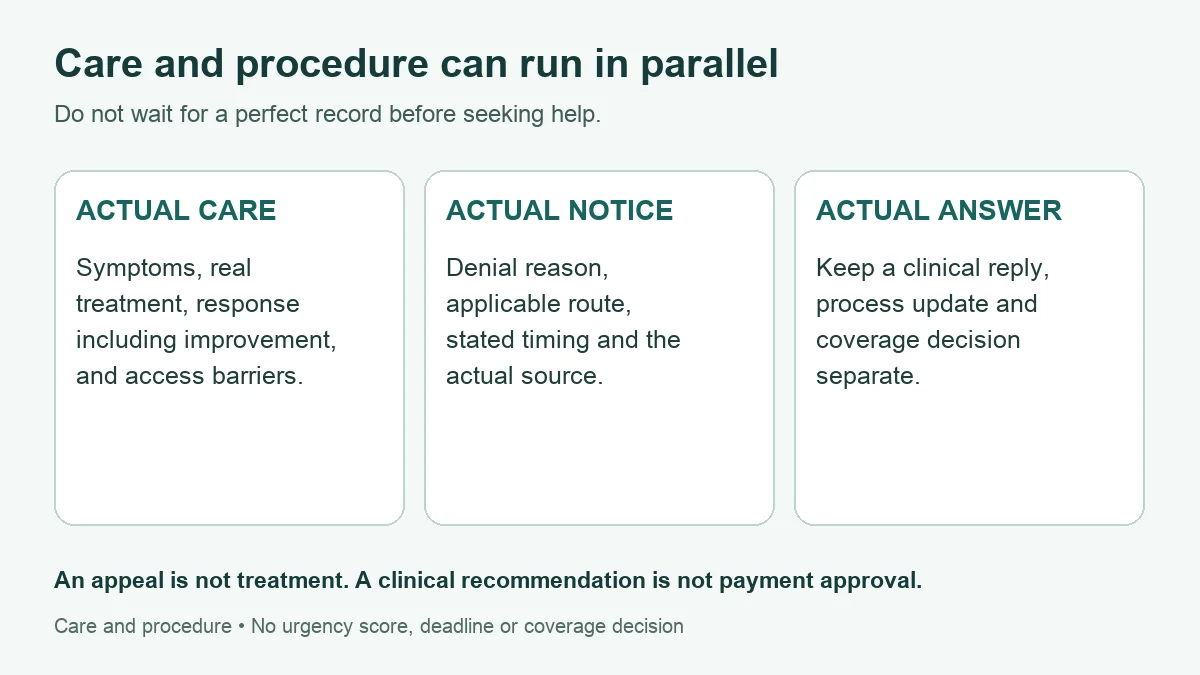
Understand the notice before borrowing a generic appeal timeline
Begin with the real decision: is this a request before a service, or payment for a service already received? What plan and review route does the notice describe? Confirm who may submit, how representation works when applicable, what must be included and where it must go. Use non-identifying summaries in a preparation worksheet; retain full notices and identifiers securely in your own records.
HealthCare.gov’s internal-appeal guidance distinguishes decisions about services not yet received from those already received and describes urgent-review options within its applicable framework. It is not a single timeline for every U.S. plan or decision. CMS’s health-plan appeals information also directs readers to ask about applicability. This guide deliberately does not calculate a filing deadline or declare your case urgent.
The Department of Labor’s health-benefit claims guide addresses covered private-sector employment-based plans, plan documents, claim types and review procedures. Medicare’s appeal guide separately explains that Original Medicare and Medicare health-plan decisions have appeal routes and relevant notices or plan materials. Identify the route that actually applies; do not transplant instructions from another system. Other coverage types may require different official guidance.
Ask about the actual deadline, the event that starts it, the submission channel and how receipt is confirmed. Do not assume a phone inquiry, peer-to-peer discussion, corrected request or additional record pauses a deadline or preserves formal appeal rights. If dates or instructions conflict, seek clarification from the relevant plan/benefits contact and appropriate assistance. The worksheet cannot resolve the conflict or tell you to miss a stated date.
When standard waiting could seriously jeopardize health or recovery, ask the treating team and relevant plan contact about the applicable expedited process. Availability, criteria and procedure depend on the applicable framework. An expedited administrative request is not emergency treatment, and emergency assessment must not wait for its result.
Clinical imaging guidance is not a coverage or treatment-failure score
Clinical appropriateness, benefit coverage and the appeal procedure answer different questions. Ask the ordering clinician what the MRI is intended to answer and how the result could affect care. Ask the plan what criterion was applied. Neither a clinician’s order nor a more detailed diary by itself establishes approval, payment or out-of-pocket cost.
RadiologyInfo’s low-back-pain appropriateness summary explains imaging in different clinical situations. The ACR low-back-pain criteria include a scenario involving a surgery or intervention candidate with persistent or progressive symptoms during or after a specified period of management. That is a particular clinical scenario, not a rule that every person must complete the same treatment or wait the same time. Low-back guidance is not a universal shoulder, knee or hip MRI standard, and it is not the reader’s insurer policy.
There is no evidence-based “coverage tier 1–5” established by this article. More pain, deterioration, longer waiting or more failed treatment does not mechanically move a person toward approval. Improvement belongs in the record. If symptoms change, the treating team may need to reconsider the care or imaging plan; do not conceal that change to maintain the original request.
Treatment should serve clinical needs. Do not arrange unnecessary visits, continue harmful treatment, buy a device, change medication or perform exercises just to generate appeal evidence. Ask the treating team about benefits, side effects, barriers and alternatives. This article prescribes no conservative-care course, dose, progression or waiting period.
Six essential checks for care and an MRI appeal record
Keep the actual care question visible
Record instructions actually received, the source and date if known, and what needs clarification. New or changing concerns should go to the appropriate care service rather than waiting for a complete log. The administrative review does not decide what symptoms you should tolerate or whether a new clinical assessment is needed.
Record the full response, not only limitations
Describe ordinary activities already experienced, including things that remain possible. Include improvement, worsening, fluctuations, possible side effects and uncertainty. Timing or distance is optional if already known; do not test a maximum sitting, walking or lifting tolerance. “I do not know” and the person’s own words are useful entries.
Describe access barriers without calling them treatment failure
If a visit, therapy or other care did not occur, record the actual reason when known: availability, cost, transport, caregiving or another barrier. A missed appointment does not prove improvement, non-cooperation or completed unsuccessful treatment. Ask what help or clinically appropriate alternative is available; do not invent attendance or a trial.
Identify the real reason, route and deadline source
Keep the notice’s reason separate from your interpretation. Record the procedure and timing only as actually stated or confirmed, including the source and starting event. Avoid borrowed deadlines or assumptions about extensions. Clinical criteria, insurer criteria and the filing route are different items to clarify.
Separate materials prepared, sent and received
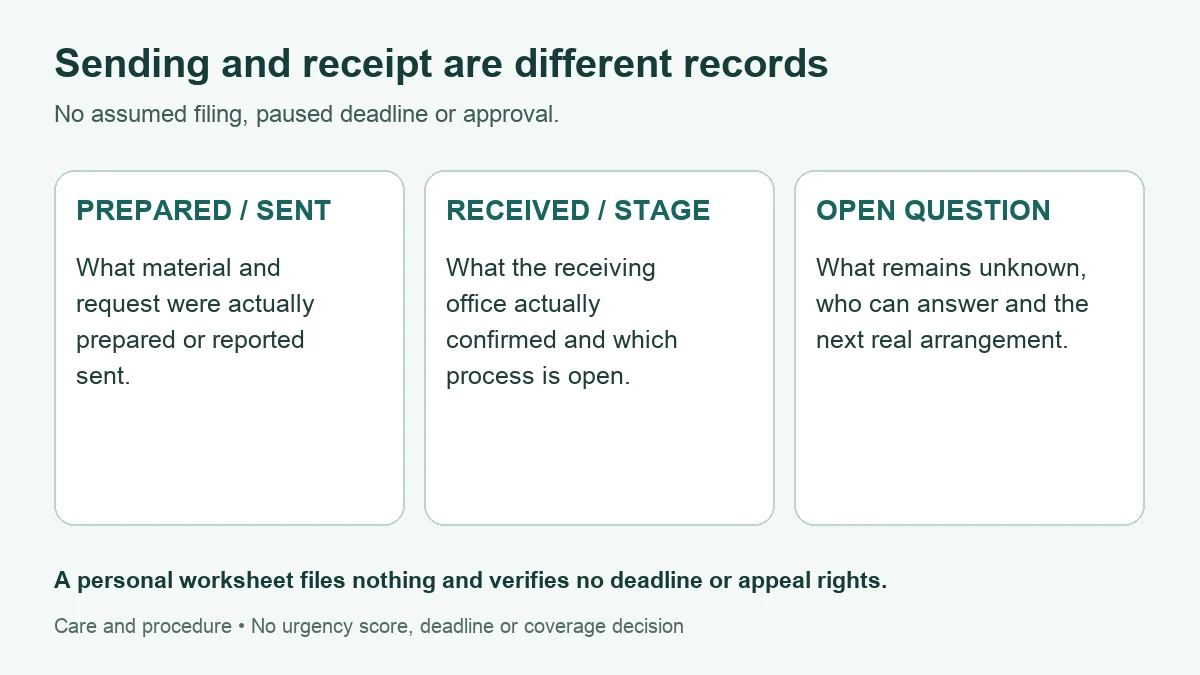
List relevant material requested, what was prepared, what was actually included and who reports sending it. Keep a delivery or receipt response with its source. A clinic’s reported action does not establish that the insurer received a formal appeal, and receipt does not mean approval. Ask which review stage is actually open.
Preserve the actual reply and next owner
Record whether the question is only prepared, has been sent or has received an answer. Keep the answer’s scope: care advice, missing-record request, process update or decision. Note any actual next arrangement and unresolved point. Do not write an agreed review date, approval or result before it exists.
A record can be short without forcing precision. You may say “the activity was difficult; exact timing was not measured.” Severe or constant pain is not merely a mood or a poorly told story. Use your own words, and add context if useful. No minimum number of functional losses or polished narrative is required by this guide.
Who answers care, documentation and review questions?
| Role | Useful question | Boundary |
|---|---|---|
| Person receiving care / helper with permission | What was actually experienced, received, unavailable and answered? | Do not invent clinical findings or speak as if a helper’s observation is the patient’s own account. |
| Ordering / treating clinical team | What care and reassessment fit the actual change, and what is the imaging question? | This page cannot prescribe treatment or convert symptoms into MRI eligibility. |
| Clinic authorization / records contact | What request and records were actually sent, by whom, when and through which route? | Sending records is not automatically formal filing, receipt or an approved request. |
| Relevant plan / administrator contact | What actual notice criterion, procedure, deadline and review stage apply? | A process answer is not necessarily a coverage decision or a reliable extension of time. |
| Applicable assistance / adviser | Which official assistance route or professional help fits an unclear or disputed process? | General guidance cannot resolve individual legal rights or guarantee an outcome. |
Use the relevant confidential channel. The official sources below identify assistance routes within their respective systems; availability depends on the plan and situation. Share relevant information with the intended office, rather than automatically forwarding a full private diary or complete medical record. No message is sent by this tool.
Compare requested material, sending and confirmed receipt
| Record item | What to keep distinct | Question when unconfirmed |
|---|---|---|
| Denial reason / criterion | Actual notice wording versus an explanation offered later. | Which criterion and decision does this request concern? |
| Requested information | A documented request versus what someone assumes will help. | Which relevant records are missing, from which source? |
| Prepared material | Existing records and personal summary versus clinician findings or signed documents. | What is ready, what is unavailable and what should not be represented as a medical finding? |
| Sent material | Sender report, date, channel and actual included items. | Was a formal appeal or a different kind of request sent? |
| Receipt / stage | Actual receiving-office confirmation versus a sending-office assurance. | Was it received and which process is now open? What deadline still applies? |
| Decision / next step | A request for more information versus an actual decision and appeal instructions. | What did the answer decide, what remains open and who owns the next step? |
The comparison is not a coverage score or an instruction to assemble every item. Follow the applicable procedure and obtain help with uncertainty. Keep original documents securely; a personal summary does not replace required forms or authenticate a professional record. Do not delay a relevant filing step while trying to complete this table.
Two fictional examples: accurate response and unconfirmed receipt
These are invented writing examples, not real patient cases, legal advice, filed appeals or evidence of success. Neither forecasts approval or sets a deadline. Example buttons replace current tool entries; export private work before loading them.
Example A: partial improvement, a side effect and an access barrier
| Record | Fictional entry |
|---|---|
| Existing care / experience | An interim plan was received. Some ordinary activity became easier while another limitation remained. |
| Actual response | Partial improvement and a possible side effect were noticed. Both will be reported. |
| Care not received | An intended visit was unavailable because of an access barrier; no failed treatment is invented. |
| Clinical question | Given the actual response, remaining concern and side effect, what care and imaging plan is appropriate? |
| Procedure question | The exact denial reason and applicable route still need the actual notice. No approval or new treatment is assumed. |
A note could read: “Some activity became easier, another concern remains, and I noticed a possible side effect. The intended visit was not available. I want advice about the current care and imaging question, and help clarifying the actual denial criterion.” It does not hide improvement or describe unavailable care as completed treatment.
Example B: the clinic reports sending material, but receipt is unknown
| Record | Fictional entry |
|---|---|
| Sender report | The clinic says supporting material was sent. The exact included list needs confirmation. |
| Unknown process | It is not confirmed whether this was a formal appeal, a corrected request or another communication. |
| Receipt / deadline | No receiving-office confirmation is recorded. The actual deadline and starting event are unconfirmed; no pause or extension is assumed. |
| Question | What was sent, was it received, which process is open, and what actual deadline still applies? |
| Actual answer / care | No insurer reply or decision is recorded. Clinical follow-up remains a separate care question. |
A concise question reads: “Please clarify the actual request sent and included material, receiving-office confirmation, open review stage and applicable timing.” The tool prepares the question; it does not send it, file an appeal or verify that rights have been preserved.
Free care and MRI appeal record with unanswered questions
The tool keeps actual care and response, notice information, the applicable process, material prepared, sending, receipt and real replies separate. Empty fields generate optional questions. Complete fields remain unverified personal entries. No urgency assessment, legal deadline, approval chance, coverage tier or treatment recommendation is generated.
Try fictional examples on the live page. Download the offline HTML copy before entering actual health or insurance notes. The live website may use site services. The downloaded tool contains no ads, analytics, external assets, browser storage or automatic network requests. No account or email is needed. Entries are not saved automatically; exported files include your entries and should be kept private.
Avoid names, member or claim identifiers, complete notices and full medical records. Build a record, copy it, download text or print/save PDF using your browser. Editing an entry hides the old result until rebuilt. Nothing is submitted or sent. If it does not load, use paper with the same headings. Do not delay emergency care, appropriate follow-up or applicable filing steps to finish a worksheet.
Care and MRI appeal record with unanswered questions
Keep actual care, the notice, applicable procedure, sending, receipt and real answers separate. No treatment plan, urgency rating, legal deadline or approval chance is generated.
For actual health or insurance notes, download the offline tool first. Try the fictional example here. The offline copy contains no site ads, analytics or external assets and needs no account.
Offline copy. This file contains no ads, analytics, external assets or automatic network requests.
The tool uses no network requests or browser storage. Unsaved changes can be lost on refresh or close. Exported files contain your entries; keep them private. Avoid names, member or claim identifiers, full notices and medical records.
Start with the fictional example or download a blank offline copy.
If the tool does not load, use paper: actual care and response; notice and confirmed process; material sent and receipt; actual reply and next question. Do not delay care or filing steps to complete a worksheet.
My care and MRI appeal record
Unverified personal record for discussion. These are unverified personal notes, not clinical advice, a filed appeal, a verified notice or a coverage decision. A complete record does not prove a right or approval; an incomplete one does not prevent seeking help.
Guide: living.kioptrix.com/mri-job-sciatica-keyboard-mouse-placement/
Questions while an MRI appeal is pending
Does a denial mean my symptoms are safe to wait on?
No. Administrative status does not determine clinical safety. Ask the appropriate care service about changes; emergency warning symptoms must not wait for an authorization or expedited-review result.
Must I keep a consistent story or show three limitations?
No such requirement is created here. Record actual variations, improvement, side effects and what remains possible. Do not invent precision, conceal facts or provoke symptoms to create evidence.
Does physical therapy automatically strengthen an appeal?
There is no automatic approval effect established by this guide. Care should be clinically appropriate. Record treatment actually received and its full response; care unavailable because of an access barrier is not completed failed treatment.
Does a clinic call mean the appeal was filed?
Not necessarily. Clarify what request and material were actually sent, what the receiver confirmed and which procedure is open. Do not assume a call, peer discussion or further documentation extends a deadline.
Can I use a general online deadline?
Do not substitute a generic timeframe for the applicable notice, plan procedure and relevant assistance. This tool calculates no date, assumes no extension and resolves no disputed timing.
Does medical necessity guarantee payment?
A clinical recommendation, benefit coverage and payment are distinct questions. Ask about the actual decision and applicable terms. This guide cannot certify eligibility, network status, authorization or personal cost.
Do I have to complete the form before asking for help?
No. The fields are optional preparation prompts, not a condition of care, assistance or filing. Use the appropriate clinical and administrative routes when needed.
Sources, correction and review limits
- HealthCare.gov: Internal appeals and CMS: Appealing Health Plan Decisions — applicable health-plan process and urgent-review context; not a universal deadline calculator.
- U.S. Department of Labor: Filing a Claim for Your Health Benefits — covered employment-based plan procedures and assistance; do not apply automatically to every coverage type.
- Medicare: Filing an appeal — Medicare-specific notices and routes; not interchangeable with other plan procedures.
- RadiologyInfo: Low Back Pain and ACR: Low Back Pain Appropriateness Criteria — clinical imaging scenarios, not a universal orthopedic or insurance approval rule.
- NHS: Sciatica and MedlinePlus: Sciatica — back/leg symptom and care-seeking education; not insurance procedure guidance.
Editorial correction and source check: October 28, 2026. Replaced approval-oriented narrative advice, the unsupported coverage-tier table, the tolerance-based mini-calculator, the artificial requirement for three functional losses and the implication that a denial is merely a documentation problem. Removed dismissive language about symptoms and access burdens, repeated images and the embedded video. The new examples are explicitly fictional; actual care, sending, receipt and decisions are kept distinct. The original URL is retained.
The representative illustration is AI-generated fictional artwork. The two body diagrams explain this editorial framework, not real patient records, a clinical pathway or a coverage decision. No independent clinical, insurance or legal review, real-user study or outcome validation is claimed. Functional checks of the tool do not establish those outcomes. Our background and editorial approach.