

Sciatica at a warehouse job needs an individual care discussion and a task-specific workplace review. Standing, walking, handling and repeated reaching describe different demands. A change called “lighter duty” may leave some demands unchanged. This guide helps you compare actual work, a proposed change, what was really agreed and what was actually implemented; it does not decide that a task is safe for you.
Start with the task-demand comparison, use the six essential checks, follow two fictional writing examples, or build a work-change record. No standing interval, lifting limit, rotation timetable, shoe treatment or return-to-work clearance is generated. Record existing experiences; do not provoke symptoms to fill the form.
Do not use a work log for emergency symptoms. New difficulty starting urination, inability to urinate, new bladder/bowel control changes, saddle-area numbness, or severe/worsening weakness or numbness in both legs needs emergency care immediately. New foot weakness, foot drop, worsening numbness or unsafe walking needs prompt clinical assessment; do not keep testing it across shifts. Stop an unsafe task and obtain appropriate help rather than finishing the record. NHS emergency warning guidance and MedlinePlus sciatica information explain when to seek care.
This is general education from a family-caregiver-run site, not individual medical, workplace-safety or legal advice. The operator is not a professional adviser. Workplace-process examples focus on the United States; the NHS source supports symptom education, not U.S. employment rules. Your clinician and appropriate workplace professionals assess your situation. You do not need a complete log or a successful informal trial before asking for care or workplace help.
Table of Contents
Sciatica at a warehouse job: separate symptoms from work demands
Back or leg discomfort during work does not identify its cause. General ergonomics evidence about musculoskeletal discomfort is not proof that a particular shoe, mat or rotation treats nerve compression. A record of when something changed can help a discussion, but it cannot diagnose the cause, establish a work-related injury or clear continued work.
OSHA’s warehousing hazards guidance identifies handling, reaching, awkward postures and repetitive work among ergonomic concerns. Describe the actual task rather than assuming that the job title, less lifting or more walking makes it appropriate. Route, pace, equipment and other hazards can change the assessment.
| Task / demand already known | Change to discuss with the relevant team | What still needs checking |
|---|---|---|
| Fixed packing or scanning station | Work-surface and reach layout; ways to vary permitted duties or posture. | Does actual work still require the same reach, fixed stance or pace? |
| Picking, carrying or repeated handling | Handling aids, load presentation, access, assistance and task redesign. | What does the real task require, and what do actual professional instructions say? |
| Walking or cart routes | Route demands, cart handling, help and permitted workflow changes. | Distance alone misses pushing, turning, surfaces and vehicle interaction; walking is not automatically a recovery task. |
| A proposed checking / “light duty” station | Compare its full demands with the previous assignment. | Less handling may leave fixed standing, bending or repeated reach unchanged. |
| Footwear, surface or mat concern | Requirements, fit, condition and environment review with the safety contact. | Would a proposed change meet the actual hazards and site requirements? A comfort claim does not answer that. |
Keep two kinds of information separate: your account of work already experienced, and the assessment or instruction actually given by a professional. If you do not know a load, time or restriction, leave it unknown. Do not estimate a medical limit from pain onset or borrow another worker’s restriction.
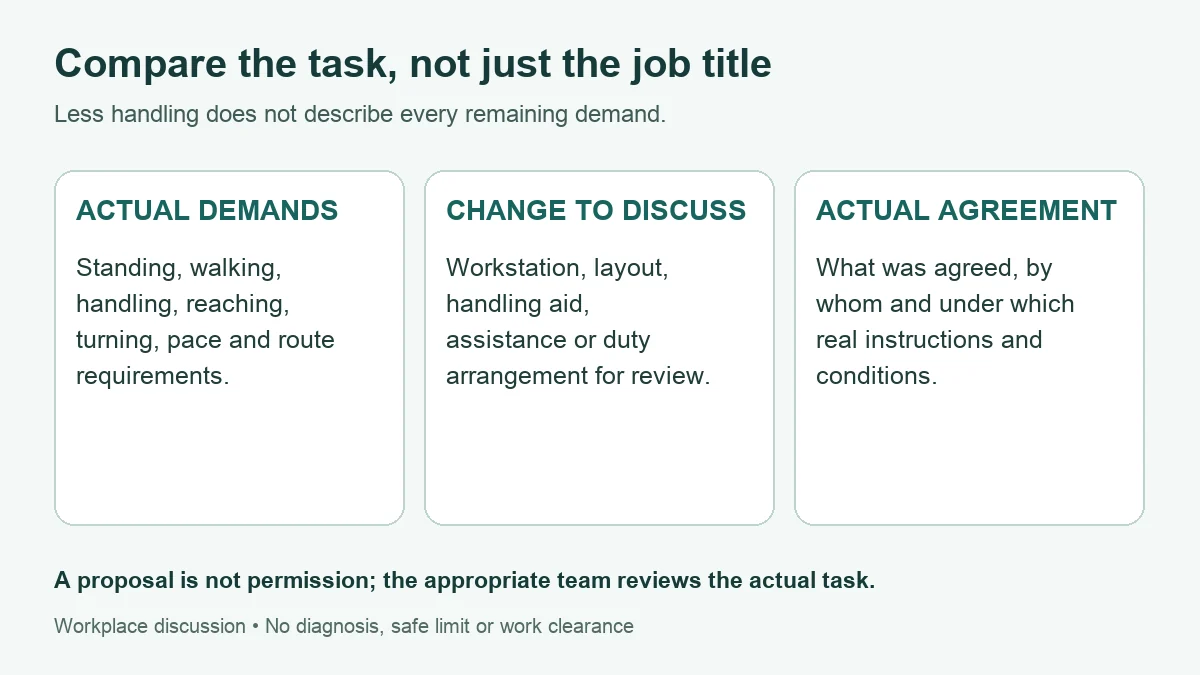
Who reviews the task, care needs and workplace arrangement?
| Role | Useful question | Boundary |
|---|---|---|
| Warehouse worker | What did I actually do, what changed, and what barrier needs help? | No need to prove toughness, conceal symptoms or promise higher productivity. |
| Treating clinician / occupational health | What assessment and clinically supported advice fit these actual demands? | The article supplies no diagnosis, work restriction or fitness-for-work certificate. |
| Supervisor / implementation owner | Which agreed duties, help and workflow changes are actually available? | A proposal or scheduled change is not proof of implementation or medical suitability. |
| Safety / ergonomics contact | Can the task, workstation, route, aid or protective equipment be changed appropriately? | Do not alter equipment, traffic arrangements, mats or required footwear from a blog instruction. |
| Designated accommodation / HR contact | Which request route and relevant supporting information apply? | A private worksheet is not an employer decision or a reason to disclose complete medical records. |
Use relevant information and the designated confidential route. A supervisor may need to understand a work barrier without receiving your entire health history. Safety reporting, clinical care and an accommodation discussion can overlap, but they are not interchangeable processes. This guide does not resolve injury reporting, compensation, leave or legal disputes.
Six essential checks for a warehouse job work-change discussion
Describe work already experienced, without an endurance test
Use ordinary permitted work already performed: the task, setting, movement or handling demands, the change noticed and its effect on safe movement. Approximate timing is useful only if already known. Do not repeat an aggravating task, wait for a high pain score or work a full shift to identify a “safe” threshold. Worsening or new neurological symptoms need assessment, not a more complete dataset.
Keep actual instructions with their source
Record professional advice, restrictions, site rules and training actually received, including source and date. Keep an unanswered question marked. A person’s account of advice is not a signed professional document. Conflicting instructions need clarification from the relevant people; the worksheet cannot choose which task you may perform.
Review the task and environment before relying on rotation
Ask about work-surface layout, reach, handling method, aids and assistance. Rotation is one option to assess, not a substitute for addressing an avoidable hazard. Changing station names may retain the same demands. Moving to a walking route, seated station or lower-handling task does not automatically make it suitable.
Check footwear and surface requirements before changing them
Bring the actual fit or condition concern to the designated safety contact and, where appropriate, a health professional. Confirm task-specific protection and permitted options before changing footwear, adding an insert or modifying an item. A shoe type, softness or visible wear pattern cannot diagnose nerve irritation or certify protection. Do not test comfort by working through worsening symptoms.
Separate proposal, actual agreement and implementation
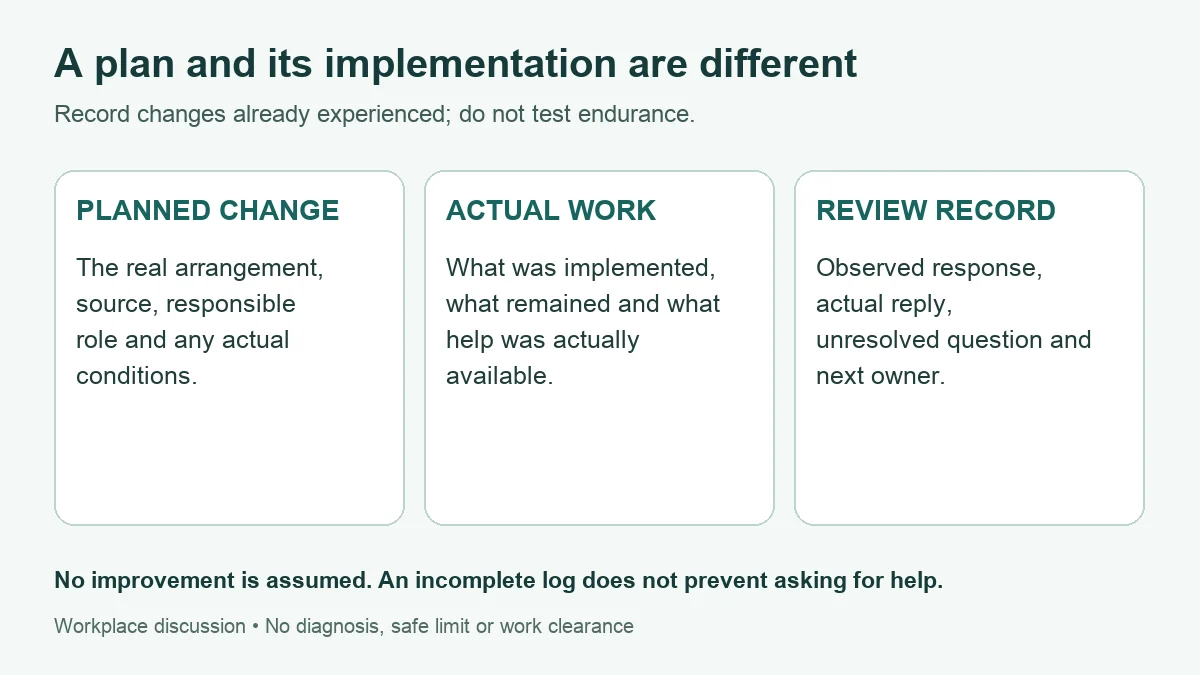
Write the change you want to discuss as a proposal. Record an agreement only when received, including the responsible role and actual conditions. Then record what was put in place, what help was available and what differed. Do not mark an entire plan implemented because one duty changed or a request was sent.
Review the real response and the next owner
Describe better, unchanged, worse, mixed or not yet observed without assuming why. Keep new clinical concerns separate from operational questions. Record the actual reply, unresolved point and agreed follow-up if any. Do not invent a review interval, use this worksheet to delay help or keep repeating an unsuitable arrangement to demonstrate failure.
OSHA’s ergonomics controls page favors physical changes to the task where possible and describes rotation between tasks using different muscle groups. It does not validate a fixed rotation interval for a person with sciatica. The NIOSH ergonomics-program guide likewise places higher-level controls ahead of reliance on administrative methods or personal protection. These are workplace hazard-control principles, not treatment trials or individual work clearance.
Warehouse footwear, mats and movement: conditions to verify
| Possible discussion | Potential purpose | Unanswered question to preserve |
|---|---|---|
| Warehouse workstation / handling change | Reduce a specific task demand after review. | Was the change implemented, and did another demand remain or appear? |
| Different duties / posture opportunities | Vary actual demands within an appropriate arrangement. | Are the demands genuinely different, available in practice and consistent with actual advice? |
| Footwear fit / condition review | Address reported fit or condition while preserving required protection. | Which requirements and permitted options apply to the real task? |
| Mat, foot support or seating option | Consider a workstation option where appropriate. | Does it suit traffic, carts, equipment, housekeeping and access? It needs site review. |
| Break / relief arrangement | Provide agreed opportunities within the workplace process. | Who supplies relief, how is it accessed, and what happens if the arrangement is unavailable? |
OSHA’s foot-protection standard addresses protective footwear for relevant hazards. It is not a certification of sciatica treatment or a universal shopping list. Do not assume that comfortable footwear meets a protective requirement, or that a required protective item must be tolerated without raising a fit concern. Ask about both protection and the reported problem.
There is no “best shoe for this diagnosis” established by this guide. A material or cushion preference does not establish symptom relief for an individual. General advice to remain active also does not authorize lifting, equipment operation or continued work when movement is unsafe. Discuss appropriate activity and task concerns with the relevant professionals.
Two fictional examples: a plan gap and a footwear question
These are invented writing examples, not real worker stories, clinical evidence or promised results. Neither example assigns minutes, weights, a productivity target or a safe work limit. Use your own facts only when already known; no symptom-provoking trial is requested. The tool’s example buttons replace the current entries.
Example A: less handling, but the same fixed-station demands
| Record | Fictional entry |
|---|---|
| Existing task / observation | Checking duty involved less handling, but fixed standing and repeated reaching remained difficult during work already experienced. |
| Agreement | A move to checking was reportedly agreed; additional workstation changes were not confirmed. |
| Actual implementation | Checking duty occurred. The planned opportunity to vary tasks was not consistently available. |
| Response / uncertainty | No clear improvement was established. The record does not diagnose the cause or certify work suitability. |
| Question / next owner | Can the responsible team review the remaining demands and the gap between the arrangement and actual work? Actual reply and next review are not yet recorded. |
A concise discussion note could say: “Less handling was introduced, but fixed standing and repeated reaching remained. The planned task variation was not consistently available. I need help reviewing these remaining barriers and the actual arrangement.” It does not require a promise to do the same output or a self-selected time limit.
Example B: footwear discomfort with a protective requirement
| Record | Fictional entry |
|---|---|
| Requirement / concern | The worker reports a protective-footwear requirement and fit discomfort already experienced; exact permitted options need confirmation. |
| Proposal | Request a requirements and fit review with the designated safety contact; ask a clinician about relevant health concerns. |
| Agreement / actual action | A review is being requested. No alternative shoe or insert has been agreed and no change is recorded. |
| Response / uncertainty | No response to an alternative has been observed. No comfort or treatment benefit is assumed. |
| Question / next owner | Which protection and fit options apply, who can decide, and what is the actual next step? No approval or deadline is invented. |
A useful question reads: “I need help with a fit concern while meeting the task’s protective requirements. Which review route and permitted options apply?” A worksheet cannot approve a substitution, modification or return to a task. If a task cannot be performed safely, obtain appropriate help rather than continuing to test the footwear.
Free warehouse job work-change record tool
The tool separates actual demands and advice, a proposed change, a real agreement, implementation, observed response and actual follow-up. Blank fields generate questions for the relevant role. They are optional prompts, not legal requirements or evidence that you failed a safety test. Filled fields do not prove accuracy or clearance. You can ask for help before using any of them.
Try fictional examples online; download the offline copy before entering real health or employment notes. The live site may use site services. The downloaded HTML tool contains no ads, analytics, external assets, browser storage or automatic network requests. It needs no account or email. Entries are not saved automatically; exported files contain your entries and should be kept private. Avoid names, employer identifiers and complete medical or employment documents.
Build the record, copy it, download text or print/save PDF. Editing any field hides the previous result until rebuilt. The tool submits nothing, creates no medical certificate and makes no accommodation or work-safety decision. Use paper with the same headings if it does not load. Emergency symptoms and unsafe tasks require appropriate help, not a completed form.
Warehouse work-change record and discussion questions
Separate actual work demands, proposals, real agreements, implementation and observations. No safe work interval, medical restriction, diagnosis or work clearance is generated.
For actual health or employment notes, download the offline tool first. Try the fictional example here. The offline copy contains no site ads, analytics or external assets and needs no account.
Offline copy. This file contains no ads, analytics, external assets or automatic network requests.
The tool uses no network requests or browser storage. Unsaved changes can be lost on refresh or close. Exported files contain your entries; keep them private. Avoid names, employer identifiers and pasted medical or employment records.
Start with the fictional example or download a blank offline copy.
If the tool does not load, use paper: actual work and advice; proposed and agreed change; real implementation; observations; actual reply and next question. Do not delay care or help to complete a log.
My warehouse work-change record
Unverified personal record for discussion. These are personal notes, not a medical certificate, employer decision, safety assessment or fitness-for-work clearance. A completed form does not make work safe; an incomplete form does not prevent asking for help.
Guide: living.kioptrix.com/sciatica-at-warehouse-job/
Request help without proving productivity or finishing a log
A practical explanation can identify the work barrier and the change you need to discuss. It need not minimize symptoms, promise more output or make a medical conclusion. The EEOC’s reasonable-accommodation guidance explains that a covered request can be made in plain language and need not use the term ADA. It also describes an individualized discussion and, when appropriate, relevant documentation. This does not establish individual eligibility or guarantee the particular change requested.
For example: “Because of a medical condition, I need help discussing a change to this work task.” You can then describe the barrier in your own words. A detailed log or precise proposed solution is not a prerequisite to starting that conversation. Ask the designated contact what relevant information is needed, and use the appropriate confidential process. A request, documentation, decision and implementation remain separate records.
Choose the contact for the actual issue: clinical assessment for symptom changes; the workplace’s designated route for an unsafe condition; implementation questions for the responsible supervisor or team; and the accommodation contact for that process. These routes can proceed when needed rather than as a five-tier ladder. An operational record does not replace medical care, hazard reporting or individualized legal advice.
Questions about sciatica at a warehouse job
How often should I rotate tasks?
This guide supplies no universal interval. An appropriate arrangement depends on the actual demands, workplace assessment and individual professional advice. Do not subtract a fixed number of minutes from symptom onset to invent a safe limit.
Is walking always better than standing?
No individual task is cleared by that comparison. Walking can include pace, load, pushing and route hazards. Describe the actual demands and ask the relevant professionals about suitable activity and work changes.
Does a lighter-duty label make the assignment suitable?
It does not describe all demands. Compare the actual handling, posture, reach, route, pace and assistance rather than relying on the title. Record what was implemented and what still needs review.
Can a new shoe, insert or mat treat the problem?
This guide establishes no treatment effect or preferred product. Discuss fit or condition, protection requirements and the environment. Do not make an unreviewed protective-equipment change or work through worsening symptoms to test a product.
Must I finish the record before asking for help?
No. The fields are optional preparation prompts. Do not delay care, workplace reporting or a request while gathering a complete shift history.
What if an agreed change was never implemented?
Record the agreement and actual work separately. Ask the responsible contact to clarify the gap and next step. Do not describe a proposal as implemented or assume the lack of response proves approval.
What should I share from this private worksheet?
Review what is relevant to the particular recipient and use the designated route. Do not automatically send the entire private note or complete medical records. The tool authenticates no advice, decision or request.
For a separate discussion of supporting documentation, see ADA documentation preparation for sciatica. This page has a narrower job: comparing warehouse task demands, agreed changes and actual implementation. It does not write a clinician’s note or determine an employer’s decision.
Sources, editorial correction and review limits
- OSHA: Warehousing — Hazards and Solutions — warehouse hazards and ergonomic demands, not a diagnosis or task clearance.
- OSHA: Solutions to Control Ergonomic Hazards and NIOSH: Implement Your Ergonomic Program — task/environment controls and administrative options; no sciatica-specific rotation timetable.
- OSHA: Foot Protection, 1910.136 — hazard-related protective-footwear requirements, not a therapeutic shoe ranking.
- NHS: Sciatica and MedlinePlus: Sciatica — symptom and care-seeking information; not U.S. workplace-law guidance.
- EEOC: Reasonable Accommodation and Undue Hardship Guidance — request and discussion framework; not an individual legal decision.
Editorial correction and source check: October 28, 2026. Replaced the retained body, removed unsupported time-based pacing, the two-hour framing, shoe-treatment implications, approval-oriented productivity language, support tiers and the unverified worker story. Replaced a generic source mislabeled as topic-specific official guidance, repeated images and the embedded video. The new examples are explicitly fictional; the tool separates proposed changes from agreements, actual implementation and later replies.
The representative illustration is AI-generated fictional artwork. The two body diagrams are editorial explanations, not a workplace inspection or actual worker records. No independent clinical, occupational-health, ergonomics or legal review, real-worker validation or user study is claimed. Functional checks cannot establish treatment benefit, safety, legal entitlement or fitness for work. Our background and editorial approach.