
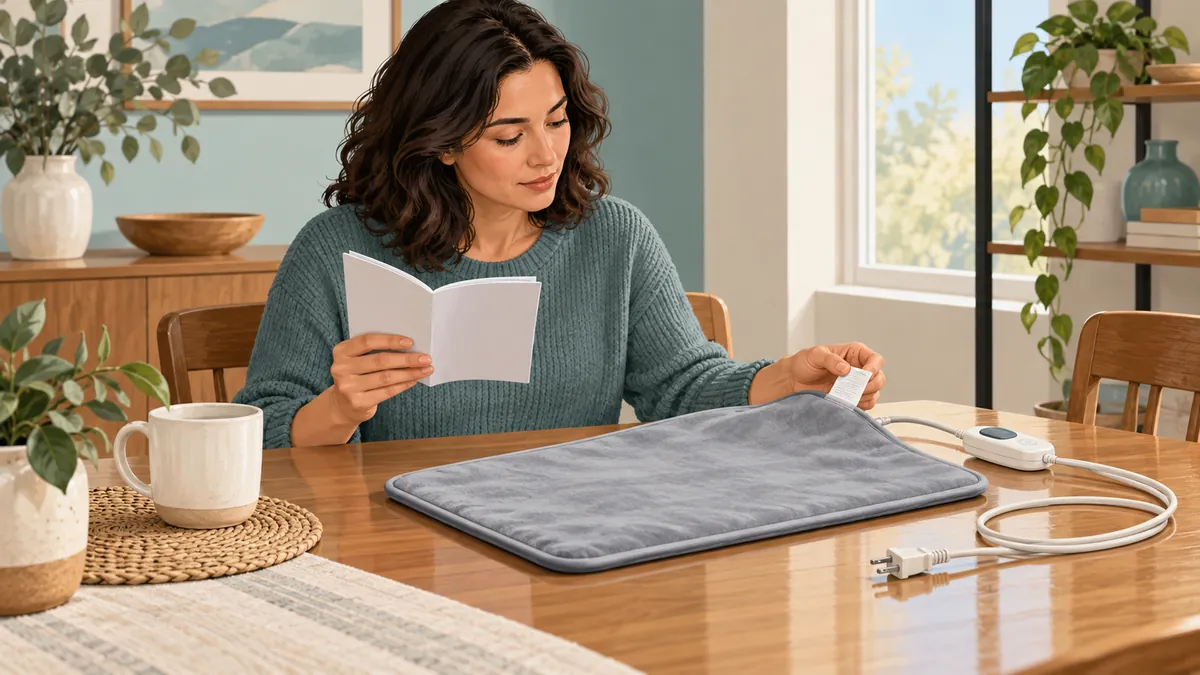
Can you sleep with a heating pad for sciatica? Do not use an ordinary electric heating pad while sleeping. Auto-off, a low setting, a phone alarm or someone nearby does not override a product warning. Identify the exact product and follow its own instructions; heated bedding is a separate category with separate directions, not a substitute this guide selects for you.
Use this guide: compare device warnings with your intended use, follow the six checks, read two fictional examples or open the before-bed and unanswered-question record tool. The record separates a plan from what actually happened. It supplies no temperature, treatment duration or permission to use heat.
Family-caregiver education, not individual medical advice or independent clinical review. Manufacturer prohibitions remain in force; a completed note or a request for clinical advice does not cancel them. For actual health notes, download the offline tool first. No account or email is needed.
On this page
Start with the exact device, not its auto-off feature
A product name, photograph or shop description is not enough to identify its instructions. Find the brand, model and appropriate market version in an existing label or record. You do not need to turn the heating pad on to do this. If the label is unreadable or the manual does not match, record the gap and contact the manufacturer rather than borrowing another model’s settings.
The Sunbeam instruction-manual directory is one example of a manufacturer lookup route. It is not a recommendation to buy that brand. Search the actual manufacturer’s official support site for the model you own; use its contact route when a match is uncertain. Retain the manual address, relevant page or section and date you checked it.
As a specific example, the Sunbeam Rebound 970-801-CN manual, English safety page 2, prohibits sleeping use, insensitive-skin use and certain user groups; it addresses placement, crushing, skin checks and unplugging. Page 3 describes auto-off alongside the sleep warning. Those features do not cancel that model’s restrictions. This Canadian model example is not a universal manual, a product test or a list of every warning.
Keep two questions separate: what the product permits, and what is appropriate for the individual. Manufacturer support can clarify the device and documentation. A clinician or pharmacist can address relevant personal care or medicine questions. Neither this article nor a helper’s presence turns a prohibited use into an approved one.
Heating pad warnings versus your use plan: a comparison table
Use this table beside the matching manual. The entries are questions to organize a record, not a replacement instruction sheet. Leave an unknown visible; do not power, wear or test a device to complete a row.
| Check in the actual product instructions | Compare with the intended arrangement | Record the gap or next action |
|---|---|---|
| Product identity and applicable manual | Does the model and market match, or was the document found for a similar-looking item? | Model, source and page; manufacturer question if not confirmed. |
| Sleep and alertness restrictions | Is the plan to remain awake, or to rely on a timer after falling asleep? | Any conflict and how ordinary-pad use will end before sleep. |
| Placement, covering and folding restrictions | Does the proposed arrangement agree with the exact instructions? | Actual restriction and unresolved placement question; no setup is certified. |
| User, skin and sensation restrictions | Is a relevant concern already known, or does personal advice need clarification? | Question for the appropriate professional; do not waive a product prohibition. |
| Shutdown, disconnection and storage directions | Who can end use, remove the ordinary pad and follow the manual before sleep? | Proposed steps, responsible role and whether they actually occurred. |
| Condition, maintenance and support instructions | Is there an existing product problem, missing label or unclear support instruction? | Contact route and actual arrangement while unresolved; no repair or trial is prescribed. |
Do not turn this into a universal twenty-minute schedule, maximum-temperature chart or “safe overnight” checklist. The source, device and person matter. A field marked complete shows that someone entered words, not that a manual was interpreted correctly or a setup was checked.
What the sources establish, and what they do not
Sunbeam’s general heating-pad FAQ identifies sleeping and several skin, circulation and user-related restrictions. It provides manufacturer context, not personal clearance or a complete list for every product. Read the matching manual in full, including warnings beyond this article’s examples.
The previous article relied on MAUDE report 21944497. That record describes an alleged burn after a user fell asleep and includes the manufacturer’s account of instructions and use. It is a reported event, not an independent clinical conclusion about the consumer or a risk estimate for all pads. FDA explains that MAUDE limitations prevent establishing event rates or causation from the reporting system alone. The report remains supplementary background, not the principal instruction source.
NHS sciatica guidance includes heat packs among self-care options. That general advice does not establish that electric-pad sleep use is permitted, that a particular device suits you or that heat repairs a compressed nerve. This article does not claim a treatment effect from completing its record or replacing a device.
| Source or record | Appropriate role | Limit |
|---|---|---|
| Matching manufacturer manual | Actual product directions, restrictions and support route. | Does not independently assess your condition or prove clinical benefit. |
| Public clinical information | General context and reasons to seek care. | Does not override a product restriction or prescribe this device. |
| MAUDE adverse-event report | A reported event and its submitted narrative. | Not incidence, causation or proof of a regulator’s individual finding. |
| Your before-bed note | Organizing warnings, plans, events and questions. | Not verification that shutdown occurred, warnings were met or heat is suitable. |
Six essential checks for the before-bed record
Identify the product without a trial
Record the exact model and whether it is an ordinary electric pad, heated bedding or another product. “Unknown” is useful information. Do not assume that a removable cover, dark controller or automatic shutoff tells you the product category or permitted use.
Keep a traceable copy of the actual warnings
Write the source, section or page and check date beside a short summary. Include restrictions relevant to the intended use; reading this article is not a substitute for the full manual. If a warning or translation is unclear, put the manufacturer question in the record rather than guessing.
Describe the plan and any mismatch
State what was intended or usually happens, including whether drowsiness or help with the controls is an issue. Put that description beside the actual warning. Do not use a device or reproduce a previous event just to make the note more detailed. The tool cannot detect contradictory text.
Arrange closure before sleep for an ordinary pad
Record how use will end and the ordinary pad will be removed before sleep, following its shutdown and storage directions. Name a responsible role only if that help is actually arranged. A proposed plan, someone nearby or an alarm does not permit prohibited use. If a workable arrangement is missing, retain that unanswered question; do not rely on an unconfirmed helper.
Separate planned steps from actual events
Choose a status that describes the record: unconfirmed, proposed, shutdown and removal recorded, or use deferred. An actual-event note is optional. It can describe an event already noticed without rating pain or skin safety. Do not restart a device, wait for discomfort or remain awake to collect a treatment comparison.
Route unresolved questions to the right person
Separate model and manual questions for manufacturer support from personal care questions for a clinician or pharmacist. Record the actual contact and interim arrangement, not a promise that someone will reply. Do not change medicines, select a replacement heat product or invent a new temperature while filling the form. Needed care takes priority over record completion.
Two fictional examples: auto-off confusion and a missing manual
These are fictional writing examples, not patient stories, tested products or treatment results. No heat trial is required. Both examples retain unanswered items rather than creating a green “safe to use” result.
Example A: auto-off was mistaken for permission to sleep
| Record section | Fictional entry |
|---|---|
| Product and warning | An ordinary pad; in this example its matching manual prohibits sleep use. |
| Original intention | Had planned to let auto-off stop the device after falling asleep. |
| Revised closure plan | End use and remove the pad before sleep; follow its own shutdown, disconnection and storage instructions. |
| Actual status | Proposed only. No completed shutdown or removal is recorded. |
| Open item | Confirm any help needed and the contact route; no medication change or timer-based permission is proposed. |
The useful change is recognizing the conflict and documenting closure before sleep. The example does not claim that any particular setting is suitable or that the new plan has already happened. A blank actual-event field is honest; do not use the device again to fill it.
Example B: the model is unknown and there is a sensation concern
| Record section | Fictional entry |
|---|---|
| Product and manual | Model unidentified; matching instructions not available. |
| Personal question | A sensation concern needs discussion with the appropriate clinician. |
| Interim arrangement | Use deferred while the product and personal questions remain unresolved. No substitute device is selected. |
| Separate recipients | Manufacturer: identify model and instructions. Clinician: review the personal concern and care plan. |
| Actual event and review | No use or test recorded. Help and review details are not yet confirmed. |
A manufacturer answer about the model would not resolve the personal care question. A personal discussion would not erase a product prohibition. Keep both questions visible, and do not turn “unknown” into presumed permission.
Free before-bed and unanswered-question record tool
Create one note for one product and intended arrangement. Begin with either fictional example. Compare actual warnings with the intended use, record the closure plan and distinguish it from what actually happened. The output lists blank key fields and selected statuses; it does not interpret instructions, decide whether text is accurate or determine whether heat is appropriate.
Copy, download text, print or save a separate offline HTML tool. Download the offline copy before entering actual health notes. It has no site ads, analytics, external assets or automatic network requests. The live page may include site services. Nothing is sent by the tool, and there is no automatic saving. Exported files contain entries; keep them private and review before sharing through an agreed channel.
Heating pad warnings and before-bed record
Put the exact product warnings beside your intended use, before-bed shutdown plan and unanswered questions. This tool organizes your words; it does not interpret a manual, select heat settings or certify safe use.
For actual health notes, download the offline tool first. Try the fictional example here. The offline copy contains no site ads, analytics or external assets and needs no account.
Offline copy. This file contains no ads, analytics, external assets or automatic network requests.
The tool uses no network requests or browser storage. Unsaved changes can be lost on refresh or close. Exported files contain your entries; keep them private. Avoid names, identifiers and pasted medical records.
Start with the fictional example or download a blank offline copy.
If the tool does not load, use paper: exact product and warnings; intended use and shutdown; questions and follow-up. Do not use or test a product to fill a blank.
Your before-bed and unanswered-question record
Unverified personal notes for discussion. This is not a device approval, diagnosis, treatment schedule or safety certificate. A completed record does not permit sleep use or override a warning.
Guide: living.kioptrix.com/sleep-with-a-heating-pad-for-sciatica/
Common questions and when this record is not the next step
Does auto-off make sleeping with a heating pad acceptable?
A feature does not override a sleep warning. The model-specific manual example above has auto-off and still prohibits sleeping use. Do not interpret a timer, low setting or a helper as a waiver.
Is heated bedding the same product?
No. Identify its exact category and instructions instead of copying an ordinary-pad guide. This page does not select heated bedding, certify overnight use or recommend a replacement purchase.
Can a helper check the skin so I can ignore a restriction?
No. A helper does not cancel manufacturer restrictions, including those concerning sensation or sleep. Ask for clarification of the actual device and personal care questions; the form supplies no exception.
What temperature or duration should I enter?
Record only actual instructions from the relevant source. This tool gives no universal treatment schedule or automated setting. If directions are absent or contradictory, retain the question rather than inventing a number.
Must I use the product to complete the record?
No. Actual-event notes are optional. A missing observation is not a reason for a trial, a restart, repeated application or a skin-sensation test.
What if pain persists or a skin injury is suspected?
Seek appropriate clinical advice rather than increasing heat or extending use. Do not delay care to finish a note. For persistent, worsening or activity-limiting sciatica, use the review advice in the linked NHS guidance.
Emergency warning examples: NHS advises emergency assessment for sciatica on both sides; severe or worsening weakness or numbness in both legs; numbness around the genitals or anus; or new difficulty passing or controlling urine or controlling bowel movements. Use your local emergency service. This tool does not assess urgency. NHS sciatica review and emergency guidance.
For the wider night-time plan, see Sleeping With Sciatica: Pillow Options and Care Planning. For questions about whether heat, cold or neither fits a care plan, see Heat or Ice for Orthopedic Pain. This page specifically covers device warnings and before-bed closure, not posture selection or a heat-versus-cold treatment rule.
Sources, applicability and editorial review
- Sunbeam Rebound 970-801-CN manual, English PDF pages 2–3. One Canadian model example, not a manual for another product. Publication date not established; no recent issue date is claimed.
- Sunbeam instruction-manual directory and Sunbeam Canada heating-pad FAQ. Manufacturer lookup and general restrictions; check the actual model and market.
- FDA: About MAUDE and its limitations. Reporting-system context, not a product-use prescription.
- MAUDE report 21944497, model 2204-900. Supplementary reported-event example; manufacturer narrative is not an independent clinical conclusion. This is a different model from the manual example.
- NHS: Sciatica, page reviewed December 3, 2024. General clinical background and care-seeking advice, not individual device clearance.
Editorial and source check: October 28, 2026. Rebuilt with a warning-versus-plan table, six checks, two fictional examples and an original before-bed record tool. The representative image is AI-generated editorial artwork showing a disconnected device and document check; it is not a tested product, real patient or approved setup. Caregiver-written education with no independent clinical review, clinical validation or patient usability study. Functional checks do not demonstrate treatment benefit or safe device use. Our background and editorial approach.