
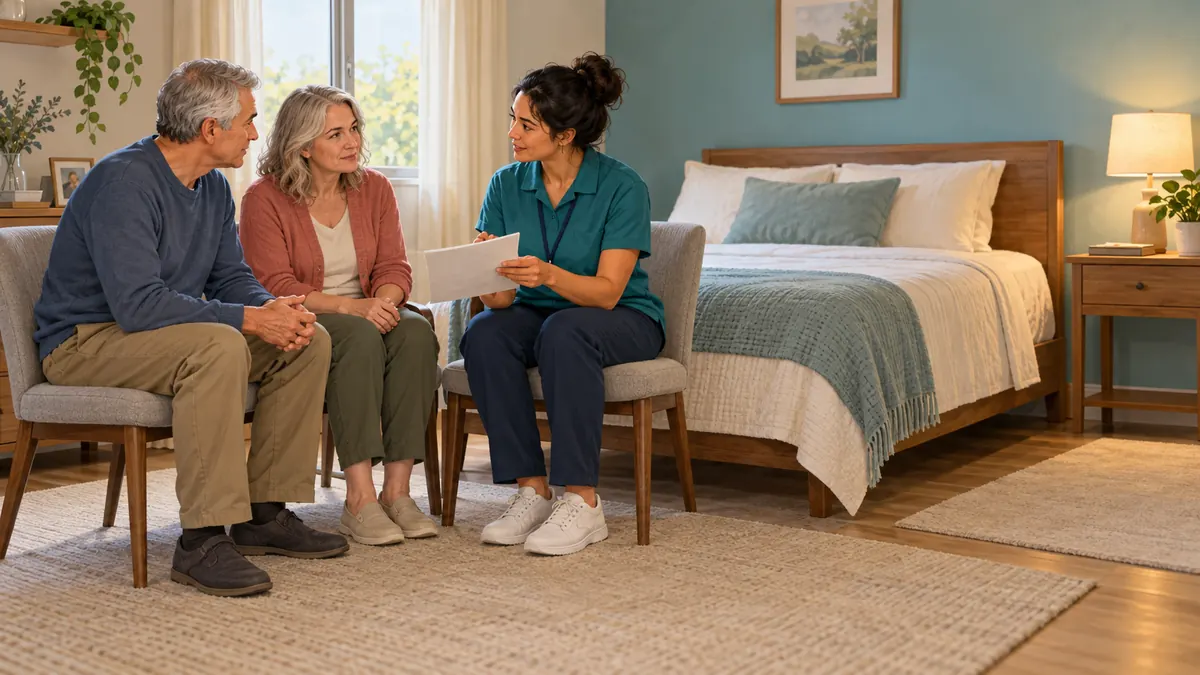
A log roll for sciatica is not a universal bed-transfer rule. The term describes a way of rolling onto the side as part of getting into or out of bed. It may be included in individual postoperative or rehabilitation teaching. Whether that method, another approach, equipment or assistance fits your situation needs the relevant instructions and assessment; a picture cannot establish it.
Get practical help here: compare the transfer stage, teaching and help, use the six checks, read two fictional examples or open the bed transfer teaching and handover record. The useful outcome is a clear account of what was taught, what is actually arranged and what needs clarification for your bed.
This is family-caregiver education, not individual medical advice or independent clinical review. It gives no movement sequence, bed-height target or self-test. Continue to follow your actual care instructions for ordinary permitted movement. The record is not a reason to stop all movement, practise a new assisted technique or wait when care is needed.
On this page
Log roll teaching: distinguish a method from its setting
“I was shown how to get out of bed” can mean several things. You might have watched a general demonstration, received individual teaching in hospital or been taught with your usual helper present. A new request for an appointment is different again. Record what actually happened without upgrading it to a competence assessment.
For a specific clinical example, Guy’s and St Thomas’ lumbar decompression or discectomy guidance describes physiotherapist-led log-roll teaching after those operations. Its recovery instructions belong to that procedure and setting. They should not be copied as a timetable or movement rule for every person with sciatica, another operation or an unassessed home arrangement.
The practical question is how the individual instructions relate to the actual person, bed and assistance. A hospital demonstration does not by itself confirm that a different mattress, exit side or helper has been considered. A difficulty at one stage also does not establish that every part of the transfer requires the same help.
This guide concentrates on that gap between teaching and home use. For resting support and night-time access, see Sleeping With Sciatica: Pillow Options and Care Planning. For waking symptoms and questions about prescribed exercises, see Morning Sciatica. Neither a sleep pattern nor a log-roll picture is a diagnostic test.
Transfer stage, teaching and help: a comparison table
Pick the stage already known to be difficult. These are assessment and handover questions, not a sequence to rehearse. You can describe a familiar situation without testing bed height, moving furniture or trying a new transfer.
| Stage or context | What to describe from an ordinary experience | Teaching or help question |
|---|---|---|
| Turning in bed | Which part was difficult and what current advice or assistance applies. | Has the relevant method been taught for this person, and does a helper need separate teaching? |
| Moving from lying to sitting | What was taught and what differs between the taught setting and home. | Does the actual mattress, space or exit direction need review? |
| Moving from sitting toward standing | Whether this transition is covered by existing instructions and support. | Does teaching cover this stage, rather than only rolling or sitting up? |
| Getting into bed | What instructions cover entry, and whether the usual assistance is available. | Does the plan address entry as well as exit, without assuming the same help? |
| The actual bed and room | Known bed arrangement, access, light, essential items and space for help. | Which details should the therapist review before a proposed change is relied on? |
| Helper and equipment handover | Who was taught, what assistance was explained and what is actually provided. | Which help, equipment conditions or backup remain unconfirmed? |
A helper’s presence, a piece of equipment in the room or a comfortable attempt does not independently establish suitability. Keep a proposed change separate from assessed and arranged support. Do not improvise bed risers, rails or lifting equipment to match an online diagram.
What the evidence supports, and where it stops
The NHS moving-and-handling guide includes turning, sitting up and getting in or out of bed. It explains that poor handling can injure the person receiving help and the carer, and recommends training or professional demonstration for regular assistance. It also points to occupational-therapy assessment and advice before buying handling equipment. Its council and funding information is UK-specific, not a worldwide entitlement.
That source supports asking for assessment and education; it does not select a sciatica transfer method or validate this tool. The surgical hospital resource offers a concrete example of procedure-specific teaching. General NHS sciatica guidance provides clinical context and care-seeking information, not a personalized transfer prescription.
| Source or record | Useful for | Does not establish |
|---|---|---|
| NHS moving and handling | Why assistance, carer training and equipment advice matter. | A method, helper technique or equipment choice for this individual. |
| Procedure-specific hospital guidance | Understanding a real clinical context in which log roll is taught. | The same restrictions or duration for every case of sciatica. |
| Actual individual instructions | Recording the source, context and conditions of the teaching received. | That a changed setting or another helper has been reviewed. |
| Your teaching and handover note | Separating known teaching, home differences and open arrangements. | Competence, independent-transfer readiness or clinical safety. |
Six essential checks for bed transfer teaching and handover
Name one difficult stage already experienced
Use turning, lying to sitting, sitting toward standing, getting into bed or another transition. Describe the person’s own account and label a helper’s observation separately. You do not need to repeat a movement, reproduce pain or time a transfer to make the note useful.
Describe the actual setting and current instructions
Record what is already known about the bed, mattress, exit side, available space and assistance. Put current clinical instructions beside it, including postoperative context when relevant. Missing details can remain unknown. This is not a request to measure a target bed height or make a room alteration yourself.
Record teaching actually received
Note who provided the teaching, where and when, and the scope as understood. Separate a general video, a demonstration, individual education and an appointment request. If you are unsure what was intended, write the question instead of reconstructing a movement sequence from memory or this article.
Compare the taught setting with home
Identify a difference that matters to the question: mattress, available space, exit side, helper or equipment. A difference is a reason to clarify the plan, not proof that a method has failed. Do not assume that changing a mattress, buying a device or reversing the exit side resolves it.
Check the helper’s education and actual arrangements
Record which helper role was involved and what assistance was actually taught. Availability and training are separate. Likewise, suggested equipment is different from equipment assessed, supplied and explained for this use. The form cannot confirm a helper’s ability. Do not improvise pulling or lifting to complete an unresolved assisted transfer.
Keep review and backup visible
Record the actual contact route, responsible role and follow-up arrangement. Ask what support applies if the current arrangement cannot be used; do not invent a backup or assume someone will be present. An optional observation can describe an ordinary event already noticed under current instructions. It can stay blank. No new practice, load challenge or readiness test is required.
Two fictional examples of a useful teaching handover
These are fictional writing examples, not patient stories or demonstrations. They show the difference between receiving some information and confirming the actual home arrangement. Neither example prescribes a new way to move or requires a test.
Example A: teaching in hospital, a different bed at home
| Part of the note | Fictional entry |
|---|---|
| Difficult stage | Moving from lying to sitting feels different at home from the teaching setting. |
| Teaching received | Individual teaching was received in hospital; actual procedure-specific instructions still apply. |
| Home difference | The mattress and exit-side space differ. The home setup has not been reviewed in this record. |
| Help and equipment | No new bed alteration or device is arranged; any needed assistance still needs confirmation. |
| Question and observation | Ask which details need review for this actual bed. No new trial or post-teaching observation is supplied. |
The useful output is a precise setting question. It does not claim the hospital instruction is wrong, that a particular height is needed or that a different bed automatically changes the prescribed method. The appropriate team needs the actual context, not a home challenge designed to prove difficulty.
Example B: the person was taught, the helper was not
| Part of the note | Fictional entry |
|---|---|
| Difficult stage | Turning is difficult and help may be needed. |
| Teaching received | The person recalls individual instructions; no helper teaching is recorded. |
| Actual helper role | A family helper is available but has not been taught the required assistance. |
| Unconfirmed arrangement | Trained assistance and any equipment conditions remain unresolved; presence alone does not fill the gap. |
| Question and backup | Request moving-and-handling assessment and teaching for this person, bed and helper, with an actual support/contact plan. |
The note distinguishes willingness from training. It does not accuse the helper of doing something wrong or supply a substitute lifting technique. No actual-event note is necessary. If an arrangement is already agreed, record its scope accurately instead of treating it as approval for every transfer stage.
Free bed transfer teaching and handover record tool
Use one record for one stage and setting. Enter what was already experienced, actual instructions and teaching, differences at home, helper education, support arranged and remaining questions. Unknowns are acceptable. The output lists blank key fields and the selected status; it does not interpret the words, verify teaching or assess readiness.
Try either fictional example online. Download the offline tool before entering actual health notes. It contains no site ads, analytics, external assets or automatic network requests. The live webpage may include site services. The tool sends nothing and does not save automatically; copy, download text or print a record if needed. Exported copies contain your entries, so keep them private and review before sharing through an agreed channel.
If the tool is unavailable, use the comparison table and example on paper: stage and setting; teaching and help; questions and review. No website function is needed to follow existing individual instructions or seek needed care. Completing fields does not prove a person or helper can perform the transfer.
Bed transfer teaching and handover record
Separate the difficult transfer stage, actual setting, teaching received and help arranged. This tool organizes your words; it does not teach a movement, choose equipment or certify independent or assisted transfers.
For actual health notes, download the offline tool first. Try the fictional example here. The offline copy contains no site ads, analytics or external assets and needs no account.
Offline copy. This file contains no ads, analytics, external assets or automatic network requests.
The tool uses no network requests or browser storage. Unsaved changes can be lost on refresh or close. Exported files contain your entries; keep them private. Avoid names, identifiers and pasted medical records.
Start with the fictional example or download a blank offline copy.
If the tool does not load, use paper: difficult stage and setting; teaching and help actually received; open questions and review. Do not repeat a transfer to complete a record.
Your bed transfer teaching and handover record
Unverified personal notes for discussion. This is not a movement prescription, diagnosis, competence assessment or transfer clearance. A completed record does not verify teaching, help or readiness.
Guide: living.kioptrix.com/log-roll-technique-for-sciatica/
Common questions about rolling, help and care
Must everyone with sciatica use a log roll?
The sources here do not establish a universal rule. The hospital example concerns particular lumbar operations. Follow the actual advice for your condition and ask about a difficult or changed setting.
Does this mean ordinary movement is unsafe until another appointment?
This page is not a blanket ban on ordinary movement permitted by your care plan. It organizes questions about a new method, unresolved assistance or changed circumstances; it does not replace your actual instructions.
Can a helper simply copy a demonstration?
An online demonstration cannot establish the assistance required for this person or the helper’s ability. When assistance is needed, ask for appropriate moving-and-handling assessment and education.
Should I buy a rail or raise the bed?
This page selects neither a device nor a height. Record the actual access problem and ask for advice before relying on a proposed modification or handling product.
What if I do not have an observation after teaching?
Leave it blank. Do not practise repeatedly, provoke pain or ask someone to lift you to complete this record. Functional testing of the website is not clinical testing of the transfer.
When should I seek clinical review instead of completing notes?
Seek appropriate review for worsening or activity-limiting symptoms and follow any procedure-specific contact instructions. Do not delay needed care to test a movement or finish a form. NHS sciatica guidance.
Emergency warning examples: NHS advises emergency assessment for sciatica on both sides; severe or worsening weakness or numbness in both legs; numbness around the genitals or anus; or new difficulty passing or controlling urine or controlling bowel movements. Use your local emergency service. The record tool does not assess urgency. NHS sciatica emergency guidance.
Sources, scope and editorial review
- NHS: Moving, lifting and handling someone else, reviewed April 29, 2024. Carer training and assessment context; UK service details do not apply everywhere.
- Guy’s and St Thomas’: Recovering from lumbar spine decompression or discectomy, reviewed July 2026. A procedure-specific example of teaching, not general sciatica instructions.
- NHS: Sciatica, reviewed December 3, 2024. General clinical background and care-seeking information, not personal transfer clearance.
Editorial and source check: October 28, 2026. Rebuilt around stage-specific questions, actual teaching, home-setting differences and helper handover. Both examples are fictional. The AI-generated representative image shows planning beside an unoccupied bed; it is not a real assessment, movement demonstration or certification of a setup. This caregiver-written article and original tool have no independent clinical review, clinical validation or patient usability study. Functional checks do not establish treatment benefit or transfer safety. Our background and editorial approach.