
This site is written from a family-caregiver perspective. The operator is not a medical professional or an insurance, legal or financial adviser. Use this guide to organize questions for the relevant service.
Keep original observations and the plan rules together
- Keep together
Plan definition, claim notice, relevant period, actual symptoms, work effects and dated clinical records.
- Question to resolve
What does the plan require, what deadline applies, and which missing records address the stated reason?
- Next contact and action
Describe better and worse days honestly. Preserve original entries and identify later additions; get qualified advice on disclosure and appeal requirements rather than shaping a diary to secure approval.
- Follow-up record
Record the date, office or representative, reference number, answer received, unanswered question, next owner and agreed review date. Recheck when the care plan, notice, provider, benefits or circumstances change. Keep identifying details in your private records.
DOL disability benefits resources
Editorial update: October 22, 2026. This update adds a topic-specific follow-up record and removes unsupported personal anecdotes. The existing guide remains below; this is not a complete clinical, legal, tax or coverage review.

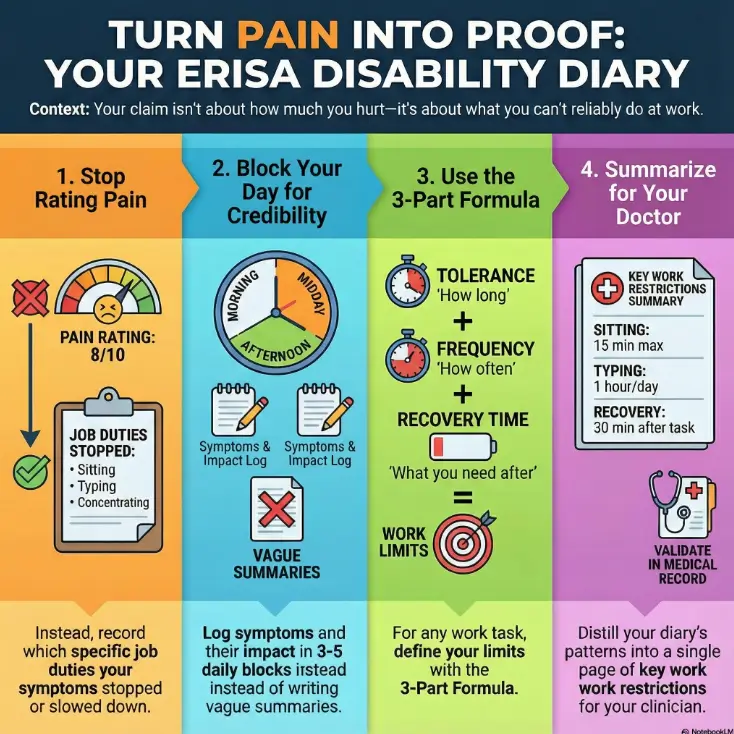
“8/10 pain” is easy to write—and strangely easy for an insurer to ignore.
The evidence that moves an ERISA file is boring on purpose: minutes, breaks, recovery time, and what work stopped.
If you’re in a long-term disability (LTD) claim or appeal, you’re not being evaluated on whether you hurt. You’re being evaluated on whether you can sustain the material duties of your job with reasonable continuity—sitting, typing, driving, concentrating, showing up.
Keep guessing and you risk the quiet loss: a denial framed as “inconsistent reporting” or “no functional proof.”
A Pain Diary for Long-Term Disability (ERISA) is a structured, time-blocked symptom log that translates flares into measurable work restrictions—tolerance + frequency + recovery—so your diary reads like functional capacity evidence, not a feelings journal.
This post uses a simple system:
Start here. Then tighten the language. Then build the one-page snapshot that survives comparison.
- Track symptoms in time blocks (not vague daily summaries).
- Tie each entry to essential job duties (sitting, keyboarding, lifting, driving, concentration, attendance).
- Convert patterns into repeatable restrictions (tolerance + frequency + recovery time).
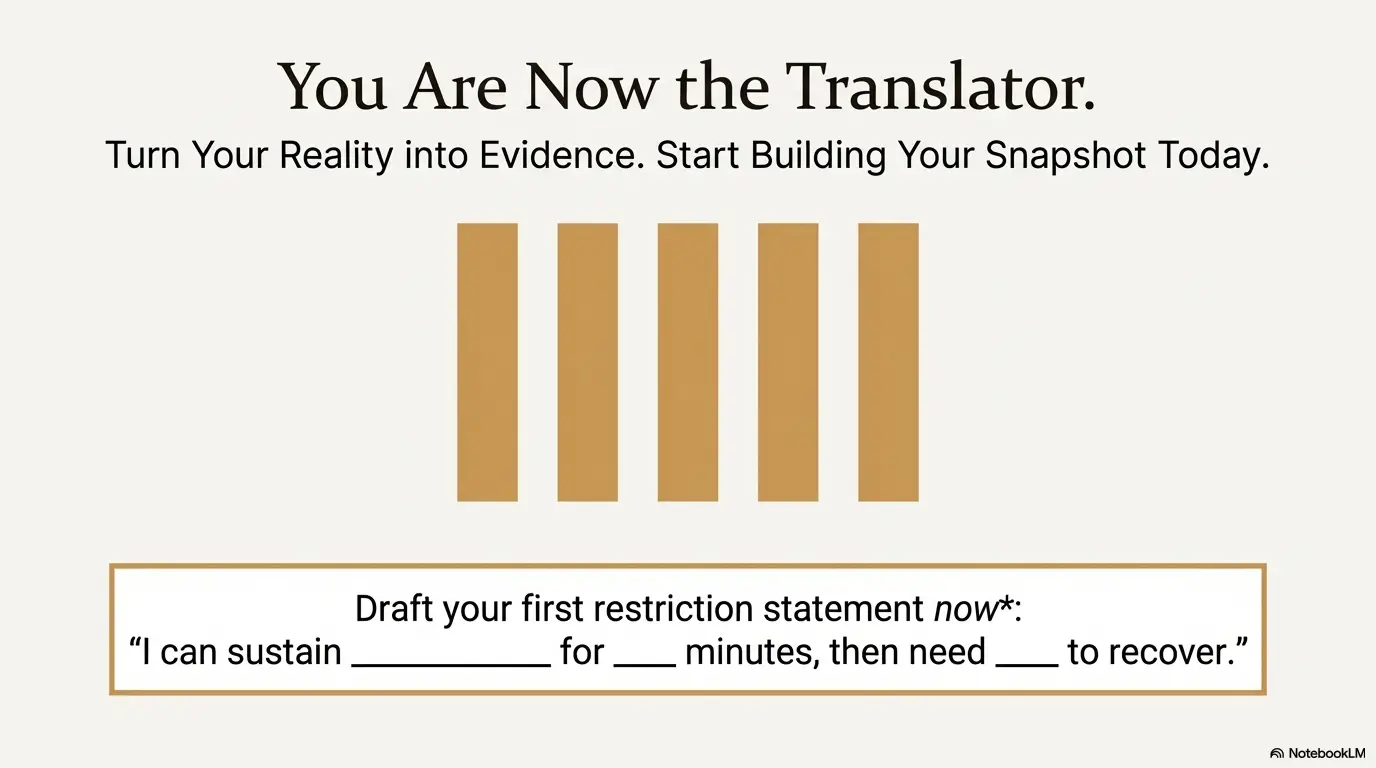
Apply in 60 seconds: Write one sentence that starts with “I can sustain ___ for ___ minutes, ___ times, then need ___ to recover.”
Table of Contents
Pain diary scope: who this is for / not for
If you’re time-poor and already exhausted, you’re allowed to want a system that doesn’t eat your life. The right pain diary is not “more writing.” It’s less chaos: fewer contradictions, fewer gaps, fewer moments where you think, “Wait… what happened last Tuesday?”
Who this is for
- US workers in ERISA-governed group LTD claims or appeals who need evidence of functional restrictions.
- People with variable symptoms (flares, “good days/bad days”) that insurers tend to interpret in the least generous way—especially when the pattern looks like desk-job flare-ups that sabotage sitting and keyboarding.
- Anyone whose work includes cognitive load (attention, pace, decision-making) plus “quiet physical” demands (sitting, hands, commuting).
Who this is not for
- People pursuing SSDI-only strategies and expecting the same documentation logic (the overlap is real, but the playbook differs).
- Anyone hoping a diary can replace medical care, evaluation, or treatment.
- Anyone planning to “sound worse than reality.” Under ERISA scrutiny, exaggeration is not bold—it’s brittle.
- Think “restrictions,” not “feelings.”
- Think “patterns,” not “one dramatic day.”
- Think “sustainability,” not “maximum effort once.”
Apply in 60 seconds: Write your job’s top 3 essential duties from memory. You’ll refine them later.
Plan terms first: read the disability definition
The plan’s definition of disability governs eligibility; ERISA does not supply one universal occupational-disability definition. Obtain the Summary Plan Description and policy, including any own-occupation/any-occupation change, exclusions, proof requirements, and deadlines. A diary is supporting self-report, not a substitute for medical evidence or a guarantee of benefits.
Your “Your Occ / Any Occ” timeline (why your diary must match it)
Many group LTD policies start with a “your occupation” period and later shift to a stricter standard. You don’t need to memorize legal wording to benefit from this—you just need to log in a way that shows what breaks now and what would still break under a broader work standard.
Curiosity gap: why “8/10 pain” can be irrelevant to an ERISA reviewer
Because numbers without function can be read as mood. A reviewer can’t price a claim on a sensation—but they can evaluate whether you can sit for 20 minutes, type for 10, drive for 0, or focus for 30 before cognitive fog turns your work into errors. Those are work restrictions. Those are measurable.
Preparation questions (not an eligibility test)
- Yes/No: My LTD claim is through an employer group plan (often ERISA-governed).
- Yes/No: My symptoms affect essential job duties (not just comfort).
- Yes/No: My limitations repeat across weeks, not only isolated days.
- Yes/No: I can track in time blocks at least 5 days/week.
- Yes/No: I can keep entries aligned with treatment events (appointments, med changes).
These questions are organizational prompts, not an eligibility score. Follow the plan’s requirements and deadlines, and seek clinical guidance for work restrictions.
Operator note: Under ERISA, claim decisions can be intensely document-driven. That’s why consistency and timing matter more than dramatic language.
Job-duty mapping: build your duty-to-restriction blueprint
If your diary doesn’t know what your job demands, it can’t prove you can’t do it. This section is where most competitor articles stay polite. We won’t. We’re going to name the duties and turn them into prompts you can actually use.
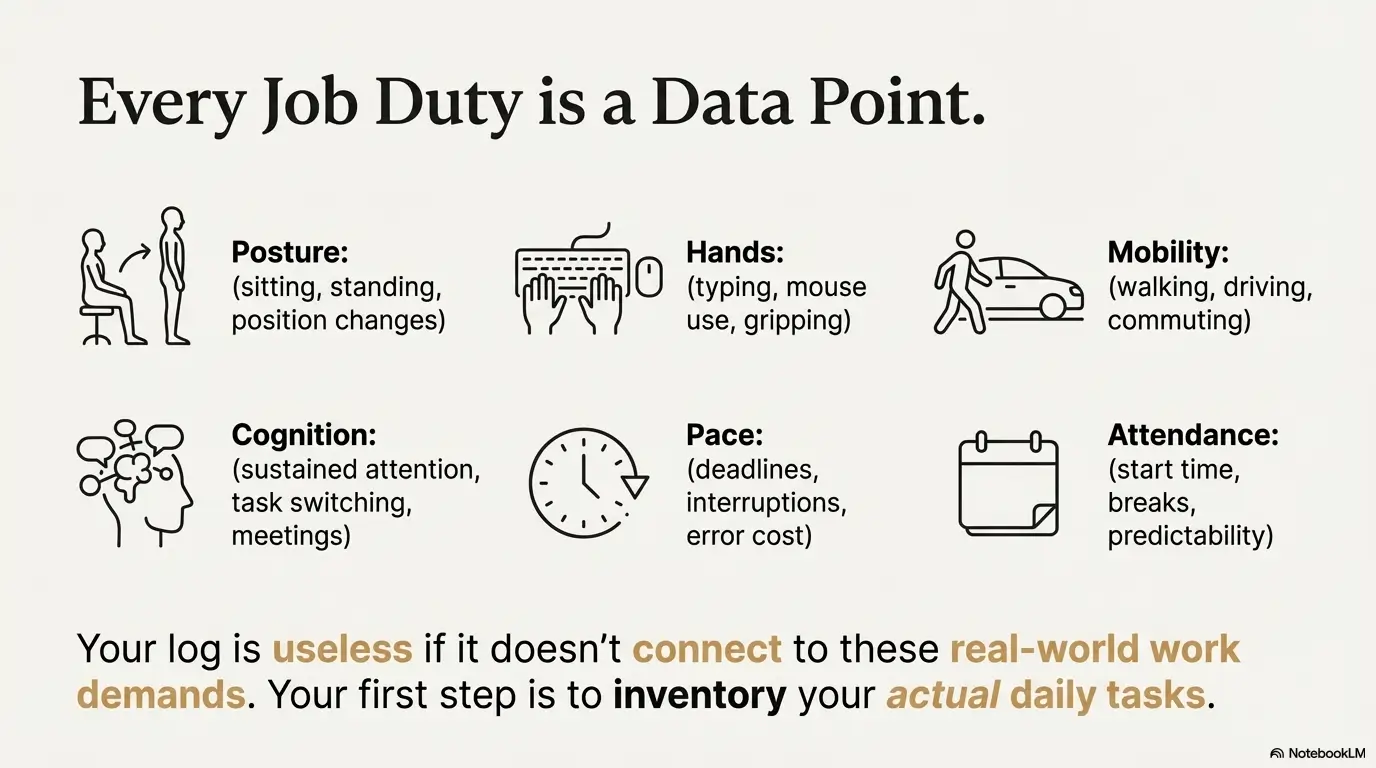
Duty inventory: posture, hands, mobility, cognition, pace, attendance
Open a blank page (or notes app) and list what your job requires on an average day. Not your job title. Not your “official description.” Your real day.
- Posture: sitting time, standing time, position changes, workstation tolerance (chair vs standing desk decisions)
- Hands: typing, mouse use, grip, reach, fine motor work
- Mobility: stairs, walking distances, driving, commuting, carrying items
- Cognition: sustained attention, task switching, decision-making, reading, meetings
- Pace: quotas, deadlines, interruptions, error cost
- Attendance: start time, breaks, recovery after flares, predictability
Let’s be honest—desk jobs still have “physical quotas.”
Convert duties into measurable “can’t sustain” prompts
Use this table logic in your diary (you can copy/paste it into your template):
- “How long could I sit before I had to change positions?”
- “How many minutes could I type before symptoms forced a break?”
- “What was my recovery time after a flare?”
Apply in 60 seconds: Pick one duty (sitting, typing, driving, focus) and write one measurable prompt for tomorrow.
Pain diary format: time blocks beat memory
Memory is not evidence. It’s vibes with a confidence problem. A time-block diary is boring—in the best way. It creates a repeatable record that’s easy for you to maintain and easy for a reviewer to scan.
Use 3–5 daily blocks (simple beats perfect)
- Morning: wake to late morning
- Midday: late morning to early afternoon
- Afternoon: afternoon work window
- Evening: after-work recovery
- Overnight (optional): sleep disruption, morning stiffness, migraine cycles
Minimum fields that matter (keep it repeatable)
- Symptom + location: “burning low back,” “throbbing right temple,” “hand numbness”
- Severity range: a range across the block (not one heroic number)
- Trigger/context: what you were doing (meeting, typing, driving)
- Functional impact: what stopped, slowed, or required help
- Mitigation + result: meds, heat/ice, PT exercises, rest—what changed (or didn’t)
- Recovery time: minutes/hours to return to baseline
- Side effects: sedation, GI upset, dizziness, brain fog
Curiosity gap: the one line adjusters look for first
It’s the line that answers: “So what could you not do—and for how long?” If you train yourself to write that sentence in every block, your diary stops being a narrative and starts being a functional record.
Money Block: 2-minute “tolerance math” mini calculator
This helps you convert “I can’t sit long” into a concrete pattern. (It’s for planning your diary language, not diagnosing anything.)
Output: Enter numbers and press Calculate.
Neutral next action: Copy the output sentence into tomorrow’s diary block and see if it matches real life.
Work restrictions writing: convert symptoms into work math
This is the section most people wish existed when they started. Because “my back hurts” isn’t a restriction. “I must change positions every 15–20 minutes and need 5–10 minutes to recover” is.
The 3-number formula: tolerance + frequency + recovery time
When you write restrictions, aim for this structure:
- Tolerance: the maximum you can sustain before symptoms force a change
- Frequency: how often that limit shows up across the workday/week
- Recovery time: what it takes to return to baseline enough to resume
Common restriction buckets (use employer-friendly language)
- Posture: sit/stand limits, position changes, walking tolerance
- Hands/arms: keyboard/mouse tolerance, grip limits, repetitive motion
- Strength: lifting/carrying limits (with frequency)
- Breaks: additional breaks, unscheduled breaks, recovery periods
- Cognition: sustained focus time, task switching, error risk under fatigue
- Schedule: reduced hours, late start, attendance variability, recovery days
Here’s what no one tells you: “I can do it once” is a trap
Insurers love “one-time ability” because it sounds like capacity. Your diary has to defend the more truthful metric: repeatable ability. If you carried groceries one afternoon and paid for it with 36 hours of increased symptoms, that’s not “working ability.” That’s a cautionary tale with a recovery bill attached.
Show me the nerdy details
Method note: A useful restriction statement is testable. It includes a measurable threshold (minutes, repetitions, pounds, distance) and an operational consequence (needs break, must change position, can’t sustain pace, increased errors). Reviewers can’t reliably compare “bad pain” across people, but they can compare functional limits across days and duties.
- Use tolerance + frequency + recovery time.
- Write for “sustained” ability, not peak effort.
- Keep language consistent across weeks.
Apply in 60 seconds: Rewrite one diary line to include a number, a consequence, and a recovery time.
Good days logging: make variability prove (not weaken) your case
Record better days accurately, including improved activities and whether there were actually later symptoms or recovery needs. Do not manufacture a “cost,” omit improvement, or make every day fit a restrictions narrative. Variability is information for clinical and claim review.
Don’t hide good days—price them
On a “better” day, record what improved, but also record what it cost:
- Did you need extra rest later?
- Did symptoms rebound the next morning?
- Did meds increase, or side effects worsen?
- Did you skip something else to “afford” the activity?
Curiosity gap: why the “best day” you logged can become the insurer’s favorite sentence
Describe what occurred, including any actual later symptoms and whether an activity could be repeated. If there was no rebound or extra recovery, record that too. The diary should document events, not be rewritten to neutralize favorable observations.
Record alignment: triangulate diary ↔ treatment ↔ medical notes
Think of your diary as one instrument in an ensemble. Alone, it’s a melody. Paired with treatment notes, appointment timelines, and clinician restrictions, it becomes harmony—and harmony is harder to dismiss.
Appointment syncing: the simplest credibility upgrade
In your diary, mark treatment events like:
- medication changes (including dose changes and side effects)
- physical therapy phases (new exercises, tolerance changes)
- procedures or injections (and the recovery window)
- imaging or testing dates (without inventing interpretations)
Objective-adjacent facts (without pretending you’re a clinician)
You can add “objective-adjacent” measures that stay within your lane:
- timed sitting/standing tolerance
- number of breaks needed in a block
- missed tasks, early logoff, errors due to cognitive fog
- sleep disruption frequency (e.g., “woke 3 times due to pain”)
Common mistakes: why diaries get discounted (and fixes)
This part can sting, so I’ll be gentle and direct: many diaries are truthful but still easy to discount because they look inconsistent, vague, or “crafted.” The fix is not more emotion. The fix is better structure.
Mistake #1: numbers without function
Problem: “8/10 pain” without what it does to sitting, typing, driving, attention, or pace.
Fix: Add a sentence: “At this level, I had to stop typing after 10 minutes and needed 15 minutes to recover.”
Mistake #2: vague language (“as needed,” “felt bad,” “couldn’t”)
Problem: Vague phrases read like guesswork.
Fix: Use ranges and thresholds: “needed 2–4 unscheduled breaks; each 7–12 minutes.”
Mistake #3: copy-paste days
Use the same fields and record the actual day. Repeated symptoms may legitimately produce similar entries; do not vary facts merely to make them look less copied. Preserve original entries and label later additions or corrections with their dates.
Money Block: Decision card — “Diary-first” vs “Test-first” evidence
Choose Diary-first if:
- Your symptoms vary by day/flares.
- You need fast documentation you control.
- You’re building a consistent restrictions narrative.
Trade-off: Requires daily discipline and clean structure.
Choose Test-first (e.g., FCE/IME coordination) if:
- A clinician is ready to document restrictions now.
- Your job duties are measurable and stable.
- You need an additional layer beyond self-report.
Trade-off: Scheduling, cost, and interpretation risks can rise—especially if you’re also navigating self-pay injection decisions like TFESI costs in parallel.
Discuss needed documentation and clinical evaluation with your provider and claim adviser. A diary-first/test-first choice is not a validated pathway, and a 14-day diary trial must not delay required treatment, testing, or claim deadlines.
- Keep structure consistent (blocks + fields).
- Make outcomes measurable (limits + recovery).
- Let context vary naturally (duties, triggers, side effects).
Apply in 60 seconds: Rewrite one “vague” sentence into a measurable restriction statement.
Don’t do this: credibility landmines (privacy, posts, over-sharing)
Over-documenting heroics without aftermath
If you document big activities (travel, heavy errands, a long outing), include the full cost: the recovery window, increased symptoms, and what you couldn’t do afterward. Otherwise, the record can read like “capacity.”
Social media mismatch (the silent credibility leak)
Activities or posts may be reviewed in a claim, but they need context and do not alone establish work capacity. Keep accurate records; do not delete, alter, or selectively change existing evidence to make it match a claim. Ask a qualified claim adviser about relevant requests and privacy.
Curiosity gap: when “more detail” makes you easier to deny
Because detail creates more surfaces for contradiction: a time you forgot, a date you misremembered, a symptom description that changes wording week to week. Your goal is not to write a memoir. Your goal is to write a repeatable log that survives comparison.
Timing strategy: how long to keep a diary (and where it matters)
Most people ask, “How many weeks do I need?” The better question is, “How many weeks do I need to show a stable pattern and cover the period being evaluated?” In ERISA contexts, timing is not just organization—it’s leverage.
Baseline window: 2–4 weeks (minimum pattern)
There is no universal two- or four-week minimum that establishes disability. Record the period relevant to the claim using truthful, contemporaneous observations. Do not wait to accumulate diary pages before filing a claim or appeal whose deadline is approaching.
Appeals window: target the disputed period (date discipline)
For an ERISA disability-benefit denial, the plan generally must allow at least 180 days to appeal, and may provide longer. Read the denial notice and plan procedures now; request relevant claim documents free of charge and submit supporting evidence by the stated deadline. A diary does not extend deadlines. DOL explains claims and appeals.
Money Block: Quote-prep list — what to gather before you “compare options”
- Your job’s essential duties (real day, not just HR description)
- Last 14–28 days of time-block diary pages
- A simple symptom timeline (med changes, appointments, procedures)
- Any employer attendance notes (missed days, reduced schedule attempts)
- Names of involved entities (plan administrator, insurer, TPA)
Neutral next action: Put these into one folder (digital or paper) before your next clinician visit or claim call.
- 2–4 weeks is a practical baseline.
- Capture at least 2 flare cycles if flares drive disability.
- Anchor entries to treatment events and work attempts.
Apply in 60 seconds: Write down the date range you’re trying to prove (even if it’s approximate).
When to seek help: medical + claim-support escalation
You are allowed to stop optimizing a diary and get help. If your health is unstable, your diary is not the priority. If your claim is escalating (denial, IME request, confusing letters), a better workflow is to stabilize documentation and get guidance.
Urgent medical red flags (don’t “diary through” danger)
- new weakness, spreading numbness, or sudden loss of function
- New bladder/bowel dysfunction or saddle numbness: seek emergency care now
- chest pain, fainting, severe shortness of breath
- suicidal thoughts or inability to stay safe
- sudden vision loss or severe headache with neurologic symptoms
If any of this is even a question, treat it like a low back pain emergency (red-flag checklist), not a documentation problem.
Claim-support triggers (when your documentation needs backup)
- you receive a denial letter (or requests that don’t make sense)
- an IME is requested, or you feel pushed into inconsistent statements
- your treating clinician won’t document restrictions in chart notes
- your diary and medical record are drifting out of alignment
Safety / Disclaimer: This article is general educational information, not medical or legal advice. ERISA LTD claims are plan-specific and fact-dependent. For urgent symptoms, seek prompt medical care. For claim strategy, consider a qualified professional who can review your plan terms and claim file.
FAQ
What should I write in a pain diary for an ERISA long-term disability claim?
Write in time blocks and focus on functional outcomes: what you tried to do, what you couldn’t sustain, how long you lasted, how often the limit shows up, and how long recovery took. Add side effects from treatment when they affect work.
How detailed should my LTD pain diary be without sounding exaggerated?
Use repeatable fields (symptom, trigger, function, recovery) and measurable statements (minutes, breaks, tolerance ranges). Avoid dramatic language. The goal is a consistent work-capacity record, not a persuasive essay.
How many weeks of entries do insurers typically take seriously?
No diary length guarantees credibility or approval. The relevant period, plan terms, clinical evidence, and claim deadlines matter. Two to four weeks is merely an organizational example, not a legal or medical minimum.
Should I include good days in my disability pain diary?
Yes—log them with structure. Include what improved and what it cost (recovery window, rebound symptoms, increased rest, side effects). “Good days” are most dangerous when they’re recorded as pure capacity without consequences.
What’s the best way to document sitting or standing tolerance for a desk job?
Time it. Even rough timing helps: “Sat 18–22 minutes, then needed 7–10 minutes to change position and recover.” Repeat that across blocks so it becomes a pattern rather than a single anecdote—and consider whether your setup issues mirror common laptop stand vs external monitor trade-offs that quietly change tolerance.
Should I track medication side effects like fatigue, sedation, or brain fog?
If side effects reduce your ability to focus, drive, type, or maintain pace, they belong in the diary. Document what you took (at a high level), the time window, and the functional impact (attention, errors, slowed processing).
Can I use an app for my pain diary, or is handwritten better?
Use what you’ll actually maintain. App, spreadsheet, or paper are all fine if the structure stays consistent, timestamps are credible, and you can produce a clean export when needed.
Should I share my diary with my doctor, HR, or the insurance company?
Often, the most useful share is with your treating clinician so chart notes can reflect consistent restrictions. Sharing with HR or the insurer is more strategic and depends on your claim stage and the documents being requested.
Can my diary contradict my medical records—and what happens if it does?
Yes, and that’s why triangulation matters. Contradictions can lead to credibility attacks. Keep your terminology stable, align major events (med changes, appointments), and avoid inventing diagnoses or interpreting tests in your diary.
Is a headache log considered evidence in disability insurance claims?
It can be helpful when it documents frequency, duration, triggers, treatment response, and functional restrictions (screen tolerance, light sensitivity, driving limits, cognitive impact). As with pain diaries, the value is in measurable work limitations.
Next step: build a 1-page Restriction Snapshot
If you do only one thing after reading this, do this: create a one-page summary that a clinician can validate in chart notes. This is how you close the gap between “my diary says…” and “the medical record supports…”
In 15 minutes: extract your last 7 days into a Restriction Snapshot
- 5 core restrictions: (tolerance + frequency + recovery time)
- 2 cognitive/side-effect limits: (if applicable)
- 1 attendance statement: predictable range (avoid “as needed”)
Bring it to your treating clinician (the exact ask)
Use calm, practical language: “Can you confirm these restrictions in your chart notes and complete any required restrictions sections consistently?” You’re not asking for drama. You’re asking for alignment.
Infographic: How a pain diary becomes claim-ready restrictions (without becoming a novel)
1) Time-block diary
Symptoms + trigger + function + recovery
2) Work math
Tolerance + frequency + recovery time
3) Restriction Snapshot
One page a clinician can validate
4) Consistent claim file
Diary ↔ notes ↔ restrictions align
- Time blocks create structure.
- Work math creates credibility.
- A one-page snapshot creates alignment.
Apply in 60 seconds: Draft one restriction statement now: “Can sustain ___ for ___ minutes, ___ times/day, then needs ___ minutes to recover.”
Wrap-up: the curiosity loop we opened at the start
Remember the opening promise—“better translation”? Here it is in one sentence: insurers don’t reward the sharpest description of pain; they respond to the clearest description of work restrictions. That’s what a well-built diary does. It turns your week into a pattern, your pattern into limits, and your limits into a claim file that reads like reality.
Updated: October 14, 2026
15-minute CTA: Set a timer, create your one-page Restriction Snapshot from the last seven days, and bring it to your next appointment. You don’t need a perfect diary. You need a diary that stays consistent long enough to tell the truth clearly.
Optional cross-bridge (if your absence is part of the record): If your diary includes missed workdays, partial days, or reduced schedules, keep the language consistent with any leave paperwork—especially WH-380-E intermittent leave documentation if you’re also using FMLA.
Operator note (symptom examples only): If what you’re logging is primarily nerve-pattern pain (burning, tingling, radiating symptoms), you may recognize the “repeatable but unpredictable” rhythm described in sciatica nerve pain patterns; the diary structure stays the same—function, thresholds, and recovery.