
This site is written from a family-caregiver perspective. The operator is not a medical professional or an insurance, legal or financial adviser. Use this guide to organize questions for the relevant service.
Follow every separate part of the proposed care
- Keep together
Current surgical plan, facility and surgeon, authorization, anesthesia estimate and recovery services.
- Question to resolve
Which charges are included, who bills separately, and what changes if the care plan changes?
- Next contact and action
Ask the team for estimates tied to the actual proposed care and your benefits. Keep later revisions with the original estimate; no general range predicts an individual final bill.
- Follow-up record
Record the date, office or representative, reference number, answer received, unanswered question, next owner and agreed review date. Recheck when the care plan, notice, provider, benefits or circumstances change. Keep identifying details in your private records.
Editorial update: October 22, 2026. This update adds a topic-specific follow-up record and removes unsupported personal anecdotes. The existing guide remains below; this is not a complete clinical, legal, tax or coverage review.

Lumbar Spinal Stenosis Surgery Costs:
It’s Not Just One Bill.
Surgery can involve several bills, but no verified patient invoices are presented here. This U.S. planning guide explains what to ask providers and insurers before a planned procedure. It does not estimate a typical national price or select an operation.
🔍 The Fragmentation
Ask which professional, facility, imaging, device and follow-up charges are included, bundled or billed separately. Not every category applies to every case.
📊 Plan A vs. Plan B
If more than one procedure is being considered, ask your surgeon to explain the clinical reason, alternatives and consent process, then request an estimate for each medically relevant scenario. Fusion is not a consumer upgrade.
🛡️ The Bucket Method
Use your current plan documents and written estimates. No personal billing experience, measured savings or named clinician review is claimed.

- Confirm what the facility and professional estimates include
- Check benefits for the actual service date
- Ask about excluded and separately billed services
Apply in 60 seconds: Write down your deductible remaining and coinsurance % before you compare any quotes.
Table of Contents
Why the sticker price feels unreal
Distinguish the provider’s billed charge, the insurer’s allowed amount and your estimated patient responsibility. They are different numbers.
An unsourced price range cannot tell you what you will owe. Confirm the planned procedure, setting, coverage and allowed amounts before relying on an estimate.
For each quote, record its date, what is included, what is excluded and who provided it.
- Ask whether facility and implant charges are bundled or separate.
- Use the actual service dates and benefit rules.
- Aftercare is where budgets quietly break.
If an estimate is bundled: ask which services it includes and which groups may bill separately. A single figure is not automatically invalid, but its scope must be clear.
Show me the nerdy details
Hospitals often split claims into professional and facility components. Add device vendors, imaging groups, and anesthesia billing entities, and the “one surgery” narrative becomes a multi-claim ecosystem.
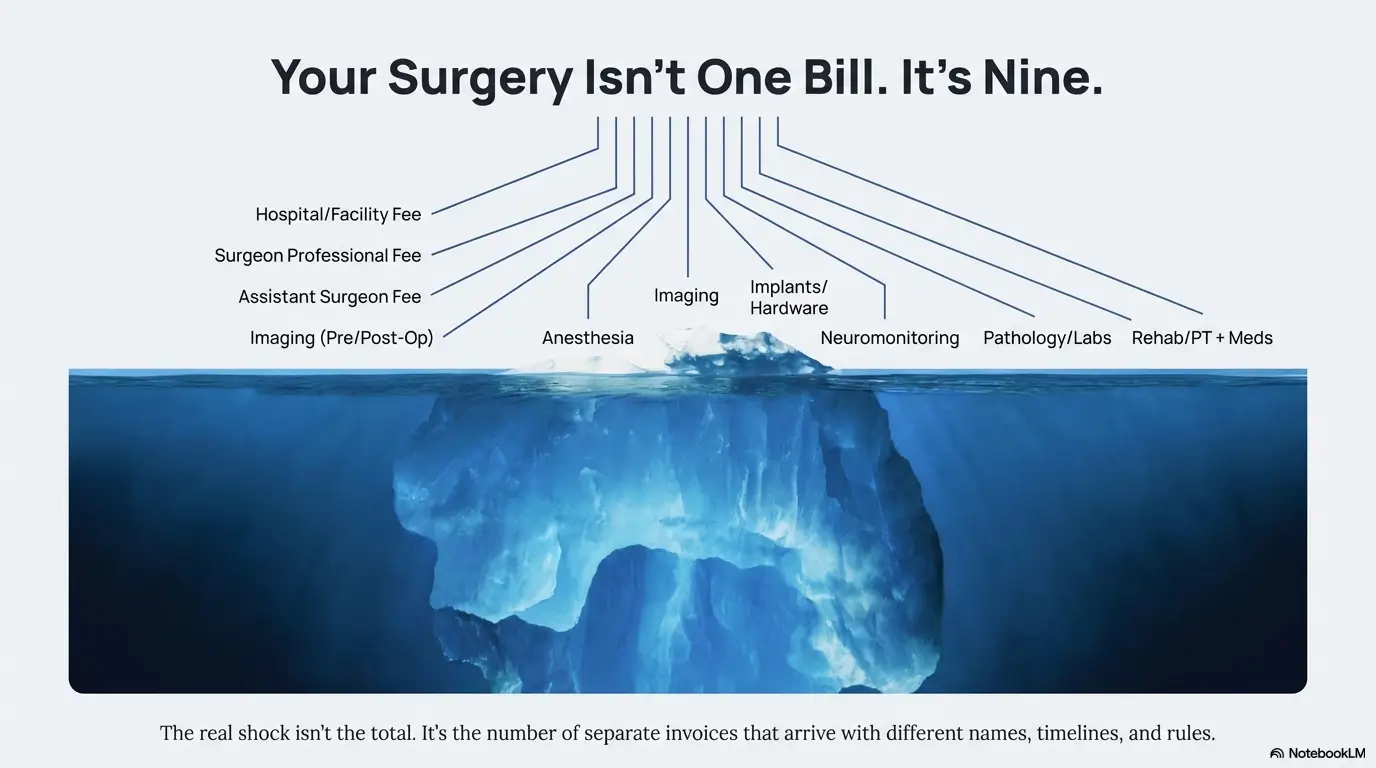
Nine billing categories to ask about
Different bills can arrive at different times. Match each statement to the service date, billing entity and insurance explanation of benefits before paying a disputed amount.
Use these nine categories as questions to ask, not a list of services every patient will need:
- Ask which entities will bill separately
- Confirm hospital vs. outpatient setting
- Request a pre-service itemized estimate
Apply in 60 seconds: Screenshot your insurance benefits page and circle deductible + coinsurance.
| Bill category | Why it surprises people | What you can verify early |
|---|---|---|
| Hospital/facility fee | Confirm included facility services and allowed amounts | In-network status, site of care, expected length of stay |
| Surgeon professional fee | Separate from facility; different billing entity | Codes planned; whether fusion is likely |
| Assistant surgeon fee | May be billed even when you never meet them | If your plan covers assistants in this setting |
| Anesthesia | Separate billing; applicable No Surprises Act protections may limit patient responsibility | Group name and network status |
| Imaging (pre/post-op) | MRI/CT/X-ray can be billed separately | Where scans will be performed and billed |
| Implants/hardware | Fusion hardware can shift totals dramatically | Whether implants are likely; vendor billing model |
| Neuromonitoring | Feels “mandatory,” sometimes billed by third party | If used, confirm coverage and expected charges |
| Pathology/lab | Small but annoying add-ons | Ask if tissue/labs are expected |
| Rehab/PT + meds | Costs accumulate after the “big event” | Visit caps, copays, and therapy network |
Save this table and confirm the current fee on the provider’s official page.
Procedure and professional fee questions (U.S.)
Ask the surgeon’s office to identify the proposed operation and the billing information the insurer needs. Patients do not need to choose procedure codes themselves.
The operation should be chosen for clinical reasons. When relevant, the estimate may distinguish:
- Decompression-only (laminectomy/laminotomy/foraminotomy)
- Decompression + fusion when instability or deformity is part of the story
Ask why fusion is or is not proposed, what alternatives are reasonable and what changes have been discussed as part of consent. Do not use a second budget scenario as permission for an unplanned procedure.
Different operations can have different allowed amounts and benefit rules. The difference in your payment cannot be inferred from the use of hardware alone; confirm both estimates with the insurer.
- Ask for a Plan A vs. Plan B estimate.
- Confirm whether an assistant surgeon is expected.
- Request the billing entity names for the surgeon group.
Save this plan split and confirm the current fee on the provider’s official page.
Anesthesia, imaging, and the facility bill that sneaks up
Check the facility separately from the surgeon and other groups. Confirm the actual planned admission or outpatient status rather than assuming it from the building’s name.
Questions that may change the estimate include:
- Site of care: hospital vs. ambulatory surgical center.
- Length of stay: ask what admission status and stay are planned.
For applicable private coverage, CMS describes No Surprises Act protections for certain out-of-network services, including anesthesia at an in-network facility. These protections do not mean that all care is free: legitimate in-network cost sharing can remain. If a bill appears inconsistent with the protection, ask the plan and billing office to review it. Coverage and setting matter.
Ask whether imaging is included and who bills for it. Confirm the applicable benefit rules rather than assuming every scan uses the same payment arrangement.
- Confirm site of care and expected stay
- Ask anesthesia group network status
- Verify where imaging will be billed
Apply in 60 seconds: Message the hospital finance office for a written pre-service estimate.
Save this checklist and confirm the current fee on the provider’s official page.
Questions about implants, navigation and technology
If implants, navigation or other technology are proposed, ask why they are clinically needed and whether their costs are included in the facility estimate.
Do not assume that technology is separately billable, optional or better because it is described as advanced. The clinical rationale and the insurer’s payment arrangement are separate questions.
Questions for the proposed surgical plan include:
- What operation is proposed and why?
- What implants, if any, are clinically planned and included in the estimate?
- Are navigation or other technologies proposed, and how are they billed?
Ask how any planned equipment affects the estimate and what would change the clinical plan. A price comparison cannot determine whether a device or technique is appropriate.
Show me the nerdy details
Device costs can be bundled into hospital claims or appear as part of a broader facility charge. Some hospitals also negotiate vendor-specific pricing that changes by contract cycle.
Save this tier map and confirm the current fee on the provider’s official page.
Rehab, PT, and the slow bleed after discharge
Include the period after discharge in the budget. Confirm the actual follow-up and rehabilitation plan rather than assuming a fixed number of weeks.
Common aftercare costs for lumbar spinal stenosis surgery can include:
- Patient payments for the actual rehabilitation plan
- Follow-up imaging
- Medication tiers and refill changes
- Transportation and time-off costs
Ask about assistance, transport, rehabilitation access and time away from work. Record unpaid earnings separately from medical patient payments.
For illustration only, 10 PT visits at an assumed $30 patient payment total $300; 12 visits at $75 total $900. These assumptions are not typical-market prices or a standard course. Confirm your own visit payment and clinical plan.
Save this aftercare estimate and confirm the current fee on the provider’s official page.
Insurance math that changes your final number
Insurance estimates need current plan information. No calculator can guarantee your final bill.
For a covered U.S. procedure, confirm the following for the relevant plan year:
- Deductible remaining
- Coinsurance % for facility and professional claims
- Out-of-pocket maximum
- Network alignment across multiple billing entities
An estimate should identify the allowed amounts, applicable deductible, copays or coinsurance and any remaining eligible annual limit. Several claims or benefit categories may require separate calculations.
- Deductible hits early
- Coinsurance multiplies big facility totals
- An applicable cap limits eligible cost sharing, not every expense
Apply in 60 seconds: Call your insurer and ask, “Which entities will you treat as in-network for this case?”
Questions to resolve—not a clinical eligibility checklist
- Yes/No: Do you know your remaining deductible for the actual plan year?
If no, check your portal and write the number down. - Yes/No: Is the hospital/facility in-network?
If no, request an in-network site-of-care alternative. - Yes/No: Have you confirmed anesthesia group network status?
If no, ask the hospital for the anesthesia billing entity name. - Yes/No: Do you know whether a change in the operation has been clinically discussed and included in consent?
If no, ask for Plan A vs. Plan B estimates.
Save this eligibility check and confirm the current fee on the provider’s official page.
Information to gather for an estimate
Before comparing quotes, gather the following inputs. They can reduce repeated questions; no specific time-saving estimate is established.
- Your remaining deductible for the actual plan year
- Your coinsurance for inpatient vs. outpatient surgery
- Your out-of-pocket max
- Planned site of care
- Likely procedure lane: decompression-only vs. possible fusion
These details support a more specific conversation; they do not guarantee the billed amount or coverage decision.
Save this quote-prep list and confirm the current fee on the provider’s official page.
Run the 60-second out-of-pocket estimator
Use this simplified calculator only if its assumptions fit the estimate. If they do not, ask the insurer for a service-specific patient responsibility calculation.
Estimator assumptions: Enter a covered in-network allowed amount subject to one deductible and one coinsurance percentage. Add the remaining applicable annual out-of-pocket limit only if the insurer confirms it applies. Leave it blank if unknown or not applicable; do not enter zero to mean unknown.
Enter the amount remaining, not the full annual limit. Zero means the applicable limit has already been reached for these covered services.
Formula: applied deductible = the smaller of allowed amount and remaining deductible. Uncapped share = applied deductible + (allowed amount − applied deductible) × coinsurance. If an applicable remaining annual limit is entered, the estimated eligible share is the smaller of those two amounts. This excludes separate copays, different claim rules, uncovered services, premiums, out-of-network charges and aftercare not included in the input. A billed sticker charge is not an allowed amount. HealthCare.gov explains the covered-cost limits. Original Medicare Part A and Part B have no annual medical out-of-pocket cap without additional coverage; this single-deductible model is not a combined Medicare bill calculator.
Hypothetical example: A $20,000 covered allowed amount, $1,000 remaining deductible and 20% coinsurance produces $1,000 + ($19,000 × 20%) = $4,800 before an applicable annual limit. If the insurer confirms only $2,000 of eligible annual cost sharing remains, the simplified capped estimate is $2,000. These are assumptions, not a surgery price.
Save this estimate and confirm the current fee on the provider’s official page.
Organize confirmed costs and uncertainties
Keep a base estimate, any clinically discussed alternative and aftercare costs separate. Do not turn a possible procedure change into an expected extra charge.
Useful budget categories include:
- Baseline bucket: decompression-only estimate
- Contingency bucket: “a clinically discussed alternative” buffer
- Recovery bucket: PT, meds, time-off, transport
Mark confirmed amounts, assumptions and unresolved questions. Update the record when a provider or insurer changes the estimate.
Keep a dated record of whom you spoke with and what they confirmed. Ask for written information where available.
A written plan supports comparison but does not guarantee fewer calls, lower costs or a final bill that matches the estimate.
How to lower costs without playing surgeon roulette
Discuss financial concerns with the care team. They should not lead you to delay urgent assessment or choose an unsuitable operation.
Questions that may help clarify costs include:
- Ask about site-of-care alternatives: some cases can be safely done in lower-cost settings.
- Request a written pre-service estimate: not a phone summary.
- Confirm all billing entities: surgeon, facility, anesthesia, monitoring, imaging.
- Ask how the plan year affects the estimate, without delaying clinically necessary care.
If an answer is unclear, ask the office to identify the person who can explain it. You do not need to characterize a dispute as a coding error before requesting review.
- Optimize site of care
- Clarify network by entity
- Budget for Plan A vs. Plan B
Apply in 60 seconds: Ask for an itemized estimate that lists every billing group by name.
Show me the nerdy details
Even when a procedure is clinically identical, contract rates can differ by facility, and your coinsurance scales with those contracted amounts.
Hypothetical example: a quote with excluded services
Hypothetical example—not a real patient bill
An estimate lists the facility amount and states that professional services are billed separately. The patient asks which groups are excluded before treating it as an all-in total.
The billing office identifies the expected groups and the insurer checks benefits. Any unresolved charge is recorded as unknown, not assumed to be zero.
This example illustrates quote review. It supplies no real invoice, market price or measured saving.
U.S. coverage questions for the actual plan year
Use the rules for your actual type of coverage. Employer insurance, Marketplace coverage, Original Medicare and Medicare Advantage do not share one universal cost-sharing formula.
For Medicare, confirm the actual coverage, admission or outpatient status, providers and any additional policy. Part A and Part B use different cost-sharing rules. Ask the plan or Medicare for a service-specific estimate.
If the clinical plan changes, ask whether the authorization and patient responsibility estimate also need updating. Prior authorization does not itself guarantee payment.
Questions about the proposed care setting
The care team should determine which settings are clinically suitable. Compare prices only among appropriate options with verified coverage.
Ask about the actual planned setting:
- Hospital: ask whether it is appropriate and what the full patient estimate includes.
- Ambulatory surgical center: ask whether it is appropriate and compare the complete covered-service estimate.
Scheduling: Ask the facility about the steps and timing for your case; this guide does not establish an extra number of steps for hospitals.
Cost: Compare written patient estimates for the actual covered services. The cheaper facility charge is not always the lower total patient payment.
Save this decision card and confirm the current fee on the provider’s official page.
The stages to include in an estimate
- Clinic consults
- Imaging
- Prior authorization
- Facility fee
- Surgeon fee
- Anesthesia
- Implants/hardware
- Neuromonitoring
- Extra nights
- PT/rehab
- Meds
- Follow-ups
Use this as your call script: confirm each stage’s billing entity and network status.
FAQ
How much will I personally pay for lumbar stenosis surgery?
There is no verified typical price in this article. Request a current estimate for the proposed operation and setting, including the expected allowed amounts and patient responsibility. Use the actual plan year even though the URL contains 2025.
What bill is most likely to surprise me?
Any excluded or separately billed service can cause confusion. Ask for the list of anticipated billing entities and which services are bundled.
Will insurance cover decompression but not fusion?
Ask your insurer and provider which procedures are being submitted, what documentation is required and whether authorization covers the actual planned care. Neither diagnosis nor authorization alone guarantees coverage.
How can I estimate my out-of-pocket quickly?
Use a verified allowed amount and current benefit information. The calculator shows the assumptions and any entered cap separately; it cannot resolve multiple claims, copays or uncertain coverage.
Is it cheaper to have surgery at an ambulatory surgical center?
An ambulatory center is not automatically appropriate or cheaper for your case. Ask the clinical team about suitability and compare the complete patient estimates for covered options.
What if I get a surprise bill anyway?
Request an itemized statement and the explanation of benefits, then ask the provider and insurer to explain discrepancies. If a bill may violate surprise-billing protections, use the official CMS guidance and help route. Ask about relevant deadlines; a dispute does not automatically cancel a bill.
Conclusion: Your next 15-minute move
The useful question is what the current estimate includes, what remains unknown and how the insurer expects to calculate your share.
Bring this short list to the provider and insurer:
- What’s the likely procedure lane today?
- What triggers Plan B?
- Which entities will bill separately?
- Are they all in-network for my plan?
- Can I get a written itemized estimate?
- Plan in tiers instead of fantasies
- Use your deductible and coinsurance as the anchor
- Protect recovery costs early
Apply in 60 seconds: Email the hospital finance office requesting a pre-service itemized estimate listing all billing groups.
Editorial corrections reviewed: October 16, 2026. Coverage explanations were checked against HealthCare.gov, Medicare’s cost guidance and CMS surprise-billing guidance. This article contains no verified patient invoices or personal billing history. Worked amounts are hypothetical, not market quotes. No individual medical, legal or insurance advice or named clinician review is claimed.
Next step: Ask for a written estimate that identifies the operation, setting, included services, exclusions, billing groups and benefit assumptions. Seek urgent clinical assessment first if warning symptoms occur.