
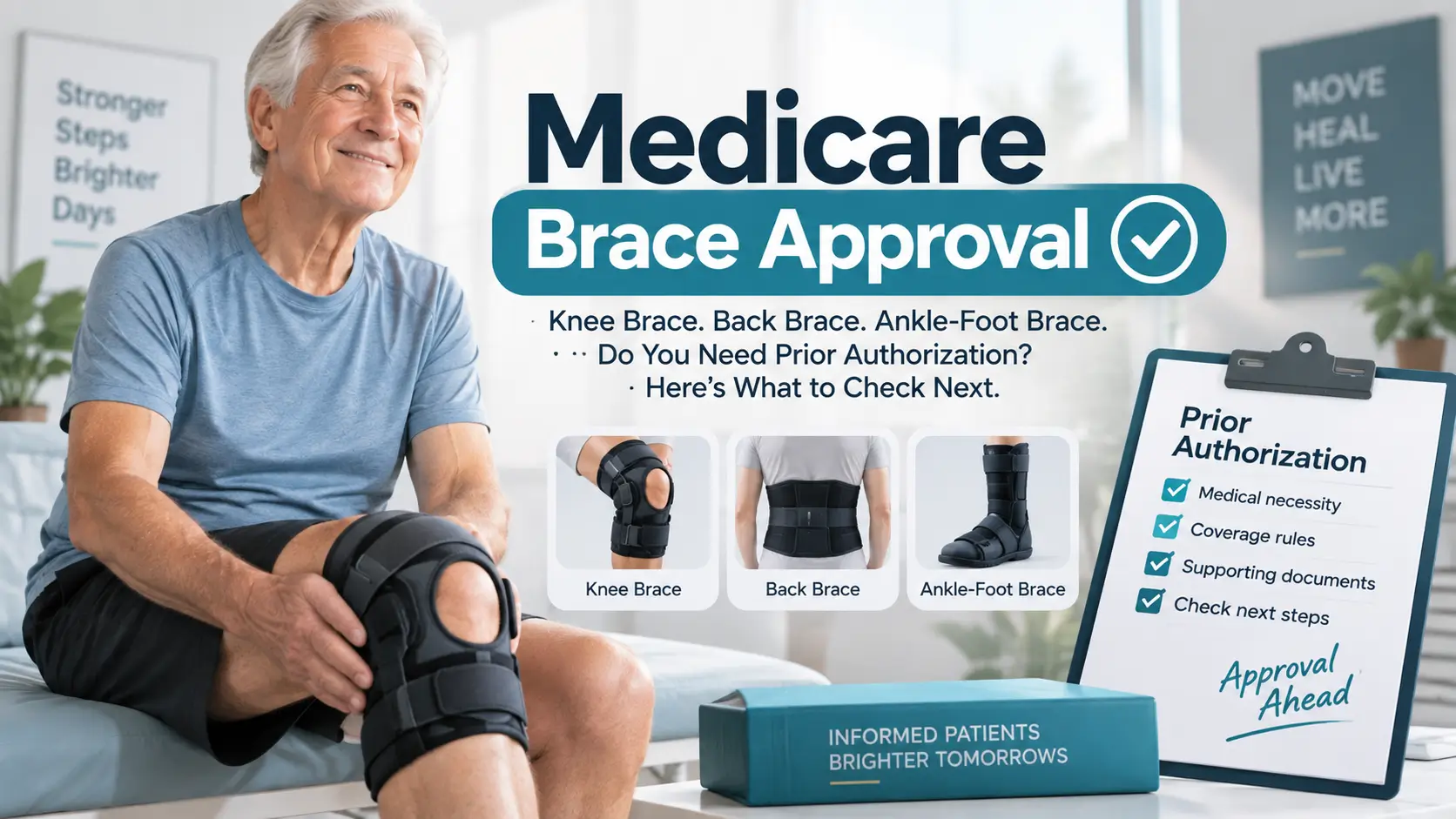
Medicare prior authorization for orthopedic braces depends on the brace’s billing code, your coverage type, and sometimes the supplier’s exemption status. Original Medicare requires advance review for selected orthoses—not every brace. Medicare Advantage members need to check their own plan’s requirements.
Your first step is to ask the supplier for the exact HCPCS code, the billing code used to identify the brace. Then ask: “Does this code require prior authorization for my coverage and delivery date, and who is submitting the request?” A prescription and a prior authorization are separate things.
This guide covers U.S. Medicare. Code-list status, implementation dates and the standard review timeframes were rechecked against CMS and CGS on October 26, 2026. Other coverage and appeal details retain their earlier review scope. Confirm the rule for the actual code, supplier, coverage and delivery date.
Current and upcoming rules: checked October 26, 2026
| Status | What applies | Effective date |
|---|---|---|
| In effect | Existing selected orthosis codes in the table below, subject to applicable exceptions and supplier exemptions. | Already implemented |
| In effect | Separate probationary process for certain newly enrolled suppliers and certain ownership changes. Ask whether it applies to this supplier. | October 15, 2026 |
| Upcoming nationwide | L0456, L0457, L0486 and L1833. | October 28, 2026 |
| Upcoming, selected states | L3761 and L3916: California, Florida, Michigan and New York. | October 28, 2026 |
| Later expansion | L3761 and L3916: adds Arizona, Georgia, Illinois, Massachusetts, Ohio, Oregon, Pennsylvania and Texas; nationwide in the following phase. | January 26, 2027; nationwide April 26, 2027 |
CGS lists request acceptance from October 14, 2026, for the October 28 additions. Request acceptance and the requirement’s effective date are different. See the current CGS table and CMS program updates. This table concerns Original Medicare’s DMEPOS process, not a Medicare Advantage plan’s authorization list.
Table of Contents
Which braces need prior authorization under Original Medicare?
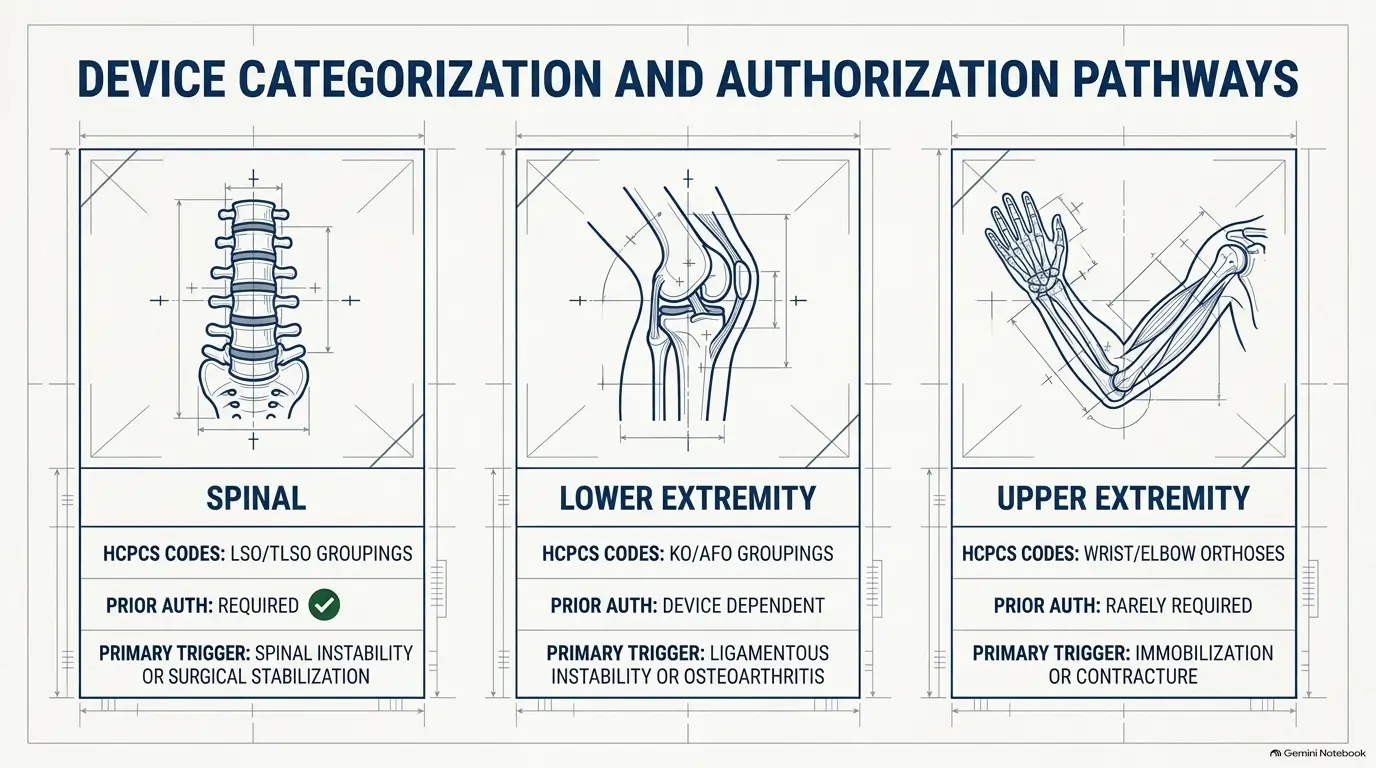
The following orthosis codes are listed for nationwide prior authorization under the standard Medicare fee-for-service DMEPOS program as of the review date. DMEPOS includes durable medical equipment, prosthetics, orthotics, and supplies. Applicable supplier exemptions and urgent-care exceptions still matter.
| Brace category | HCPCS codes |
|---|---|
| Ankle-foot | L1932, L1951 |
| Knee | L1832, L1843, L1844, L1845, L1846, L1851, L1852 |
| Spinal | L0631, L0637, L0639, L0648, L0650, L0651 |
Source: CGS Medicare’s orthoses prior authorization guidance. Ask the supplier to verify the code rather than choosing one yourself from a product listing.
Five of these codes—L0651, L1844, L1846, L1852, and L1932—were added effective April 13, 2026. CMS announced that expansion in its January 2026 notice. An older checklist may therefore omit braces that now require review.
Distinguish code implementation from supplier-specific rules
CMS has scheduled nationwide prior authorization for L0456, L0457, L0486, and L1833 beginning October 28, 2026. Upper-limb codes L3761 and L3916 have a phased start: October 28, 2026, in California, Florida, Michigan, and New York; January 26, 2027, in those states plus Arizona, Georgia, Illinois, Massachusetts, Ohio, Oregon, Pennsylvania, and Texas; and April 26, 2027, nationwide.
CMS implemented a separate probationary prior authorization process on October 15, 2026, for certain newly enrolled suppliers and suppliers undergoing certain ownership changes. If delivery falls on or after these dates, have the supplier recheck the applicable process. See CMS’s DMEPOS program updates.
Why a supplier may say approval is not required
Some qualifying suppliers became exempt from submitting prior authorization requests on June 1, 2026. The exemption depends on the supplier’s Medicare jurisdiction and enrollment identifier; it does not apply automatically to every supplier selling the same brace.
If your supplier claims an exemption, ask it to confirm that the exemption applies to the location billing your brace. Exemption does not remove the underlying coverage, coding, or payment requirements. CGS explains the supplier exemption process.
What changes with Medicare Advantage?
Medicare Advantage delivers Medicare benefits through a private plan. Do not use the Original Medicare code table as your plan’s authorization list. Check the plan’s current rules for the exact brace and supplier. For example, Medicare HMO guidance explains that network restrictions and required prior approvals must be followed.
Call the number on your plan card and ask whether the proposed supplier is in network, whether the code requires authorization, who must submit it, and what your estimated cost will be. Request a reference number for the conversation. If coverage remains unclear, request an organization determination—the plan’s formal coverage decision—before committing to a purchase.
What the request needs to establish
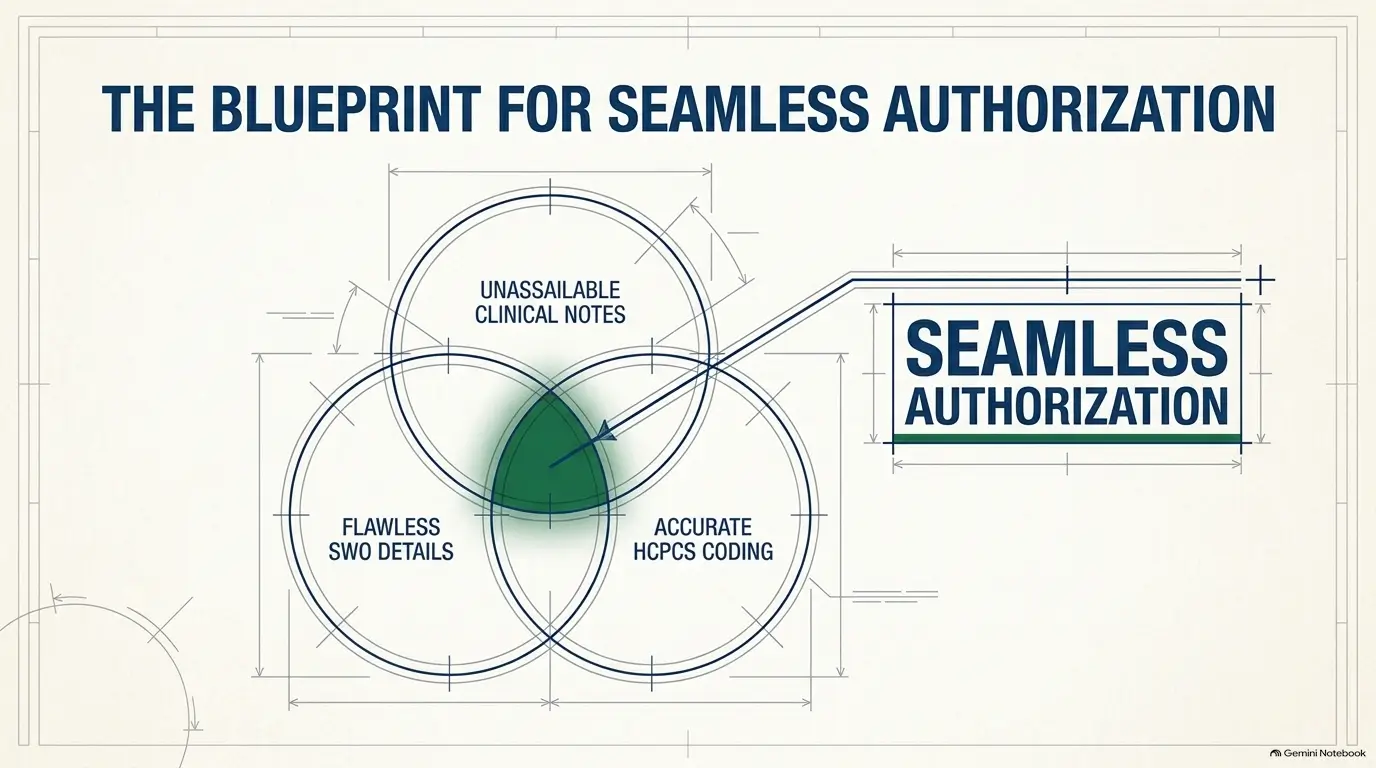
For Original Medicare’s DMEPOS program, the request must support the applicable coverage, coding, and payment rules. CMS identifies the written order, relevant medical records, and supplier documentation as evidence for review. A prescription alone may not establish why the particular device qualifies. An affirmed decision is provisional; it is not an unconditional guarantee of claim payment. These requirements are described in the CMS implementation notice.
Use these questions to coordinate the clinician’s office and supplier:
- Order: Has the supplier received the signed order for the intended brace?
- Clinical records: Which examination notes or other records does the supplier still need?
- Device selection: Do the records explain why this brace’s features are needed?
- Encounter requirements: Does this code require a qualifying face-to-face encounter and a written order before delivery?
- Previous equipment: Does an earlier brace claim raise a replacement or same-or-similar equipment question?
- Submission: Who will send the request, and when will they confirm receipt?
Describe your actual limitations accurately. For example, tell the clinician when your knee buckles and what activities are affected; let the clinician document the examination findings. Do not copy a diagnosis or claimed finding from an approval template.
How long does approval take?
CGS lists a standard DMEPOS review timeframe of five business days, not exceeding seven calendar days. For justified expedited requests, it makes reasonable efforts to respond within two business days. Orthosis affirmations remain valid for 60 calendar days; delivery must occur within that window or a new request is needed. See CGS’s decision and delivery timeframes.
These are review periods, not promises about the entire time from your appointment to fitting. Ask separately whether the records have arrived, whether the request has been submitted, and whether the brace is available.
If even expedited review would delay care and risk your health or life, the supplier should assess the documented urgent exception described in CGS’s orthoses guidance. This is a specific billing pathway subject to review, not permission to bypass approval for convenience. Medicare Advantage members should ask their plan about its expedited process.
What to do if the request is not approved
Under Original Medicare, a non-affirmed prior authorization is different from an appealable claim denial. Ask for the decision letter and identify the precise missing requirement. The supplier can correct the documentation and resubmit; CGS places no limit on resubmissions. Its resubmission-versus-appeal guidance explains that a claim denial follows a different route and can be appealed.
For Medicare Advantage, follow the plan’s denial notice. Medicare.gov currently states that the initial appeal generally must be filed within 65 days of the denial notice date. When waiting could seriously jeopardize health or recovery of function, ask about an expedited appeal. See Medicare Advantage appeal instructions.
Keep the decision, submitted records, confirmation receipts, and call notes together. Our guide to organizing a denied brace insurance appeal explains how to separate documentation, coding, supplier, and medical-necessity problems. Use the official notice to determine your actual deadline and procedure.
Does approval mean the brace is free?
No. Original Medicare Part B covers medically necessary arm, leg, back, and neck braces ordered by a doctor or other healthcare provider. After the Part B deductible, the usual patient share is 20% of the Medicare-approved amount. Other insurance and assignment can affect what you owe. See Medicare’s brace coverage and costs.
As a hypothetical example, if the approved amount is $400, your deductible is already met, the supplier accepts assignment, and no secondary coverage pays your share, 20% is $80. This is an illustration, not a quoted brace price.
Before delivery, request a written estimate identifying the brace code, your expected share, and any noncovered charges. Ask for the authorization result—or the specific reason authorization is unnecessary—and confirm the planned delivery date. Those details are more useful than a general assurance that a brace is “covered by Medicare.”
Which rule applies to this supplier and delivery?
CMS distinguishes the required code list and effective dates, supplier exemptions, and a separate probationary prior authorization process for certain suppliers. Ask which rule applies to the exact item and delivery rather than treating a general code list as the complete answer. An Original Medicare DMEPOS rule should not be used as a Medicare Advantage plan’s authorization list.
CMS: current DMEPOS prior authorization information
Updated October 26, 2026: rechecked the code lists, effective dates and standard review timeframes; separated rules already in effect from future phases and removed duplicated front matter. Other coverage and appeal details retain their earlier review scope. This is editorial verification, not individual coverage advice or independent professional review.