
A clearer way to see home recovery
Pain Diary vs Function Diary After Orthopedic Surgery:
Which Tracks Recovery Better?
A pain score can shout while recovery whispers. One difficult evening may produce a seven out of ten, yet the same patient may have walked farther, needed less help getting dressed, and slept for an extra hour. Another patient may report less pain while becoming more unsteady, sleepy, or dependent on a caregiver.
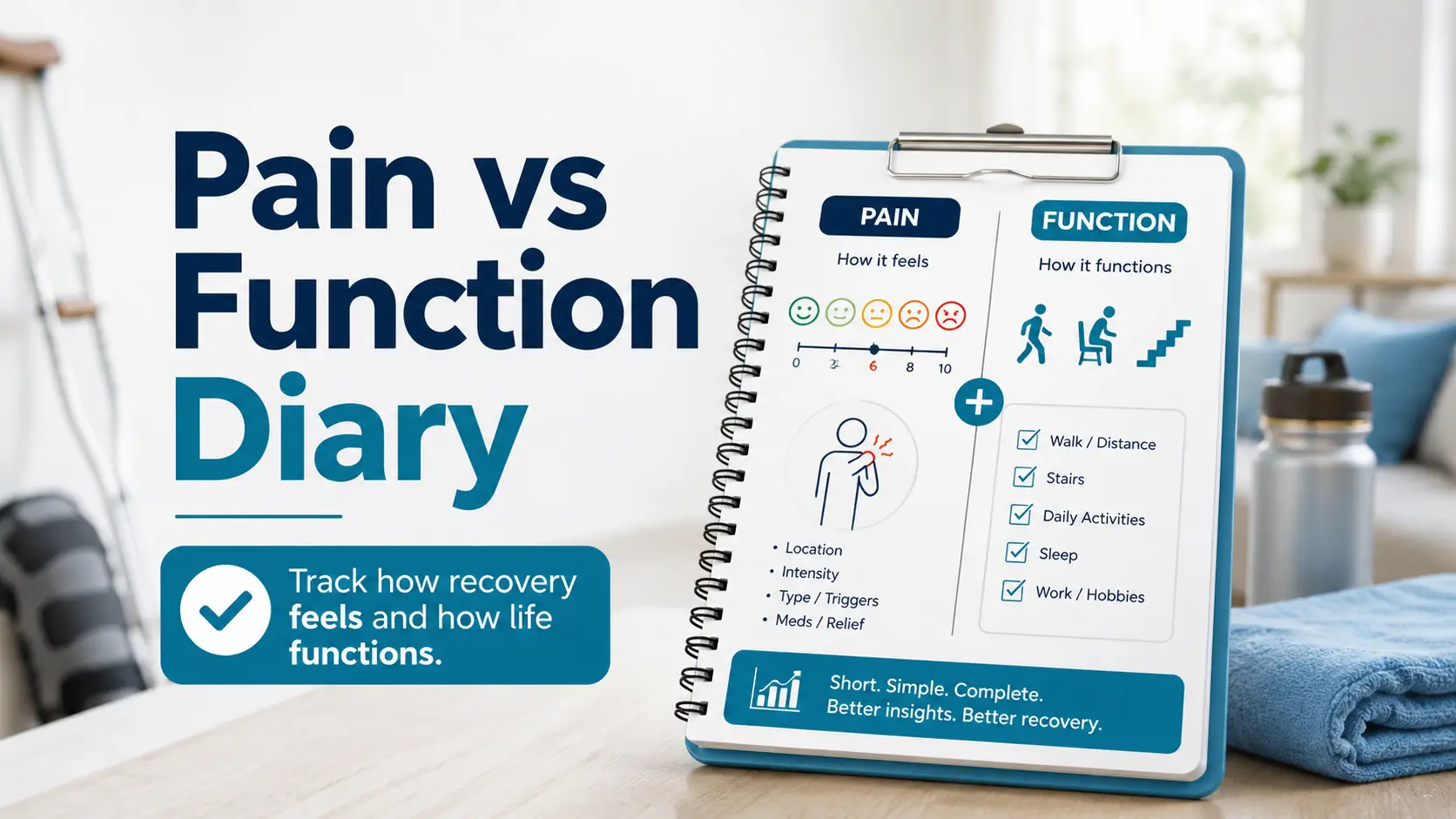
That is why choosing between a pain diary and a function diary is not really a contest. Each records a different part of the recovery story. Pain describes the symptom experience. Function shows what daily life currently permits. Used together, they can turn a foggy week of “better, I think” into a concise record a surgeon or physical therapist can actually discuss.
This guide shows how to build a two-minute combined recovery log, compare trends without self-diagnosing, choose simple or paid tracking tools, and recognize symptoms that should never wait for tomorrow’s diary entry.
The goal is not a perfect recovery score. It is to make meaningful change visible. 🧭
Snapshot
Who this is for: orthopedic-surgery patients and family caregivers managing routine home recovery. What it solves: uncertainty about whether pain scores or daily abilities provide the more useful record. What you can do next: create a safe two-column diary, summarize a trend, and prepare a clearer question for the surgeon or physical therapist.
Before You Use a Recovery Diary
This article offers a general tracking framework. It cannot diagnose a complication, assess a wound, test strength or circulation, or tell you whether an activity is permitted after your particular operation.
Follow your written discharge instructions first. Do not change medication doses, weight-bearing limits, braces, wound care, assistive devices, or prescribed exercises because of a diary pattern. Contact the surgical team when symptoms are worsening, unusual, or outside the recovery plan.
Table of Contents

Pain Score vs Daily Life: What Each Diary Measures
A pain diary answers a symptom question: How much does it hurt, where does it hurt, and what was happening when it changed? A function diary answers a daily-life question: What can I do safely, how much help do I need, and is that changing?
Those questions overlap, but they are not interchangeable. Pain is personal and may vary with movement, position, sleep, stress, swelling, and medication timing. Function is more observable, yet it can also be shaped by restrictions, fear, fatigue, dizziness, available help, and the design of the home.
What a pain diary actually measures
A useful pain entry includes more than one large number circled in red. It records enough context to distinguish quiet resting discomfort from pain that appears during a permitted activity.
- Pain at rest
- Pain during one repeatable, permitted activity
- Location, such as the incision area, joint, calf, back, or shoulder
- Character, such as aching, burning, sharp, throbbing, or electric
- Time of day and duration
- Swelling, stiffness, sleep interruption, or position
- Medication taken exactly as prescribed
Pain after an operation commonly comes with soreness and swelling, but the surgeon’s instructions should define what is expected for the specific procedure. Unexpected pain or a worsening pattern deserves direct discussion rather than interpretation by diary alone.
Readers who struggle to describe a complicated symptom may also find the companion guide on how to describe pain to an orthopedist helpful before a follow-up visit.
What a function diary reveals that pain scores miss
Function means what daily life currently allows within the recovery plan. Depending on the operation, that may include getting out of bed, transferring from a chair, using the bathroom, dressing, walking with the prescribed device, sleeping, or completing assigned rehabilitation exercises.
The key phrase is within the recovery plan. A shoulder patient may be temporarily prohibited from reaching or lifting. A hip or knee patient may have specific instructions for stairs, assistive devices, or weight bearing. “Not allowed” is not the same as “physically unable.”
Orthopedic recovery guidance commonly uses activities, prescribed exercises, assistive-device use, and safe return to daily tasks as practical markers of progress. The permitted activities differ by operation and patient.
Key Takeaway
Pain tells you how recovery feels. Function tells you how recovery is affecting life. Neither number should erase the other.
A lower number is not the whole recovery
A patient may report lower pain because medication is working, yet be too sleepy or dizzy to walk safely. Another may feel sore after physical therapy while completing a longer approved walk with less help.
That is the central reason a combined diary usually wins. It captures the symptom and its practical consequence without pretending that either one provides a complete clinical assessment.
Which Diary Fits the Question You Need Answered?
The “best” diary depends on what you are trying to communicate. Before opening a notebook or downloading an app, finish this sentence: I need the diary to help me understand or explain…
Choose pain-first tracking for symptom questions
Lead with pain details when the main concern involves nighttime discomfort, a new location, movement-related flares, pain that no longer settles as expected, or whether the current care plan is providing enough relief.
A pain flare trigger log can be especially useful when discomfort repeatedly rises after a particular activity, position, therapy session, or time of day.
Choose function-first tracking for independence questions
Lead with function when the concern is walking, transfers, bathroom access, self-care, sleep, assistive-device use, or the amount of help required from another person.
Function-first notes can be particularly revealing for older adults living alone, patients trying to resume work, and caregivers deciding whether scheduled help is still enough. The site’s functional pain assessment guide offers additional examples of describing what pain prevents rather than reporting intensity alone.
Use both when recovery feels contradictory
Combined tracking is most valuable when the two signals move differently:
- “Pain increased after therapy, but I walked farther with the walker.”
- “Resting pain fell, but I now need help standing from the toilet.”
- “The shoulder aches more at night, but dressing requires less assistance.”
- “The knee feels similar, but swelling and standing tolerance have worsened for three days.”
Pain diary vs function diary comparison
| Tracking method | Best for | What it may miss | Useful example |
|---|---|---|---|
| Pain diary | Timing, intensity, location, symptom control, nighttime flares | Mobility, assistance, balance, independence | “Rest pain 3; pain during chair transfer 6.” |
| Function diary | Walking, transfers, self-care, sleep, prescribed exercises | New pain quality, location, or symptom severity | “Walked five minutes with walker and one rest.” |
| Combined diary | Contradictory or changing recovery patterns | Still cannot replace an examination | “Walked farther, but new calf swelling developed.” |
Short Story: Maria’s Two Numbers
After knee surgery, Maria wrote “6” in a notebook every evening. By the fourth day, the numbers looked discouragingly flat. Her daughter assumed recovery had stalled.
Then they added one function question: “How did the chair transfer go?” On Monday, Maria needed both armrests and her daughter’s help. On Tuesday, she needed the armrests but no physical assistance. By Thursday, she completed the transfer safely and paused only once.
The pain number had barely changed, yet the daily task had. At the follow-up call, they could explain both facts instead of choosing one story over the other.
The lesson was not that pain did not matter. It was that a single number had been holding the camera too close. Adding function widened the frame and produced a better question for the clinician.
The Two-Minute Combined Recovery Log
A diary only works when someone continues using it. A complicated spreadsheet with 19 fields may look impressive on discharge day and become abandoned archaeology by Friday.
The better option is a short, repeatable entry completed at roughly the same time each day. Keep current restrictions visible at the top of the page so the diary never turns a prohibited activity into a failed goal.
Column one: pain and symptom context
- Pain at rest: Use the same scale each day.
- Pain during one repeatable activity: Choose an activity already permitted.
- Location and quality: Note whether anything is new.
- Swelling or wound change: Record direction, not a home diagnosis.
- Sleep: Note how often symptoms interrupted sleep.
- Medication: Record what was taken and when, exactly as directed.
Column two: function and independence
- Bed, chair, or toilet transfer
- Walking time or a familiar indoor distance
- Walker, cane, crutches, sling, brace, rail, or raised seat used
- Dressing, bathing, bathroom use, or meal preparation
- Prescribed rehabilitation activity completed
- Help, supervision, extra rest, or cueing required
Add one sentence that explains the day
The summary sentence is where scattered facts become useful communication. Keep it descriptive and neutral:
- “Walked farther with the walker, but calf swelling was greater than yesterday.”
- “Resting pain was stable, but standing from the toilet required more help.”
- “Completed prescribed exercises, then shoulder soreness lasted longer than usual.”
- “Pain improved, but dizziness made the bathroom walk feel unsafe.”
The Four-Step Recovery Snapshot
Key Takeaway
The minimum useful entry is one pain measure, one permitted task, the help required, and one sentence about what changed.
A copyable daily diary template
| Date and time | ____________________ |
|---|---|
| Current restrictions | ____________________ |
| Pain at rest | ____ / 10 |
| Pain during permitted task | ____ / 10 during ____________________ |
| Location or quality change | ____________________ |
| Function completed | ____________________ |
| Device or assistance | ____________________ |
| Medication taken as directed | ____________________ |
| New symptom or change | ____________________ |
| One-sentence summary | ____________________ |
A caregiver can maintain the same format using the communication practices in this caregiver notes guide for orthopedic appointments. Record what the patient reports separately from what the caregiver observes.
How to Read Recovery Trends Without Self-Diagnosing
A diary should help you notice change and form better questions. It should not become a kitchen-table diagnostic laboratory.
Compare the same task under similar conditions
Walking to the bathroom at 7 a.m. is not directly comparable with walking outdoors after physical therapy at 4 p.m. Choose one stable reference task and record it at roughly the same time.
Useful reference tasks might include standing from the same chair, walking the same hallway, putting on one item of clothing, or completing the same prescribed exercise. Consistency turns ordinary observations into a readable trend.
Use direction, duration, and consequence
- Direction: Is the symptom or task improving, stable, or worsening?
- Duration: Was this a single episode, or has it continued for several entries?
- Consequence: Is it affecting sleep, walking, balance, therapy, or independence?
“Pain was worse today” is difficult to interpret. “Resting pain increased from 3 to 5 for three days and now wakes me twice each night” gives the care team a clearer starting point.
Bring questions, not self-diagnoses
Turn the trend into a calm appointment prompt:
- “My resting pain is stable, but standing tolerance has decreased for three days. Is that expected at this stage?”
- “The incision looks more red than it did two days ago. How would you like me to document or report it?”
- “I need more help with transfers despite less pain. Could medication effects, weakness, or another issue need review?”
- “Which activity should I use as my weekly function benchmark?”
Show me the nerdy details
Pain intensity and function are related but separate outcomes. A change in one does not mathematically require the same change in the other. Medication may lower reported pain without restoring balance or strength. Adaptation, assistive devices, or improved technique may increase function while soreness remains noticeable.
This is why a combined log should not be collapsed into one homemade “recovery score.” Keeping the columns separate preserves clinically useful differences. The diary records a trajectory, while the clinician interprets that trajectory alongside the procedure, examination, restrictions, medications, wound status, and rehabilitation plan.
Common Diary Mistakes That Distort the Story
Bad tracking rarely looks obviously bad. It usually looks diligent: more numbers, more fields, more late-night analysis. Unfortunately, extra detail can still produce a crooked picture.
Recording only the worst moment
If every entry captures only the day’s sharpest flare, every day may appear equally severe. Record rest pain, pain during one repeatable task, and the worst pain separately when all three are useful.
Changing the scale or reference task
A five-point verbal scale on Monday and a 10-point numeric scale on Tuesday create needless static. The same problem occurs when Tuesday’s hallway walk is compared with Wednesday’s staircase attempt.
Choose one scale, define it simply, and keep one reference task stable until the clinician recommends a different benchmark.
Confusing “not permitted” with “unable”
A patient wearing a shoulder immobilizer may not be permitted to perform a reaching task. A patient with weight-bearing restrictions may not be allowed to test unsupported walking. Those entries should say “not attempted because restricted,” not “failed.”
Using the diary to redesign treatment
Do not stop, double, combine, taper, or reschedule medication based only on diary patterns. Prescription pain medicines can cause important side effects and safety risks, and orthopedic guidance emphasizes taking medication as directed and discussing inadequate relief, side effects, or medication changes with the care team.
Families concerned about missed doses, duplicate doses, unusual drowsiness, or confusion can use the practical observations in how to monitor medication confusion after surgery.
| Common mistake | Safer alternative |
|---|---|
| Logging only the highest pain score | Separate rest pain, repeatable-activity pain, and worst pain |
| Testing a prohibited activity | Track only tasks permitted by the written plan |
| Writing “better” or “worse” without context | Add the task, duration, assistance, and consequence |
| Comparing recovery with a stranger online | Compare your own repeated entries and procedure-specific instructions |
| Changing medication after noticing a pattern | Document the pattern and contact the appropriate clinician |
| Building a diary too complex to maintain | Use a two-minute daily entry |
Key Takeaway
A sustainable diary beats an exhaustive one. Consistency creates a trend; complexity often creates an abandoned notebook.
When Pain and Function Move in Opposite Directions
The most useful diary entries are often the ones that do not fit a tidy recovery narrative. A mismatch does not automatically mean something is wrong, but it is worth describing accurately.
Pain is better, but function is worse
Possible diary clues include unusual sleepiness, dizziness, weakness, poor balance, fear of falling, low energy, disrupted sleep, or an unexpected increase in assistance.
Do not assume the patient is simply “being cautious.” Record the exact task and what changed:
- Needed a second person for a transfer that was previously supervised only
- Reached for furniture instead of using the prescribed device
- Became unusually sleepy during a conversation
- Stopped an approved activity because of fear or uncertainty
- Needed more rest during the same walking route
When walker use is part of recovery, practical home skills matter too. Review safe walker turns at home rather than experimenting with a new technique while fatigued.
Function is better, but pain is worse
A patient may complete more activity and experience more soreness afterward. The diary should describe the timing, duration, rest response, location, swelling, and whether pain now appears at rest as well as during movement.
A new pain location changes the communication priority. Surgical-area soreness after an approved task is a different observation from new calf pain, chest discomfort, spreading numbness, or pain in an unrelated joint.
The combination may matter more than the score
Worsening pain combined with declining function, increasing swelling, wound changes, fever, new weakness, numbness, balance problems, or troubling medication effects deserves more attention than an isolated number.
Describe what is happening and follow the communication instructions supplied by the surgical team. Avoid deciding at home whether the combination is normal, dangerous, or caused by a particular condition.
Key Takeaway
A mismatch is information. Report the pain trend, the function trend, and any associated symptom instead of forcing them into one verdict.
Red Flags a Diary Should Never Delay
A recovery log belongs beneath the care plan, not above it. When urgent symptoms appear, seek the appropriate help first. Details can be recorded afterward.
Seek emergency help for possible pulmonary embolism symptoms
Difficulty breathing, sudden chest pain, coughing up blood, fainting, lightheadedness, or a very fast or irregular heartbeat can be symptoms of a pulmonary embolism. The CDC advises seeking immediate medical help for possible pulmonary embolism symptoms.
Promptly report possible limb blood-clot symptoms
New or increasing swelling in one limb, pain or tenderness, warmth, redness, or discoloration should be reported promptly according to the patient’s instructions. Surgery, fractures, and reduced blood flow from limited movement can increase blood-clot risk.
Contact the surgical team about possible wound infection
Increasing redness, heat, pain, swelling, drainage, bad odor, fever, chills, or a wound that is opening should prompt contact with the care team. Follow the wound-specific instructions provided at discharge.
Call about unexpected neurologic, medication, or fall concerns
- New numbness or weakness
- Extreme sleepiness, unusual difficulty waking, or confusion
- A fall, near-fall, or sudden decline in balance
- Medication side effects that interfere with breathing, alertness, or safe mobility
- Uncontrolled swelling or pain that is worsening rather than following the expected plan
- An unexpected increase in the amount of physical assistance required
Use the contact route and urgency instructions in the discharge paperwork. When symptoms appear life-threatening, use emergency services rather than leaving a portal message or waiting for the next office opening.
The diary comes second.
Do not finish the entry, search for a matching diagnosis, or wait for another data point when urgent symptoms are present. Obtain appropriate help first.
Free, Paid, and Caregiver Recovery-Diary Tools
You do not need an expensive device to record useful recovery information. A sheet of paper can outperform a polished app when it is easier to reach, easier to understand, and used every day.
Good, better, and best tracking setups
| Setup | What it includes | Best for | Watch for |
|---|---|---|---|
| Good: paper log | Printed template, pen, discharge instructions | Simple routines, low cost, patients who dislike screens | Lost pages, hard-to-read handwriting, no automatic sharing |
| Better: phone note or spreadsheet | Reusable fields, dates, shared access | Caregiver coordination and appointment preparation | Too many fields, privacy settings, accidental edits |
| Best for complex needs: clinician-approved platform | Structured questionnaires, reminders, secure care-team workflow | Patients whose clinic already uses remote monitoring | Cost, subscription terms, data access, and whether anyone reviews entries |
When a free DIY diary is enough
A paper template or ordinary phone note is usually enough when recovery is routine, the patient can complete entries consistently, and the diary is mainly being used to prepare for scheduled follow-up.
A wearable is optional, not essential. Step counts can be misleading when stride length, assistive-device use, restricted movement, or indoor walking affects accuracy. Recovery can still be tracked meaningfully without a fitness tracker.
When a paid tool or service may be worth considering
A paid option may be reasonable when several caregivers need coordinated access, reminders reduce missed entries, visual summaries help at frequent appointments, or the surgical practice actively reviews data through an approved platform.
Before paying, ask:
- Does the tool record pain and function separately?
- Can I export a short report without sending the entire account history?
- Can another person edit entries, or only view them?
- How is health information stored and shared?
- Does the clinic actually accept or review its reports?
- Will reminders become helpful prompts or relentless digital woodpeckers?
- Can the subscription be cancelled easily?
Set caregiver-sharing boundaries before the first entry
Agree on who records medication, who observes function, and who contacts the care team. A shared diary becomes confusing when three people document the same dose differently or assume someone else reported a concerning change.
For larger families, a caregiver group chat after surgery can support logistics, but medical questions and urgent symptoms should still follow the communication route provided by the clinical team.

Frequently Asked Questions
Should I record pain once a day or after every activity?
Follow any schedule supplied by the surgical team. Without a prescribed schedule, one consistent daily entry plus a note for a meaningful flare or new symptom is often more sustainable than recording every movement.
Should I log my worst pain or average pain?
Separate categories are clearer. Record pain at rest, pain during one repeatable permitted task, and worst pain only when the worst episode adds useful context. Avoid blending several experiences into one ambiguous average.
What functional activities are safest to track?
Track only activities already permitted by the discharge or rehabilitation plan. Good options are repeatable and low-risk, such as a prescribed transfer, a familiar indoor walk with the required device, dressing, bathroom use, or assigned exercises.
Can a function diary replace a physical-therapy assessment?
No. Home observations may support communication, but they cannot assess gait, strength, range of motion, wound status, circulation, surgical healing, or exercise technique with the precision of a professional examination.
Should medication use appear in the diary?
Yes, when it is recorded exactly as taken. Include the medicine name, time, and prescribed dose if the care team wants that information. Do not independently alter the dose, combination, taper, or timing.
What if my pain stays high but I can do more?
Record both facts. Add the activity, assistance required, how long the pain lasted, whether it settled as expected, and any swelling or new symptoms. The care team can interpret the combination in the context of your procedure.
What if pain decreases but walking becomes harder?
Report the mismatch, especially when it accompanies dizziness, weakness, swelling, poor balance, unusual sleepiness, or increased assistance. Less pain does not automatically mean safer mobility.
How long should I keep the diary?
Use the schedule recommended by the surgeon or therapist. Otherwise, a diary is most useful during active early recovery, while symptoms or abilities are changing, and before follow-up appointments. Stop or simplify it when it no longer improves communication.
Should I bring the whole diary to an appointment?
Bring it, but prepare a short summary. Highlight the main trend, how long it has continued, its effect on function, and two or three questions. This orthopedic visit checklist can help organize the rest of the appointment.
Build Your Baseline Tonight
Do not begin with a complicated scoring system. Begin with one ordinary evening and six observations.
- Write the current activity, weight-bearing, brace, and wound-care restrictions at the top.
- Record pain at rest using one consistent scale.
- Record pain during one permitted, repeatable activity.
- Describe one functional task completed and the device or help required.
- Note medication taken exactly as prescribed.
- Write one sentence describing what changed, including any new swelling, wound change, weakness, dizziness, balance problem, or breathing symptom.
Place the entry beside the discharge instructions and repeat the same basic measurements tomorrow. Within 15 minutes, you will have something more useful than a lonely pain score: a baseline that shows both how recovery feels and how recovery is shaping daily life.
Tomorrow’s number may rise or fall. The deeper question is whether the person is safer, steadier, more independent, or developing a change that deserves attention. That is the recovery story worth preserving.
Last reviewed: 2026-09