

Orthopedic recovery guide
What Your Walking Speed Says
During Orthopedic Recovery
After surgery, a fracture, a joint replacement, or a stubborn sports injury, walking can feel strangely personal. One day your hallway feels like a victory lap. The next day, the same hallway feels longer, louder, and slightly judgmental.
Walking speed can be a useful recovery signal because it quietly gathers several clues at once: pain control, strength, swelling, balance, confidence, endurance, and whether your body trusts the repaired area yet. But it is not a crystal ball, and it is not a medical diagnosis. It is a conversation starter.
This guide shows you how to track walking pace without turning your living room into a lab, when slower walking is expected, when it deserves a call to your care team, and how to bring a useful 7-day walking snapshot to your physical therapist or surgeon.
Read the pattern
Learn why trend matters more than one slow walk.
Avoid bad data
Track pace, pain, swelling, device use, and next-day response.
Know when to ask
Separate normal stiffness from warning signs worth reporting.
Your stopwatch is not the judge. It is the flashlight. 🔦
Snapshot
This article is for adults in the US or UK who have already been cleared to walk during orthopedic recovery. It helps you understand what walking-speed changes may mean, what to track besides pace, which symptoms should not be ignored, and how to build a simple 7-day record your clinician can actually use.
Table of Contents
The Walking-Speed Clue Most Patients Miss
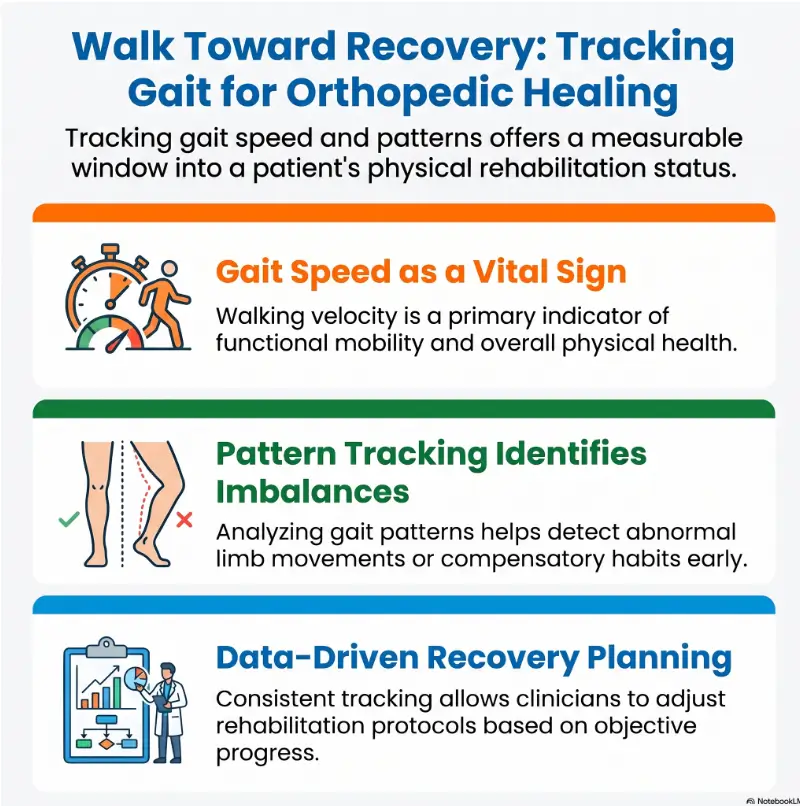
Walking speed during orthopedic recovery is not just about being “fast again.” It is a compact little status report from your body. Pace can reflect pain, stiffness, swelling, muscle strength, balance, fatigue, fear of falling, and confidence in the healing area.
That is why clinicians often care about gait speed. A person who walks more smoothly, with fewer pauses, fewer compensations, and less next-day irritation is often showing functional progress. The key word is functional. Recovery is not only about what a scan says or what the incision looks like. It is also about whether you can move through ordinary life without your body negotiating every step like a tiny courtroom drama.
Still, walking speed should be handled gently. One slow day does not mean failure. One fast day does not prove full recovery. The useful clue is the pattern.
Why gait speed is more than “am I walking faster?”
Gait speed is usually expressed as distance divided by time. In rehab settings, that might be meters per second. At home, you might simply record how long it takes to walk the same hallway or safe, flat route.
The number matters less when it stands alone. It becomes useful when paired with context. Did your pain climb from 2 to 6 afterward? Did your knee swell later that evening? Did you need the walker again after trying to walk without it? Did your limp get louder even though the stopwatch looked better?
A good recovery log does not worship the number. It invites the number to sit at the table with pain, swelling, confidence, and form.
Pain, strength, balance, fear, and fatigue all show up in your pace
After orthopedic surgery or injury, slower walking can happen for several reasonable reasons. Your body may be protecting a sore joint. Your muscles may be deconditioned after rest or immobilization. Your nervous system may be cautious because the last few weeks taught it that movement can hurt.
For a knee replacement patient, slower walking may come from swelling and stiffness. For someone recovering from hip surgery, it may come from precautions, weakness, or fear of twisting. For an athlete after a fracture or ligament procedure, speed may be limited by confidence and load tolerance rather than pure pain.
That is why the best question is not, “Why am I slow?” A better question is, “What is slowing me down today?”
Key takeaway
Walking speed is most useful when it is tracked as a trend. Pair the number with pain, swelling, fatigue, assistive-device use, and how your body feels 24 hours later.
Why one slow day is less important than a repeated pattern
Recovery is rarely a polite staircase. It is more like a tide chart with shoes. You may have a slower walk after poor sleep, a long car ride, a physical therapy session, a change in medication timing, or a busier-than-usual morning.
A repeated pattern is more meaningful. If your pace slows across several walks, your limp increases, pain rises, or swelling becomes more noticeable, that deserves attention. It may mean your activity level needs adjustment, your assistive device still has a job, or your care team needs to review your plan.
In other words: do not panic over a single rainy Tuesday. Do pay attention when Tuesday keeps happening.
Before You Track: Safety, Restrictions, And Red Flags
This guide is educational and cannot tell you whether your specific surgery, fracture, implant, tendon repair, ligament repair, or pain flare is safe to test. Walking-speed tracking only makes sense if your clinician has cleared you to walk and you understand your current restrictions.
That includes weight-bearing status, brace or boot use, hip precautions, fall-risk instructions, medication cautions, incision care, and whether you should use a cane, walker, crutches, or another device. A stopwatch is not allowed to outrank your surgeon’s instructions.
Before you act
Walking-speed tracking can help you prepare better questions for your physical therapist, surgeon, primary care clinician, or caregiver. It cannot diagnose a blood clot, infection, implant issue, fracture complication, nerve problem, or failed recovery.
If you have new or worsening symptoms, unclear restrictions, or sudden loss of function, check with a qualified clinician promptly instead of trying to “walk it off.”
Good fit: post-op patients cleared to walk by their clinician
If you are already walking as part of your recovery plan, a simple walking log can help you see whether your daily function is improving. This can be especially helpful between appointments, when memory gets foggy and every day blends into a soft blur of ice packs, pillows, and “where did I put my medication list?”
Tracking is most useful when the route is safe, short, repeatable, and approved for your stage of healing. It should not push you into stairs, uneven pavement, long distances, or “just one more block” bravado.
For related home-safety planning, you may find this guide on walker path safety useful if you are using a walker or recovering in a tight home layout.
Not for: red-flag symptoms or unclear weight-bearing rules
Do not use walking-speed tracking to test a new injury, prove you are ready to stop using a device, or override instructions you do not fully understand. If your paperwork says partial weight bearing, toe-touch weight bearing, non-weight bearing, brace locked in extension, boot required, or hip precautions, ask for clarification before experimenting.
The same applies to symptoms that feel different from normal soreness. A sudden drop in walking ability is not just “data.” It may be your body knocking with both hands.
Red flags that deserve medical guidance
After orthopedic surgery or immobilization, certain symptoms deserve prompt attention. The list below is not complete, but it gives you a practical safety filter.
- New or worsening calf pain, tenderness, redness, warmth, or swelling
- Shortness of breath, chest pain, fainting, coughing blood, or sudden severe weakness
- Increasing incision redness, swelling, warmth, drainage, odor, or wound opening
- Persistent fever, chills, or feeling suddenly ill
- New numbness, foot drop, loss of bladder or bowel control, or major change in strength
- Sharp pain, sudden instability, a fall, or a feeling that something “gave way”
For official patient education, review the AAOS pages on deep vein thrombosis and warning signs of infection after joint replacement. These resources can help you recognize when a walking change should become a call, not a home experiment.
How To Measure Walking Speed Without Overdoing It
Clinical tests such as the 10-Meter Walk Test measure walking speed over a short distance, often in meters per second. That does not mean you need to recreate a rehab clinic in your hallway. At home, the goal is not to produce perfect research-grade data. The goal is to create a clean, repeatable snapshot.
Think of it as brewing coffee the same way each morning so the taste means something. Same route. Same shoes. Same assistive device. Same approximate time of day. Same rule: stop if symptoms tell you to stop.
What clinicians mean by gait speed in meters per second
Gait speed is usually calculated by dividing distance by time. If someone walks 10 meters in 12.5 seconds, the gait speed is 0.8 meters per second. In clinical settings, the measurement may include a starting zone, a timed middle distance, and instructions such as comfortable pace or fast pace.
At home, you do not need to obsess over decimals. A simple time record can still show whether you are trending better, flat, or backward.
Simple formula
Walking speed = distance ÷ time. If math adds stress, skip the formula and track the same route time instead. Your clinician can help interpret the pattern.
The safe home version
Choose a short, flat, clutter-free route you already walk safely. For many people, that is a hallway, a straight stretch from bedroom to kitchen, or a smooth sidewalk with no cracks, slopes, pets, rugs, cords, or dramatic furniture corners waiting to audition as villains.
Use your prescribed device. If your PT told you to use a walker, use the walker. If you were told to wear a boot, brace, or sling, keep that instruction intact. Tracking should reflect your real approved recovery setup, not a secret tryout for independence.
If your home setup is part of the problem, this article on furniture walking and fall risk can help you spot unsafe “support” habits before they become setbacks.
Keep the setup boring: same shoes, same surface, same time
Boring tracking is good tracking. A fast walk on a sunny sidewalk and a slow walk across carpet at night are not the same test. A walk after pain medication may not compare cleanly with a walk before medication. A walk after PT may look different from a walk after breakfast.
Try to keep these variables steady:
- Same route or measured distance
- Same shoes or supportive footwear
- Same assistive device and brace setup
- Same time of day when possible
- Same instruction: comfortable pace, not maximum pace
- Same note-taking format afterward
Show me the nerdy details
Gait speed is attractive in rehab because it is simple, quick, and functional. It compresses several systems into one observable task: musculoskeletal strength, joint range, balance, coordination, pain control, endurance, and confidence. But that same usefulness is also its limitation. A slow speed does not tell you which system is responsible. That is why clinicians often interpret gait speed alongside other measures, such as range of motion, strength testing, balance assessment, pain reports, swelling, assistive-device use, and task performance.
At home, the biggest measurement problem is inconsistency. Changing the route, shoes, device, surface, or time of day can create noisy data. For recovery decisions, a clean repeated pattern is more useful than a single dramatic number.
Slow Walking After Surgery: Normal Signal Or Warning Whisper?
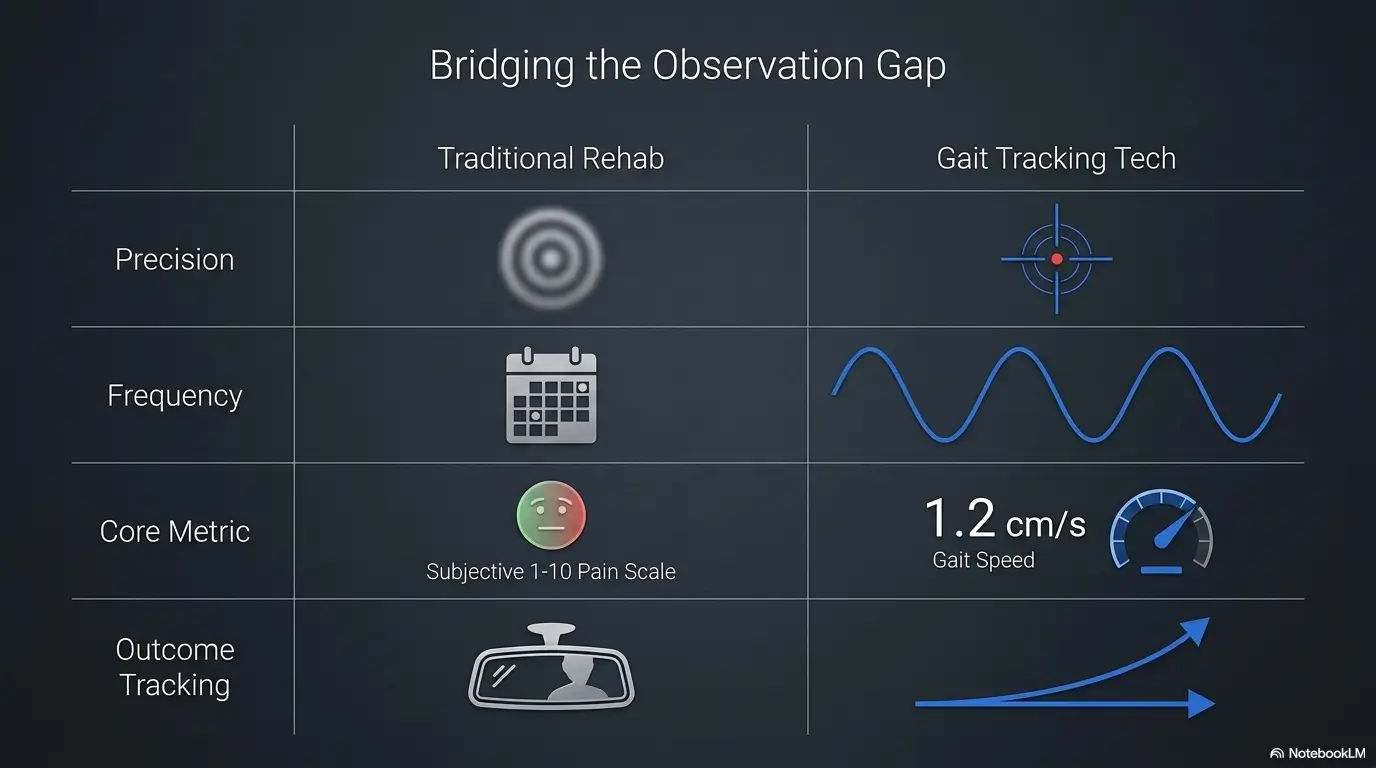
Slower walking is often normal early in recovery. Surgery, immobilization, pain, swelling, and reduced activity can all turn the body’s usual rhythm into careful punctuation. The question is whether the slowdown fits your recovery stage and whether it is improving over time.
A slow walk that gradually becomes smoother and more confident is different from a sudden regression. A temporary stiff morning is different from increasing pain at rest. A cautious gait while using a walker is different from new instability or sharp pain.
Expected slowdowns: stiffness, swelling, guarded movement, fatigue
Many people walk slowly because the body is guarding. Guarding is a protective strategy. It can show up as shorter steps, less time standing on the surgical side, a stiff knee, a stiff hip, a cautious turn, or a reluctance to load the injured limb.
Fatigue also matters. Orthopedic recovery can make ordinary movement expensive. A shower, a clinic appointment, or a trip from bed to the kitchen may use more energy than expected. Your pace may slow because your system is managing inflammation, sleep disruption, medications, and stress at the same time.
That does not mean you should ignore it. It means the number needs context.
Concerning slowdowns: sudden regression, sharp pain, instability, new weakness
A sudden drop in walking ability deserves more caution. This is especially true if it comes with sharp pain, new swelling, new redness, fever, drainage, calf symptoms, shortness of breath, chest pain, numbness, new weakness, or a fall.
For spine-related symptoms, a sudden walking change paired with new neurological symptoms deserves particular care. If your situation involves sciatica, numbness, weakness, or bladder or bowel changes, review this related guide on cauda equina syndrome red flags and seek urgent guidance when warning signs appear.
When the walking change feels new, severe, or different from your expected recovery soreness, do not turn the hallway into a courtroom. Call the right clinician and describe what changed.
The recovery question: “Is my trend improving, flat, or sliding backward?”
The trend question is the heart of the article. You are not asking your walking speed to declare you healed. You are asking it to help you notice direction.
| Trend | What it may suggest | What to do next |
|---|---|---|
| Gradually improving | Pain, strength, confidence, or endurance may be moving in the right direction | Keep tracking and follow your rehab plan |
| Flat for several walks | Your plan may need adjustment, or your body may be in a normal plateau | Ask your PT what variable to change safely |
| Sliding backward | Activity may be too much, symptoms may be changing, or a complication may need review | Document symptoms and contact your care team if concerning |
| Fast but limping more | You may be gaining speed through compensation | Prioritize form and ask for gait feedback |
The Limp Pattern That Says More Than The Stopwatch
A faster limp is still a limp. That sentence is annoyingly simple, and it may save you from chasing the wrong victory.
Walking speed can improve while movement quality gets worse. You may take shorter steps on one side, swing your leg around instead of bending normally, lean away from pain, rush through the sore limb, or grip a cane so hard your shoulder starts filing a complaint.
Shorter steps may point to pain avoidance
Short steps can happen when your body does not want to spend time on the healing side. This can be a pain response, a strength issue, a balance issue, or a confidence issue. The location of the surgery or injury matters too.
After knee surgery, someone may shorten the opposite step because standing on the surgical leg feels uncomfortable. After hip surgery, someone may avoid hip extension or rotate awkwardly. After foot or ankle injury, someone may reduce push-off because the end of the step feels unsafe.
Do not self-diagnose from the limp. Use it as a note for your PT: “My right step is shorter when I get tired” is more useful than “I think my gait is broken.”
Uneven rhythm may reveal confidence or balance problems
Listen to the rhythm of your steps if you can do so safely. A smooth walk often has a steady beat. An uneven walk may have pauses, shuffles, quick steps, or hesitation before turns.
This matters because falls often happen during ordinary transitions: turning, backing up, entering a bathroom, stepping over a threshold, reaching for a counter, or navigating a parking lot. If your gait gets uneven during turns or when distracted, tell your clinician. That detail is gold.
For outdoor safety, especially when using a walker, see this practical guide on parking lot safety with a walker.
Let’s be honest: speed can hide compensation
Speed is seductive because it feels objective. The stopwatch says you improved, and the brain throws confetti. But compensation can be sneaky. You may walk faster by leaning, twisting, dragging, rushing, or overusing the non-injured side.
That is why video feedback from a physical therapist can be valuable. A trained eye may see what the stopwatch cannot: hip drop, knee collapse, limited ankle motion, poor cane height, unsafe turning, or a habit that may irritate another joint later.
Key takeaway
Do not celebrate speed if your limp, pain, swelling, or instability is getting worse. Better walking means smoother, safer, and more repeatable, not merely faster.
Do Not Chase Speed Before You Earn Symmetry
Symmetry means the left and right sides are sharing the work in a reasonably balanced way. Perfect symmetry is not always realistic, especially early in recovery or with long-standing joint disease. But wildly uneven walking can create new problems.
If you speed up before your mechanics are ready, your body may learn an inefficient pattern. That pattern can become familiar, and familiar can feel “normal” even when it is costing you energy, irritating your back, or loading the other hip, knee, or foot more heavily.
The difference between walking faster and walking better
Walking faster means the clock improved. Walking better means the movement became safer, more controlled, and less costly to your body.
Better walking may include fewer rest breaks, steadier turns, less gripping of the walker, less next-day swelling, a smoother rhythm, and more confidence. Sometimes better walking temporarily looks slower because you are rebuilding control instead of sprinting through compensation.
That is not failure. That is craftsmanship.
When a cane, walker, brace, or boot is helping rather than “holding you back”
Many people feel emotionally ready to ditch the device before the body is mechanically ready. That is understandable. Assistive devices can feel awkward, noisy, or aging. Nobody dreams of becoming fluent in walker choreography.
But a cane, walker, brace, or boot can reduce pain, protect healing tissue, improve balance, prevent unsafe limping, and allow you to practice better mechanics. Used correctly, the device is not a symbol of weakness. It is a temporary editor, helping remove the rough draft from your gait.
If daily tasks are difficult with a walker, this guide on how to carry a plate with a walker may help you avoid unsafe improvisation at home.
Short Story: A faster limp was not the win
Martin was six weeks out from knee surgery and proud of one thing: he had shaved 40 seconds off his apartment hallway walk. He wrote the number on a sticky note and placed it on the fridge like a tiny medal.
At PT, his therapist watched him walk and did not cheer right away. She noticed he was rushing over the surgical side, locking his knee, and leaning his trunk.
They slowed the walk down. They adjusted his cane height. They practiced equal steps and quiet turns. His time got worse for a few days.
Then something better happened. His swelling calmed. His stride smoothed out. The hallway no longer felt like a test. It felt like a room inside his life again.
The lesson was simple: the stopwatch had noticed progress, but the therapist helped him make it real.
Tools, Apps, PT Visits, And Cost-Smart Tracking Options
You do not need expensive technology to track walking-speed changes during orthopedic recovery. A timer, a safe route, and a notebook can be enough. That said, some tools and professional services may be worth considering when they improve safety, consistency, or communication with your care team.
This is where commercial intent can be useful without becoming pushy. The goal is not to buy more recovery clutter. The goal is to choose the simplest option that helps you avoid wasted money, unsafe guesses, and confusing appointments.
Good / Better / Best tracking setup
| Setup | What it includes | Best for | Watch-outs |
|---|---|---|---|
| Good | Phone timer, paper log, same hallway route | Budget-conscious patients with clear walking instructions | Easy to forget pain and swelling notes |
| Better | Timer plus printed 7-day tracker and caregiver observation | Older adults, joint replacement patients, or anyone with fatigue | Caregiver should observe, not pressure |
| Best | PT-guided gait assessment plus home log | People with limping, falls risk, plateau, or unclear progress | May involve copays, coinsurance, travel, or scheduling limits |
If cost is a concern, ask your clinic what can be assessed in a regular PT visit before paying for extra services. Some people need only a simple gait check and home program adjustment. Others may benefit from formal gait analysis, especially when limping persists or recovery is complicated.
Free checklist vs paid help: how to choose
A free DIY approach may be enough if you are improving steadily, have no red flags, understand your restrictions, and your care team has already approved walking. A paid visit or professional review may be worth considering if your symptoms are changing, your walking is plateauing, you keep compensating, or you are not sure whether your assistive device fits correctly.
Before paying for a new brace, cane, walker, recovery app, shoe insert, or gait service, ask what problem it is supposed to solve. “I saw it online” is not a treatment plan. It is a shopping cart wearing a lab coat.
- Ask whether the tool matches your current surgery or injury restrictions.
- Confirm whether your PT or surgeon wants you using it.
- Check return policies before buying equipment.
- Compare total cost, not only sticker price.
- Ask whether insurance, HSA, FSA, or local lending closets may apply.
Questions to ask a provider before paying
If you are considering paid physical therapy, a gait assessment, home health support, or orthopedic equipment, take a question list. It keeps the appointment practical and protects your wallet from foggy decisions.
- What walking change are we trying to improve?
- Is my current device the right height and type?
- Should I prioritize speed, distance, symmetry, or endurance this week?
- What symptoms mean I should stop the walk?
- What should I track after walking: pain, swelling, fatigue, or all three?
- How many days of data would help you adjust my plan?
- Are there lower-cost options before buying new equipment?
- Does my insurance plan require authorization, referral, or visit limits for PT?
If you are confused by orthopedic bills or multiple provider charges, this related guide on orthopedic bills from multiple providers may help you organize the money side without losing the plot.
Common Mistakes That Make Walking Data Useless
Bad walking data does not usually look dramatic. It looks reasonable on the surface: different routes, different shoes, different times, different pain levels, and a wearable number that arrives with the confidence of a tiny robot accountant.
The problem is not tracking. The problem is tracking in a way that makes the pattern impossible to interpret.
Mistake 1: comparing your pace to internet averages
Internet averages can be interesting, but they are not your recovery plan. Your age, surgery type, baseline fitness, pre-surgery pain, weight-bearing rules, home layout, medications, and rehab stage all matter.
A “good walking speed after orthopedic surgery” is not a universal number. A better target is the one your clinician gives you based on your procedure, restrictions, and function.
Mistake 2: timing yourself on different routes every day
A carpeted hallway, a sloped driveway, a crowded grocery aisle, and a hospital corridor are different worlds. Changing the route makes the data noisy. If you want to compare, keep the route steady.
If you want to track real-world walking too, label it separately. “Hallway test” and “grocery store walk” should not live in the same column without context.
Mistake 3: ignoring pain, swelling, and fatigue after the walk
Today’s pace can look wonderful while tomorrow morning’s swelling writes a different review. That is why the 24-hour response matters. If walking faster repeatedly leads to more swelling, more pain, worse sleep, or reduced function the next day, bring that pattern to your PT.
For a more detailed symptom record, this pain flare trigger log can help you connect activity, timing, and symptoms more clearly.
Mistake 4: treating a wearable estimate as a medical verdict
Smartwatches and phones can be useful, especially for steps, trends, reminders, and gentle accountability. But consumer devices can estimate movement differently depending on stride, arm swing, device placement, assistive-device use, and gait changes.
Use wearable data as a rough clue, not a diagnosis. If the device says your walking speed improved but your limp, pain, or swelling worsened, believe the whole body, not just the dashboard.
Key takeaway
The most common tracking failure is not a bad stopwatch. It is missing context. Always record pain, swelling, device use, and next-day response with your time.
What To Track Besides Speed
Walking speed is one tile in the mosaic. To make it useful, track the pieces that explain the number. A slower walk with less pain and better symmetry may be progress. A faster walk with more swelling and worse limping may be a warning that you outran your mechanics.
Keep your record short. If tracking feels like homework with a clipboard and a scowl, you will abandon it by Wednesday.
Pain before, during, and after walking
Use a simple 0 to 10 pain scale if your clinician has not given you another method. Record pain before walking, during walking, and later that day. You can also add a plain-English note, such as “front of knee tight,” “outer hip ache,” or “sharp calf pain.”
Location matters. Quality matters. Timing matters. “Pain 5” is less useful than “pain 5, sharp inside ankle, started during turns, settled after rest.”
Swelling later that day or next morning
Swelling can lag behind activity. You may feel fine during the walk and notice tightness later. Record whether swelling is unchanged, mildly increased, clearly worse, or affecting motion.
If swelling is sudden, severe, one-sided, associated with calf pain, redness, warmth, shortness of breath, or chest pain, do not treat it as a normal training response. Seek medical guidance promptly.
Step symmetry, confidence, device use, and rest breaks
These are the notes clinicians often appreciate because they describe function. Did you use the cane the whole time or only near the end? Did you stop twice? Did you feel safe turning? Did you avoid loading one side? Did a caregiver notice dragging, shuffling, or leaning?
A busy parent recovering from ankle surgery may care most about reaching the kitchen safely. An older adult after hip replacement may care most about steady bathroom trips. A desk worker after knee surgery may care about walking from the parking lot to the office without swelling later. The useful metric depends on the life you are trying to re-enter.
Recovery walking framework
Track the walk, then listen to the echo.
1
Pace
Same route, same setup, comfortable speed.
2
Pattern
Watch limp, rhythm, turns, and rest breaks.
3
Symptoms
Pain, swelling, fatigue, and 24-hour response.
4
Question
Ask what to change: distance, speed, device, or rest.
Build A 7-Day Walking Snapshot Your Clinician Can Use
A 7-day snapshot is long enough to reveal a pattern and short enough that you might actually do it. The goal is not perfection. The goal is to walk into your next appointment with something better than, “Some days are good, some days are weird.”
Use one route. Use the same walking aid. Track comfortable pace, not maximum effort. If your clinician told you to avoid walking on certain days or limit distance, follow those instructions first.
Choose one safe, flat route already approved for your stage
Pick a route that does not require stairs, uneven ground, sharp turns, slippery floors, crowded spaces, pets underfoot, loose rugs, or heroic furniture grabbing. If your route requires bravery, choose a different route.
If you are preparing a home after surgery, this fall risk checklist before surgery is a helpful companion for reducing trip hazards before they become recovery plot twists.
Record the five notes that matter
Keep the log simple. A complicated tracker is just a guilt machine with columns.
| Day | Route time | Pain before / after | Swelling later? | Device used | Confidence note |
|---|---|---|---|---|---|
| Day 1 | |||||
| Day 2 | |||||
| Day 3 | |||||
| Day 4 | |||||
| Day 5 | |||||
| Day 6 | |||||
| Day 7 |
Bring the pattern, not just the number
At your next appointment, do not only say, “I walked faster.” Say something like, “Over seven days, my hallway time improved a little, but swelling increased on the two days I skipped the walker.” That sentence gives your clinician a usable puzzle piece.
Here are better questions to ask:
- Does my gait speed trend match where I should be at this stage?
- Should I work on distance, speed, balance, or symmetry first?
- Is my limp expected, or should we adjust my exercises?
- When should I reduce walking and focus on swelling control?
- When can I safely change my assistive device?
- What symptoms should make me call before the next visit?
Key takeaway
A 7-day walking snapshot is not meant to impress anyone. It is meant to make your next clinical conversation sharper, safer, and less dependent on memory.
For broader patient education on blood clots, the CDC provides a clear overview of blood clot symptoms and when to seek help. This is especially relevant if walking changes come with leg swelling, chest symptoms, or sudden shortness of breath.

FAQ
What is a good walking speed after orthopedic surgery?
There is no single “good” walking speed that applies to every orthopedic recovery. A useful target depends on your procedure, injury, age, baseline fitness, restrictions, pain, swelling, assistive-device use, and physical therapy goals. Ask your PT or surgeon what trend is appropriate for your stage instead of comparing yourself to internet averages.
Why am I walking slower even though my pain is better?
Pain is only one part of walking speed. You may still have weakness, stiffness, swelling, balance changes, fear of falling, fatigue, or restrictions that limit pace. Sometimes people slow down because they are finally walking with better control instead of rushing through a limp.
Is limping normal during recovery?
Some limping can happen during orthopedic recovery, especially early on. But a limp that worsens, persists across several walks, causes new pain elsewhere, or appears with new weakness, swelling, numbness, or instability should be discussed with your care team. Do not assume a limp is harmless just because you can move faster with it.
Should I walk every day after orthopedic surgery?
Follow your surgeon’s or physical therapist’s instructions. Many recovery plans include regular walking, but the amount, timing, and assistive-device use vary widely by procedure and patient. If walking increases pain, swelling, drainage, calf symptoms, or next-day function problems, ask whether your plan needs adjustment.
Can walking too fast slow down healing?
Walking too fast may irritate symptoms or reinforce compensation if your body is not ready. The concern is not speed by itself. The concern is speed that comes with worse form, increased swelling, increased pain, instability, or violation of weight-bearing restrictions. In recovery, clean movement usually beats rushed movement.
When should I worry about slower walking after a knee or hip procedure?
Call your care team if slower walking is sudden, worsening, or paired with concerning symptoms such as increased pain, calf swelling, redness, fever, chills, wound drainage, new numbness, new weakness, chest pain, shortness of breath, or a fall. If the change is gradual and mild but persists, bring your tracking notes to your PT or surgeon.
Do smartwatches measure recovery walking speed accurately?
Smartwatches can be useful for general trends, but they may be less reliable when your gait is uneven, your arm swing changes, or you use a cane, walker, crutches, brace, or boot. Treat wearable estimates as supporting clues, not medical verdicts.
What should I ask my physical therapist about my walking pace?
Ask whether your trend matches your recovery stage, whether your limp needs correction, whether you should prioritize speed or symmetry, whether your assistive device is still appropriate, and what symptoms should make you reduce activity or call the clinic. Bring a 7-day log if you have one.
Your 15-Minute Next Step: Turn Pace Into A Useful Question
Here is the calmest next step: spend 15 minutes setting up your 7-day walking snapshot. Do not test your limits. Do not chase a record. Do not turn the hallway into a tiny Olympic venue.
Choose one safe route. Write down your current walking rules. Set a comfortable pace. Record time, pain, swelling, device use, and confidence. Then bring the pattern to your next physical therapy or surgeon visit.
The best question is not, “Am I fast enough?” It is, “Does my walking pattern match where I should be, and what should I change safely this week?” That question turns a stopwatch into a bridge between your daily life and your clinical care.
15-minute setup
- Pick one safe, flat, repeatable route.
- Write your current restrictions at the top of the page.
- Time one comfortable walk using your prescribed device.
- Record pain before and after.
- Check swelling and fatigue later that day or the next morning.
- Repeat only as allowed by your recovery plan.
Last reviewed: 2026-08