
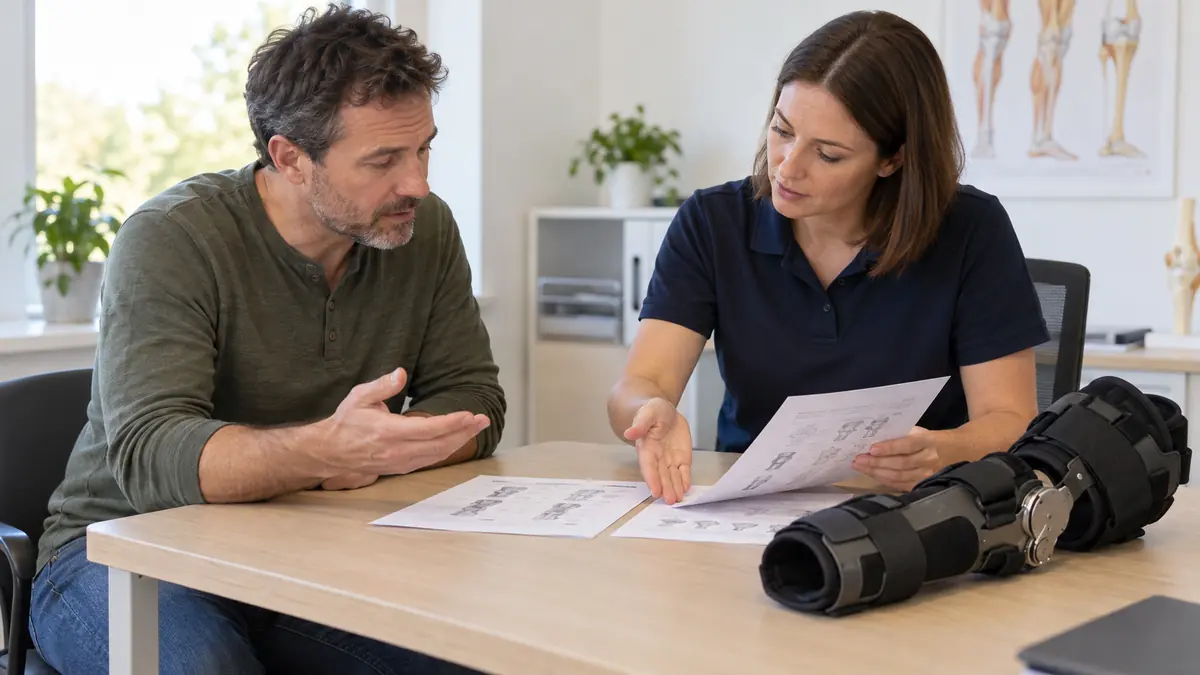
Conflicting hinged knee brace instructions need clarification for the actual device and situation. A discharge sheet, later conversation and replacement brace may not describe the same activity or stage of care. Keep the real wording and source of each instruction, identify the unresolved point, and ask the responsible team what applies. This guide does not choose a hinge setting or decide which instruction wins.
Use the existing-versus-new instruction comparison, follow seven essential clarification checks, read two fictional writing examples, or download the free offline actual-answer, education and implementation record. One unclear instruction is enough to begin; no stair or movement trial is required.
This page focuses on instruction mismatch, actual professional clarification, revised communication, education and implementation. The separate hinged knee brace and stairs guide compares individual teaching with the actual staircase. This is not another stair technique, route assessment or equipment-shopping checklist.
General education from a family-caregiver-run website, not a prescription review, fitting service or individual medical advice. The operator is not a medical professional. No independent clinical review or clinical validation of this tool is claimed. Dates and source roles organize questions; they do not establish authority or replace the responsible team’s assessment.
Table of Contents
Urgent symptoms come before routine instruction clarification
New chest pain or sudden breathing difficulty needs emergency help. Use local emergency services, including 911 in a U.S. emergency; do not drive yourself. New calf or thigh pain, concerning leg swelling, blue/white or cold toes, persistent numbness or severe pain out of proportion needs urgent or immediate medical assessment, rather than a routine equipment message. UCLH’s hinged-brace warning guidance describes these concerns. Do not reproduce symptoms, test walking or wait for a fuller record.
Rubbing or blister-like discomfort, skin damage, discharge, fever with knee symptoms, a broken brace or a new fit problem also needs prompt advice through the relevant brace or care service. The appropriate urgency depends on the actual symptoms; routine office hours are not permission to wait. Use emergency services for a serious acute problem. MedlinePlus emergency guidance gives broader immediate-help examples. These selected signs are not a complete triage checklist.
UK hospital leaflets provide symptom education here; their local numbers, clinic hours, wearing schedules and handling instructions are not generalized to U.S. readers. This article supplies no waiting interval, emergency device-removal method or temporary setting. If a current instruction cannot be followed or necessary help is absent, explain the current need to the appropriate team without waiting for the worksheet.
Compare existing and new hinged knee brace instructions
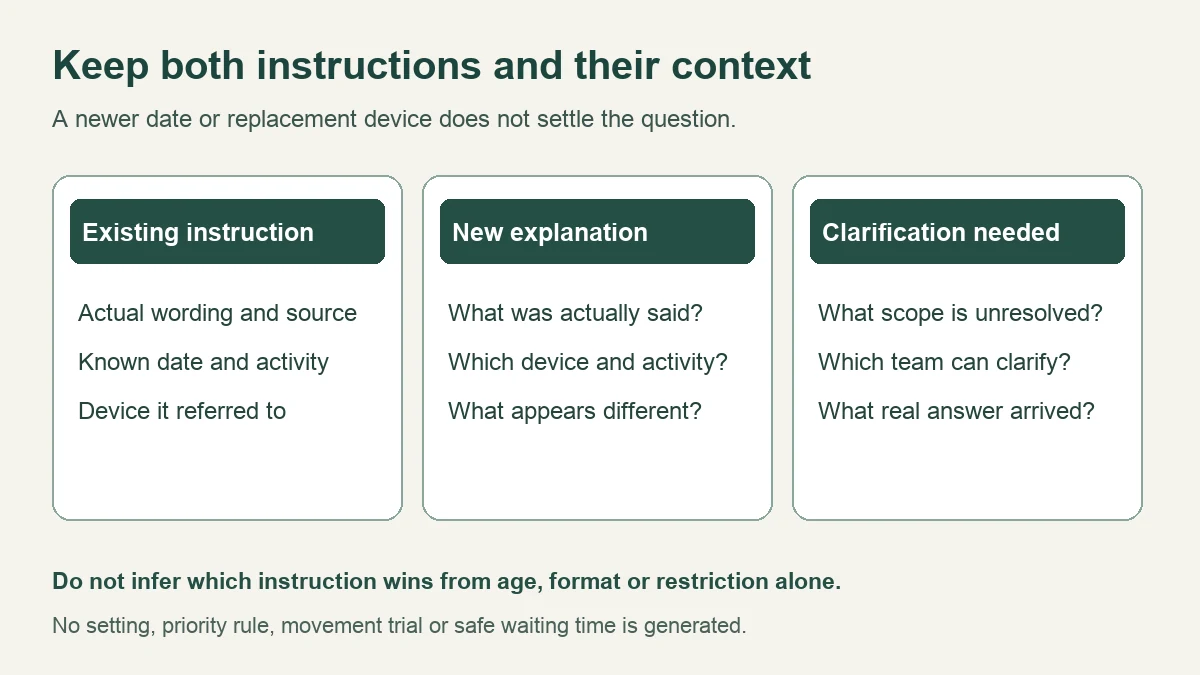
A difference can involve wording, device, activity, date or the condition the instruction was intended to cover. It may be a genuine conflict, a planned change or an incomplete explanation. The worksheet cannot determine which. Record uncertainty rather than treating a later date, verbal reassurance or a new device as proof of an updated prescription.
| What to compare | Existing instruction / known context | New explanation / question to clarify |
|---|---|---|
| Actual device and purpose | Named hinged knee brace and reason given, if known. | Same device, replacement or uncertain match? What instructions apply to the actual item? |
| Source, date and wording | Written instruction, conversation or report with its real source/date. | What exactly was said, by which role and for what situation? Do not silently combine versions. |
| Hinge / lock / movement range | The individual setting or instruction actually supplied; unknown stays unknown. | Was any change explicitly prescribed? Does it cover this activity and device? No angle is supplied here. |
| Wearing / permitted handling | Individual advice on wearing, removal, reapplication and taught adjustments. | Which part changed, which remains and what needs device-specific teaching? |
| Weight-bearing / aid / assistance | The actual instruction and mobility education received. | Does the new explanation address these separate questions or only the device? |
| Reply, update and execution | Actual clarification, education and completed action, if received. | Which instruction was clarified or replaced, who received the update and what remains pending? |
For example, an explanation about fitting straps may not address hinge settings. A statement about wearing the brace may not answer weight-bearing or stair questions. A replacement delivery may not include fitting, revised instructions or teaching. Ask about the specific unanswered part instead of marking the whole plan clarified.
Seven essential checks for hinged knee brace instruction differences
Identify the actual device without inferring settings
Use known device details and the purpose explained by the team. A photograph or generic product label cannot establish prescribed range, locking, wearing or mobility instructions. If a device was replaced, keep the old and new item descriptions separate. Do not adjust it to match a picture.
Preserve both instructions and their scope
Retain the existing and new wording, actual source, date if known and situation addressed. Distinguish a written instruction, remembered conversation and another person’s report. Do not invent a quotation, angle or restriction to make the record complete. Unknown context is a useful question.
Name the exact mismatch
State the disputed or unclear point: same activity with different wording, replacement device without instructions, or a change that leaves another issue unanswered. Do not assume the newest, oldest, most restrictive or easiest instruction automatically wins. This form supplies no prescription priority rule.
Send the question through the actual care route
Ask the appropriate prescribing, surgical, fracture, therapy or device service which role can clarify the specific issue. No universal order of departments is prescribed. Keep actual contact and response status: drafted, sent, acknowledged or professionally answered. Needed assessment comes before routine message handling.
Retain the real professional clarification
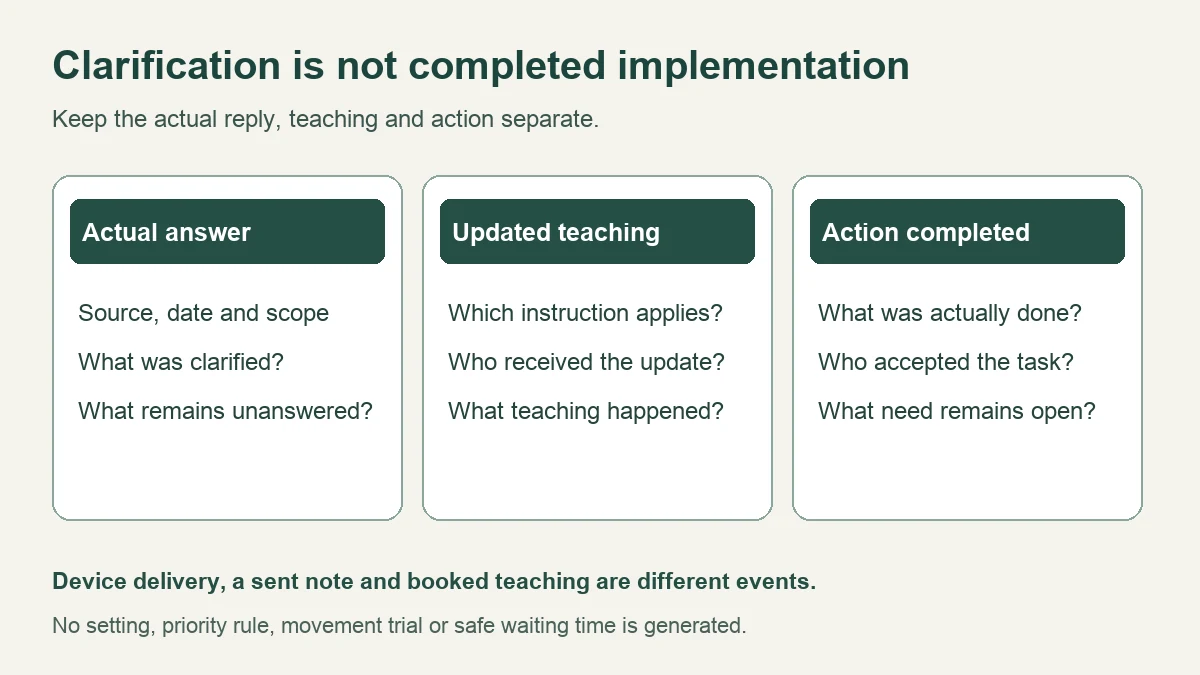
Write the actual answer, source, date and activity/device scope. Ask what remains in effect, what was explicitly changed and whether written clarification can be provided. A response about one item may leave another open. Silence is not permission, a clinical answer or a safe waiting plan.
Confirm education and communication of the update
Record whether device-specific teaching was needed and actually received, who participated with consent and which relevant service or helper received the clarification. An updated note, teaching appointment and completed teaching are different events. The worksheet does not test competence or request practice.
Check implementation and preserve the remaining gap
Describe agreed action and what really occurred: device service, advice communication, teaching or a permitted change actually implemented. Keep patient observations separate from clinical explanations. Do not infer improved safety or recovery from a completed action. Retain unresolved needs and the real next owner if accepted.
Keep device settings, taught handling and mobility advice distinct
Hinged knee brace advice can contain several different instructions. A person may have received education on applying straps but no answer about changing a prescribed hinge range. Conversely, a blanket rule against all contact with a strap could contradict handling the actual team has taught and permitted. The useful question is what this person was actually instructed and trained to do with this device.
UCLH’s patient leaflet separates a dial set by the team from its application instructions. Kingston and Richmond’s leaflet also addresses a prescribed range-of-movement brace and care concerns. These are hospital patient instructions for the circumstances described, not universal protocols. Their handling details, settings, skin-check frequency or wearing times should not be copied into an individual plan from this page.
If the ambiguity concerns skin care or fit, explain the actual concern and education already received. Do not add padding, tighten straps, remove the device outside actual instructions or keep walking to see whether symptoms persist from this article. New symptoms need their own appropriate contact route; they are not merely evidence in a disagreement over wording.
Mobility advice is separate. A clarified device instruction does not automatically establish weight-bearing permission, a walking aid, a stair sequence or availability of necessary assistance. If the real question is the staircase and its support conditions, use the individual stair-plan comparison guide. This page records whether that separate question was actually answered.
An alternative arrangement also needs an actual plan. A same-floor proposal, different aid or nearby helper is not automatically appropriate or available. Explain essential needs and missing support to the relevant team and retain the actual advice and arrangement. No substitute transfer, carrying method or equipment purchase is generated here.
Who can clarify the instruction and who implements it?
| Actual role | Question to bring | What is not established by the role alone |
|---|---|---|
| Relevant prescribing / surgical / fracture team | Which instruction applies to this device and situation, and what was changed? | That a message received is a completed assessment or that this article can assign a new restriction. |
| Orthotist / fitter / device service | Does the actual device match the instructions and what service or teaching is needed? | That replacement delivery resolves the prescription, mobility or urgent symptom question. |
| Relevant physiotherapist / mobility team | What education and assistance fit the clarified individual instructions? | A universal step sequence, a home test or automatic stair clearance. |
| Patient and consenting helper | What was heard, received, taught and actually done? What remains unclear? | Authority to choose settings, judge capacity or replace a professional explanation. |
| Agreed implementation owner | Which action was accepted and actually completed? | That a booked visit or promised action has already happened. |
Responsibilities depend on the real service. Ask the recipient what they can answer and who can address the remaining part. Keep relevant information private and share with appropriate agreement. A worksheet does not give a relative access to records or authority to make treatment decisions.
The NHS moving-and-handling guide supports appropriate training and assessment when helping someone move. It is general caregiver background, not condition- or procedure-specific knee-brace guidance or a source for settings. Its UK social-care arrangements do not establish U.S. service availability or funding.
Confirm the actual answer, teaching and changed implementation
| Event | Record only what actually happened | What may remain unresolved |
|---|---|---|
| Clarification received | Real professional answer with source and scope. | Other device, activity or mobility questions not addressed. |
| Instruction clarified / replaced | What the responsible team explicitly said now applies. | Unconfirmed wording, an old copy still in use or a recipient not informed. |
| Education received | Actual device-specific explanation or teaching delivered. | Appointment only booked, helper absent or remaining teaching question. |
| Action completed | Actual device service, communication or permitted change implemented. | A promise, delivery without teaching or support still unavailable. |
| Follow-through | Existing observations, remaining need and accepted next owner. | No assumed benefit, fit verification, safe staircase or completed care outcome. |
Use a short closed-loop question: “This was the previous instruction, this is the new explanation, and this is our actual device and situation. Which current instruction applies, what teaching is needed, who receives the clarified update, and who will carry out the agreed action?” Preserve the reply as received rather than translating it into a rule for other readers.
If clarification is incomplete or conflicts with another source, record the remaining question and seek appropriate clarification. Do not label an instruction obsolete solely because it is older. Record any real individual interim advice exactly as received; if none was supplied, leave it unconfirmed. The form cannot invent a safe temporary treatment or decide how long to wait.
Two fictional hinged knee brace instruction examples
These are invented writing examples, not actual patients, prescriptions, professional advice or successful outcomes. Neither supplies an angle, wearing time, weight-bearing limit, method or safe waiting interval. They demonstrate how to keep the question open without changing the device or provoking symptoms.
Example A: written and later verbal instructions appear different
| Record | Fictional entry |
|---|---|
| Existing / new source | A discharge instruction and later verbal explanation appear different; exact wording is not supplied here. |
| Scope question | Whether both refer to the same device, activity and care stage is unknown. |
| Contact / actual answer | A question is drafted; sending, receipt and clinical clarification are not claimed. |
| Update / education | No instruction is confirmed as replaced and no new teaching is recorded. |
| Implementation / remaining issue | No device change or benefit claimed. Clarification and an actual individual plan remain needed. |
A note could say: “The written and verbal explanations seem different. We do not know whether they cover the same situation. Please clarify the current instruction for this actual brace and activity, what teaching is needed, and what individual plan applies while this is unresolved.” The example does not tell the reader to choose either version or simply keep using a possibly unsuitable plan.
Example B: a replacement brace arrives without confirmed updated teaching
| Record | Fictional entry |
|---|---|
| Device / earlier education | The supplied device was replaced. Earlier instructions referred to the previous item. |
| Unanswered point | Whether those instructions apply to the replacement is not established. |
| Actual reply | A device service acknowledged the question. Individual clinical clarification is not recorded. |
| Education / implementation | Delivery occurred; new fitting, instruction update, teaching and changed use are not claimed completed. |
| Next owner / gap | Relevant clinical and device roles need to clarify the unresolved scope and required education. No waiting interval supplied. |
A note could say: “The replacement arrived, but we have not confirmed whether the old instructions and teaching apply. Please identify which instructions cover this device, who will provide any needed education and what has actually been completed.” This keeps delivery separate from an implemented individual plan.
Private hinged knee brace clarification and implementation record
Download the offline tool before entering actual health or care details. Use fictional entries on this webpage because surrounding advertisements and analytics may be present. The tool itself makes no network requests, uses no browser storage and does not automatically save. The offline export contains no external assets or automatic network requests.
Begin with one mismatch. Blank fields create optional questions; they do not calculate risk or choose instructions. Omit names, addresses, private contacts, identifiers, label photographs and full records. Share relevant information through an agreed private channel. Paper with these headings is an alternative, and needed care never depends on completing the form.
Hinged knee brace instruction clarification record
Begin with one mismatch. Any field can remain blank; optional questions do not decide which instruction applies.
Download the offline tool before entering actual health or care details. Use fictional entries here; surrounding ads and analytics may be present.
Offline copy. No ads, analytics, external assets or automatic network requests.
The tool makes no network requests, uses no browser storage and does not save automatically. Refreshing may lose entries. Omit names, identifiers, private contacts and full reports. Needed care comes before this record.
Start with the fictional example or download a blank offline copy.
Paper alternative: device; existing instruction; new explanation; mismatch; contact; actual answer; clarified update; education; action completed; existing concern; unresolved need and owner.
My brace instruction, actual answer and implementation record
Unverified personal record for discussion. Entries verify no diagnosis, advice, completed change or treatment outcome.
Guide: living.kioptrix.com/hinged-knee-brace-for-stairs-2/
Build the record, then copy, download text or print/save PDF. Editing hides the old result until rebuilt. The example buttons replace entries and label the output fictional. Offline copies include current entries, so keep them private. Closing or refreshing may lose unsaved notes. The tool sends nothing, books no appointment and verifies no prescription or training outcome.
Common questions about conflicting hinged knee brace instructions
Does the latest instruction automatically win?
No priority rule is supplied. Ask whether the new explanation actually applies to this device, activity and care stage and whether an earlier instruction was explicitly replaced.
Should I choose the most restrictive version?
This page cannot choose an interim prescription. Explain the exact mismatch and current needs to the responsible team and retain real individual advice rather than inventing it.
Does replacement delivery complete the plan?
No. Device supply, fitting, actual instructions, education and implementation are separate facts to confirm.
Can I use a stair attempt to demonstrate the problem?
No test is needed for this record. Use existing information and describe the mismatch without repeating a difficult or unsafe task.
Does acknowledgement count as clarification?
Receipt alone does not establish a professional answer. Record the actual reply, scope and unresolved point.
Can a fully filled record verify correct use?
No. Full fields remain unverified. The tool provides neither a competence test nor medical clearance.
Sources, editorial corrections and limits
Editorial revision and source check: October 30, 2026. The former prescribed-support overview is rewritten around instruction mismatch and actual clarification. Repeated safety cards and the generic preparation link are replaced. No universal lead-leg sequence, hinge setting, trial period, priority rule or same-floor substitute plan is provided. The existing URL and original publication date are retained.
- UCLH: Hinge knee brace advice for patients — device-specific education and selected warning signs; not a universal wearing, handling or settings protocol.
- Kingston and Richmond: Hinged knee brace — range-of-movement brace instructions and care concerns; not permission to copy another patient’s plan.
- NHS: Moving, lifting and handling someone else — general caregiver training and assessment, not knee-brace or stair instructions.
- MedlinePlus: Recognizing medical emergencies — general immediate-help examples, not a complete triage assessment.
The seven checks, tables and record are editorial communication aids, not validated prescription-reconciliation or safety instruments. No independent clinical reviewer, verified fitting, patient outcome or service test is claimed. The representative image is an AI-generated fictional consultation, not a real patient, setting recommendation or treatment demonstration. The diagrams distinguish information, replies and completed actions. Qualified clinical review and independent reader usability research remain opportunities to strengthen this guide.