

Telehealth vs in-person orthopedics starts with your visit purpose and the service actually available. Ask what can be assessed, which existing records the clinician can access, what may remain uncertain and how further assessment would be arranged. A video visit followed by a clinically indicated office examination can be an appropriate care pathway; needing another visit does not establish that the first was wasted.
Use the six essential checks, compare actual services and limits, read two fictional examples, or build a visit and handoff record. The worksheet organizes real answers. It does not choose a format, diagnose symptoms or predict a second visit or savings.
Emergency needs come before appointment-format comparisons. With back pain, new difficulty urinating or bladder/bowel control changes, numbness around the genitals or anus, symptoms such as weakness or numbness in both legs, chest pain or pain after a serious accident need emergency assessment. Use appropriate local emergency services, including 911 for U.S. emergencies; do not wait for a video or routine office appointment. NHS back-pain warning guidance.
A suddenly very painful, swollen or hot joint needs urgent assessment even without fever. These are selected examples, not a complete triage list. New or worsening concerns require appropriate clinical assessment rather than self-classification as suitable for video. NHS joint-infection guidance. A booking, familiar diagnosis or previous scan is not reassurance about a new concern.
This is U.S.-focused education from a family-caregiver-run site. The operator is not a medical professional. The relevant clinical service assesses suitability and care needs; the office and plan explain their own arrangements. No individual medical, insurance or financial advice is supplied. You can ask for help with an incomplete note.
Table of Contents
Telehealth vs in-person orthopedics: six essential checks
| Check | What to confirm with the relevant service | Keep separate |
|---|---|---|
| 1. Purpose | What question is this particular appointment intended to address? | Your concern and the service actually offered. |
| 2. Assessment and limits | What may be assessed in this format, and how are unresolved needs handled? | A general visit description and an individual clinical judgment. |
| 3. Existing material | Can the clinician access the relevant report and images? | Sent, received and actually available to review. |
| 4. Participation support | Location eligibility, technology, communication support and connection backup. | Support requested and support actually arranged. |
| 5. Real answer | What was explained, what remains uncertain and which instructions were given? | Administrative information and clinical advice. |
| 6. Conversion and handoff | Who arranges additional assessment, passes material and confirms receipt? | A recommendation, booking and completed clinical handoff. |
These are preparation categories, not a validated suitability checklist or a clinical sequence. A known diagnosis, clear symptom description or available imaging does not by itself establish that remote care is appropriate. The clinical question can change during an encounter. Describe existing concerns to the service rather than deciding what examination you need on your own.
Actual services and limits: compare the appointment offered
| Visit task | What to ask about remote care | What to ask about office care / remaining limit |
|---|---|---|
| History, questions and plan explanation | Can this service address the stated purpose and review the existing plan? | Which additional assessment, if any, is needed for this purpose? Neither format guarantees resolution. |
| Observation and examination | Which clinician-guided observations or examination elements are possible, and which are limited? | Which direct examination is actually available? Do not assume every facility provides every test. |
| Existing imaging or reports | Can the actual material be opened and explained, not merely uploaded? | Is access to outside images arranged? A report and the image files are different items. |
| Tests, fitting or procedures | Can the visit discuss or coordinate a later service, if indicated? | Is the service performed there, separately booked or referred elsewhere? A discussion is not a completed procedure. |
| Communication and participation | Are interpretation, captions, accessible technology or an authorized helper available as needed? | What equivalent support and physical access arrangements are available? |
| Further assessment | How will the clinician explain an unresolved need and the appropriate next step? | Who accepts the handoff, schedules the indicated visit and explains the actual plan? |
Remote care is not simply conversation without examination. HHS includes resources for virtual physical examination as well as preparation and emergency planning. Some findings or services require direct assessment, and a remote encounter may reveal that limitation. An office label also does not promise same-day imaging, fitting, injection or a definitive diagnosis. HHS preparation and virtual-examination resources.
Do not perform self-tests, resistance tests, painful movements or unsupported standing to decide whether video will work. If a clinician asks you to move during a real encounter, explain existing restrictions, pain, balance concerns or inability to perform it. Ask for clarification rather than copying a demonstration from this page. The worksheet supplies no examination routine or activity clearance.
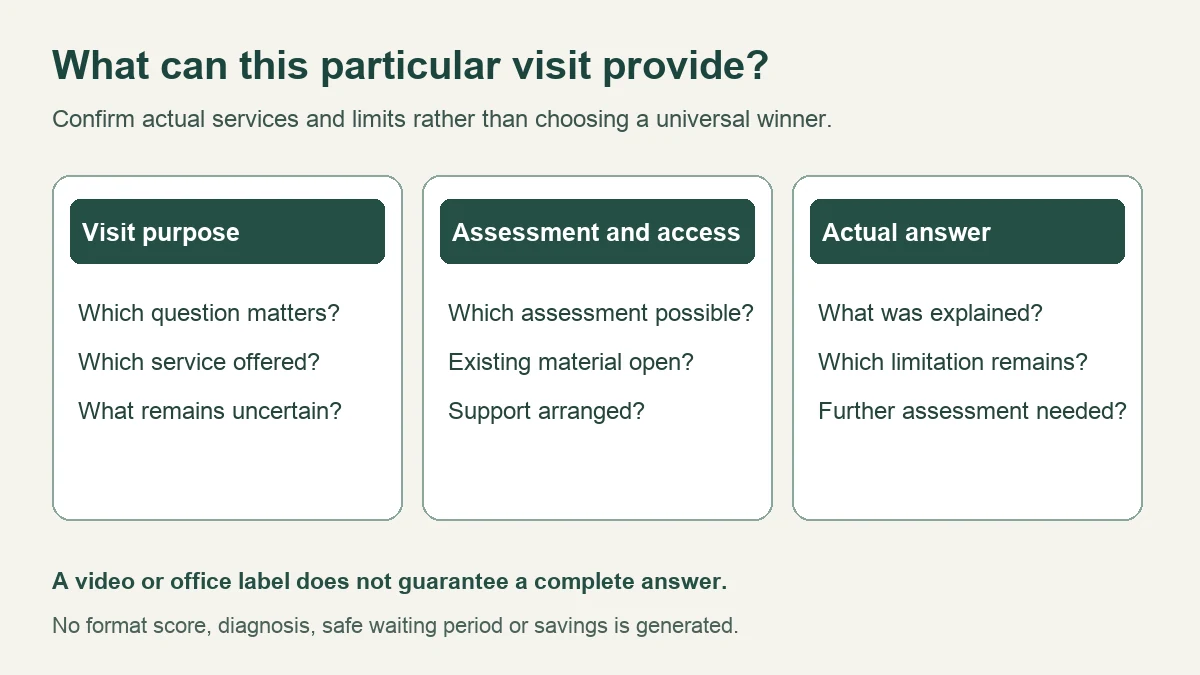
Prepare existing records and participation support
Before a non-emergency appointment, explain the purpose and any practical barrier to the service. Ask about the actual connection method and technical support. Tell the service if hearing, vision, language, dexterity or another communication need makes its usual setup difficult. Record what was requested and what was actually arranged; do not assume that video access alone makes participation effective. HHS technology-preparation guidance.
Ask what happens if the connection fails, which callback route is used and whether an alternative encounter needs separate arrangements. Audio-only care is not automatically equivalent to the planned video visit, covered or appropriate for the clinical purpose. Obtain the service’s actual answer. A connection failure is not a clinical conclusion, and the worksheet does not cancel or change an appointment.
HHS explains that cross-state practice depends on applicable rules and that providers should verify patient location and obtain consent. Confirm that the clinician can provide the planned service where you will physically be during the appointment. Give real location and callback details directly through the clinic’s approved route; omit precise locations and identifiers from the public worksheet. HHS licensing across state lines.
Use the clinic’s approved route for existing reports, image access and relevant notes. Record delivery separately from confirmed availability to the clinician. Do not obtain extra imaging or invent treatment failure to make a consultation seem more suitable. A helper’s involvement and record sharing need appropriate permission; do not assume that being a relative authorizes disclosure or speaking for the patient.
Our parent-companion guide focuses on the parent’s agenda, consent and accepted support. This page focuses on what the chosen encounter actually provided and how unresolved needs move to another service.
Record the actual assessment, clinical answer and limits
Retain the question actually asked, assessment actually received, limitation explained and answer really given. A portal notice, booking confirmation or uploaded report is not an explanation of its clinical meaning. Keep an administrative answer about access separate from advice given by a clinician. If a point was not addressed, mark it unanswered instead of guessing the conclusion.
Record pain, sleep, daily function and burden already experienced without ranking one as inherently more truthful. Do not provoke symptoms to create evidence for a format change. A familiar condition does not explain every new symptom; the record cannot decide that a concern is routine or safe to monitor. Appropriate assessment must not wait for a complete history or a routine reply.
Preserve actual instructions and their source. If advice conflicts with an existing restriction or is unclear, ask the relevant clinical team to clarify it. The tool does not choose which instruction to follow, stop a medicine, prescribe exercise or extend a treatment trial. A statement that further assessment is needed should retain its actual scope rather than being converted into a diagnosis or urgency score.
When further assessment is needed: conversion and clinical handoff
| Fact | What to retain | What is still unconfirmed |
|---|---|---|
| Recommendation | What additional assessment was actually recommended and by whom. | That an appointment exists or the destination accepted the request. |
| Arrangement | Actual booking details and any change to the existing appointment. | That an order or material was received and clinically reviewed. |
| Material transfer | What was sent, to which role and which receipt was acknowledged. | That the next clinician has explained the findings or assumed care. |
| Clinical contact | Actual current contact and advice about the unresolved concern. | That silence or a scheduled date makes waiting safe. |
| Next owner | Action actually agreed, responsible role and remaining question. | Completion of an unresolved task. |
Ask how an indicated office examination or another service will be arranged, who receives the material and who addresses clinical concerns in the meantime. Keep proposed, booked, received and reviewed distinct. The next service may have its own intake requirements. Do not cancel an existing appointment or change treatment on the basis of this record.
A further examination can add information that the earlier encounter could not obtain. That does not automatically make the first encounter duplicative, and it does not prove either format is superior. Record the real limitation and onward plan. There is no guaranteed one-visit answer, conversion deadline or safe waiting interval here.
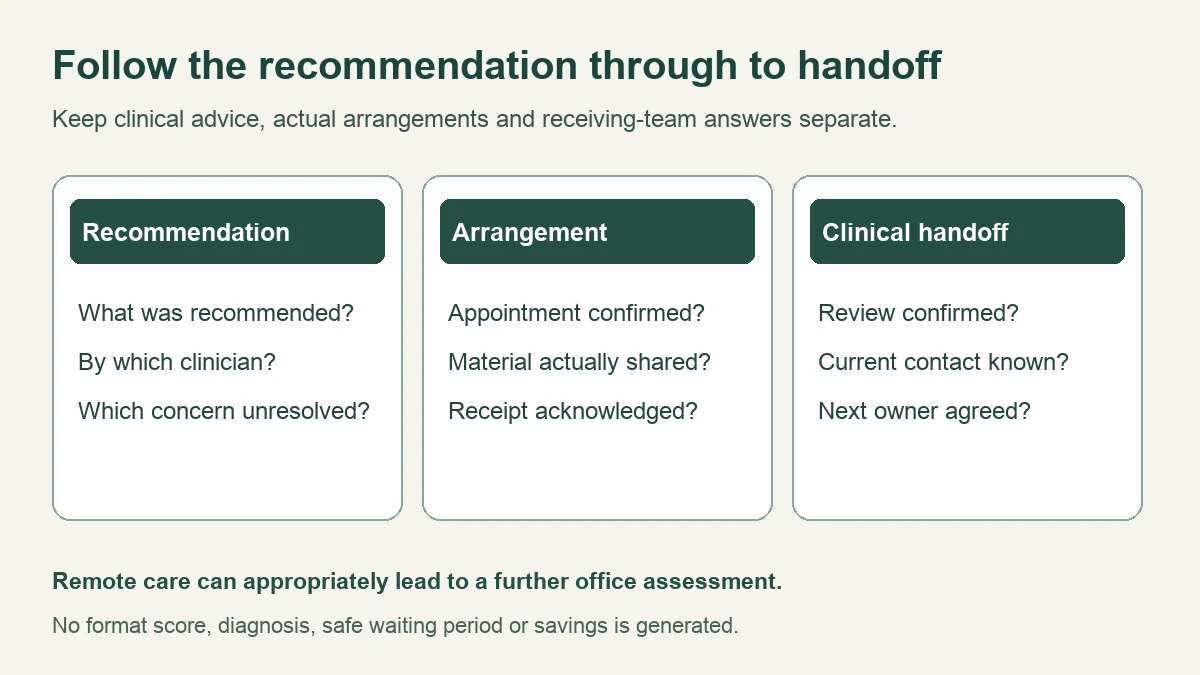
Unlike our referral-status guide, which tracks access before specialist input, this page connects an encounter’s actual assessment and limitations to a real next-step handoff. The service-comparison guide concerns what different services offer; neither article chooses a format for an individual.
Compare actual cost conditions without predicting waste
Ask the clinic and plan about the actual clinician, site, service, network and member-cost conditions. Check whether tests, procedures or a later encounter would be billed separately and what remains only an estimate. A video charge or office charge is not necessarily lower. The tool provides no price ranges, future-visit probability, expected savings or cost-per-diagnosis calculation.
- Current encounter: actual quoted amount, source and assumptions, if supplied.
- Further assessment: separately confirmed conditions; an estimate does not prove it will be needed.
- Access burden: travel, time away from work, assistance, technology and communication support relevant to you.
- Unanswered condition: which office or plan role can clarify it and what they actually said.
Do not add hypothetical follow-up fees as if they are known costs. Equally, do not assume a later encounter is included or free. An estimate does not determine medical need. If cost or access blocks recommended care, tell the relevant clinical/support team; needed urgent assessment must not wait for insurance answers or comparison shopping. Our care-access guide organizes support inquiries.
Two fictional visit-format and handoff examples
These are invented documentation examples, not patient stories or clinical instructions. They establish no diagnosis, improvement, urgency, cost saving or preferred visit type. The example buttons replace entries and label generated output fictional. Unknown and pending remain visible.
Example A: planned report review, image access unconfirmed
| Area | Fictional entry |
|---|---|
| Purpose / format | Explanation of an existing imaging report; clinic confirms a video appointment for that stated purpose. |
| Material / support | Report delivery recorded; actual image access and communication support not confirmed. |
| Question / real answer | Question about what can be reviewed prepared, not yet asked. No encounter or clinical answer supplied. |
| Next point | Ask what may remain unresolved and how further assessment would be arranged; no suitability clearance inferred. |
An available report and a booked video visit are preparation facts. They do not prove that the clinician can review every image, answer every question or avoid an office visit.
Example B: further examination recommended, handoff pending
| Area | Fictional entry |
|---|---|
| Actual encounter / limit | A video encounter occurred. The clinician explained that a required assessment could not be completed remotely; retain the precise real explanation. |
| Clinical reply | Additional in-person assessment recommended; the example supplies no diagnosis or urgency decision. |
| Conversion / transfer | No appointment confirmed. Message reportedly sent to the receiving service; receipt and clinical review unconfirmed. |
| Next owner / condition | Clinical contact and booking owner still need actual confirmation. Follow-up charge unknown; initial care is not labeled waste. |
A recommendation is not a completed handoff. Appropriate assessment must not wait for a routine response or a finished worksheet. Record the advice and next owner actually agreed, without inventing a deadline or assuming the receiving clinician has taken over.
Private visit format, real-answer, conversion and handoff tool
Download an offline copy before entering actual health or appointment information. Use fictional entries on this page because surrounding ads or analytics may be present. The tool makes no network requests, uses no browser storage and does not automatically save. Its downloaded copy has no external assets or automatic network requests. Keep completed copies private.
Use a short label for one encounter and its related onward question. Unknown, pending, not asked and not applicable according to a real answer are valid entries. Omit names, precise locations, contact numbers, insurance identifiers and full reports. Paper with the same headings is an alternative. Nothing is sent, booked or clinically verified.
Visit format, real answer, conversion and handoff record
Keep proposed services, actual assessment, clinical answers and onward arrangements separate. The tool does not choose a visit format or judge clinical suitability.
Download the offline tool before entering real health or appointment details. Use fictional entries here; the surrounding page may contain ads and analytics.
Offline copy. No ads, analytics, external assets or automatic network requests.
The tool makes no network requests, uses no browser storage and does not automatically save. Refreshing may lose entries. Omit names, identifiers and complete records; keep exports private. Needed assessment must not wait for this worksheet, a booking or an insurance answer.
Start with the fictional example or download a blank offline copy.
Paper alternative: purpose; format; support; existing material; actual assessment and limits; question; real answer; actual instructions; additional assessment; handoff receipt; next owner; unresolved condition.
My visit format, real-answer and handoff record
Unverified personal record for discussion. Entries verify no service suitability, clinical answer, appointment or completed handoff.
Guide: living.kioptrix.com/telehealth-vs-in-person-orthopedics/
Build again after editing, then copy, download text or print. Offline downloads include current entries; refresh or closing can lose unsaved work. Blank fields produce optional questions, not a score or clinical recommendation. An entry marked complete remains an unverified personal record.
Common telehealth and office-visit questions
Does a known diagnosis mean video is suitable?
No automatic conclusion follows. Describe the current question and changes to the service. Existing findings support a discussion but do not replace assessment of current needs.
Can an examination occur remotely?
Some clinician-guided observations and examination components can occur remotely; other findings require direct assessment. Ask about the actual service and limits. Do not self-test to choose a format.
Was my video visit wasted if an office examination was recommended?
Not automatically. An appropriate encounter may identify an unresolved need and arrange further evaluation. Keep the assessment, limitation, real recommendation and handoff distinct.
Does a booking or uploaded image mean care has been handed over?
No. Record actual access, receipt, review and clinical responsibility as explained. A notification is not a completed explanation of results.
What if the connection fails or I need support?
Use the service’s actual support and backup arrangements. Ask about suitable alternatives rather than assuming audio-only care or a new appointment has been arranged.
Which format costs less?
No universal answer is provided. Obtain actual office and plan conditions for the service, including separate follow-up or test billing where applicable. No probability or savings is generated.
Sources, corrections and limits of this guide
Sources checked: October 30, 2026. This revision removes the conversation-versus-examination rule, cost-fear framing, unsupported time-loss claims, speculative calculator and unverified reader story. The broken HHS preparation link is replaced. The earlier COVID-era Ortho-pinion essay is not presented as a formal AAOS format-selection guideline.
- HHS: preparing patients for telehealth — preparation, virtual examination and emergency-planning resources; not a personal suitability decision.
- HHS: telehealth technology setup — technology barriers and support; does not establish coverage or clinical appropriateness.
- HHS: licensing across state lines — location and applicable practice routes; actual service eligibility needs confirmation.
- Buvik and colleagues: randomized orthopaedic consultation trial (2016) — selected patients in a supported regional setting with trained nurses and imaging access. Its findings do not establish equivalence for every unassisted home video encounter, emergency, condition or health system.
- MedlinePlus: joint disorders — general condition and assessment information; not evidence for a universal visit-format hierarchy or savings.
- NHS back pain and NHS septic arthritis — selected warning-sign education. UK sources do not define U.S. service, coverage or referral rules.
This is document-based editorial education, not direct clinic testing or independent medical review. No clinic capability, price, booking policy or patient outcome has been verified by this guide. The worksheet has not been validated as a clinical decision instrument. Actual service arrangements and professional advice remain necessary; no ranking, timing or outcome guarantee is implied.