

Knee pain at a warehouse needs a task-specific conversation, not a self-diagnosis or a return-to-work score. Describe the actual low picking, kneeling, stairs, platforms, carrying or equipment demands. Then keep the change requested, the agreement, the assignment and the work actually performed as separate records.
This guide helps workers prepare a clinical or workplace discussion and check whether an agreed change was implemented. It includes six essential checks, task-and-change comparison tables, two fictional writing examples and a free offline implementation record. Jump to the record tool or see the examples. It does not diagnose warehouse knee pain, set a lifting or standing limit, choose a brace or decide fitness for work.
Seek urgent medical advice for a very painful knee, inability to move it or bear weight, marked swelling or a changed shape, locking/giving way, or a hot/red knee with fever or feeling unwell. Do not finish a shift or complete this record before seeking needed help. NHS knee-pain guidance describes urgent warning signs; use the appropriate service where you live. A suddenly hot, swollen and painful joint also warrants prompt assessment even if you have not recorded a fever. This is not a complete symptom list or an online urgency test.
New one-sided calf or leg pain and swelling need urgent assessment for a possible clot. Chest pain or breathlessness with those symptoms can indicate an emergency: call your local emergency number and do not drive yourself. Do not assume leg swelling is ordinary workload irritation or wait for a routine equipment review. NHS DVT guidance explains the distinction between urgent clot assessment and emergency symptoms. Absence of these signs is not permission to continue a task.
Table of Contents
Six essential checks for warehouse knee pain discussions
| Check | Record what is actually known | Keep this distinction |
|---|---|---|
| 1. Actual task demands | Low picking, kneeling, repeated bending, stairs/platforms, carrying, route and pace; relevant equipment and footwear requirements. | Job title and “light duty” do not describe every demand. Use existing information, not a capacity test. |
| 2. Actual clinical instruction | Relevant instruction or restriction actually given, source/date and scope. | A symptom description, device purchase or worksheet is not an instruction or fitness decision. |
| 3. Change requested | Specific task affected, change proposed and request status. | A request is not agreement or proof that the alternative is available. |
| 4. Actual agreement | What was actually agreed, by whom, source/date, conditions and review arrangement. | An agreement does not prove that the change was implemented. |
| 5. Assignment and performance | Task actually assigned, resources available, work actually done and differences from the agreement. | Assignment is not proof of completion. Record if something was assigned but not performed. |
| 6. Observation, contact and reply | Existing changes, actual report/question, recipient role, date/status, real answer and remaining gap. | A message sent is not a reply or permission to repeat the task. |
These six checks are a discussion framework, not six requirements that make work safe. Leave unknown information unconfirmed. A full form verifies no fact, restriction or capacity. Do not perform a painful or unsafe task to obtain a number, finish a shift to make the record complete, or delay actual reporting or appropriate care.
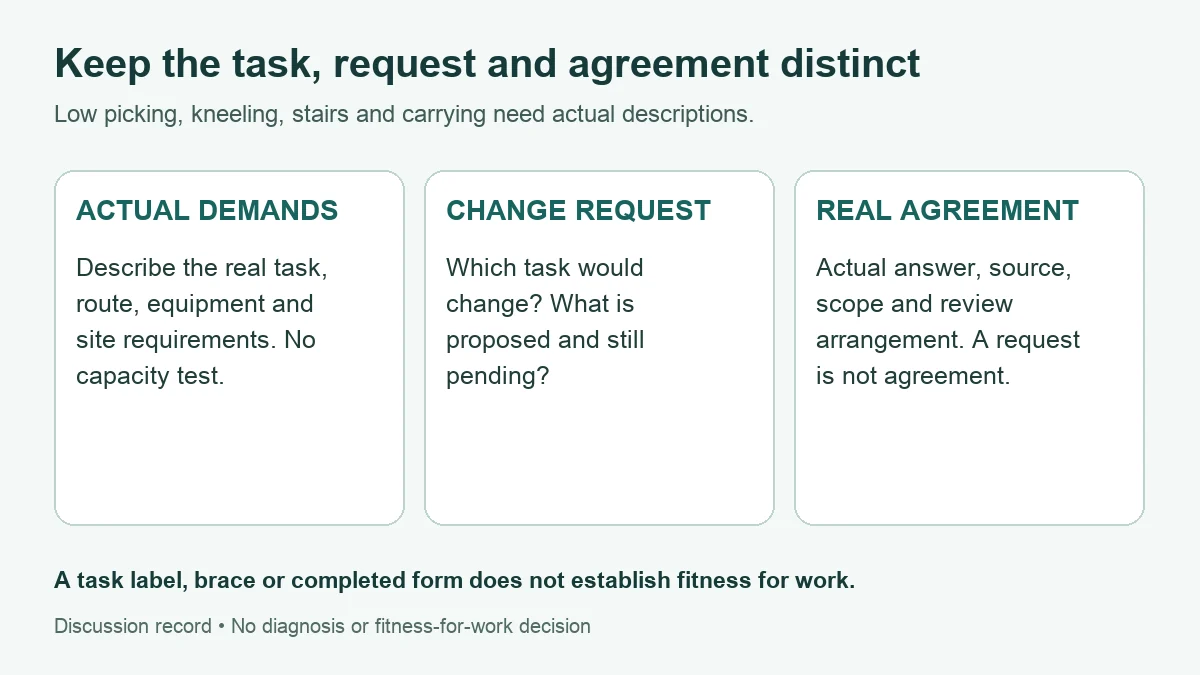
Knee pain sources: what they establish and what they do not
NHS knee-pain guidance describes multiple possible causes and advises against self-diagnosis. Location, timing or improvement away from work can be useful observations, but they do not separate “workload irritation” from a structural problem in an individual reader. This guide therefore provides no symptom-to-diagnosis table or rule that a quieter knee is ready for work.
OSHA’s warehousing guidance identifies lifting/lowering, bending, reaching, pushing/pulling, awkward postures, repetition and work pace among ergonomic concerns. It provides a more directly relevant workplace context than an aircrew leaflet. It does not determine the cause of your knee pain or prove that one shoe, brace, task rotation or break schedule will resolve it.
OSHA’s ergonomics controls guidance distinguishes changes to the workplace or task from administrative measures and personal protection. That supports discussing the actual job design rather than relying only on individual equipment. It does not authorize a worker to move stock, alter equipment, change traffic routes or select duties independently. Site-specific assessment, procedures and training still matter.
AAOS’s Knee Conditioning Program says the program should be performed under a doctor’s supervision and exercises should be discussed with a doctor or physical therapist. It is not a work-capacity test. This article prescribes no exercise set, squat test, progression schedule or return-to-duty stage.
The tables and record tool are editorial organizing aids, not a clinical, ergonomic or legal assessment. They cannot establish whether work caused a condition, whether a particular assignment is appropriate, or whether a compensation or accommodation rule applies. Record actual instructions and decisions instead of treating an official source link as approval of an individual plan.
Compare knee-related task demands with proposed changes
| Actual task or constraint | Existing information to describe | Change or assessment question |
|---|---|---|
| Low-level picking / repeated bending | Where items are actually accessed, reach and handling demands, repetition if already known, and equipment used. | Can the responsible team review stock access, task layout or handling equipment? What is proposed and what is actually agreed? |
| Kneeling / crouching | Which job step requires it, the actual surface and task conditions, and any instruction already supplied. | Can that step be changed or assessed? Do not substitute a different movement or kneeling aid as a self-prescribed solution. |
| Stairs, steps and platforms | Actual access route, carrying requirements, hand use and site procedures. | Does the proposed duty still require these tasks? What actual clinical and workplace guidance applies? |
| Carrying, pushing or pulling | Actual handling route, load information already known, equipment availability and assistance. | Would the proposed change alter another demand or hazard? No safe load or pushing limit is calculated. |
| Standing/walking route and pace | Actual surface, route, pace, obstacles and work organization. | What work-design review or change is being considered? No universal break or standing-time allowance is generated. |
| Safety footwear, equipment and controls | Actual site footwear/PPE requirements and any concern about fit, support or equipment operation. | Which responsible contact can review compatibility? A comfort product is not permission to bypass site requirements or operate machinery. |
Describe the job that actually exists. “Higher picking” might reduce one low access task but still involve carrying, steps, reach, pace or equipment demands. “No kneeling” may leave other duties unresolved. The label “lighter” is not enough; compare each relevant demand against the real instruction and agreement, without inventing a permitted load or repetition limit.
Record known task information accurately. If a load, repetition count or route detail is unknown, say so. Do not estimate a medical exposure score from hours on concrete, deep bends and the number of times pain exceeded an arbitrary threshold. If the relevant professional requests a particular measurement, record its source and method rather than replacing it with this article’s invented standard.
Footwear and supports deserve their own specific discussion. A sleeve, brace, insole or cushioning change can raise questions about clinical purpose, fit and workplace requirements. This guide recommends no device and promises no benefit. A product that feels supportive does not establish fitness for a task, and purchasing one does not remove the need to address an unresolved work-design or clinical issue.
Keep requested, agreed, assigned and performed work separate
| Record stage | Useful evidence or note | What it does not establish |
|---|---|---|
| Requested | Actual proposal, affected task, recipient role, date and pending status. | That it was accepted, available or clinically appropriate. |
| Agreed | Actual response, scope, conditions, responsible role and any agreed review. | That the station, equipment, help or assignment was changed. |
| Assigned / made available | Actual task assigned, equipment or help available and relevant date. | That the worker performed it, or that it matches the agreement. |
| Performed | What already happened, including work not performed, help used and deviations. | That a completed task or shift clears future duties or machinery. |
| Reported / answered | Actual report or question, recipient/date/status, reply received and unresolved issue. | That a message sent has been reviewed or that silence is approval. |
When an assignment differs from an agreement, preserve both records. State the specific mismatch rather than rewriting the agreement to fit what happened. For example, distinguish a request to change low picking, the actual response and the next assignment. Do not claim that a task was completed if it was only assigned. You do not need to perform an unsafe task to document a gap.
The relevant roles answer different questions. A treating clinician or occupational-health professional can address clinical matters within their scope. A supervisor or workplace contact can confirm an assignment or implementation arrangement. A safety/ergonomics contact may review workplace hazards. One person’s answer should not be presented as deciding every clinical, operational, reporting or legal question.
Use the workplace’s actual reporting and review channels. Record the responsible contact, actual reply and any follow-up agreed. This worksheet does not send a message, file an incident or claim, create an accommodation request, certify restrictions or decide an entitlement. If help or equipment was unavailable, record that actual barrier and the question raised; do not invent a fallback duty.
Record existing knee pain observations without a readiness score
Useful notes describe what was already noticed, when it began, where it was felt, which actual task was happening and how it affected that task. Include no change or improvement when that is what occurred. Keep the symptom description separate from a causal conclusion. A change during low picking does not by itself diagnose a meniscus, tendon or arthritis problem.
A rest-day improvement, less pain after medication or one completed shift does not establish readiness for a ladder, a loaded route or equipment operation. This guide uses no Tier 1–5 recovery map, pain cutoff or cumulative knee-demand score. If a clinician uses a symptom scale, record it as part of the actual plan; it does not automatically authorize work.
Record actual medicine questions without treating prescribed pain control as a failure or an attempt to hide the truth. Follow labels and the prescribed plan and ask the clinician or pharmacist about uncertainty. NHTSA’s medicine and driving guidance explains effects on judgment, coordination and reaction time and notes warnings about heavy machinery. Do not drive, operate a forklift or perform hazardous tasks while impaired; follow relevant warnings and actual workplace requirements. This article changes no dose or timing and supplies no self-test for clearance.
Avoid testing the knee, repeating a movement that caused difficulty, or waiting until a shift ends to gather a fuller timeline. Report a concerning change through the appropriate clinical service; emergency signs belong with emergency care. A clinical concern and an implementation problem may coexist, so do not wait for an equipment or supervisor reply when medical help is needed.
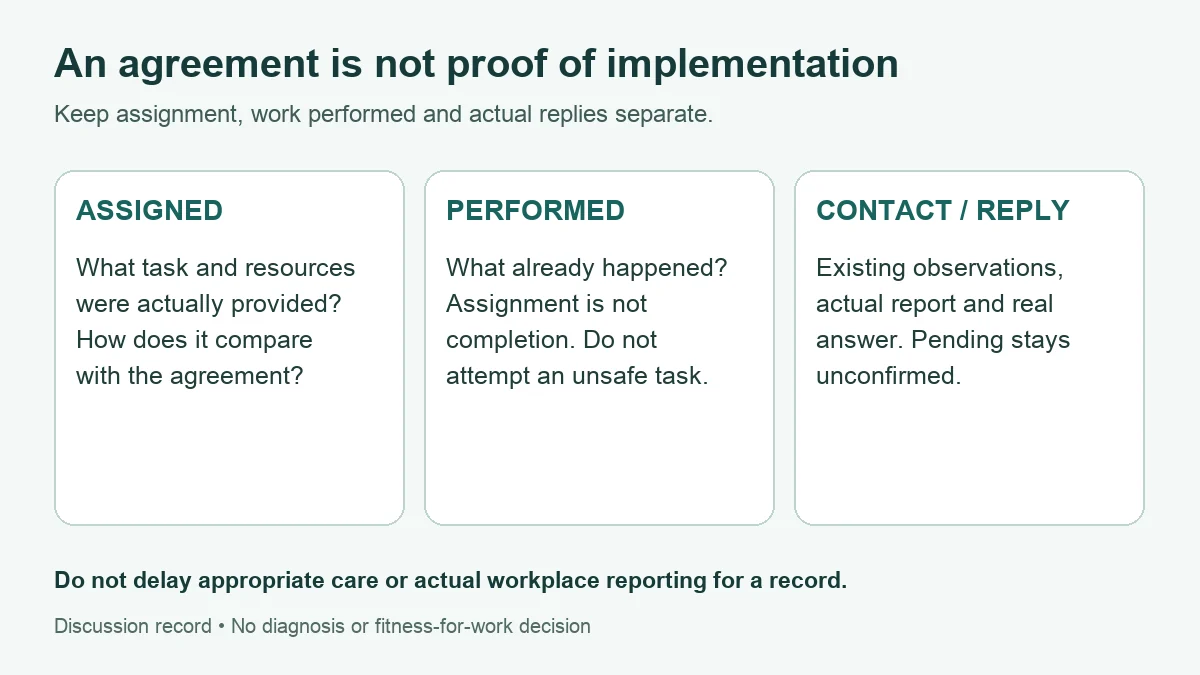
Two fictional warehouse knee pain record examples
These are invented writing examples, not real workers, clinical recommendations, employer commitments or evidence of improved outcomes. Neither supplies a diagnosis, safe workload or successful return to work. The tool’s example buttons replace existing entries.
Example A: low-picking change requested, duties unconfirmed
| Record | Fictional entry |
|---|---|
| Actual demand | Low-level picking is part of the reported assignment; other task details remain to be described from existing information. |
| Request | A change to the low-picking assignment was requested. |
| Actual agreement | Unconfirmed. No specific alternative duty or resource is established. |
| Clinical instruction | No individual clinical restriction or capacity is supplied by this example. |
| Question | Which actual duties and resources are being considered, who can confirm the response, and what remains to be reviewed? |
Writing sample: “I requested a change to the low-picking task. The actual alternative duties and response are not confirmed. Please clarify the task demands, resources, responsible contact and review arrangement being considered. I have kept the request separate from any agreement or clinical instruction.”
Example B: reported agreement differs from the assignment
| Record | Fictional entry |
|---|---|
| Agreement | A change to low picking was reportedly agreed; its real source, date and scope would be retained. |
| Assignment | The original low-picking assignment was reportedly assigned again. |
| Actual performance | No completion of that task is claimed by this example. Only actual events belong in the record. |
| Contact / reply | A question about the difference was sent through the relevant workplace contact. Reply pending; no answer or outcome invented. |
| Question | What was actually agreed, how does this assignment differ, and who can clarify implementation and any clinical issue? |
Writing sample: “This is the actual agreement I have recorded, and this is the assignment I received. The two appear different in this task. I have separated assignment from performance and have not attempted an unsafe task to demonstrate the gap. Who can clarify the implementation and any remaining clinical question?”
Free warehouse knee task-change and implementation record
The tool has 13 optional fields covering knee-related job demands, actual instructions, requested changes, agreements, assignments, work performed, existing observations and real replies. Blank items produce optional questions. Full fields remain unverified notes. It does not diagnose knee pain, calculate capacity, approve duty, select equipment or generate legal conclusions.
Try fictional examples here. Download the offline HTML copy before entering actual health or workplace notes. The live website may use site services. The downloaded tool contains no ads, analytics, external assets, automatic network requests or browser storage. No account or email is required. Entries are not automatically saved; completed exports contain your entries and should remain private.
Use non-identifying summaries and private references instead of names, employer details, confidential job information, claim identifiers or full medical records. Build the record, copy it, download text or print/save PDF through your browser. Editing hides the previous output until rebuilt. Nothing is sent or filed. If the tool does not load, use paper with the same headings without delaying care or actual workplace reporting.
Warehouse knee task-change and implementation record
Keep actual knee-related job demands, instructions, requested changes, agreements, assignments, work performed and real replies separate. No diagnosis, workload limit or fitness-for-work decision is generated.
For actual health or workplace notes, download the offline tool first. Try the fictional example here. The offline copy contains no site ads, analytics or external assets and needs no account.
Offline copy. This file contains no ads, analytics, external assets or automatic network requests.
The tool uses no network requests or browser storage. Unsaved changes can be lost on refresh or close. Exported files contain your entries; keep them private. Avoid names, employer details, confidential job records, claim identifiers and full medical records.
Start with the fictional example or download a blank offline copy.
If the tool does not load, use paper: job demands; actual instructions; proposal; agreement; assignment; work performed; observations; contact and real reply. Do not delay care for a worksheet.
My warehouse knee task-change and implementation record
Unverified personal record for discussion. These are unverified discussion notes, not medical advice, a work restriction, an incident report or permission to perform a task. Filled fields verify no instruction, agreement or reply.
Guide: living.kioptrix.com/warehouse-worker-knee-pain/
Common warehouse knee pain and work-change questions
Can this tell me whether I can work with knee pain?
No. It organizes actual demands, instructions, implementation and observations. It gives no fitness decision, safe workload or return-to-work permission.
Does improvement on days off show it is only overuse?
No. That is an observation to describe, not a diagnosis or proof that continuing a task is suitable. Different causes can have overlapping symptoms.
Should I count tasks until pain reaches a threshold?
This guide does not ask for a symptom or endurance test. Record existing information and any measurements actually requested by the relevant professional. No pain score approves a task.
What if the requested change has no answer yet?
Mark it pending. Do not write the proposed duty as an agreement or assume it is available. Record the actual contact and unanswered question.
What if an agreed change was not implemented?
Keep the agreement and actual assignment separate and describe the specific difference through the relevant process. Do not perform an unsafe task to create evidence.
Can a brace or softer shoe replace a work review?
A product does not establish clinical suitability, compatibility with site requirements or fitness for duty. Record the actual concern and ask the relevant clinical and workplace contacts.
Does the tool submit a report or claim?
No. It sends and files nothing. Use the actual reporting process and do not delay urgent care or reporting to complete a worksheet.
Sources, corrections and review limits
- NHS: Knee pain — symptoms, urgent-contact context and limits of self-diagnosis; not individual work clearance.
- NHS: DVT — urgent clot concerns and emergency symptoms; not a workplace symptom score.
- OSHA: Warehousing—Hazards and Solutions — warehouse-specific workplace hazards and controls; not a diagnosis or individual workload prescription.
- OSHA: Ergonomics—Solutions to Control Hazards — work-design/control framework; not permission to alter equipment or site procedures independently.
- AAOS: Knee Conditioning Program — supervised exercise context; not a self-directed work-capacity test.
- NHTSA: Prescription/OTC medicines and driving — impairment and machinery-warning context; no medication change or personal clearance is generated here.
Editorial correction and source check: October 29, 2026. Removed symptom-to-cause selection, the five-tier readiness map, the arbitrary 5/10 workload count, unsupported cause/effect generalizations and unrelated billing links. Replaced the aircrew-specific workplace citation with warehouse/control sources. Replaced the hypothetical success story with two incomplete-record examples. Removed duplicate imagery and the embedded video. The original URL is retained.
The hero is AI-generated fictional editorial artwork. The diagrams organize a discussion, not a movement technique, workplace inspection or fitness decision. No independent clinical, occupational-health, ergonomics or legal review, real-worker usability study or improved outcome is claimed. Functional tool checks do not establish those results. Our background and editorial approach. Keep actual clinical and workplace decisions with their real sources.