

After shoulder surgery, a recliner is not automatically better than a bed. Some people find a reclining chair or a supported bed more comfortable, but the useful question is whether the actual setup fits your procedure-specific instructions and the help you need. Comfort alone does not establish safe positioning or transfers.
This guide helps patients and caregivers prepare a shoulder surgery sleep plan: actual position and sling instructions, furniture concerns, help for each night-time segment, what already happened, and the answer actually received. It includes six checks, a bed-versus-recliner comparison table, two fictional writing examples and a free offline record. Jump to the record tool or see the examples. No furniture winner, transfer technique or safety score is generated.
Get emergency help for sudden chest pain or severe/sudden breathlessness. A newly cold, pale or blue hand, loss of movement or severe rapidly escalating symptoms need immediate assessment; use emergency services for severe or rapidly developing symptoms. Do not drive yourself in an emergency, wait for a routine portal reply or try a different sleeping position first. MedlinePlus shoulder aftercare identifies circulation, sensation and other symptoms needing contact; South Tees nerve-block discharge advice specifically directs severe breathlessness after a block near the neck/collarbone/chest to emergency care.
Contact the surgical service promptly for uncontrolled pain despite the prescribed plan, fever, wound redness or drainage, persistent bleeding, new or concerning swelling or changes in hand sensation. Follow your discharge contact instructions, and use urgent care when needed if the team cannot be reached. A nerve block can temporarily affect sensation and movement: record the actual block instructions and expected course supplied to you. Do not assume a new or worsening change is just the block or a pillow problem. MedlinePlus and South Tees provide relevant aftercare context. This is not an exhaustive symptom list or an online urgency assessment.
Table of Contents
Six essential checks for a shoulder surgery sleep plan
| Check | Actual information to keep | Question if unclear |
|---|---|---|
| 1. Procedure and instructions | Procedure actually performed, position guidance, instruction source and date. | Which instructions apply to this operation and current stage? “Arthroscopy” alone does not describe the repair. |
| 2. Sling and arm use | Actual night-time sling, support, arm-use/loading and review instructions. | What has the team actually told me to do? Preserve conflicting instructions for clarification. |
| 3. Furniture and controls | Actual bed or recliner, access and control concerns, existing professional advice. | Can the prescribed plan be accommodated, and is assessment or teaching needed? No product or angle is selected here. |
| 4. Teaching and help | Method actually taught and help actually agreed for entry, settling, rising, bathroom and return. | Who is available for each segment, and how will they be contacted? |
| 5. Actual use and change | What already happened, help received, differences from the plan and existing observations. | What needs reporting? Do not repeat a difficult movement to produce data. |
| 6. Contact and actual answer | Question sent, recipient role, date/status, answer received and remaining gap. | Has an answer actually been received, and what arrangement is still unconfirmed? |
These are organizing checks, not conditions that approve a setup. A filled field is not verified evidence. You can ask for help with an incomplete record, and you do not need to perform a trial in both pieces of furniture first. Keep the original instruction and any later clarification with their real sources and dates.
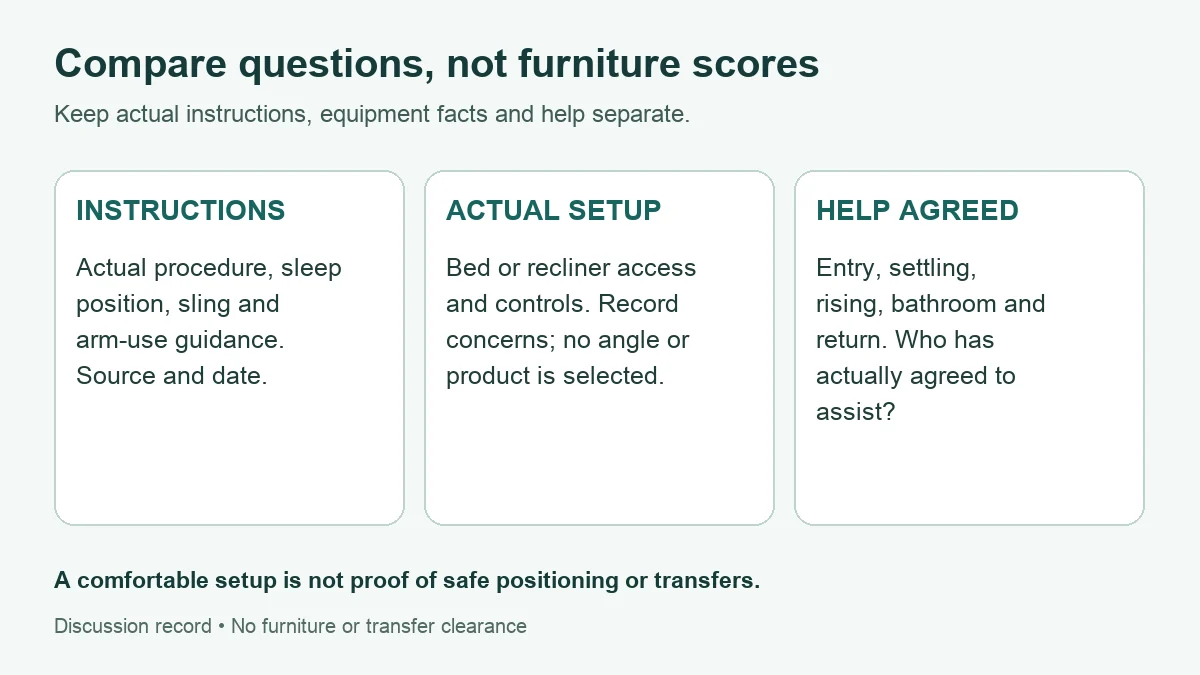
Shoulder surgery evidence: comfort is not proof of safety
AAOS: Shoulder Arthroscopy says some patients are more comfortable in a reclining chair or propped up in bed during the first days. It also explains that rehabilitation depends on the procedures required. That supports discussing both options; it does not prove that recliners prevent falls, protect repairs better or speed healing compared with beds.
AAOS: Outpatient Total Joint Replacement also mentions arranging a recliner or wedge for comfort after shoulder replacement. This is a replacement-surgery context, not a universal timeline for every shoulder operation. Neither AAOS page establishes a five-night selection test, a best recline angle or a furniture safety score.
Kingston and Richmond NHS guidance addresses daily activities after total shoulder replacement. It discusses sleep support, prescribed sling use and how arm-loading restrictions affect bed mobility. It notes that occupational therapy assessment may be needed for positioning and transfers. Its instructions should not be copied into a different patient’s protocol or used to promise that equipment is available.
MedlinePlus: Using your shoulder after surgery covers postoperative shoulder care, sleep support and activity restrictions while emphasizing the surgeon’s instructions. It is a reminder resource, not an assessment of your furniture. Do not import its example exercises, sling handling or support details into your plan without the relevant team’s instructions.
The comparison table and record tool below are editorial preparation aids. They are not a clinical pathway tested in patients. A manufacturer can explain a chair’s controls without deciding whether it is appropriate for your operation. A relative can confirm availability without being trained to provide the required assistance. Keep these different answers separate.
Compare the actual bed and recliner after shoulder surgery
| Issue to clarify | Actual bed: record or ask | Actual recliner: record or ask |
|---|---|---|
| Prescribed sleep position and arm support | Can the position and support actually advised be maintained? What remains unclear? | Can the specific chair accommodate the actual instructions? Comfort is not confirmation. |
| Sling and arm-use instructions | What was actually taught for using this setup under the prescribed restrictions? | Can controls or adjustments be managed under those instructions, or is help needed? |
| Getting in, settling and getting up | What transfer teaching and assistance apply to this bed and the person’s mobility? | What teaching and help apply to this chair’s actual height, depth and mechanism? |
| Night-time bathroom and return | Which route and assistance arrangements are actually confirmed? | Is help available for getting up, managing the chair if needed and returning? |
| Control or equipment concern | Record actual adjustment difficulty, device instructions and the relevant question. | Record whether operation requires a difficult reach or arm use, and who can clarify or assist. |
| Existing observations | What has already been noticed during actual permitted use? No test night is required. | What has already been noticed? Do not repeat a difficult transfer to compare the options. |
| Unresolved issue | Ask the responsible clinical/therapy contact about clinical gaps and the relevant provider about equipment facts. | A purchase, rental or helper offer is not clinical approval. Record the real answer. |
An adjustable bed is still a specific piece of furniture with particular controls and access needs. A recliner may have a manual lever, powered controls or a footrest requiring assistance. Those details belong in the conversation; the furniture category alone does not answer them. This guide recommends no chair model, wedge, pillow stack, accessory, bed height or recline setting.
If existing furniture does not appear to fit the instructions or assistance needs, describe the concrete barrier to the surgical, therapy or discharge team. Ask what assessment, teaching or practical arrangement is appropriate. Do not assume buying or renting something resolves the issue. Availability, cost and any service eligibility need their own actual confirmation.
Do not resolve uncertainty by choosing whichever surface feels better at rest. A person may be comfortable once settled yet need help to get up, reach controls or return from the bathroom. Conversely, difficulty with one task does not establish that the other piece of furniture is suitable. The useful result is a specific question and an actual plan, not a declared winner.
Plan night-time teaching and help after shoulder surgery
| Segment | What to clarify | What to record as confirmed |
|---|---|---|
| Getting into the setup | The individual method and level of assistance actually advised. | Who taught it, what assistance was specified and who has agreed to provide it. |
| Settling and adjustments | Actual position, support and sling instructions; who manages controls if needed. | Teaching received and the helper’s actual role. Do not invent a pillow barrier or adjustment method. |
| Getting up | Actual transfer instruction, assistance and concerns already noticed. | Real help available at the required time. A helper in the house is not necessarily available or trained. |
| Bathroom access and use | Relevant movement instructions and assistance for the route and tasks. | Actual arrangement and any gap. Equipment needs belong with the relevant assessment. |
| Return and resettling | Help for returning, entering and re-establishing the prescribed setup. | Which person/role has agreed to each part and how to contact them. |
| If the plan cannot be followed | The clinical or practical issue and relevant contact. | The actual answer or pending status. No routine message replaces emergency help. |
Before surgery, ask about appropriate preparation and any teaching or practice the team recommends. After shoulder surgery, use the instructions and assistance actually supplied rather than performing a new furniture trial because a blog suggests it. This article does not prescribe rolling, pushing with the other arm, lifting the legs, pulling on furniture or a caregiver lifting method.
Tell the relevant team if the other arm is painful or weak, mobility is limited, or help is unavailable. Do not assume the “good arm” can safely take over every task. A generic one-handed movement sequence does not account for balance, other conditions or the actual repair. Describe the barrier rather than compensating with an improvised technique.
Practical preparation can include identifying a contact method, discussing access concerns and asking where necessary items should be placed under the actual plan. A clear route and reachable phone are useful matters to discuss, but do not convert them into a declaration that independent night-time movement is safe. Confirm who will act if the arrangement changes.
Record actual use and changes without a furniture score
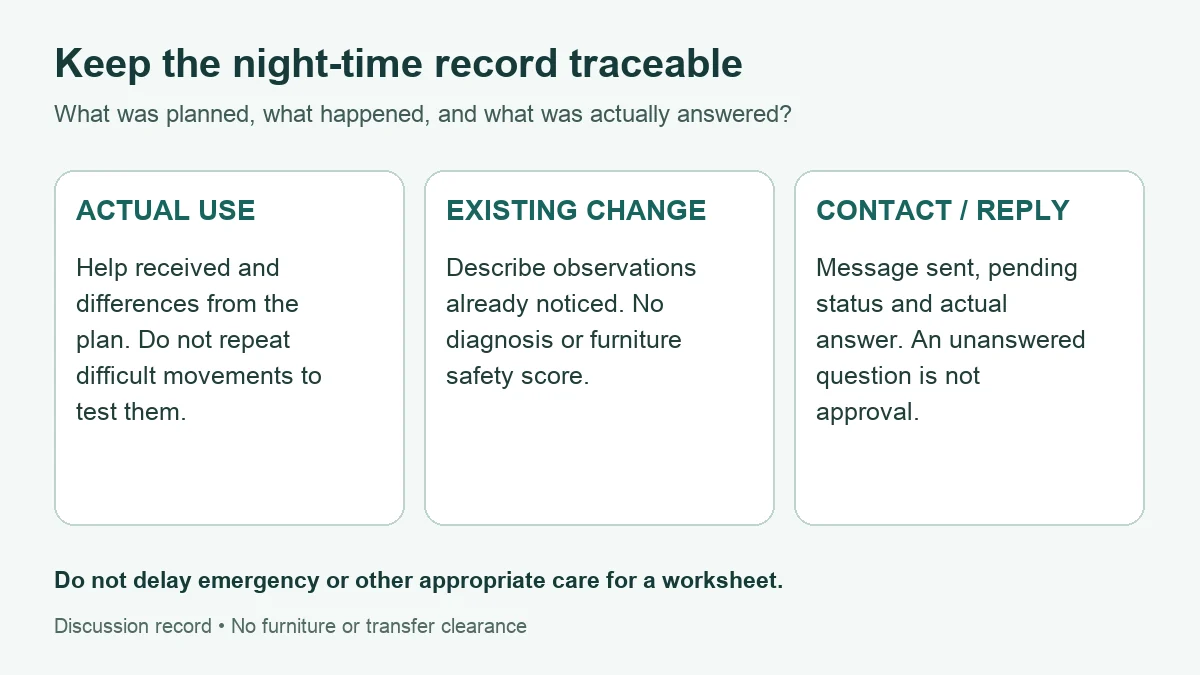
Keep the plan and the event separate. “A relative offered to help” is an arrangement under discussion. “The relative assisted with this task” is an actual event. “The clinical team advised this method” needs a real source. Recording each separately makes an unresolved gap easier to explain without making the history look more certain than it is.
Useful observations include a difficulty already noticed, its onset and location if relevant, what task was happening and the effect on that task. Include no change or benefit when that is what was actually observed. Do not sit longer, repeat a near-fall or switch furniture to create a comparison. A near-fall or inability to manage a task deserves attention rather than another trial.
A change after using a bed or chair does not identify its cause. Do not label it poor pillow geometry, normal swelling, nerve damage or a failed repair from timing alone. Likewise, better comfort does not prove healing or permission to alter restrictions. Tell the relevant team what happened and record the actual reply.
There is no combined comfort-and-safety score here. If your clinical team uses a symptom scale, record it as part of their actual plan; it is not a score that approves furniture or offsets a restriction. This guide supplies no required number of nights, transition date or “pass” threshold for returning to bed.
Keep medicine, cold-therapy and nerve-block questions with the real care instructions. Follow the prescribed plan and ask the responsible professional about uncertainty. South Tees nerve-block advice explains that temporary altered sensation needs protection and supplies contact instructions for concerns. Its specific timing is not a universal rule for every block. This tool generates no dose, timing change, cold-therapy schedule or permission to use equipment while sleeping.
Two fictional shoulder surgery sleep-record examples
These are invented writing examples, not testimonials, treatment instructions or evidence of better sleep. Neither supplies a real clinician’s answer, a safe transfer method or a successful recovery outcome. The example buttons in the tool replace any existing entries.
Example A: recliner available, control and night help unconfirmed
| Record | Fictional entry |
|---|---|
| Actual instructions | No individual procedure, position or sling instructions are supplied by this example. |
| Furniture concern | A household recliner is available. Control operation and help needed for getting up are unconfirmed. |
| Help plan | A relative offered evening help; assistance for rising, bathroom use and return overnight has not been confirmed. |
| Teaching / actual reply | No individual transfer teaching or clinical answer is supplied. |
| Question | Which actual instructions apply, and who can help with each task? No recliner recommendation is generated. |
Writing sample: “We have a recliner, but availability does not tell us whether it fits the actual instructions. The control and getting-up assistance are unclear, and evening help does not cover the whole night. Which teaching and arrangements do we need to discuss, and who can confirm each part?”
Example B: difficulty after bed use, answer pending
| Record | Fictional entry |
|---|---|
| Actual setup | An existing bed was used; the example prescribes no pillow arrangement or position. |
| Actual event | Difficulty was noticed when getting up. Actual assistance and differences from the plan would be recorded as they occurred. |
| Observation | Describe the existing difficulty and any change without repeating the movement or assigning a cause. |
| Contact / actual answer | A question was sent to the relevant treating-team contact. Reply pending; no answer or outcome is invented. |
| Question | What guidance and assistance apply to the reported difficulty? Urgent or emergency care must not wait for a routine reply. |
Writing sample: “This is what already happened when I got up, the help I actually received and how it differed from the plan. I have not repeated the movement to test it. My question is pending, so I have not treated it as permission to switch setups. What advice and assistance apply?” This wording does not instruct someone to wait if immediate help is needed.
Free shoulder surgery sleep, help and contact record
The tool organizes actual instructions, furniture concerns, teaching, help by night-time segment, actual use, changes, contact and real replies. Blank fields generate optional clarification questions. Full fields remain unverified notes. It selects no furniture, prescribes no movement and determines no safety or urgency. A complete form is not required before asking for assistance or care.
Try fictional examples here. Download the offline HTML copy before entering actual health or household notes. The live website may use site services. The downloaded tool contains no ads, analytics, external assets, automatic network requests or browser storage. It requires no account or email. Entries are not automatically saved; exports include your notes and should remain private.
Use non-identifying summaries and private references instead of names, addresses, appointment identifiers or full medical records. Build the record, copy it, download text, or print/save PDF through your browser. Editing hides the old output until rebuilt. Nothing is sent to the care team. If the tool does not load, use paper with the same headings without delaying appropriate help.
Shoulder surgery sleep, help and contact record
Keep actual sleep and sling instructions, help by night-time segment, actual use, existing changes, contact and real replies separate. No furniture recommendation or safety clearance is generated.
For actual health or household notes, download the offline tool first. Try the fictional example here. The offline copy contains no site ads, analytics or external assets and needs no account.
Offline copy. This file contains no ads, analytics, external assets or automatic network requests.
The tool uses no network requests or browser storage. Unsaved changes can be lost on refresh or close. Exported files contain your entries; keep them private. Avoid names, addresses, appointment identifiers and full medical records.
Start with the fictional example or download a blank offline copy.
If the tool does not load, use paper: actual instructions; furniture concerns; teaching and help; actual use; changes; contact and real answer. Do not delay care for a worksheet.
My shoulder surgery sleep, help and contact record
Unverified personal record for discussion. These are unverified discussion notes, not clinical advice, a transfer tutorial or permission to use a setup. Filled fields verify no instruction, arrangement or reply.
Guide: living.kioptrix.com/shoulder-surgery-recliner-vs-bed/
Common shoulder surgery bed-versus-recliner questions
Is a recliner safer than a bed after shoulder surgery?
The sources cited here describe comfort options, not a universal safety advantage. Suitability depends on the actual instructions, furniture, teaching and help. The tool supplies no safety clearance.
How long must I sleep in a recliner?
This guide supplies no required number of nights or transition date. Record your own team’s actual instructions and review advice. Another patient’s schedule does not establish yours.
Should I try both setups tonight?
This article does not instruct a postoperative trial. Record existing information and ask about teaching or assistance if the plan is unclear. Do not repeat difficult movements to fill the worksheet.
Can I remove the sling or change support if I am uncomfortable?
Use the individual instructions and ask the responsible team about a problem. This guide gives no removal, adjustment or pillow-barrier prescription. Preserve conflicting advice for clarification.
What if I am alone or the helper cannot assist?
Tell the relevant clinical, therapy or discharge contact about the real gap. Ask what assessment or arrangement is appropriate and available. A recliner does not automatically make independent movement suitable.
Does numbness mean the furniture is wrong?
Timing alone does not establish the cause. Keep the actual nerve-block instructions and report concerning changes through the appropriate service. Do not assume a circulation or movement change can be solved by a different pillow.
Does the record send a request or verify an answer?
No. It sends nothing and verifies no instruction or reply. An unanswered message stays pending, even if all other fields contain entries.
Sources, corrections and review limits
- AAOS: Shoulder Arthroscopy — early comfort options and procedure-dependent rehabilitation; not a furniture superiority trial.
- AAOS: Outpatient Total Joint Replacement — preparation in a replacement-surgery context; not a universal shoulder protocol.
- Kingston and Richmond NHS: Total shoulder replacement—managing daily activities — sleep and bed-mobility/occupational-therapy context for that operation.
- MedlinePlus: Using your shoulder after surgery — aftercare, restrictions and symptoms requiring contact; follow the treating team’s instructions.
- South Tees: Peripheral nerve block—discharge instructions — block aftercare and contact guidance; individual block instructions still matter.
Editorial correction and source check: October 29, 2026. Removed conflicting instructions to test both setups after surgery, furniture scoring, unsupported winner and cause claims, generic transfer steps, an unverified family success story and unrelated billing links. Removed duplicate imagery and the embedded video. Official source links were relevant, but their comfort guidance is no longer presented as proof of greater safety. The original URL is retained.
The hero is AI-generated fictional editorial artwork. The body diagrams organize a discussion, not a sleeping position, transfer technique or approval pathway. No independent clinician review, real-patient usability study or improved sleep/recovery outcome is claimed. Functional tool checks do not establish clinical validation. Our background and editorial approach. Use this guide to prepare questions alongside your actual care plan.