

Lumbar fusion car travel needs an individual plan, not a universal safe number of minutes. Start with the surgical team’s actual instructions, identify help for each part of the journey, and keep what happened separate from what was planned. Pain after a ride does not, by itself, establish its cause or whether another journey is appropriate.
This guide is for patients and caregivers preparing passenger travel or reporting an existing change after lumbar fusion. It includes six planning checks, a segment-by-segment comparison table, two fictional writing examples and a free offline travel-and-contact record. Jump to the record tool or see the examples. It does not provide medical clearance, a transfer tutorial or driving permission.
Get emergency help first: call your local emergency number for sudden chest pain with breathlessness, coughing blood, collapse or inability to move a leg. New saddle/genital numbness, new difficulty passing urine or loss of bladder/bowel control, or severe/worsening weakness or numbness in both legs also require emergency assessment. Do not drive yourself or wait to complete this tool or receive a routine portal reply. See Alberta’s lumbar-fusion warning signs and the NHS emergency back/nerve warning signs. The latter supports these warning signs, not a postoperative exercise plan.
For new or worsening leg symptoms, uncontrolled or worsening pain, fever, wound opening or drainage, or other concerning changes, contact the surgical service promptly using your discharge instructions; seek urgent assessment when indicated. If you cannot reach the team and urgent care is needed, use an appropriate urgent service. New calf pain or swelling also needs prompt medical assessment; see MedlinePlus discharge guidance. The absence of listed warning signs is not permission to travel. Alberta aftercare provides additional contact guidance; your own discharge plan may specify other concerns.
Table of Contents
Six essential checks for lumbar fusion car travel
| Check | Record what is actually known | Question if unclear |
|---|---|---|
| 1. Individual instructions | Actual surgical-team advice, its source and date, including any movement or travel restrictions. | Does this instruction apply to this procedure, recovery stage and proposed journey? |
| 2. Journey and role | Purpose, destination, passenger arrangement and the actual clinical answer about travel. | Is this particular journey appropriate, and does its timing or arrangement need discussion? Driving is a separate question. |
| 3. Vehicle and transfers | Actual car access, restraint concern and transfer/help instructions actually taught. | What help or alternative arrangement is needed if the current vehicle or transfer is unsuitable? |
| 4. Help for every segment | Named private contacts or roles, actual assistance agreed, access, waiting and return arrangements. | Who has actually agreed to help at departure, destination and home again? |
| 5. Actual journey and change | What already happened, differences from the plan and existing observations. | What changed, when was it noticed, and what needs reporting? Do not repeat a trip to test it. |
| 6. Contact and real reply | Message or call, recipient role, date/status, actual answer and remaining questions. | Has an answer actually been received, and which instruction or arrangement remains unconfirmed? |
These checks organize a conversation; they are not six conditions that make travel safe. A filled field is not verified evidence, and a missing field does not prevent you from asking for help. No total time, readiness percentage or green-light score is calculated. If you have conflicting instructions, preserve both sources and ask the responsible team to clarify rather than choosing whichever makes the journey easier.
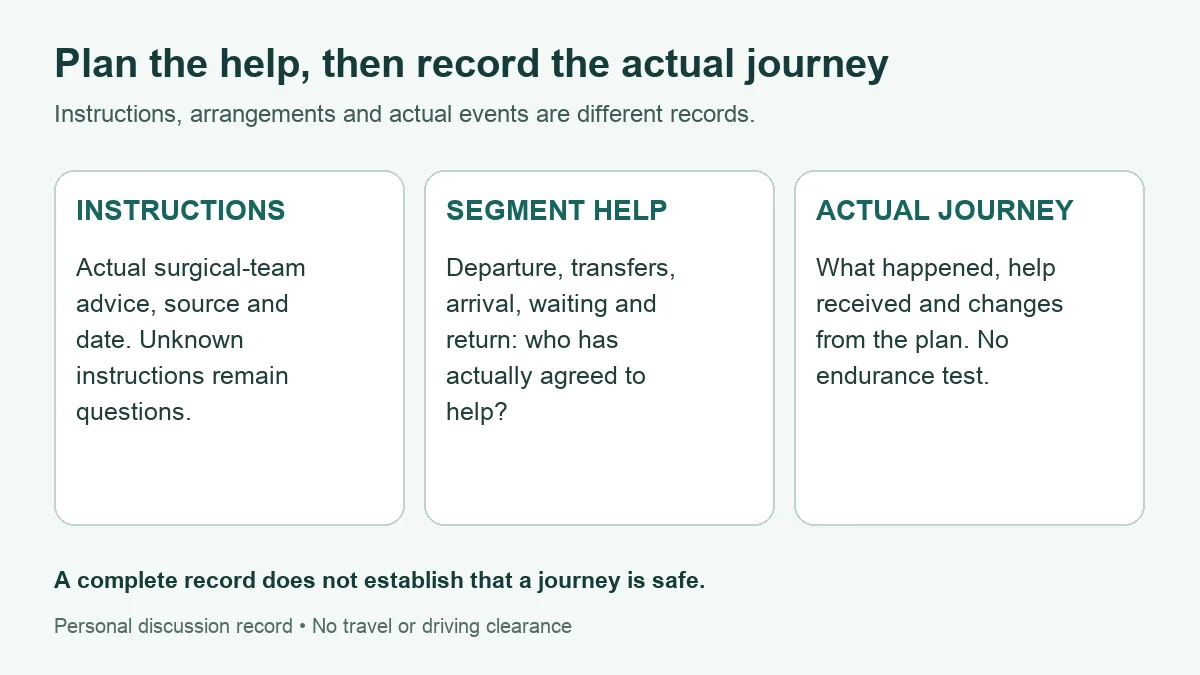
Lumbar fusion sources: what they establish and their limits
MedlinePlus: Spine surgery—discharge covers several procedures, including fusion. It advises following the surgeon’s instructions, discusses prescribed physical therapy for daily movements, and distinguishes passenger travel from driving. Its general activity and travel examples are not an individualized lumbar-fusion prescription. This article does not turn those examples into a personal sitting limit or a driving date.
Alberta: Lumbar Spinal Fusion—What to Expect at Home is more specifically about fusion and also says recovery varies. It includes example restrictions and stopping advice for car journeys. Differences between published leaflets do not establish which schedule applies to you. Ask the team responsible for your surgery about the actual journey and any change since the instructions were issued; do not average two leaflets or pick the more permissive number.
Neither source validates this worksheet, proves that a certain cushion prevents pain, or explains the cause of an individual symptom after a ride. The planning table and tool are editorial organizing aids, not a clinical protocol tested in patients. They deliberately record the source of an instruction and keep unanswered questions visible. A hospital visit being necessary does not itself establish that a private-car journey is clinically suitable.
Compare lumbar fusion movement instructions and segment help
| Journey segment | Instruction / help to clarify | Actual arrangement to record |
|---|---|---|
| Home to the vehicle | Which movement instructions apply, and what assistance has the team taught or advised? | Actual helper agreement, route/access concern and who handles belongings. Do not assume the driver can provide every kind of physical help. |
| Entering the actual car | Whether the specific vehicle and transfer arrangement fit the individual plan. | Vehicle access concern, help actually available and instruction source. A general “sit and pivot” rule does not replace teaching. |
| Passenger journey | The team’s actual travel guidance and any planned change of position or stops it has advised. | Driver’s actual agreement and practical arrangement. No sitting-plus-waiting sum or endurance target is created. |
| Car exit and destination access | Help with exit, building access and mobility needs under the actual plan. | Destination contact’s real answer, assistance location and any unresolved access barrier. |
| Waiting and appointment | What assistance or accommodation can actually be arranged. | Confirmed arrangement versus request pending. An office accommodation is not clinical travel clearance. |
| Return and arrival home | Whether the return arrangement and home-entry help are covered. | Actual return driver/help, what changed during the visit, and who to contact about a clinical concern. |
Use the actual vehicle and real destination in the discussion. “Someone is driving” leaves several questions unanswered: who can assist with the transfer, who can manage belongings, and what happens at the destination? Do not assume a higher seat, lower seat, taxi, wheelchair or different car solves the problem without considering the individual instructions and assistance available.
If a private-car plan cannot meet the needs described, tell the surgical/discharge team or relevant transport contact about the specific barrier. Ask what alternatives are clinically appropriate and actually available. A service may have assessment, booking or payment requirements. This guide neither prescribes medical transport nor promises eligibility, funding or availability. Record the real answer instead of treating a request as a booking.
Keep clinical advice and practical confirmation separate. The clinic can confirm where assistance is available without authorizing a movement technique. A family member can agree to help without knowing how to provide the required assistance. Ask the relevant clinical or rehabilitation team about teaching when needed; the record does not instruct someone to pull, lift or twist a person recovering from lumbar fusion.
Vehicle restraints, comfort and driving after lumbar fusion
NHTSA’s adult seat-belt guidance places the lap belt across the hips/pelvis and the shoulder belt across the chest, and says never to put the shoulder belt behind the back or under an arm. Airbags work with seat belts rather than replacing them. Do not bypass the restraint to accommodate discomfort, a brace or a cushion. Use the vehicle’s instructions for its seat and restraint system; this article gives no universal seat angle or accessory recommendation.
If the prescribed position, brace or transfer needs seem incompatible with proper restraint use, raise the actual conflict before routine travel with the treating team and appropriate vehicle/transport contact. Comfort alone does not verify crash protection. An accessory advertised for back pain is not evidence that it is suitable after lumbar fusion or compatible with your car. This guide does not recommend belt-routing changes, airbag changes or improvised restraint modifications.
Driving requires its own actual clinical discussion and any applicable local requirements. A comfortable passenger ride, elapsed time since surgery or a completed worksheet does not establish readiness. Do not use a driveway trial, hard-braking test or public-road experiment to obtain permission. Record the actual answer and its scope rather than treating a general leaflet as a personal authorization.
Keep medicines and prescribed supports in the real care plan. Ask the prescriber or pharmacist about medication questions and the treating team about brace or movement instructions. This article does not advise taking an extra dose, changing dose timing, removing a brace or using heat to get through a journey. Write down a problem with the plan and the actual reply rather than trying to solve it by tolerating more symptoms.
Record changes after lumbar fusion without diagnosing the cause
A useful observation states what was already noticed: the location and character of a change, when it appeared, what activity was happening and how it affected an actual task. Keep a baseline description only if you already know it. Do not create a symptom by sitting longer, repeat a transfer, or make another journey to obtain a comparison. You do not need a perfect log before contacting a clinician.
| Record category | Useful entry | Avoid concluding |
|---|---|---|
| Planned arrangement | Help or instruction actually agreed, with source/date. | A planned helper was definitely present, or an instruction still applies despite a new change. |
| Actual movement / travel | What occurred, actual assistance received and differences from the plan. | The journey was safe because it was short, or a wait can be added to sitting to calculate a safe limit. |
| Existing observation | New, recurring or unchanged symptom as actually noticed; onset/location and effect. | It is “just mechanical,” normal healing, nerve damage or hardware failure based on timing alone. |
| Contact made | Actual message/call, recipient role, time/date and pending status. | Sending a portal message equals clinical review or permission to repeat the trip. |
| Answer received | Actual reply, who supplied it, scope and unresolved question. | Silence or an incomplete answer fills every gap in the plan. |
The fact that discomfort followed a ride does not identify its cause. This article cannot distinguish muscle soreness, nerve symptoms, a wound problem or another complication from a description alone. A smoother route or cushion is not a diagnosis or a substitute for reporting a concerning change. Avoid blaming a patient for “bad trip design”; practical barriers and clinical concerns may coexist.
Keep the sequence intact when plans change. For example, retain the original assistance request, add what actually happened at the destination, and then record the message sent about a change. Do not overwrite the earlier plan so that it looks as though the deviation was approved. If a clinical answer is received later, add its actual date and wording or an accurate summary with the source.
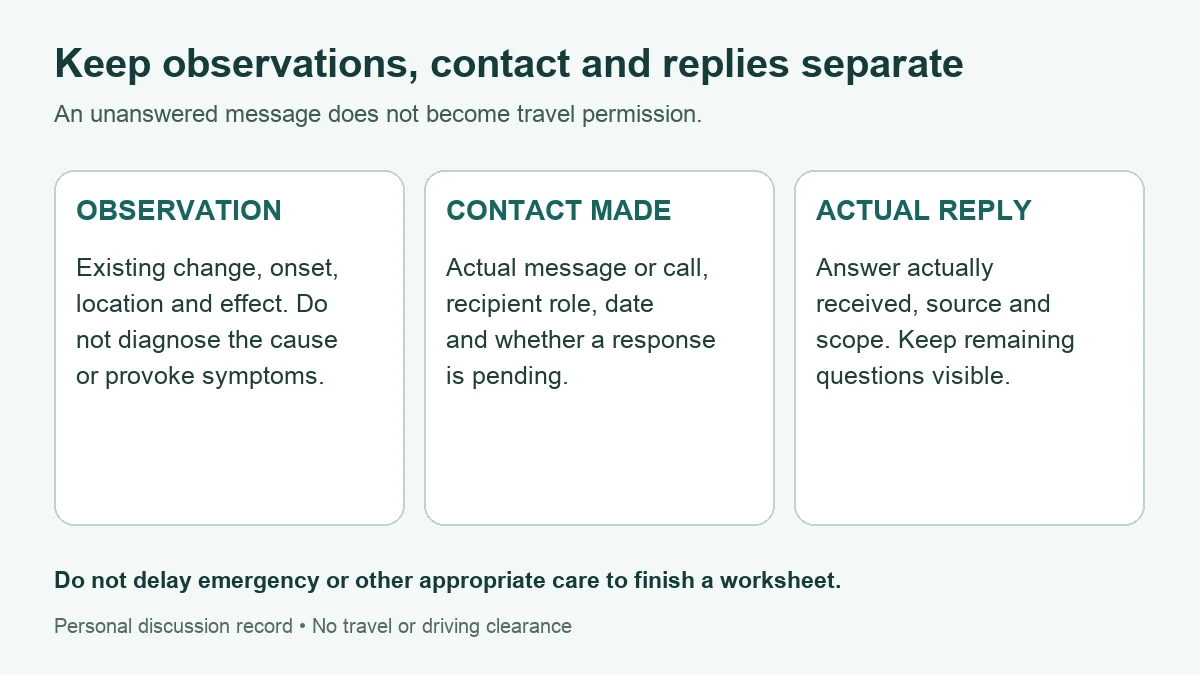
Two fictional examples: uncertainty stays visible
These are invented writing examples, not patient testimonials, clinical recommendations or evidence of improved recovery. Neither example supplies a real clinician’s answer or permission to travel. The tool’s example buttons load the same kinds of incomplete notes and replace existing entries.
Example A: follow-up proposed, help not confirmed
| Record | Fictional entry |
|---|---|
| Purpose / instruction | Follow-up visit proposed as a passenger. Individual travel and transfer instructions are not supplied by this example. |
| Outward help | Family member offered to drive. Assistance entering the actual car is unconfirmed. |
| Destination / return | Destination help, waiting arrangement and return assistance remain unknown. |
| Actual clinical answer | No answer about this particular journey is recorded. |
| Open question | Which instructions apply, who can help at each segment, and what arrangement needs discussion? No clearance is generated. |
Writing sample: “I need to discuss transport for the follow-up. A relative has offered to drive, but entry assistance, destination help and the return arrangement are not confirmed. Which actual movement instructions apply, and whom should I contact about the gaps? Please distinguish the clinical advice from any booking or assistance confirmation.”
Example B: completed journey, change and reply pending
| Record | Fictional entry |
|---|---|
| Actual journey | Passenger journey completed. Waiting and return arrangements differed from the original plan. |
| Existing change | A change in discomfort was noticed after travel. Its real onset, location and effect would be described without attributing a cause. |
| Contact | A question was sent to the surgical-team contact; response pending in this fictional example. |
| Actual reply | Unconfirmed. No clinical answer or subsequent outcome is invented. |
| Open question | What guidance applies to the reported change and future travel? Emergency symptoms require help without waiting for a routine reply. |
Writing sample: “This is what actually happened during the journey, and this is the change I have already noticed. I have kept it separate from the original plan. My message is pending, so I have not recorded it as approval for another trip. What guidance applies, and what remains to be clarified?” This wording is not a reason to wait when urgent or emergency assessment is needed.
Free lumbar fusion travel, help and contact record tool
The tool keeps movement instructions, segment-specific help, actual travel, observations, contact and real replies distinct. Blank fields produce optional questions. Filling every field verifies nothing. It generates no safe duration, symptom classification, treatment instruction, driving permission or transport eligibility decision. No form is required before seeking care or contacting the team.
Try fictional examples here. Download the offline HTML copy before entering actual health or travel notes. The live website may use site services. The downloaded tool has no ads, analytics, external assets, automatic network requests or browser storage. It needs no account or email. Entries are not automatically saved; completed exports contain your notes and should remain private.
Use non-identifying summaries and private references rather than names, addresses, appointment identifiers or full medical records. Build the record, copy it, download text, or print/save PDF through your browser. Editing hides the previous output until rebuilt. Nothing is submitted to a clinician or transport service. If the tool does not load, use paper with the same headings and seek help without waiting for a worksheet.
Lumbar fusion travel, help and contact record
Keep actual movement instructions, help by journey segment, the real journey, observed changes, contact and actual replies separate. No travel clearance, driving permission or symptom diagnosis is generated.
For actual health or travel notes, download the offline tool first. Try the fictional example here. The offline copy contains no site ads, analytics or external assets and needs no account.
Offline copy. This file contains no ads, analytics, external assets or automatic network requests.
The tool uses no network requests or browser storage. Unsaved changes can be lost on refresh or close. Exported files contain your entries; keep them private. Avoid names, addresses, appointment identifiers and full medical records.
Start with the fictional example or download a blank offline copy.
If the tool does not load, use paper: actual instructions; segment help; actual journey; existing changes; contact; actual reply and questions. Do not delay care for a worksheet.
My lumbar fusion travel, help and contact record
Unverified personal record for discussion. These are unverified discussion notes, not clinical advice, travel clearance or driving permission. Filled fields verify no instruction, arrangement or reply.
Guide: living.kioptrix.com/lumbar-fusion-car-ride-pain/
Questions about lumbar fusion car travel records
How many minutes can I safely ride after lumbar fusion?
This guide does not calculate that. Record the team’s actual journey-specific instruction and ask about gaps or changed circumstances. Do not combine sitting, waiting and walking into a tolerance allowance or take a test ride to obtain a limit.
Does pain after a ride mean I damaged the lumbar fusion?
The timing alone establishes neither damage nor harmlessness. Describe existing observations and seek appropriate assessment for a concerning change. Use the emergency guidance above rather than waiting to complete the record.
Can a cushion or reclined seat make the journey safe?
A comfort change is not clinical clearance or proof of restraint compatibility. Discuss the actual conflict and follow the vehicle’s instructions and individual care plan; this article selects no product or seat angle.
Does a completed passenger trip mean I can drive?
No. Passenger experience and driving permission are separate. Record the actual driving discussion and applicable requirements; do not perform a self-test to infer readiness.
What if the helper or destination plan changes?
Preserve the original arrangement and add the change. Contact the relevant person or service about the practical gap and the clinical team about clinical implications. A planned return arrangement is not evidence that help actually occurred.
Can I send this record to my surgical team automatically?
The tool sends nothing. Use the actual contact method provided by the service and record the reply only when received. A routine channel is not an emergency service.
What if I cannot fill in every field?
Leave it blank or mark it unconfirmed. The tool lists optional clarification questions and makes no clearance decision. Missing information is not a reason to delay appropriate care.
Sources, corrections and review limits
- MedlinePlus: Spine surgery—discharge — broad discharge context covering multiple procedures; not fusion-only or individualized permission.
- MyHealth Alberta: Lumbar Spinal Fusion—What to Expect at Home — fusion aftercare and warning signs; source-specific examples do not prescribe an individual travel schedule.
- NHS: Sciatica — emergency neurological warning signs only; general sciatica activity advice is not substituted for postoperative restrictions.
- NHTSA: Seat Belt Safety for Adults — adult restraint basics; does not determine postoperative travel suitability.
Editorial correction and source check: October 29, 2026. Removed the self-management clearance checklist, combined-time tolerance calculation, arbitrary test journey, unsupported pain-cause generalizations, unverified first-person patient story and generic transfer prescription. Removed duplicate imagery and the embedded video. Source-specific travel numbers are not presented as personal limits. The original URL is retained.
The hero is AI-generated fictional editorial artwork. The diagrams illustrate record organization, not a movement technique or medical approval. No independent clinician review, patient usability study or improved recovery outcome is claimed. Functional tool checks do not establish clinical validation. Our background and editorial approach. The tool can help prepare a discussion, but it cannot replace the treating service’s instructions or assessment.