
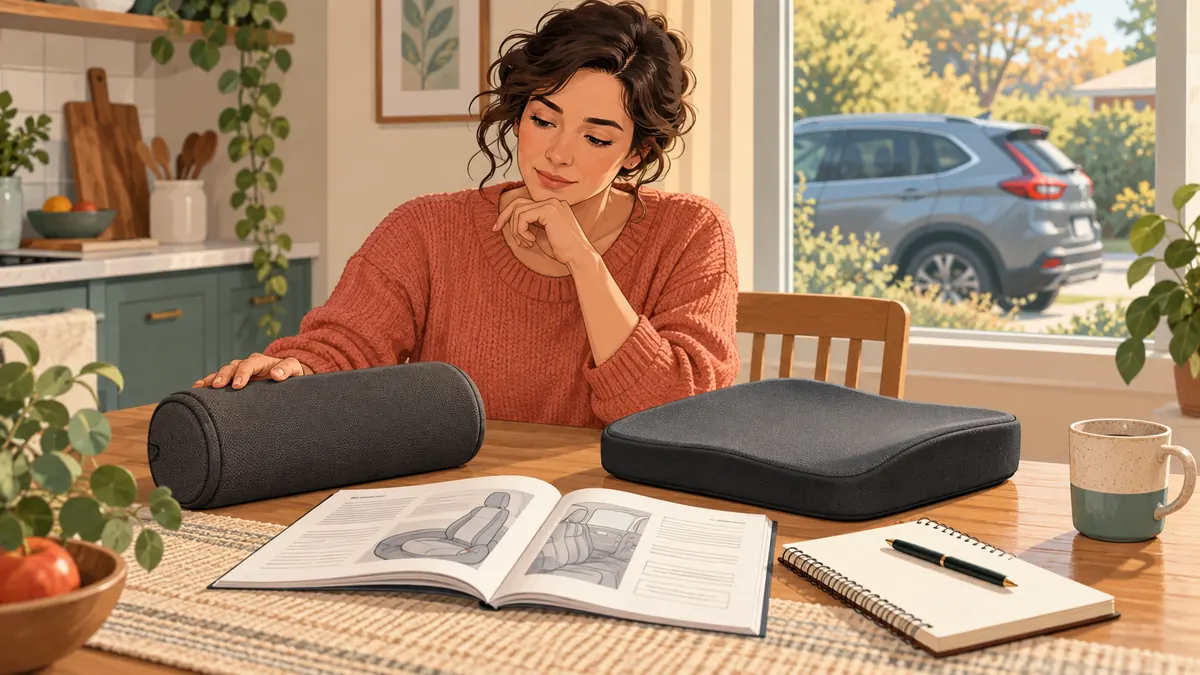
A seat cushion sits under you; a lumbar roll adds support behind your lower back. Neither is a proven winner for sciatica based on where you feel pain. Either can change your relationship to the vehicle seat. Compare the physical change, the actual vehicle instructions and your care needs before assuming that extra comfort makes an accessory appropriate for driving.
This seat cushion vs lumbar roll guide offers a practical comparison, six essential checks, two fictional examples and a free seat setup and question record. It supplies no product prescription, driving test, accessory dimensions or safe journey length. Keeping the original seat setup or deferring an addition is also an option to discuss.
When care comes first: new difficulty starting urination or inability to urinate, new bladder/bowel control changes, saddle-area numbness, or severe/worsening weakness or numbness in both legs needs emergency care immediately. Do not drive yourself to emergency care. New foot weakness, foot drop or worsening numbness needs prompt clinical assessment. Do not keep driving to test a support. NHS sciatica warning guidance and MedlinePlus sciatica information explain relevant symptoms.
Do not drive if symptoms or medication affect safe control, strength, sensation, alertness or reactions. Ask for appropriate clinical help and another transport arrangement. This article is general education from a family-caregiver-run site, not a diagnosis, vehicle inspection or individual driving assessment. Its operator is not a professional adviser. A worksheet is never a prerequisite for help.
Table of Contents
Seat cushion vs lumbar roll: compare what each changes
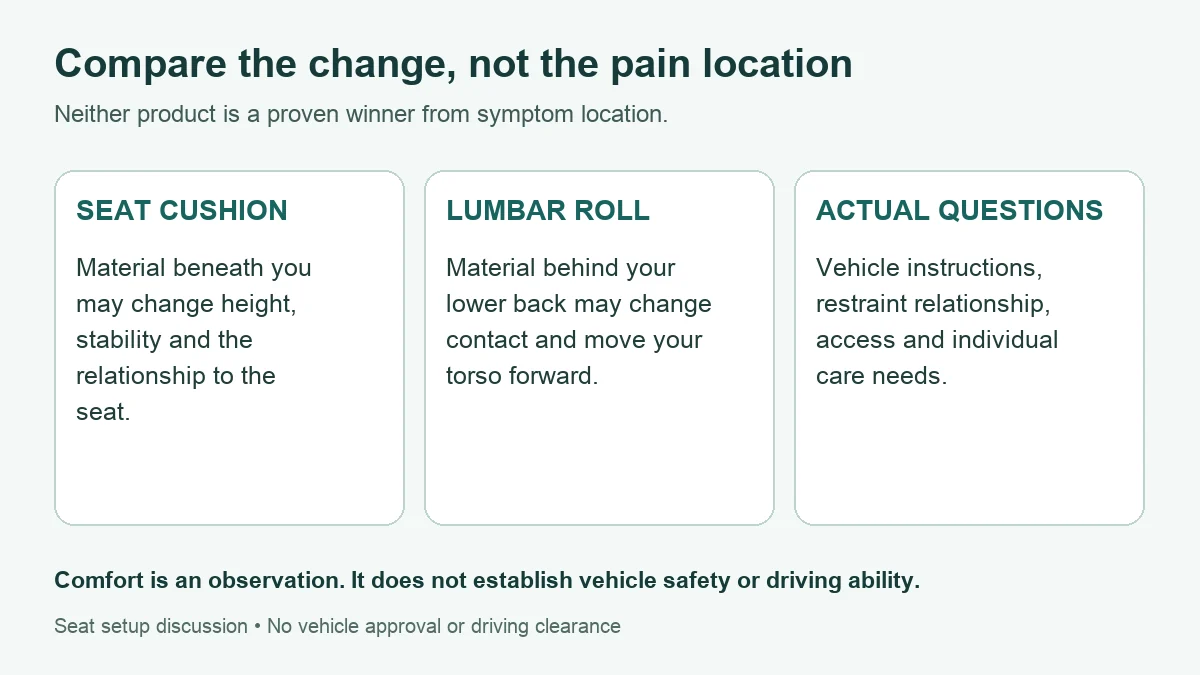
The useful distinction is where an addition changes contact or position, not a promise about the cause of leg pain. A seat cushion may alter sitting height and the relationship between your body and the seat. A lumbar roll may alter back contact and how far forward you sit. The effect depends on the person, vehicle, seat and accessory. More padding and more support are not automatically better.
| Option | Physical role to describe | Question still needing an answer |
|---|---|---|
| Existing factory seat adjustments | Uses the vehicle’s own adjustment features and instructions. | What settings and features actually apply to this seat? A familiar position does not establish individual driving ability. |
| Seat cushion | Adds material beneath the occupant; may change height, stability and reach. | What does the vehicle manual say? How are belt, head restraint, visibility, controls and any seat-related systems affected? |
| Lumbar roll | Adds material behind the lower back; may move the torso forward or change contact. | Does it interfere with the seat, restraint relationship, access or control? General back-support advice is not product approval. |
| Seat cushion plus lumbar roll | Combines changes beneath and behind the occupant. | Do not assume two additions retain the conditions of either alone. No combination is endorsed here. |
| No addition / defer an addition | Leaves a product decision open while questions are clarified. | Is care, vehicle information, an individual assessment or different transport the more immediate need? |
Pain in the buttock does not select a seat cushion; discomfort associated with slumping does not select a lumbar roll. Neither observation diagnoses nerve compression or proves a product will treat it. If several settings or supports changed together, a later difference cannot identify which change caused it.
What the evidence supports—and what it cannot decide
Mayo Clinic’s sciatica prevention guidance includes general lower-back support and a pillow or rolled towel as a sitting option. That is not a head-to-head vehicle trial, a symptom-location selection rule or approval of a particular car accessory. This guide does not turn general advice into a claim that a roll treats nerve compression.
A 2018 randomized trial in occupational drivers compared gel and foam seat cushions over three months. Of 80 enrolled participants, 75 were analyzed; participants were men aged 40–65 with chronic low-back pain who drove for work more than six hours a day. The study reported greater pain improvement with gel than foam. It did not compare a seat cushion with a lumbar roll, establish a sciatica selection rule or certify vehicle safety. Lower-extremity weakness and prior lumbar surgery were among its exclusions. The paper reports manufacturer funding. These limits matter when applying a product result to a different reader.
CCOHS’s driving ergonomics guidance explains why car seating differs from desk seating: controls, leg position, movement and vibration change the task. It discusses seat adjustment and access, not a clinical diagnosis or a cushion-versus-roll treatment ranking. Use ergonomic information to identify questions about the real vehicle, rather than copying a desk setup into a car.
A report of less discomfort remains useful as an observation. It does not establish nerve recovery, a safer crash position or permission to drive longer. There is no pain-score cutoff, “good by day four” rule or calculated weekly benefit in this guide. Research can inform a discussion without deciding an individual’s driving ability.
Six essential checks before relying on a seat addition
Identify the actual seat and occupant role
A driver and passenger have different control tasks. Record the seat location, relevant vehicle information and existing adjustment features without recording a VIN, registration, route or home address. Use the actual owner manual. An accessory’s advertising, popularity or office-chair use does not answer a vehicle-specific question.
Read vehicle instructions and preserve unanswered questions
Look for instructions relevant to accessories, seat belts, head restraints, seat-mounted airbags and occupant-sensing systems. Ask the manufacturer or an appropriate service contact when unclear. Do not infer compatibility from a lack of an obvious warning, a stationary comfort impression or this article’s comparison table. Record the actual source and reply.
Describe stationary changes without declaring a pass
If reviewing an existing setup, do so only while safely parked and secured, with the engine off. Note a change in view, reach, belt relationship, head-restraint relationship, seat movement or accessory movement. Do not improvise attachment methods or alter safety systems. A parked observation is a question-finding step, not a safety certification or a reason to start a test drive.
Keep symptom and medicine questions separate from product choice
A support cannot resolve impaired pedal control, weakness, sensation, alertness or reaction. Seek appropriate assessment rather than trying a different product to compensate. Ask a pharmacist or clinician about actual medicine warnings and effects; do not stop or change medication from this page. New neurological symptoms and emergency signs take priority over completing a comparison.
Use only observations from travel already completed
Record existing experience after travel, never while the vehicle is moving. Distinguish driver from passenger, current setup from proposed change, what you noticed from what you assume. Do not extend or repeat a journey to discover a pain threshold or make two products compete. No first-short-drive, day-by-day challenge or endurance protocol is prescribed.
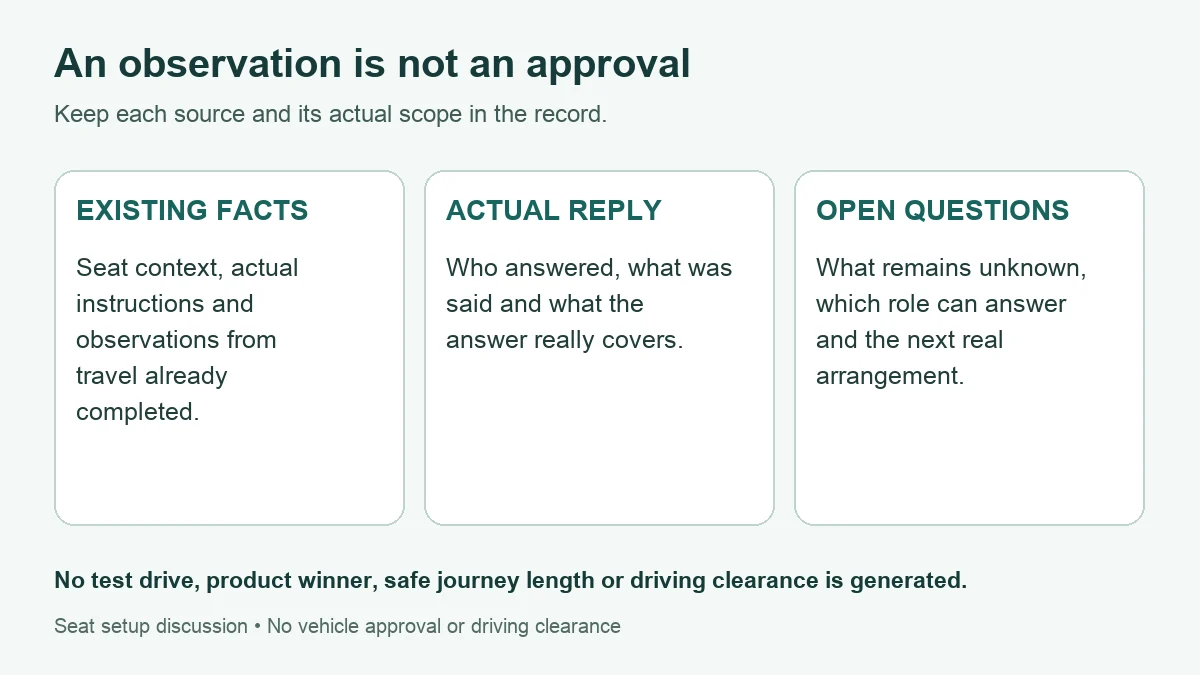
Record the answer, scope and next arrangement
A prepared question, a sent message and a received reply are different. Keep a general recommendation separate from vehicle compatibility and individual driving advice. Note who can answer each remaining question and any arrangement actually made. Do not invent clearance, a recovery date or a universal review interval. You can seek help with no worksheet at all.
NHTSA’s airbag guidance explains that some advanced frontal passenger systems use occupant sensing and that position or loading can matter. This is not a claim that every cushion disables every airbag, or that all accessories are prohibited. Follow the actual vehicle instructions; an unexpected indicator needs the manual’s guidance and appropriate service advice, not an improvised workaround.
NHTSA’s prescription and over-the-counter medicine guidance warns that medicines can impair driving. Relevant questions include a new medicine, dose change, combined effects and warnings about coordination, judgment or reactions. Obtain individual advice from a pharmacist or clinician. This page supplies no waiting period or medication adjustment.
Match the question to the person who can answer it
| Question | Relevant source / role | What this record cannot establish |
|---|---|---|
| What happened during an existing journey? | Your own account, recorded afterward. | A diagnosis, cause of change or verified treatment effect. |
| Does this accessory suit the actual seat and systems? | Owner manual; manufacturer or appropriate vehicle service contact. | Approval from a generic blog checklist or product review. |
| Do new or changing symptoms need assessment? | Treating clinician or appropriate urgent/emergency service. | A decision to delay care until a product trial is complete. |
| Could a medicine affect driving? | Pharmacist or prescribing/treating clinician; actual medicine warnings. | Permission to drive or change a medicine based on a form. |
| What individual driving assessment or advice is needed? | Appropriate clinician and, when relevant, a qualified driving assessment service. | Fitness to drive from comfort, completed fields or stationary observations. |
Keep the exact scope of an answer. For example, “general lower-back support may help sitting comfort” does not mean “this accessory is compatible with my seat” or “I can drive despite weakness.” If two instructions seem inconsistent, ask the relevant source to clarify. The tool cannot adjudicate them. Transport help can be arranged while those questions remain open.
Two fictional examples: document uncertainty without inventing permission
These are invented writing examples, not real cases, testimonials or evidence of benefit. They model clear records rather than a successful product choice. Neither asks anyone to drive to collect data. The tool’s example buttons replace existing entries, so export private work before using them.
Example A: comfort changed, vehicle conditions remain unconfirmed
| Part of the record | Fictional entry |
|---|---|
| Already experienced | A seat cushion was used during a previous journey. The person reports less local seat discomfort. |
| Stationary recollection | The person recalls sitting higher; restraint, visibility and control implications have not been assessed. |
| Unknown | Actual vehicle instructions and compatibility remain unconfirmed. No individual driving advice is recorded. |
| Question / actual reply | A question about the seat and accessory is prepared; it has not yet been sent. No answer is invented. |
| Conclusion allowed | The record describes an observation and open questions. It establishes no treatment effect, vehicle approval or driving clearance. |
A concise note could read: “I noticed less local seat discomfort during travel already completed, and I recall sitting higher. I have not confirmed the vehicle instructions or had the implications assessed. Which source can clarify the accessory question, and which concerns need clinical review?” This avoids describing improved comfort as proof of improved nerve health.
Example B: attention or medicine concern comes before product choice
| Part of the record | Fictional entry |
|---|---|
| Existing concern | Difficulty with attention was noticed before considering a new journey. No test drive was performed. |
| Product decision | No seat cushion or lumbar roll is selected; selecting one would not resolve the attention concern. |
| Professional question | A medication warning needs pharmacist or clinician clarification. No medicine is stopped or changed from this example. |
| Actual contact / reply | A question is prepared, but no reply has been received. An individual driving assessment is not recorded. |
| Next arrangement | Transport help is being requested; no arrangement is confirmed. Do not drive while safe control, alertness or reactions are affected. |
A useful question reads: “What warnings apply to my actual medicine and effects, which professional should assess the concern, and what alternative transport can I arrange?” The record must not fill an unanswered field with a reassuring result, approved product or guessed waiting period.
Free seat setup, observation and unanswered-question tool
Use this tool to keep the actual seat context, vehicle information, existing observations, clinical or medication advice, contact status and real reply separate. Empty fields generate optional questions. They are not failed safety checks, required documentation or a reason to delay help. Filled fields are personal entries, not authenticated professional advice.
Use fictional examples on the live page. Download the offline HTML copy before entering actual health or travel notes. The live website may use site services. The downloaded tool has no ads, analytics, external assets, browser storage or automatic network requests. It needs no account or email. Files you export include your entries; keep them private and share only relevant details. Avoid names, VINs, routes, precise locations and full medical records.
Build a record, copy it, download text or use your browser’s print/Save PDF option. Changes to an entry hide the old output until rebuilt. Entries are not automatically saved or sent. If the tool does not load, write the same headings on paper. Do not use it while driving, make a symptom-provoking journey to complete it or use it instead of urgent help.
Seat setup, travel observations and question cards
Keep seat conditions, existing travel observations and actual professional replies separate. No product winner, diagnosis, driving permission or safe travel duration is generated.
For actual health or travel notes, download the offline tool first. Try the fictional example here. The offline copy contains no site ads, analytics or external assets and needs no account.
Offline copy. This file contains no ads, analytics, external assets or automatic network requests.
The tool uses no network requests or browser storage. Unsaved changes can be lost on refresh or close. Exported files contain your entries; keep them private. Avoid names, VINs, routes, precise locations and pasted medical records.
Start with the fictional example or download a blank offline copy.
If this tool does not load, use paper: seat context, actual vehicle instructions, existing observations, actual professional reply and unanswered questions. Do not delay care or make a test drive to fill it in.
My seat setup and question record
Unverified personal record for discussion. These personal notes are not a vehicle approval, clinical assessment or fitness-to-drive clearance. Completed entries prove none of these; blank entries do not prevent seeking help.
Guide: living.kioptrix.com/seat-cushion-vs-lumbar-roll-for-sciatica/
Seat cushion and lumbar roll questions
Which is better for sciatica: a seat cushion or a lumbar roll?
This guide establishes no universal winner. The items change different parts of sitting contact, and neither can be chosen by pain location alone. Discuss symptoms separately from the actual vehicle’s instructions and any individual driving concerns.
Does a lumbar roll relieve nerve compression?
General support advice does not prove that an accessory changes nerve compression in an individual. A comfort difference is not a diagnosis or evidence of nerve recovery. New weakness, sensory change or other concerning symptoms need appropriate care.
Can I use both a seat cushion and a lumbar roll?
The combination is not approved by this article. It may change more than either addition alone. Actual seat instructions, restraint relationships, access and individual needs still require clarification. No thickness, positioning angle or fastening method is prescribed.
Should I drive until symptoms begin to compare them?
No. Do not drive or extend a journey to provoke symptoms, establish a threshold or choose a product. Record only travel already experienced, afterward. Do not drive if safe control, alertness or reactions are affected.
Does a completed parked checklist mean I can drive?
No. Stationary observations cannot verify dynamic driving ability, vehicle safety or the truth of an entry. An appropriate individual assessment may be needed. A worksheet creates neither permission nor a safe journey duration.
What if the owner manual or actual reply is unavailable?
Keep it unconfirmed and ask the relevant manufacturer, service or professional contact. Do not interpret missing information as approval. You can seek care or arrange transport without finishing the tool.
Sources, correction and review limits
- Mayo Clinic: Sciatica — Symptoms and causes — general sitting-support advice; not a car-accessory comparison or vehicle approval.
- Lee et al., 2018: gel versus foam seat-cushion trial — a specific chronic low-back-pain study; not a seat cushion versus lumbar roll trial for sciatica.
- CCOHS: Driving and Ergonomics — driving task and adjustment considerations, not individual medical or driving clearance.
- NHTSA: Air Bags — restraint and occupant-sensing context; actual vehicle instructions still matter.
- NHTSA: Driving after prescription or over-the-counter medicines — impairment warnings and professional consultation.
- NHS: Sciatica and MedlinePlus: Sciatica — symptom education and care-seeking information. Emergency contact arrangements depend on location.
Editorial correction and source check: October 28, 2026. Replaced the symptom-to-product formula, contradictory driving trials, unsupported day-by-day claims, benefit arithmetic and unverified friend story. Corrected the scope of the general clinical source. Replaced repeated images and the embedded video with a comparison diagram, a record diagram and explicitly fictional examples. The original URL is retained.
The representative illustration is AI-generated fictional artwork. The body diagrams explain the editorial framework; they are not vehicle instructions or actual patient records. No independent clinical, vehicle-engineering or driving-assessment review, real-user study or treatment benefit is claimed. Functional checks of the tool do not establish those outcomes. Our background and editorial approach.